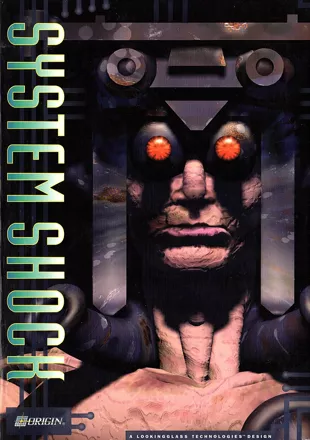
This cover may contain mature content.

-
 System Shock
(2023)
System Shock
(2023) -
 System Shock: Enhanced Edition
(2015)
System Shock: Enhanced Edition
(2015)
- Gift Pak (1995)
- Origin Pak (1996)
-
 Telstar Double Value Games: System Shock / Space Hulk
(1996)
Telstar Double Value Games: System Shock / Space Hulk
(1996)
Description official descriptions
The year is 2072. A hacker from a Saturn colony breaks into computer system of TriOptimum Corporation and gets arrested. He is taken to the Citadel Station, where Edward Diego, a TriOptimum executive, offers to drop all charges against the hacker, as well as grant him a valuable neural implant, if he agrees to hack into SHODAN (Sentient Hyper-Optimized Data Access Network) , the artificial intelligence that controls the station. The hacker removes the AI's ethical constraints and undergoes the promised implant surgery, after which he is put into a six-month healing coma.
The hacker awakens into a horrifying reality: with her ethical restrictions removed, SHODAN took control over the station, reprogrammed all robots and machines to suit her needs, and disposed of the crew members by either transforming them into mutants and cyborgs, or killing them outright. Rebecca Lansing, a TriOptimum counter-terrorism consultant, contacts the hacker and informs him of an even more terrifying possible future: SHODAN's plan involves using the station's mining lasers to annihilate all life on Earth. The hacker must explore and traverse the desolate corridors and rooms of the large space station, fighting SHODAN's minions on his way to thwart her maniacal design.
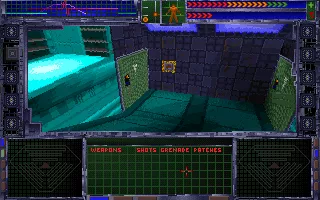
System Shock is a first-person shooter with puzzle-solving and light role-playing elements. The gameplay incorporates gradual exploration of the Citadel's ten levels, interaction with the environment, problem-solving, fulfilling objectives, and combat.
On his way the hacker encounters numerous enemies - robots, cyborgs and mutants, all of which can be fought back with a variety of weapons. Some of the weapons use ammo, while other have infinite ammo and instead draw on electric energy. Some weapons are more effective on certain foes - e.g. the dart gun only works on organic enemies, while the magpulse is best used against robots. Once killed, the enemies can be searched for ammo and other items. The player can also find items in crates, cabinets, corpses or just lying around on the ground.
Apart from weapons and ammo, the player can find patches (such as medical patches, which replenish the hero's health; berserk patches, which temporarily increase his strength but cause hallucinations; detox patches, which remove the harmful effects of radiation and biohazard; etc.), grenades of various kinds (EMP grenades are effective against robots, gas grenades are good for mutants, land mines can be used to set traps, etc.), battery packs for replenishing electricity, first aid kits for restoring health, and others.
Thanks to the hacker's implant he is able to install various pieces of hardware into his body, such as a booster which makes him go faster, or a head lantern to bright up dark areas. As the player progresses in the game, higher versions of existing hardware are found, which are more effective and useful. However, most hardware uses up electric energy while it is active.
At some places in the game, the player has to find a wall-mounted "cyberjack" to go into cyberspace in order to find helpful data, remotely open doors or unlock sealed areas, or give himself clearance to access off-limits areas. Cyberspace is represented as a 3-D wireframe place, where the protagonist floats around freely in three dimensions, shoots hostile cyber-guards with phasers, and collects files represented as colorful cubes.
The story of System Shock is mostly told through e-mail messages the protagonist received, and electronic diaries (logs) left by various characters (as well as SHODAN herself), which are scattered around the space station. The game features separate adjustable difficulty settings for combat, mission objectives and puzzles. The CD version of the game includes full speech for e-mails and logs, as well as higher-resolution, more detailed graphics.
Series +
System Shock series- Next: System Shock 2 (1999)
Groups +
- EA Classics releases
- Gameplay feature: Adaptive music
- Gameplay feature: Audio logs
- Gameplay feature: Auto-mapping
- Gameplay feature: Radiation / radioactive poisoning
- Games with 451
- Games with officially released source code
- Protagonist: Cyborg
- Setting: Cyberspace
- Setting: Space station / Spaceship
- Sound Engine: AIL / Miles Sound System
- Theme: Hacking / Pseudohacking
Spellings
- システムショック - Japanese spelling
- 시스텡쇼크 - Korean spelling
Screenshots
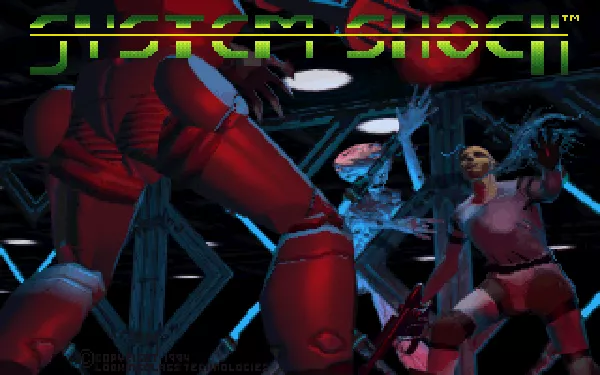
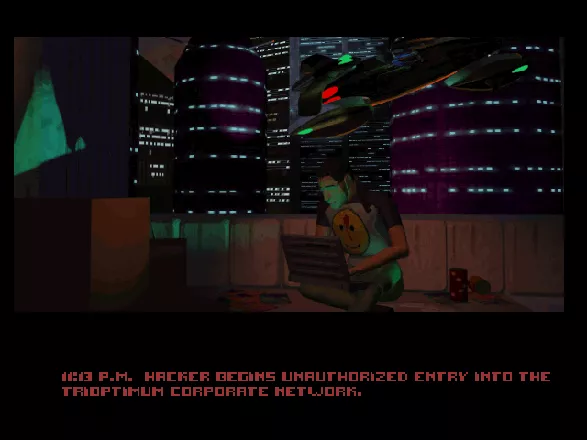
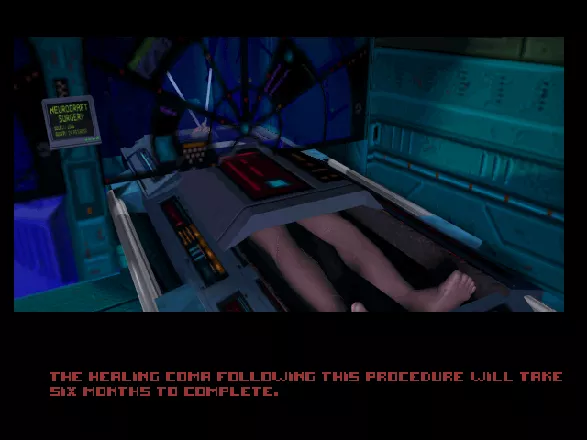
These images may contain mature content.
Credits (DOS version)
65 People · View all
| Project Leader | |
| Designers | |
| Lead Programmer | |
| Programmers | |
| Libraries | |
| [ full credits ] | |
Collaborations
People credited on this game were also credited on:
- System Shock: Enhanced Edition, a group of 50 people
- System Shock, a group of 34 people
- Ultima Underworld II: Labyrinth of Worlds, a group of 22 people
- And 22 more...
[ Upgrade to MobyPlus to view more! ]
Other Games
In addition to this game, these people were also credited on other games:
- Sean T. Barrett on 84 other games
- John Miles on 73 other games
- Tim Stellmach on 49 other games
- And 22 more...
[ Upgrade to MobyPlus to view more! ]
Reviews
Critics
Average score: 90% (based on 26 ratings)
Players
Average score: 4.0 out of 5 (based on 203 ratings with 22 reviews)
The Good
A famously good space-bound RPG, this was the follow-up to the same team's 'Ultima Underworld'. Boasting a proper 3D engine, years before 'Quake', this came out at the same time as 'Doom' and suffered commercially. Game-wise it's top-notch - it looks and sounds fantastic, and the quest on which you embark is deep enough to keep you playing for several weeks. It's probably the only game to capture the early-90s cyberpunk fascination effectively, and it has an amazingly intense atmosphere. It's hard, too, in a good way.
It's excellent in so many ways that it makes me unhappy, and is still great fun today.
The Bad
Allowing for the age, the only thing that marks the game down is the clumsy interface. Long before 'mouselooking', it requires you to co-ordinate your movements with both the keyboard and the mouse, and can be tricky to use in a hurry.
The Bottom Line
Excellent, nostalgic, hugely atmospheric space-bound sci-fi RPG.
DOS · by Ashley Pomeroy (225) · 2000
A Classic Game in league with Ultima Underworld I and II
The Good
And why wouldn't it be in the same league? Looking Glass Studios was responsible for UU1 and UU2! This game is well thought out.
There are three main things that make this game great:
-
Story - The backstory is unlike any other in RPG gaming. You start on CITADEL, and you are the only living being on board. Everyone else is dead. You find out the backstory through the journals and datacards left by the dead residents of the space station. By the time the game is over you will have pieced together, bit by bit, the events leading up to the time you awoke (the start of the game).
-
Configurability (if that isn't a word, it is now) - The fact that the player can configure the game to his or her tastes is a great feature. Combat, Missions, Puzzles, and Cyberspace could be made as easy or as tough as you want. Like hard puzzles, but don't like strong enemies? You can set it with System Shock
-
Sound - One word: Eerie. Along the same lines a Dungeon Master and Ultima Underworld, the ambient sounds are well placed, and very creepy. Not overbearing, but not so soft that you can't hear them. Just the right mix.
The Bad
The graphics are very dark, making it difficult (for me at least) to discern the end of a wall, etc.
The Bottom Line
If you like a very flexible game system, combined with the graphical feel of Ultima Underworld I and II, and sci-fi setting, grab System Shock. It's difficult to find, but you'll enjoy every minute.
DOS · by Chris Martin (1153) · 2006
Great game, much better than Half-life.
The Good
The gameplay is cool, and very clasic, a fist person advernture game, you don't see many of those. This game quite frankley, is better than most new games, even the graphics have more mood and ambiance, than most games that come out now, in fact Deus Ex (another Warren Specter game) is probally one of the few games to come out in several years that can even top System Shock.
The Bad
Nothing.
The Bottom Line
The summary might seem a bet ambitious, but it is true. Half-life is a great game, but isn't better than System Shock.
DOS · by Wolfang (155) · 2001
Discussion
| Subject | By | Date |
|---|---|---|
| Video review | DJP Mom (11333) | Oct 21, 2010 |
| Finally completed | Unicorn Lynx (181444) | Oct 18, 2008 |
| Voices? | Unicorn Lynx (181444) | Apr 3, 2008 |
Trivia
CD version
The CD-ROM version adds SVGA modes, full speech for e-mails and logs, slightly improved intro/end sequences and a few other adjustments and additions.
Development
The game was originally conceived and pitched by Warren Spector as a Wing Commander spin-off with the working title Alien Commander, and would be set on the wreckage of TCS Tiger's Claw. However, both Spector and project leader Doug Church decided that they wanted a greater degree of creative freedom with the game and to not be tied to an existing franchise, and so reconfigured the pitch into its own original setting very early into pre-production.
Ending (Spoiler!)
If the player engages the mining laser before activating the station's shields, the Earth will be destroyed. Moreover, SHODAN sends the player an e-mail thanking them and inviting them to a celebration! The e-mail also includes a nice picture of a city being incinerated, but unfortunately the game restarts afterwards, so no robo-party.
Engine
System Shock's engine was derived from that of Ultima Underworld, from 1992. Nonetheless, it was more advanced that that of Doom or Duke Nukem 3D, featuring sloped surfaces, variable gravity, realistic physics, "2.5D" environments (with limited 'sector-on-sector', but otherwise 3D), functional camera viewscreens, weapon recoil, leaning and several other clever things.
References to the game
- During the end-game sequence, the player hacks into another corporate computer to grab some data. The data is info on some powered battle armor, which made its way into Terra Nova: Strike Force Centauri.
- In the end sequence, the hacker breaks in the corporate network of a corporation called Tetracorp. In System Shock 2, the name Tetracorp is printed on a generic two-state switch. Kinda rough change of business.
- It is hinted in the Wing Commander and Crusader games that they are set in the same universe as System Shock. For example, an article in a "newspaper" from the Crusader: No Remorse box mentions an artificial intelligence and the Citadel station.
References
- The Hacker's employee number, 2-4601, is a reference to the inmate number of Jean Valjean, the protagonist in the novel Les Misérables.
- There is a reference to the movie Soylent Green in the game (although it's spelled slightly different). In level 3, Maintenance, there is a relay panel in the northern section called "Soylant Green Filtration".
Sequel
There were rumours of a possible sequel, soon after System Shock's release, but fans had to wait five years for System Shock 2.
Awards
- Computer Gaming World
- November 1996 (15th anniversary issue) - #98 on the “150 Best Games of All Time” list
- GameSpy
- 2001 – #24 Top Game of All Time
- GameStar (Germany)
- Issue 12/1999 - #15 in the "100 Most Important PC Games of the Nineties" ranking
- PC Gamer
- April 2000 - #43 in the "All-Time Top 50 Games Poll"
- Power Play
- Issue 02/1995 – Best Action-Adventure in 1994
Information also contributed by Adam Baratz, Ashley Pomeroy, dasfatso, DreamWeaver, PCGamer77, Stefan Pieratzki and Zovni
Analytics
Related Games
Released 1999 on Windows, 2013 on Macintosh, 2014 on Linux
Released 2024 on Windows, Nintendo Switch, PlayStation 4...
Released 2025 on Windows, PlayStation 4, Xbox One...
Released 1994 on 3DO

Released 1994 on DOS, 1996 on SEGA Saturn, 3DO...
Released 2016 on Dedicated console
Released 2006 on Windows

Released 2015 on Xbox One
Released 2017 on Dedicated console
Related Sites +
-
Other Worlds - System Shock
official page of the game at Origin System's website, archived from 1998 by the Wayback Machine -
TTLG: The System Shock 1 Fansite Hub
Through The Looking Glass' System Shock section.
Identifiers +
Contribute
Are you familiar with this game? Help document and preserve this entry in video game history! If your contribution is approved, you will earn points and be credited as a contributor.
Contributors to this Entry
Game added by xroox.
PC-98, Macintosh added by Terok Nor.
Additional contributors: Patrick Bregger, Plok, Rik Hideto, MrFlibble, firefang9212, somato, WONDERなパン, Gamestorian.
Game added January 6, 2000. Last modified March 8, 2026.