

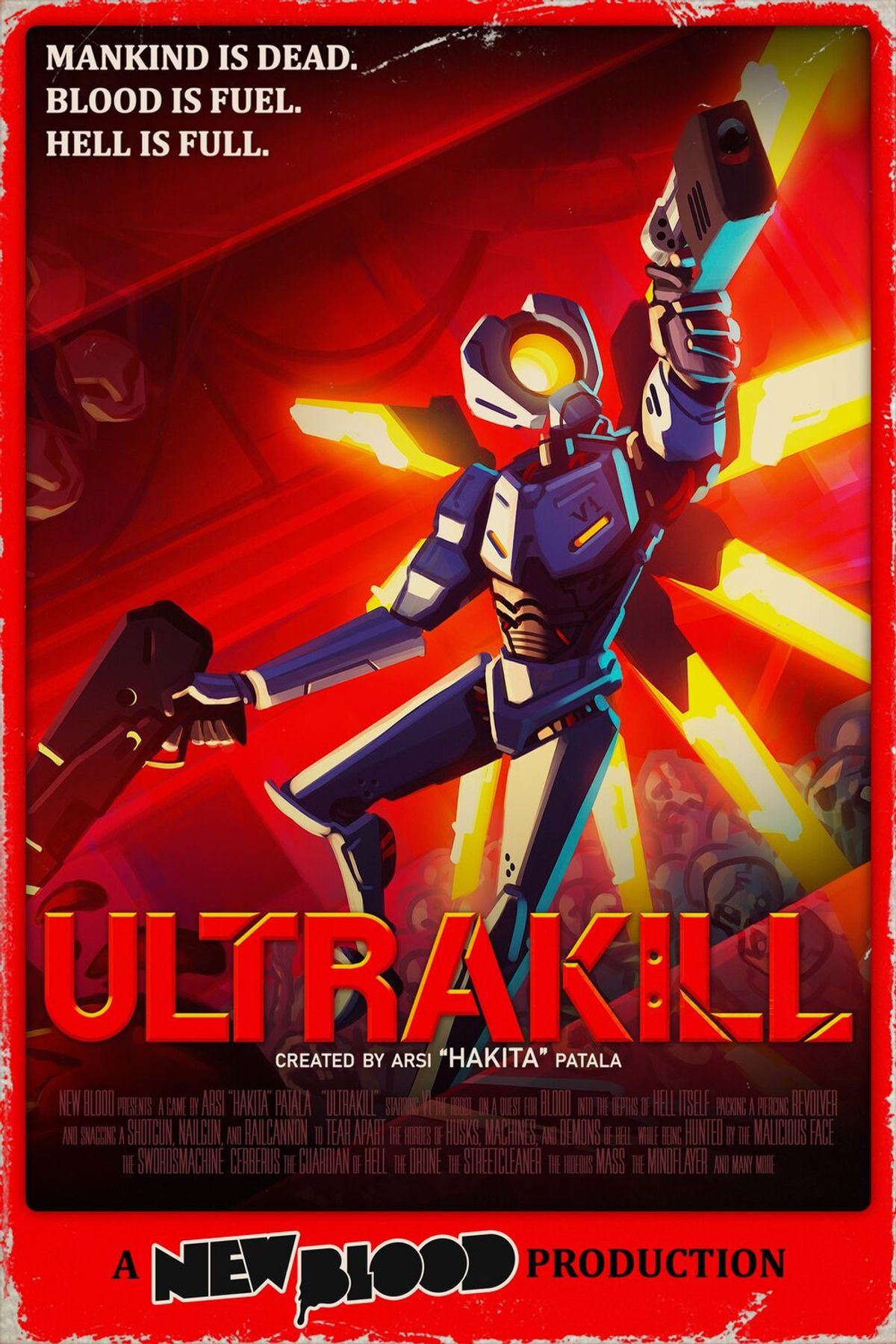
BLOOD IS FUEL.
HELL IS FULL.
ULTRAKILL is a Stylish Action retro-style First-Person Shooter made by Arsi "Hakita" Patala and published by New Blood Interactive. You play as V1, one of the robotic survivors of a war where combat robots that run on blood exterminated humanity for fuel, and finds itself fresh out. But there is still one last source left to tap into: all the demons and damned souls in Hell.
Gameplay hearkens back to the lightning-fast shooters of old and places emphasis on movement, dodging attacks, and unbridled aggression in arena-style levels. V1's health can only be restored by showering in the blood of enemies, necessitating damaging foes at close range. Along the way, killing foes in varied and stylish ways will grant points that V1 can spend on weapon upgrades.
The game's prologue and first act were released in Early Access on September 3, 2020, and a free demo is available on Steam and itch.io. The second and third acts would gradually release over the course of the next decade.
May your tropes be many...
- Action Film, Quiet Drama Scene:
- The intermission cutscenes after each Act take a break from V1's violent rampage in order to show the strained relationship between Gabriel and the Council of Angels running Heaven. The Act 2 intermission does have some bloodshed, but Gabriel's slaughtering of the Council is a cold and calculated act of violence compared to all the madness going on in Hell.
- The Secret levels focus on some sort of Unexpected Gameplay Change, but almost all of them feature a Terminal at the end containing a "Testament", which outlines the tragic God's tragic backstory. A Nostalgic Music Box plays in the background to set the mood.
- Adaptational Heroism: A few characters are more sympathetic than their original poem counterparts...
- In Dante's Inferno, King Minos is the merciless judge of Hell who judges the souls of the damned to decide which layer they belong in. In ULTRAKILL, Minos is a benevolent king who turned Lust into a thriving paradise because he felt that eternal damnation is an unfair punishment for sinners who simply love another. He also fights V1 as a Prime Soul to avenge both his people and humankind.
- Testament IV reveals that Lucifer did not betray God out of sheer hubris, nor introduce evil and suffering to the world. Instead, he merely questions Him if eternal damnation is a fitting punishment for sinners, and while he sees sinners as fools, he still shows them far more sympathy than God did.
- Adaptational Villainy: ...while others are more immoral than the originals.
- By Dante's rules, V1 is not just this game's equivalent to him, but a violent and amoral version of him. While Dante's motives are partially selfish and he doesn't intend any harm, V1 invades Hell to slaughter its denizens and their fellow robots for the completely selfish motive of sustaining themself with blood.
- In both The Bible and Inferno, the Archangel Gabriel is an angel of pure goodness who serves as God's messenger. In ULTRAKILL, he's a ruthless zealot who murdered the beloved King Minos just for showing compassion for the damned and turning Lust into a thriving paradise. This is subverted at the end of Act II, where Gabriel realizes how wrong his Knight Templar ways were, causing him to atone for his crimes by slaughtering the Council as retribution for their tyranny before descending to Hell one last time to battle V1 and their kind.
- :In the Bible and Inferno, Hell is a place of punishment, but it never extends beyond that. In ULTRAKILL, Hell is alive and malevolent, being a sadistic entity that's implied to have orchestrated mankind's extinction so it can claim their souls and torture them for all eternity as an act of twisted entertainment.
- Advanced Movement Technique: Owing to its roots both in old-school shooters and character action games, as well as Hakita simply being unhinged, the game has a lot of these.
- Jumping out of a dash will retain the dash's momentum, sending V1 flying forward at high speed. You can then carry that momentum into a slide and jump to start slide-hopping around the level. Instead of a dash, you can instead shoot the Rocket Launcher at your feet to get a boost forward, or use any other explosion.
- If that's still not enough speed, there's also slam storage. It's an Ascended Glitch that involves cancelling a ground slam with a wall jump, which lets you "store" the velocity of the slam until you land. If you jump again as soon as you land, V1 will leap ridiculously high, which is useful to skip massive parts of levels with open ceilings; but if you slide and then jump, you can convert the velocity to horizontal and blitz through entire sections.
- One trick commonly used in speedruns involves the Core Eject Shotgun's Secondary Fire. All you need to do is eject the core behind you and then shoot it with the Revolver; being sniped will increase the power of the explosion, making it blow you even further away, and it means you don't need a surface to get an explosive boost. You can even use the Malicious Railcannon instead of the Revolver to create the largest, most powerful explosion possible in the game and go further still, which has been dubbed an ULTRABOOST by the community. Combine this with slam storage, and you can skip entire levels, such as 2-1, in seconds.
- After the End:
- MANKIND IS DEAD. It's implied that the machines had a hand in it, which, considering how they've all been augmented into bloodthirsty Killer Robots, isn't hard to assume. Even without the machines, humanity was involved in several wars (which, according to V2's first Terminal entry, thankfully ended at some point), and went through a climate catastrophe that warranted the creation of the Streetcleaners. That said, though, the apocalypse is just beginning; Gabriel states that the machines are rampaging through Hell at such a rapid pace that Limbo and Lust have already been completely cleaned out, with Gluttony soon to follow by the time of his second fight. The machines are so bloodthirsty, they'll bring the end of Hell itself.
- Recursively, the Encore levels are implied to be V1 returning to Hell in the aftermath of the machines' invasion, with its layers having fallen even further into disrepair. Morse code in E-1 implies this is because Hell Itself will literally never be satisfied by V1's rampage, forcing them into more and more dangerous displays of bloodsport.
- Aggressive Play Incentive: ULTRAKILL features a few game mechanics that reward players for getting up close and personal:
- The primary method of healing mid-fight requires being close to enemies when they take damage, in order to shower in their fresh blood.
- Parries fully restore health and stamina, in addition to stunning or interrupting certain attacks. While projectiles can be parried at range, certain melee attacks can also be parried for the same effect, and these parries can even be performed with a point-blank Shotgun blast.
- Alien Geometries: The layers of Hell are weird, which becomes more obvious from Greed onwards. Many levels seem to exist in utterly massive locations, with unobstructed skies and a horizon that goes on for miles, even though you came in by dropping down a shaft from what may have been another massive location with an unobstructed sky and miles-long horizon. You can sometimes see the shaft the level entrance connects to reaching upwards seemingly infinitely, while other times it's inside of a structure you can climb to the top of without ending up back in the previous level.
- All the Worlds Are a Stage: 8-3 "DISINTEGRATION LOOP" represents the illusions of Fraud beginning to overtake V1's programming and corrupt their sense of reality, turning the entire level into a protean, incoherent jigsaw layout of every other level and layer of Hell they've already encountered (including many enemies from said levels). And it gets weirder still, as certain parts of the level begin actively swapping between levels in the middle of combat, making it so that you're fighting two entirely different sets of enemies at once in two different arenas. Finally, the end of the stage has the walls of the level peel back to reveal the infinite expanse of the cosmos, creating a Space Zone where you have to hop between Floating Platforms made out of the walls and terrain from various different levels.
- Always Chaotic Evil: The machines are a race of Killer Robots that slaughter every living being they come across to satiate their need for blood, including their fellow machines. According to the Rocket Launcher's lore entry, the robots view cooperation and sharing as a waste of resources. However, things get muddy in Violence, where a secret diary written by a Gutterman shows that the Machines can feel love and remorse, at least on a by-individual basis.
- Alternate Fire: Every weapon except the Railcannon (which zooms in the camera), has one, which is determined by the equipped variant. They range from relatively mundane (The Piercer Revolver's Charge Attack, the Core Eject Shotgun's grenade projectile) to more creative and stylish (the Marksman Revolver's Coin-Targeting Trickshot, the Attractor Nailgun's magnet traps).
- Alternate History: ULTRAKILL takes place in a world where World War I went on 200 years too long, after the creation of blood-fuelled robots created a Lensman Arms Race known as the Final War.
- Always Close: Upon leaving 7-4, no matter how much time you had left, the timer will automatically be reduced to a few seconds so that the boss arena explodes as V1 soars through the air towards the exit.
- Amen Break: Many tracks use amen breaks in various tempos, cuts, and sometimes even in reverse.
- And Your Reward Is Clothes: Collecting Souls Orbs unlocks up to five alternate colour schemes for each gun. Additionally, each weapon has a custom palette which allows you to hand-customize that weapon's colour scheme for just a whopping 1,000,000 points.
- Animal Motif: In reference to his Inferno counterpart being a serpentine demon, King Minos has a snake motif, which can be seen through his Corpse (the parasitic worms controlling it are described as serpentine), and through his Prime Soul (each of his arms are coiled by a snake, and he uses them to enhance his attacks. He also summons a large ethereal snake as a deadly homing projectile).
- Antepiece:
- Some obstacles are introduced in a safer environment before throwing the player into more dangerous situations with them. Examples include glass, crushers, and grapple points.
- Some enemies are introduced alone. Examples include a single Schism spawning in a fairly large room in 1-3, followed by two more than spawn after the first dies; the first Stalker is shown sanding a Malicious Face inside a caged area, to demonstrate their main interaction; and the Idol is introduced directly by spawning a single Filth which it protects, requiring the player to follow the light beam upstairs to find it.
- Blood Puppets (and how they're Ditto Fighters that don't grant Style Points) are first introduced as a level gimmick in 7-3 "NO SOUND, NO MEMORY", where V1 needs to kill large quantities of them in order to power up the various Blood Trees around the level. This is because the enemy that primarily and regularly summons Blood Puppets, the Deathcatcher, is introduced properly in the following Fraud layer during 8-2 "THROUGH THE MIRROR".
- The split paths in 8-3 each have their own gimmick that is introduced with a safer version before moving on to more advanced versions of the concept. On the red skull path, the rooms reconfigure themselves on an audio cue, a mechanic that's introduced with a shifting, enemy-less hallway that switches between one full of loud, dangerous, but highly telegraphed crushers, and one that has nothing in it. On the blue skull path, the rooms teleport you between two separate versions of themselves, which is introduced with an empty hallway that regularly gives way to an identical hallway full of Filth.
- Anti-Air: The Rocket Launcher's slow projectiles make it difficult to hit airborne enemies, but if you manage it, the explosion turns red and becomes significantly more powerful.
- Anti-Frustration Features:
- Stuck on a boss? After you fight them at least once, their Terminal entry will become partially unlocked, showing only the tips for how to take them on. You'll need to actually apply those skills if you want to defeat them and see their lore.
- Usually when facing a boss, you have to defeat it in one go, with any deaths sending you back to the beginning of the fight. However, there are a few battles where the game does give you checkpoints; V2 in 4-4 because of the second phase being much shorter and easier than the first, the Minotaur in 7-1 because of the second phase being a surprise, the 1000-THR Earthmover because of its nature as a Level in Boss Clothing, and the Prime Sanctums because you have to fight the respective Prime Souls immediately after defeating their prisons.
- Every secret level can be completed using cheats without consequence, meaning players that can't accommodate to the Genre Shifts, like 0-S being a horror stage with jumpscares, can still 100% the game. This even applies to 4-S, which does have a stage challenge for breaking all the boxes, Crash Bandicoot style. You can enable no-clip at the end and go back to smash any boxes you missed, and that won't disqualify you.
- The Boss Only Levels usually have ways to skip taking the long route for players who are replaying them (or are just clever). 1-4, for example, allows you to entirely skip finding three blue skulls by jumping through the window above the locked door. P-2 is a notable example for being able to skip straight to Sisyphus Prime via a hidden entrance in the starting area; P-2 has an actual Brutal Bonus Level attached, so this route provides very good practice on the boss for players who need it.
- The Freshness meter encourages the player to use a variety of weapons, as every weapon has a meter that applies a style multiplier or divider, this meter going down each time you use the weapon and going up as you use other weapons. Accordingly, the Freshness meter is locked to higher levels if you have very few weapons, only being able to reach its worst state (Dull) once the player has at least four weapons in their possession.
- Due to how oppressive certain enemies can be, the Cyber Grind has a few restrictions in place to rein in their presence on the battlefield. Chief among these is the "Special" enemy class, which contains the most aggressive and durable foes in semi-regular rotation: Mindflayers, Insurrectionists, and Ferrymen. Special-class enemies cost hidden "tokens" for the game to spawn, which increase slowly every 10 waves; additionally, every Special enemy that spawns delays the appearance of the next Special enemy wave by one wave each. In practice, this means that you can encounter a Mindflayer and Insurrectionist on Wave 20, but not see either on waves 21 or 22, but they can re-appear on Wave 23 should the game decide to spawn them.
- A similar but looser restriction is also applied to the "Uncommon" enemy class, which consists of Virtues, Sentries, Idols, and Stalkers. While they don't have a "token" system in place restricting their overall numbers and occurences, only one Uncommon enemy type can appear in a given wave, meaning you won't have to deal with (for example) Virtues and Sentries in conjunction during the early game. This applies up to Wave 25, where two Uncommon enemy types can now appear in the same wave.
- 7-S, like PowerWash Simulator, has a feature where cleaning part of the room up to 99% leads to the game deciding that your clean is "good enough" and removing the remaining 1%, which should significantly reduce how much you need to search for that Last Lousy Stain. For masochists that want to do it perfectly themselves there is an advanced option to turn this off.
- The ULTRA_REVAMP update added symbols to the red and blue skulls and their matching pedestals, allowing colorblind players to tell them apart.
- Some of the doors in Fraud are blatanly labeled with a green Exit-Door sign above them, which are there to denote the path forward. Considering just how confusing the levels are to navigate with their Alien Geometries, it's a godsend that you can at least know where you have to go to progress.
- One of the areas in Fraud features rooms that flip between two different states, each with different enemies populating them. Killing all the enemies in one room state will send you to the other and pause the dimension-hopping, so that you won't be interrupted by the room state changing to the emptied one where there's nothing left to kill.
- The Anti-Nihilist: The point-of-view character in 2-S rejects the idea that nothing matters, and counters a Straw Nihilist's viewpoint with a speech on how the lack of inherent meaning to existence allows one to come up with whatever meaning they want.
- Anti-Regeneration:
- On Standard difficulty and higher, to prevent players from getting up-close to enemies and tanking all damage with constant regeneration, a portion of incoming damage is dealt as "hard damage", indicated by a grey section on the health meter. Hard damage cannot be healed until it drains, but drains faster with a higher style meter, encouraging players to dodge attacks and play stylishly to succeed.
- Stalkers and Idols can grant anti-regeneration buffs to other enemies; the former by sanding them so they no longer bleed, and the latter through granting invincibiltiy. Thankfully, you can still heal from parrying their attacks.
- Apocalypse How: A Class 3a. As explained in the Tagline, "Mankind is dead." Essentially, during a huge world-spanning war, humanity constructed machines to fight their battles for them and made them run off of human blood, but eventually the world came to a Great Peace. What the humans didn't realize is that without any more battles to fight, the machines would turn on them and take their blood to stay alive. Now the entire human population is in Hell, which has caused a massive overpopulation crisis, which in turn brings forth new problems for Heaven.
- Arc Symbol: The door lock sigil: a skull without a lower jaw over an X-crossnote . While appearing as a simplistic pictogram in most layers, it is depicted in a realistic form on the mural walls in Violence.
- Armless Biped:
- Filth are small green husks that lack arms and eyes.
- Sentries have a massive anti-materiel rifle for a head with a single eye attached off-center to aim; between this and their powerful kicks, arms would be redundant.
- Artificial Outdoors Display: The reason those damned to an eternity in Limbo eventually go insane is that the apparent beauty and serenity of the place is very obviously fake. The pleasant vistas are monitors on the walls, the trees and water are holograms, and the sounds of birds and wind are emitted from loudspeakers.
- Artistic License – Physics: The weapons in the game, while absurdly cool and fun to use, don't quite match up with the actual behavior their lore entries would imply.
- The Revolver is stated to accelerate microscopic flakes of metal rather than actual bullets in order to store enough ammunition that it would take weeks of nonstop firing to deplete its reserves. However, if such a small object were accelerated enough to do actual damage (since momentum is tied to mass), it would have to reach speeds high enough to initiate nuclear fusion with the air molecules around it. That would result in the weapon simply exploding in a massive nuclear fireball in V1's hands each time it was fired, but that obviously wouldn't be fun for gameplay purposes.
- The Shotgun is likewise described as a prototype to those weapons, and its projectiles are said to be concentrated blasts of heat. Heat is simply the motion of a substance's particles, and as such has no tangible mass of its own. The Shotgun would therefore behave more like an absurdly overclocked hair dryer than a firearm, and parrying the non-existent pellets would obviously be impossible.
- Ascended Glitch:
- There's a glitch called "Slam storage" that allows you to jump to insane heights. Hakita decided to leave it in, and some later levels have secrets only practically accessible through the height you get off it.
- Areas where you can do tricky out-of-bounds clips that can be used for speedrunning are deliberately left unfixed, with unique messages added so people stop asking to fix them.
- Downplayed with shotgun parrying. When the Shotgun received the ability to parry enemies, it dealt increased point-blank damage to any enemy, whether it was parrying an attack or not. When the developers fixed it, the increased point-blank damage was kept in for Malicious Faces.
- There is a quirk where pressing slide at the same time or just after jumping intiates a move called a "dive". Eventually, this was recognized and given a slightly more lenient timing window.
- Aspect Ratio Switch: The screen in 2-S starts in 3:4 aspect ratio. In the middle, it gradually shrinks into 1:1 aspect ratio, and at the end it suddenly expands to widescreen ratio. Aspect ratio changes are done to reflect the mood present in the level.
- Atop a Mountain of Corpses: To accentuate the perpetual Hell Is War setting of the Violence layer, the second level within it is a wartorn city where the ground is made of corpses.
- Attack Its Weak Point: Just about every single enemy and boss has a weak spot (with very rare exceptions such as Drones), and since a majority of them are humanoid, the head is the obvious answer. As for the other enemies, you have to aim for something other than their head.
- Streetcleaners die instantly if you aim for the flamethrower tank behind their back.
- The Hideous Mass enemy is almost immune to damage on its many, many faces, but takes full damage if its exposed flesh is struck. The tail is also a good weak point, as long as your aiming is good.
- The Mindflayer's weakpoints are the machine's head and the two protrusions on the back, and attacking the tentacles counts as limb damage.
- The Corpse of King Minos can be hit anywhere, but his eyes take the most damage, along with the parasitic worms that pop out of his eye sockets.
- The Leviathan can also be hit anywhere, save for the armored plating on its head, but the exposed heart on its head takes the most damage.
- The Minotaur, much like the Hideous Mass, is mostly covered in armor but has exposed flesh at its abdomen. In its second phase, some of its armor breaks off to reveal a new weak point on the right side of its face, but it tends to cover that area with its hand.
- The 1000-THR "Earthmover" can only be killed from the inside by destroying its brain.
- Attack of the 50-Foot Whatever:
- The Corpse of King Minos, boss of 2-4, is so massive that just one of his hands is several times larger than V1 and the next few levels are inside of it.
- The Leviathan rivals Minos' Corpse in size, and it's so big that V1 can climb on its back.
- 7-4 features the 1000-THR Earthmover, a titanic war machine that dwarfs both examples above.
- Attack Reflector: V1 starts off with the Feedbacker Arm, which can send opponents' projectiles back at them and heal V1 while doing so.
- Audible Gleam:
- When coins sparkle, they make a sound.
- The spark that some enemies emit to indicate their parriable status has a distinct sound cue.
- Author Avatar:
- Hakita's profile image for most social media gets referenced a bunch throughout the game, appearing to block off areas that haven't been developed yet.
- 5-S features the "PITR Fish", modeled after developer PITR's social media avatar.
- The Developer's Room uses plush toys to represent the various development team members who worked on the game. A blue alligator plush is used for artist Francis Xie, for example.
- Bait-and-Switch: 8-3 "DISINTEGRATION LOOP" initially begins by randomly replicating the first room of 0-2 "THE MEATGRINDER", 0-3 "A ONE-MACHINE ARMY", 1-1 "HEART OF THE SUNRISE" or 5-3 "SHIP OF FOOLS" complete with level Title Drop, since these levels all start with a room with no enemies and a single open door. Going through the door causes the gravity to suddenly shift and for you to fall through the ceiling into the level's first proper combat arena, where it's quickly established that the level's actual theme is being a patchwork combination of every previous level theme.
- Bait-and-Switch Boss: For a little while, you get to fight the initial boss of P-2, the Flesh Panopticon. However, after depleting only a quarter of its health, Sisyphus Prime breaks out of it on his own and challenges you to a battle.
- Bare Hands Barely Hurt: V1's default Feedbacker Arm has the lowest DPS (0.86) and shortest range of any attack in the game. Its real utility comes from its Punch Parry. Gaining any substantial damage requires the Knuckleblaster, which straps a shotgun to V1's hand for improved range and damage at the cost of loss of Parry.
- Battle in the Rain: Wrath is constantly raining as you slaughter your way through the layer, with special mention going to the fights against the Ferryman and Leviathan. This also applies to P-2, where you take on one Hellish gauntlet after another while making your way up to Sisyphus Prime in the middle of a Rain of Blood.
- Beating a Dead Player: Enemies will continue to attack even as V1 collapses upon receiving critical damage.
- Beware My Stinger Tail: Hideous Masses can use their tails to fire harpoons at you, which greatly restrict V1's movement and make it harder to dodge attacks. The only way to break free if to either punch the harpoon or shoot the tail.
- Beyond the Impossible: During the build-up to the boss of 6-2, Gabriel explains that somehow, the machines have not only successfully invaded Hell en masse for blood, but are successfully destroying it in its entirety in their ravenous need for blood; with the layers of Limbo and Lust completely obliterated and Gluttony not too far behind by the time of their fight, it's clear that the days reality itself has are numbered with the robots slaughtering everything for fuel.
- BFG: Most of the weapons, aside from the revolver, are half V1's size.
- Big Creepy-Crawlies:
- Malicious Faces appear to be floating disembodied heads, but if you look hard enough, you can see transparent spider-like legs supporting their giant heads.
- Hideous Masses are fashioned in the form of a giant scorpion.
- Halfway through the fight against the Corpse of King Minos, it reveals the giant parasitic worms that control it, which are much larger than V1. For extra creepy points, they're made of skeletons.
- Bilingual Bonus:
- The abbreviation on the right shoulder of Guttermen reads "ЧТ-01," which uses letters from the Cyrillic alphabet, and is short for "ЧЕЛОВЕК-ТАНК 01" (MAN-TANK 01).
- The text on the left forearm of Guttertanks reads "FAUST PANZER," which is German for "FIST TANK".
- In 7-2, the banner on the dead Gutterman in the hole where the Jackhammer is found reads "Vechter van die volk", which means "Fighter of the people" in Afrikaans.
- Several warning signs in 7-4 are written in Japanese, and the name of the boss itself, "1000-THR Earthmover", is a joke revolving around the Japanese pronunciation of 1000 — it can be translated to "sen-THR", which sounds similar to "Centaur".
- Bizarrchitecture: Fraud takes place in in a series of shape-shifting, non-euclidean environments, where TVs function like portals, hallways loop endlessly, shrink in size, or expand into full rooms, doors loop into opposite-sided doors from the same room, and gravity doesn't obey the orientation of the surroundings. When V1 breaks out of the hotel in 8-1, they emerge into a modern European city center, which curves in such a way that it encompasses the sky and stretches off into the distance. Rooms can even alternate between two states, with enemies and bloodstains vanishing in one version only to reappear in the next.
- Blackout Basement:
- 0-S is a pitch-black labyrinth, meaning that the player has to navigate almost entirely by the light given off by skulls.
- 4-3 takes place inside the pyramid in Greed, with V1 having to carry a torch to light their way.
- The opening section of 7-3 is very dark, with V1 turning on a flashlight to help the player see.
- Blood Is Squicker in Water: Used as a gameplay mechanic. Killing an enemy underwater creates a diluted mist of blood, which heals less but lingers for longer.
- Blood-Splattered Warrior: Since you're playing as a self-repairing Killer Robot fuelled by blood, soaking yourself in the fresh blood of your enemies is the main way to heal, preferably with the shotgun.
- Bloody Bowels of Hell: Gluttony is a Womb Level entered through the defeated Corpse of King Minos. The layer is a visceral area whose floors are made of meat and bone, stomach acid is an environmental hazard, disembodied mouths are doors, and giant eyeballs cover the layer's surfaces.
- Body Motifs: Eyes, usually the absence of them specifically, are a recurring motif throughout the game.
- None of the characters have visible eyes, between the machines having cameras or equivalents, the husks having Body Horror or other mutilations that affect their heads, and the demons merely having stone facsimiles of faces (and thus also lack eyes). The Virtues, an angelic creature after the classical ophanim angel which was surrounded with rings of eyes, are noted to lack eyes for unclear reasons. Gabriel and other humanoid angels, the closest beings to looking like normal humans, all wear helmets with no obvious location for eyes to see through or be seen through. King Minos' Corpse is piloted by demon parasites that reside within its eye sockets. The Providence's Terminal entry reveals that the angels swore an oath to God that they would remove their eyesight when entering Hell, with the angels getting desperate enough to break it after Gabriel's slaughter of the Council throws Heaven into chaos.
- Most of the truly intact eyes seem to be associated with the environment in some way, like with the prominent wadjet symbol over the first door in Greed, or eyes within Gluttony that follow the player's movements, or the two-pupiled eye that flickers briefly on the screen when V1 dies. In Fraud there are several moments where a facade breaks to reveal a giant fleshy eye behind it, representing Hell actively watching V1.
- Body of Bodies: The Leviathan's body is formed from the Sullen, sinners who gave up fighting for air in the Styx and sank to the depths in despair. They congealed into a Supreme Demon in the same way other demons form, but with souls instead of Hell mass.
- Bomb Whistle: In 4-S, a descending whistle plays if V1 falls into a Bottomless Pit.
- Bookends: Wrath begins with V1 descending into a massive body of water. It ends with V1 ascending from the depths of the ocean to face the boss.
- Boom, Headshot!: Hitscan weapons give additional damage and style points when aiming for limbs or heads. The Marksman revolver's ricoshots will always target these weak points (except with Streetcleaners — if the angle is right, the ricoshot will target their fuel tank, causing them to explode and earning the +INSTAKILL style bonus).
- Boss Banter: Exploited in all cases.
- Gabriel frequently stops attacking V1 to taunt or scream at them, which gives an opening to heal off of him easily."Foolishness, Machine. Foolishness."
"You are less than nothing."
"Not. Even. Mortal."
"A mere object."
"YOU'RE GETTING RUSTY, MACHINE!"
"IS THIS WHAT I LOST TO?!"
"TIME TO RIGHT MY WRONG!" - Both Prime Sanctum Superbosses have distinct voicelines before attacking, and one of the keys to defeating them is learning which voiceline telegraphs which attack.]]
- Gabriel frequently stops attacking V1 to taunt or scream at them, which gives an opening to heal off of him easily.
- Boss Corridor: 2-4 begins with V1 riding through a subway tunnel to reach the boss.
- Boss-Only Level: The final level of each layer generally consists of just a boss fight, with some light platforming or exploration in the sections leading up to it. 4-4 has a few enemies after the boss fight, but they are mainly there to demonstrate how the newly-acquired Whiplash works.
- Bottomless Magazines: Guns don't need to be reloaded and have unlimited ammo. The only restrictions are the Nailgun's recharging ammo, as well as the cooldowns on the Railcannon and certain variation abilities.
- Justified in-universe with the advent of "electric guns", which fire microscopic bits of metal at high speed using powerful internal batteries, allowing for "weeks of non-stop firing" before one would need to scrape some metal dust into the chamber to reload. The Revolver is one such electric weapon.
- The Shotgun is a "heat weapon" that fires "hyperconcentrated heat projectiles". This translates to a sort of plasma weapon with onerous heat management requirements, lest the weapon melt or explode. On the upside, this means that their ammunition is "truly infinite" rather than just "practically infinite".
- The Nailgun is made from construction equipment and obsolete bullet-gun parts; it forges nails from ambient iron (including the iron from blood). Various methods are used to Avert Explosive Overclocking: the regenerating "magazine" of the Attractor variant is actually just a hardware rate limiter, while the Overheat variant instead uses heat sinks.
- The Railcannon is a portable generator unit that was converted to a flywheel energy accumulator. It seems to use electric gun technology like the Revolver, except for the Screwdriver variant which fires a massive drill harpoon instead.
- The Rocket Launcher is explicitly based around a sufficiently advanced device that can produce rockets and explosives from effectively nothing.
- Bottomless Pits: Falling off the level or into hazards such as rotating machinery in Prelude results in V1 taking 50 damage before being teleported back to solid ground, although they cannot die from this. Falling into pits in the Cyber Grind, however, will instantly end your run.
- Bragging Rights Reward: Beating a level's Challenge (or just clearing a Prime Sanctum) unlocks all the music in that level to be added into your custom Cyber Grind playlist, meaning a longer playlist signifies how good at the game you are.
- Brutal Bonus Level:
- Encore levels are Marathon Levels remixing every single level in an act together, complete with some new ideas and mechanics, and also feature Radiant enemies which are much more annoying to deal with.
- The Prime Sanctums. There's one for each Act, and they'll only unlock if you've P-ranked every level in that Act, on top of the actual entrance being hidden in the penultimate level. Needless to say, as many have put it, the act of unlocking the Sanctums isn't a challenge — it's a warning.
- Build Like an Egyptian: Greed has a prominent Egyptian theme, being a desert made of gold dust with the levels taking place in ruins around an enormous pyramid.
- Cast from Hit Points: The Whiplash arm allows V1 to snatch lesser enemies to bring them to him, or grapple towards larger ones, which is especially useful if you need to cover a large distance to take out high-priority targets like Virtues or Guttermen, but quickly inflicts hard damage when the wire is pulled in. However, this doesn't apply underwater or when grappling to dedicated grapple points in the level and it doesn't damage filled up real health.
- Catch of the Doomsday: Among the fish V1 can catch in 5-S are explosive fish, eyeballs, and the Chomper and Frog. The elusive Size 2 fish, unobtainable through normal means, has caused an unnamed fisher to go insane.
- Catching Some Z's: In 7-2, there is an Easter Egg where a Filth is sleeping on a bench, emitting letter "Z"s in the process.
- Cave Behind the Falls:
- One of the Soul Orbs in 1-1 is hidden behind a waterfall.
- The entrance to 2-S is located behind an artificial waterfall in 2-3, with V1 having to drain the water to get past.
- One of the areas in 5-S is a cave accessed by going through a waterfall.
- 7-S contains an incredibly long cave passage called the Agnes Gorge Trail, at the end of which lies a door locked by a red skull pedestal. Opening it grants the player access to a beach where a Hakita plushie can be found relaxing.
- In 7-S, there is a slightly longer cave hidden behind a waterfall called the Agnes Gorge Trail, which leads to a secret blocked off by a Red Skull pedestal.
- Cerebus Call-Back: During V1's boot sequence during the intro, one detail of note is that its latest firmware update was in 2112. While this seemingly is a reference to the Rush album of the same name, information uncovered in the Violence layer puts it into actual context: This is around, or just before, the end of the Final War, when the devastation caused by Earthmovers became so horrible that it blacked out the skies and deprived the titanic machines of solar power — and V1 of its purpose when the War ended.
- Chainsaw Good: The Sawed-On Shotgun has a chainsaw attached to it. V1 can rev the chainsaw to shred enemies in melee ranged, before releasing it as a bungee-based projectile that continues to bounce out for as long as the player can parry it or can be fired off with the Knuckleblaster.
- Charged Attack: Several weapon variations have one as their main gimmick.
- The Piercer and Sharpshooter Revolvers' alternate projectiles are a straightforward example, the former needing to be charged fully before it can be shot and the latter having more potential to ricochet when charged.
- The Core Eject Shotgun and S.R.S. Cannon Rocket Launcher launch a projectile that travels in an arc, which can be charged to increase the range.
- The Pump Charge Shotgun's power depends how many times it was pumped before. The first two charges increase the number of pellets fired, while the third charge creates a massive explosion that deals tons of damage (including yourself) and launches you backwards. The launch is useful for reaching hard-to-reach places.
- The Overheat Nailgun gains heat as you fire, with the alternate fire expending a heat sink for a barrage of nails. The more full the sink was, the longer the barrage lasts.
- The Freezeframe Rocket Launcher can pause rockets in mid-air. Pausing rockets will increase their blast radius; pause them for long enough, and they charge up into an even stronger and larger explosion.
- Checkpoint: Checkpoints appear as purple banners with the word "Checkpoint" on them. When touched, the player will respawn at one when they die. Circular checkpoints in levels such as 2-2 and 4-2 can be re-used after combat encounters.
- Cherry Tapping: Directly punching most bosses with the Feedbacker earns a +DISRESPECT bonus, since it's one of the weakest attacks in the game. Curiously, V2 doesn't seem to care about it at all, as long as you don't punch it with its own arm during the rematch.
- Circles of Hell: Hell is layered in the classic Dante fashion. The game is split into three Acts with three layers each — the first two layers have four levels and culminate in a boss fight against a powerful machine or demon, while the third only has two levels and culminates in a fight with Gabriel.
- City of the Damned: Layer 6, Heresy, much like its The Divine Comedy counterpart, takes place in the City of Dis. 6-1 and 6-2 places you in the outskirts and inside one of its buildings respectively, but in P-2 you get to see it in person.
- The Coconut Effect: On multiple occasions, the lights in dark rooms turn on with a very audible thump.
- Coloring in the World: 7-1 is a pitch white mausoleum, with a book at the beginning which tells you to "TAKE UP YOUR BRUSH AND PAINT THE WORLD R E D." Naturally, considering that the game consists of Ludicrous Gibs aplenty, every encounter will end with every surface painted with the blood of your enemies, which visually stands out the most out of every Layer in the game.
- Combination Attack:
- The Revolver's coins which reflect Hitscan attacks with higher damage. This can be paired with the Railcannon to multiply the damage of its high singular shot even higher.
- The Core Eject Shotgun's core grenades can be shot with hitscan from Revolvers and the Electric Railcannon to detonate them prematurely, increasing damage. Also, the Malicious Railcannon increases the damage even further and expands the explosion size if it hits a grenade, and coins will prioritize reflecting bullets into grenades if any are present. And if you're using the Jackhammer instead of the standard shotgun, you can hit the core grenades with the primary fire to turn them into hitscan explosive attacks.
- The Nailgun's magnets will also attract the Rocket Launcher's rockets, making it easier to connect direct hits.
- Nailgun nails will get stuck in enemies they hit. If you then shoot them with the Electric Railcannon, the metal nails conduct the electricity and explode for additional damage.
- Companion Cube: It's noted in the lore entry for the Mindflayer that the body it is attached to is a creation of its own and serves no practical purpose (being even called a "waste of resources"), but the Mindflayer will nevertheless protect it at all costs, even if that means its own destruction.
- Company Cross-References:
- DUSK, another FPS game published by New Blood Interactive, is referenced a couple times: the Crystal of Madness appears as an exclusive sandbox item to make enemies infight, alongside a secret One-Hit Kill Soap Bar found in 1-3 that references a recurring Easter Egg in DUSK.
- One of the default custom Cyber Grind skyboxes is a red cityscape with large billboards for other New Blood Interactive games: Gloomwood, Super Galaxy Squadron EX Turbo, Unfortunate Spacemen, DUSK, AMID EVIL, and FAITH: The Unholy Trinity.
- Big Johninator, a secret boss that can be fought in 7-1, is a reference to the Rise of the Triad reboot that has shown up in several New Blood games, including Amid Evil, Dusk, and Rise of the Triad: Ludicrous Edition. He's voiced by the company's CEO, Dave Oshry.
- Convection, Schmonvection: Lava will not hurt anyone unless directly touched.
- Crapsaccharine World: Limbo is a beautiful and serene Grecco-Roman-Medieval inspired world that seems like it should be a paradise. However, everything here is fake—the walls are computer monitors while the wind rustling through the trees is just music. It seems that the rest of Hell is behind the fake walls, meaning the damned are waiting to pop out and wreck havoc. In essence, Limbo is a beautiful paradise just waiting to be destroyed, and a journal you can find at the climax of the level implies that the perfect stillness of the place is driving its residents insane."...My mind is adrift with the eternal torments. Lurid vistas painted insidious tones, hollow walls that scream to the touch. A mocking song plays at all hours, even the sounds of birds are fake. All reminders of my enduring damnation."
- Crapsack World: Earth is barren of human, fauna, and flora life, and the only dominant species are Killer Robots fueled by blood, and they will kill anything to survive, such as the denizens of the afterlife, and each other. Speaking of the afterlife, it's just as bad, if not, worse than post-humanity Earth. Hell is seemingly ruled by a ruthless Council of Angels that enforce draconic punishments against Husks (damned human souls), such as lifting heavy boulders in the blazing dunes of Greed, getting blown away by the fearsome winds of Lust, or losing their sanity from the fake serenity of Limbo. Heaven is somewhat better, as while virtuous humans are not being actively tortured, they are still forced to serve the higher Angels by doing tedious jobs, such as being wardens of Hell as Lesser Angels. Also, the reason why Hell is such a miserable realm to exist in is because it is actively tormenting its inhabitants out of sadistic pleasure, including its own Demons.
- Creative Closing Credits: The P-2 update replaced the credits page with a fully-explorable developer museum, featuring throwable plushies of everyone who contributed to the game alongside their contributions, scrapped weapons and early enemy designs, and a theater that plays a montage of developer updates set to "Gymnopédie No.1".
- Creepy Cathedral: Heresy borrows a lot of imagery from cathedrals, from the twisting window fences resembling stained glass and an early area being similar to catacombs, to explicitly borrowing real-world architecture (the first level has a pillars-and-arches room with stairs in the corner that looks like the San Giorgio Maggiore basement). The layer is also the closest thing the game has to a classical depiction of Hell. It's painted in an eye-searing red and black color scheme, it's decorated with demonic goat skulls and pools of blood and lava, 6-1's intro track is a Drone of Dread, and 6-2's Boss Hallway uses Ominous Pipe Organ music. For extra creepiness, 6-1's four-way room contains a gigantic, headless, bleeding skeleton that's hanging up-side-down.
- Crate Expectations: The level 4-S is full of breakable crates. In sandbox mode, the player can also summon boxes with a spawner arm.
- Crosshair Aware: Light beam attacks (like ones from Virtues) are neatly telegraphed by circular rotating crosshairs before the attacks happen.
- Cyber Cyclops: V1 and V2 just have a glowing yellow hole on their "face," which seems to be an eye.
- Cyberpunk: The circle of Lust has a futuristic city aesthetic.
- Dangerous Forbidden Technique: In 8-2, there's a slideshow presentation left on a frame describing what appear to be different fictional blood-powered programming frameworks. One of them is "Nocturnal Systems", old wartime machine operating systems — marked to never be used, because they're unsustainably powered by harvesting living beings.
- Deader than Dead:
- Lampshaded with Act 1's title, "Infinite Hyperdeath"; V1 is going into Hell and killing things that are ostensibly already dead.
- P-1 has this happen to King Minos, when his Prime Soul is destroyed. He was already killed, resulting in his Prime Soul being born, and then that had to be trapped away for all of eternity. The same happens when you defeat King Sisyphus in P-2.
- Deadly Disc: The Sawblade Launcher fires these. You can acquire it by shooting the pool in the secret room in 4-4 with the Electric Railcannon, which you can only get to itself by already having the Whiplash arm from beating V2 the second time.
- Degraded Boss: Certain powerful enemies in the game are introduced to the player as boss fights before they become normal enemies in later levels. Boss versions have more health.
- Deliberate Game Crash: There is an Easter egg in level 5-2 which ends in this fashion. By bringing a florp, found in the boat's chimney stack, to the pedestal near the start of the level at the very top of the tower, Jakito will be freed from their cage, now free to lay waste to the world, leading the game to eventually crash as the screen goes white.
- Destructible Projectiles: The Core Eject Shotgun's cores and the Rocket Launcher's rockets and cannonballs can be shot with a hitscan weapon, making their explosions bigger and stronger. Magnets can also be destroyed mid-air but doing so has no effect. The enemy projectiles can be destroyed with the Sharpshooter Revolver's Alt Fire.
- Developer's Foresight:
- Various objects will make the final pillar in 4-3 shine different lights into the arena: green if using the torch, blue if using the blue skull, and rainbow with the secret soap. A red skull will turn on the red lights, even though it can't be obtained without the cheat menu.
- Entrances to secret levels that aren't complete are blocked off with signs saying "UNDER CONSTRUCTION". If you noclip through them, Hakita himself will appear at the gate and tell you that "you're not supposed to be here."
- Most-every level has fallbacks for scripts that rely on enemies if the Disable Enemy Spawns cheat is enabled, going so far to even remove early bird cameos of some of the bosses or add details implying they left without fighting you. The biggest exception to this is the Prime Sanctum, which is likely intentional given unlocking it requires not using cheats.
- Another cheat which affects levels is 4-S' secret Clash Mode, spawning extra jump pads and changing certain setpieces to account for the unorthodox controls.
- When the player succeeds in falling out of bounds most of the time, the player is teleported back with no loss of health and a message "Whoops! Sorry about that" is displayed. However, there's certain spots used for speedrunning that won't trigger the failsafe and show a custom message, such as "PIPE CLIP LIVES" and "WHAT'S UPDOOR?" in the first two Prelude levels.
- There's a unique style bonus for when an enemy dies by falling into the underwater abyss in 5-4, where no normal enemies appear without the use of cheats. It's fittingly labelled "why are you even spawning enemies here".
- In P-2, there is a shortcut that leads right to the boss that has a death zone. If the player uses the shortcut to defeat the boss, goes back and lead one of the regular enemies into the death area (which takes considerable effort as it requires going out of the way to execute it), the player will receive the +SCRINDONGULODED style bonus. Moreover, getting an enemy to teleport into lava red substance an elevator yields a player +SCRONGBONGLED bonus but doing this without cheating requires actions like resetting after grabbing a blue skull to un-kill a mindflayer.
- Several rare but feasible damage sources have specific Style Bonuses attached to them. For example, if you use magnets to fling an enemy so hard into the floor that they splatter, you get a "CATAPULTED" bonus.
- If you unequip all of your arms and attempt a melee attack, a message "CAN'T PUNCH IF YOU HAVE NO ARM EQUIPPED, DUMBASS" is displayed, as well as a tip to re-equip them at the shop.
- In 7-2, after running into your first encounter with the Gutterman enemy, if you don’t figure out that you can use the knuckleblaster to break its shield, a message will pop up saying “The GUTTERMAN shield can be broken with the KNUCKLEBLASTER. Swap arms with [G by default]”. However, if you don’t have the arm equipped at all, the message instead reads “The GUTTERMAN shield can be broken with the KNUCKLEBLASTER. You should probably re-equip it.”
- After defeating the boss of the Violence layer, you're given 80 seconds to escape the impending explosion. If this timer runs out, you haven't used the jump pad to trigger the scripted escape sequence, and you're somehow not dead after the explosion goes off, you earn the M.A.D. style bonus.
- Developer's Room: The Developer Museum, which functions one third like this, one third like a Creative Closing Credits, and one third like a museum, showing in-game some various scrapped or altered concepts. The first floor has rooms filled with toys depicting the games' developers, artists, musicians, and voice actors, accompanied by books with quotations from them and portraits of their avatars.
- Die, Chair, Die!: There are a lot of small breakable objects in many combat arenas that serve no purpose other than to be destroyed during the subsequent hectic battle, some of which can even be set on fire by the Nailgun or Rocket Launcher.
- Diegetic Interface: Approaching the Terminal won't pop open a separate menu with which to change weapons, view lore entries, etc. You interact with the screen like it's a normal gameplay element, aiming V1's finger at various buttons on it to navigate the interface, and when you're done, just walk away from it.
- Difficult, but Awesome:
- The Marksman Revolver. While the coin is a very tiny target that can be difficult to hit in the middle of a heated battle, it flies in a predictable arc relative to your velocity when you flip it, and the ricochet shot automatically homes in on enemy weak points (making it the quickest way to kill Streetcleaners) and subsequently does massive damage to most things it hits (and gives a big boost to the style meter to boot). Creative use of it even allows hitting enemies around corners or behind V1. Shoot it at the very peak of its arc, or when it's falling really fast, and the projectile will even split in half to hit two enemies at once! The coins will also reflect Electric Railcannon shots too, for a higher damage bonus. And, just in case that wasn't difficult and awesome enough, you can abuse the Railcannon's One-Hit Polykill properties to hit a single target multiple times — which means carefully positioning yourself to have coins on either side of your enemy, being able to shoot a coin-sized target while it's being blocked from your vision by the enemy, and not missing with your Too Awesome to Use Railcannon — but if you can pull that off, you'll be able to nearly One-Hit Kill certain bosses.
- The Screwdriver Railcannon fires a drill that causes blood to continuously gush out of its targets, creating a steady source of healing for a few seconds. This gives the weapon an immediately obvious defensive utility. However, the drill can also be parried with the Feedbacker, forcing it out of the enemy and heavily hurting them with the remaining damage it would have dealt if left alone. The freed drill can potentially land on another target, resetting its timer and allowing V1 to parry it again for the same effect, with no limit for doing this beyond the number of active enemies in battle. It can be tough to land a parried drill, and even tougher to juggle it between targets, as each enemy will obstruct V1's view of the rest. The Screwdriver also doesn't reward many style points no matter what is done with it, discouraging over-reliance on it more than any other weapon. But if one can come to grips with the Screwdriver's hurdles, then they have a powerful damage-over-time option that supplements already effective gameplay with the rest of V1's arsenal.
- The Marksman Revolver. While the coin is a very tiny target that can be difficult to hit in the middle of a heated battle, it flies in a predictable arc relative to your velocity when you flip it, and the ricochet shot automatically homes in on enemy weak points (making it the quickest way to kill Streetcleaners) and subsequently does massive damage to most things it hits (and gives a big boost to the style meter to boot). Creative use of it even allows hitting enemies around corners or behind V1. Shoot it at the very peak of its arc, or when it's falling really fast, and the projectile will even split in half to hit two enemies at once! The coins will also reflect Electric Railcannon shots too, for a higher damage bonus. And, just in case that wasn't difficult and awesome enough, you can abuse the Railcannon's One-Hit Polykill properties to hit a single target multiple times
- Dilating Door: Square-shaped doors in layer 2 open like camera shutters.
- Diminishing Returns for Balance:
- Unless your loadout is small, using the same weapon over and over again will steadily earn you less style meter points, to encourage using other weapons.
- Back-to-back rocket riding will eventually provide less and less thrust from the rockets, preventing you from using them to infinitely stall out enemies on the Cyber Grind by hanging out offstage. In addition, the vertical capabilities of Rocket Jump from rockets get smaller for every rocket when not landing to compensate it doing no damage.
- Door of Doom: The massive stone door that serves at the entrance to Hell seen in 0-5 is this, which even includes the original warning from Dante's Inferno."Abandon all hope, ye who enter here."
- The doors leading to the Prime Sanctums also do a very good job communicating the level of danger behind them, by forcing the player to P-Rank every level of it's corresponding act, other than looking ominous.
- Double-Edged Buff: The Jackhammer deals more damage depending on how fast V1 is currently traveling, but firing a shot with it while going at maximum speed will cause it to overheat and need to cool down for a few seconds as the cost of being able to unleash a single quadruple-damage Pile Bunker Megaton Punch.
- Double Entendre: Gabriel's line from near the end of 6-1, "Come to me", is obviously supposed to be a challenge to V1, but the breathy way he says it and especially the increased Foe Romance Subtext from his rematch make it feel like he's either telling V1 to masturbate while thinking of him or to physically come to him so they can have sex. Hakita confirmed in a developer stream that this was fully intentional.
- Double-Meaning Title: "Belly of the Beast" means to be in a bad situation with no alternative (like raiding Hell for the last sources of machine fuel in existence), and "In the Flesh" references Gabriel's in-person appearance as the boss of the first act. They're both also Womb Levels, fitting for the Gluttony layer.
- Drone of Dread: "Chord of the Crooked Saints", the song that plays in the first quarter of 6-1, is a dreadful harsh drone.
- Drop Pod: In Violence, several Greater Machines enter the fray by being airdropped into the immediate vicinity.
- Drum and Bass: The best way to describe the soundtrack is this mixed with Industrial Metal, with some exceptions here and there.
- Dual-World Gameplay:
- 8-2 "THROUGH THE MIRROR"'s eponymous gimmick is that you have to jump between two different versions of the level (one during the daytime when the sky is clear, and one at night when it's raining) using various mirrors in order to progress through it and collect the skulls neccessary to get to the end.
- The blue skull path in 8-3 involves moving portals that teleport the player between two versions of the same room. In one encounter you may be fighting Providences in an underwater arena, only to be teleported and needing to switch gears to fighting a Hideous Mass in a bone-dry lava pit.
- Early-Bird Cameo:
- You can catch glimpses of the Swordsmachine tearing apart Husks in 0-2 before you fight him proper in the next stage.
- 1-1 has a couple instances:
- Near the Nailgun is a broken statue of the Ferryman, long before V1 meets him in 5-2.
- Some glass windows depict skulls being held up by a few jointed white arms, which actually belong to the Mannequins first encountered in 7-1.
- In 1-3 you can see broken statues depicting Powers. You won't meet them until much, much later, in 8-3.
- Gabriel can be seen depicted on a stained glass window in 1-4, a few hours before his first boss fight in 3-2.
- The Corpse of King Minos, boss of 2-4, can be seen way off in the distance in the first three stages of Lust, getting higher up and closer as V1 descends through the city.
- Corpses of schisms can be seen in a level before the one where you first start fighting them.
- In 4-1, silhouettes of the Sisyphean Insurrectionists can be seen climbing on the pyramid in the background, shortly before V1 faces one at the end of 7-2.
- When viewing through one of the ship's windows in 5-3, the Leviathan's tail can be seen as it swims across the Ocean Styx.
- Partway through 7-1, the Minotaur is briefly seen charging across a room, only to later engage V1 when they activate a railway towards the end of the level.
- 7-2 opens with the silhouettes of enormous machines in the background. It's not until 7-4 that you get to see an Earthmover up close and realize just how big these things actually are.
- In 8-1, just immediately after making your way out of the building and reaching the outside, you can see Geryon flying among the skyscrapers. You meet it later in 8-4 as the boss fight of the Fraud layer.
- Early Game Hell: Following the game's normal progression, the player starts out with nothing but a standard revolver while not having access to the full set of weapons (and all of their alternate abilities or versions) until 5-3 "SHIP OF FOOLS" at the earliest. This not only makes the game much more difficult because you have to fight every enemy you come across with the same three weapons for a large chunk of the game, but it also makes it much harder to accrue Style Points because one of the integral factors of that mechanic is rapidly switching between different weapons. This is particularly noticeable when fighting V2 in 1-4 "CLAIR DE LUNE"; trying to hit them with nothing but a revolver, shotgun and nailgun is a torturous experience, whereas the refight with them in 4-4 "CLAIR DE SOLEIL" is much more manageable since you'll have unlocked some extra abilities for each weapon by that point that allow you to punish their fast and erratic movement.
- Early-Installment Weirdness:
- A few from the first layers, which were the first ones designed in the game:
- Prelude has five levels, whereas every other layer has either two or four. This is a holdover from when it was the entirety of the game in its earliest versions.
- 0-S is the only secret level that has a Terminal entry for the creature within. Future secret levels don't try to justify their existence in the same way, even when they contain creatures that could have Terminal sections dedicated to them.
- The first secret weapon released for the game, the Alternate Revolver, is similar to the standard Revolver but with a Discard and Draw gimmick of more powerful shots at the cost of slower fire rate. The later alternate weapons are reworked to have drastically different functions from their standard counterparts.
- A few from the first layers, which were the first ones designed in the game:
- Easter Egg:
- Soul Orbs can be found in out-of-the-way locations in levels, and exist primarily as things for curious players to find, though red and gold orbs also serve as power-ups.
- The challenge in 4-3 is to complete the level without grabbing the torch. If you previously completed 0-S, about halfway through the challenge, the music will suddenly cut out and the distinctive hiss of Something Wicked will play, accompanied with the following prompts:
- In 5-S, using cheats to fly to the top of the waterfall shows that it's being vomited out by a PITR plushie, which will say "It's a living" as you approach.
- In 5-4, if you enable cheats and use the Spawner Arm to drop enemies into the depths of the Boss Hallway, the game gives the "why are you even spawning enemies here" style bonus.
- The Developer's Room has multiple hidden things:
- Destroying all the developer plushies will spawn 60 Gianni Matragrano :PN Gs that chase you down like Filth.
- On the back of the sign in front of Dave Oshry's statue is a panel that enables a racing minigame to get through every single ring spawned in the Museum.
- Most of the developer portraits have no interaction, except for one: Salad's portrait, which is a picture of a green deer. Shooting it causes it to turn into a drawing of a dead deer by the road, with a "Get Well Soon" balloon tied to one of its legs.
- Under one of the stairwells is :KITR, a really low-poly cat with no animation. Finding this secret allows you to spawn it anywhere you want by using cheats.
- Easy Levels, Hard Bosses: Enemy encounters tend to be quite easy, since enemies move fairly predictably and healing sources (ie. anything that bleeds) are plentiful. The bosses, on the other hand, tend to be longer encounters that place more strain on staying alive, with fewer enemies present to heal off of, and (in the case of Gabriel and the Superbosses) they have very sudden movements that can make them hard to track. The developers recognized that the bosses in this game tend to be harder than the regular levels, thus adding the "boss difficulty override" option in the major assists menu.
- Easy Level Trick:
- For a few levels, most combat encounters can be skipped even without using glitches. For example, the challenges of 2-1 and 4-1 require you to skip all combat, and 2-2 lets you skip past every enemy in favor of racing through the level under 1 minute. Some levels outright have beating them while killing minimal or no enemies as their listed Challenge.
- In 5-2, if you pay the Ferryman by tossing three Marksman coins at him, he will open the exit door without a fight.
- In 7-4, you can charge a generator on the Earthmover with the Railcannon in order to swing a crane holding a bomb into the side of the machine, thereby allowing you to skip past the Earthmover's Security System.
- There is a section in 1-E where you must fight several flying enemies while the floor opens up over a spinning turbine, the intended method being to use a combination of wall jumps, time-boosted rockets, and the Whiplash to avoid falling in before clearing out all the enemies. What the game won't tell you is that higher up in the room, there's a pipe you can stand on.
- Electrified Bathtub: Water conducts electricity, which you can take advantage of: use the Electric Railcannon on a body of water or attach a Jumpstart Nailgun cable to an enemy in a fully-filled room and you can zap every submerged enemy at once. Just be sure to stay dry yourself (or have the requisite dodge timing to avoid damage), or you'll also be fried for massive damage.
- Elevator Failure: The elevator that leads to Geryon in 8-4 "FINAL FLIGHT" doesn't actually lead anywhere; a moment after pressing the "up" button, the whole carriage will start to shake before blasting apart and sending V1 careening into a Free-Fall Fight with the demon. Worse yet, trying to hit the "down" button before this happens causes a message to pop up reading "N O P E".
- Elite Mooks: Enemies in Encore levels and later waves of the Cyber Grind can be empowered with the Radiant modifier, which covers them in an iridescent rainbow pattern that increases their attack speed, damage, and health. Radiant enemies will also have a unique chime when spawning in.
- Enemy Strength Groupings: The game divides its enemies into Lesser, Greater, and Supreme, along with ??? for unranked enemies or bosses. Prime is reserved for the Superbosses fought in Prime Sanctums.
- Energy Ball: Several enemies are able to fire energy orbs made from Hell energy. Orange ones fly straight, turquoise ones are slow but have homing capabilities, and gold ones fly in a mortar-like arc.
- Energy Weapon: Lore-wise, while being counted as an electric gun like the Revolver, the Railcannon actually fires an incredibly powerful electric beam (as seen in its Electric variant, where its beam is capable of piercing several enemies in a straight line). Additionally, the Malicious variant in gameplay fires a beam that creates a massive explosion on impact.
- Endless Game: The Cyber Grind, a game mode where the player battles endless waves of enemies in a large arena with a constantly-shifting layout.
- Establishing Series Moment: The entire game can basically be boiled down to one weapon: the Marksman Revolver and it's coin shots. It's stylish, difficult, surprisingly complex and varied in use despite its simple premise, atypical of a mechanic that one might expect of a First-Person Shooter, and is probably the earliest sign to new players that ULTRAKILL isn't trying to be an early-90s Quake-like as its Retreaux graphics and marketing might imply, but a game that evolves that traditional formula into something new.
- Eternal Engine: The Prelude, also known as "Overture: The Mouth of Hell", is a man-made mining facility full of steam-emitting vents, damaged pipes, crushers, fans, and torrents of blood, gore, and, in one case, melted minerals.
- Ethereal Choir:
- Used in "Dancer in Darkness", heard in 4-3, heard most prominently in the beginning section where there are less other instruments.
- During the sections before and after the boss fight in 4-4, the choir can be faintly heard in the midst of other instruments.
- Every Bullet Is a Tracer: The Revolvers leave perfectly visible trails when fired.
- Every Car Is a Pinto: The cars from the Fraud layer will explode in a rocket-sized fireball if they take a big hit.
- The Evils of Free Will: In Testament I, God considers humankind a failure, free will a flaw, and that humanity deserves to be destroyed by its own evil.
- Evil Versus Evil: The Machines are vicious, (literally) bloodthirsty monsters that played a major part in wiping out humanity and are now moving down to Hell to kill everything down there. The Angels running the place follow God's will, but punish failure very severely and don't think much of humanity, treating the Lesser Angels made from human souls as menial workers, and Gabriel is more motivated by the fact that the Machines are defying God's will rather than their active genocide. The only unambiguously heroic figure, King Minos, was killed long ago when he lead a peaceful revolution and restructuring of Lust, and is completely destroyed too soon after retaining freedom to make any move against either side. King Sisyphus is a much darker grey at best, as he was far from a good man even when leading a rebellion against Heaven, and like Minos before him, his soul is destroyed before he can do anything more than fighting V1. Eventually, Gabriel manages to subvert this; after his second loss to V1, he has a moment of reflection and clarity, recognizing what the Council really is and how far Heaven has strayed from the Father's wishes; to atone, he slaughters the entire Council and frees Heaven from their rule before returning to Hell for one final time. Speaking of which, the ultimate evil is Hell itself, which orchestrated all the game's combat encounters as violent Gladiator Games for its sick and twisted amusement, and it's implied that the demonic realm is responsible for pulling strings in order to wipe out all life on Earth, claim their souls, and torture them forever.
- Evolving Title Screen: The title screen shows a silhouette of V1 in The Vitruvian Pose, which updates to show the arms you have unlocked (also more or less confirming that V1 does indeed have all their extra arms attached at once). V1's left wing disappears after obtaining the Knuckleblaster in 1-4 (probably to avoid overlap).
- Excuse Plot: Deconstructed. Based on the Retraux aesthetic and the over-the-top tagline ("MANKIND IS DEAD. BLOOD IS FUEL. HELL IS FULL."), as well as how the initial levels of the game are little more than shooting galleries adjoined together by doors, the player may be led to believe that the game is primarily focused on delivering a gameplay experience rather than having a story. However, it quickly becomes apparent that this only applies to V1 specifically, as they have no higher motivation for entering Hell beyond killing everything in their path to stay alive. Through countless Story Breadcrumbs and cutscenes, the game's wider story of being the slow end of all things, the destruction of humanity and the failures of God and Heaven, becomes much more apparent than V1's own personal journey.
- Exploding Barrels: While not present in levels, the player can summon explosive barrels in sandbox mode.
- Explosive Punch:
- The Knuckleblaster arm has a delayed explosive punch via detonating shotgun shells packed into the knuckles.
- Superboss Minos Prime has an
 especially infamous explosive dropkick. In his case it's unknown if it's a matter of soul power or if (much like his debris-scattering Flash Steps) it's just a matter of him hitting that hard.
- Expospeak Gag: 2-S opens with a long, verbose and very omnious-sounding text log, over a pitch black screen and creepy ambient sound. If you read it closely, it just describes the memetic anime-style Meet Cute of crashing into someone while lost and late for school, complete with Toast of Tardiness.
- Expy: Gabriel is a very transparent homage to Vergil, wielding a holy light-themed version of Vergil's summoned swords, and even paraphrasing one of his most iconic taunts in 3-2:Gabriel: Foolishness, machine. Foolishness.
- Fackler Scale of FPS Realism: High emphasis on dodging attacks rather than taking cover, scarcity of enemies with Hitscan attacks, no reloading, no iron-sights, foes with obvious attack patterns, keycard hunting, and advanced movement systems like Rocket Jumping and bunny-hopping all contribute to place ULTRAKILL firmly on the unrealistic, "classic" end of the scale.
- Fake Difficulty: 4-S switches up the map design and controls to ape Crash Bandicoot, but the game's Jump Physics don't follow suit. V1's extremely floaty handling while airborne, normally useful for gliding across hectic arenas, makes something as simple as bouncing between three evenly-spaced boxes an incredibly tricky task. Further exaggerated by Clash Mode taking away your mid-air stomp, leaving you with no way to easily halt your momentum and just land where you want to.]]
- Falling Chandelier of Doom: The chandeliers in 5-3 can be shot from where they hang on the ceiling, causing them to crash to the floor and deal severe damage to anything caught in the impact radius.
- Falling Damage: Certain enemies, such as Lesser Husks, Streetcleaners, and Swordsmachines, will splatter when their falling speed is high enough — they will begin screaming if they meet the requirement. The sole exceptions are the Stalkers, who instead begin breathing at a higher pitch under the same conditions. Falls don't directly deal damage, enemies either instantly die on impact or they survive unscratched.
- Fantastic Racism:
- Apparently, angels have a very low opinion on robots, considering them mere objects and the idea that a machine could overcome a wielder of Holy Light to be utter heresy. When Gabriel is defeated by V1, the Council of Angels blame Gabe and strip him of his power and demand that he defeat V1 for good as penance.
- If the Virtue's lore (and other lore found in Greed) is any indication, they don't have a good opinion of humans either, sinner or otherwise; sinners are given eternal punishments, angels derived from human souls are explicitly referred to as lesser angels, and anyone who deviates from God's plan (such as King Minos) is slain with extreme prejudice. They generally see humanity as God's personal (failed) experiment.
- Fire and Brimstone Hell: Heresy is the closest the game gets to the classic depiction of Hell, looking almost like a rendition of the Hell levels in Doom Eternal.
- Fishing Minigame: 5-S has V1 exploring a small garden while fishing for various different kinds of fish, needing to catch them all to open the exit.
- Flamethrower Backfire: Shooting a Streetcleaner's gas tank will detonate it and cause them to expode, earning the +INSTAKILL bonus.
- Floating Platforms: While platforms that float show up occasionally, they are most common in 4-S, and some of them even move.
- Foreshadowing :
- The "Tip of the Day" found on each level's Terminal will usually have advice that is relevant for a certain gimmick or enemy that you'll soon encounter.
- The Corpse of King Minos' Terminal entry notes that "small traces of the original soul" are still in the body despite it being controlled by parasites. Sure enough, within the depths of P-1, the Prime Soul of Minos is trapped inside the Flesh Prison, and once freed he becomes the Superboss of Act I.
- P-2's set-up in general. The fact that the Flesh Panopticon is guarded very heavily compared to the Flesh Prison should tell you just how menacing Sisyphus was to the angels, even before you unlock the door to the Panopticon's chamber and see the monitor warning any supervisors to not even so much as stare at it.
- The main menu's diagram of V1 shows "Visual Processing Accuracy: Minimal" near its eye, alluding to a tidbit told in the Sentry's terminal entry that the Machines render environments in as little detail as possible to conserve energy.
- 5-2 and 5-3 show a surprisingly kind side to Gabriel, as he saved a Ferryman from drowning in the Styx and allowed the creation of the holy yet demonic Idols, which the Council would otherwise despise. At the end of Act II, Gabriel undergoes a Heel Realization and stops the Council's tyranny over Heaven by killing them all.
- In 8-2, touching the Invisible Wall enclosing the level from the outdoors will reveal a theatre. This foreshadows the ending of 8-4, where it's revealed that the entire Fraud layer was all just a stageplay.
- Fragile Speedster: V1 is very mobile, and the player can move around the levels extremely quickly once they get the hang of the game's movement system. That said, even the weakest enemies in this game can take about a quarter of your health bar if they hit you, meaning that V1's mobility needs to be used dashing into melee range to heal as often as it's used to avoid damage in the first place.
- Freeze-Frame Bonus: The death screen features a Wall of Text wash over the screen in the last seconds before V1 deactivates. Examining it closer indicates that it's a last-ditch system diagnostic by V1 to avoid shutdown which fails, an attempt to initiate "escape protocol" which fails because their legs have stopped working, the immediate failure of their internal organs and them crying out "I DON'T WANT TO DIE." six times at the end right before their total system failure, followed by a shot of a reddened human eye with two pupils just before everything goes black.
- Fun with Palindromes: The names for the various soundtracks that play throughout level 8-2 are all palindromes: "No Devil Lived On", "Never Odd or Even", and "Mirror Rim". Fitting for a level where the player must enter mirrors to progress.
- Gameplay Grading: In standard stylish action faction. At the end of each level, the player is ranked on a scale from D to S for how quickly they got through a level, how many enemies were killed, and how many style points were gained, granting an overall letter grade for the level that averages out the three stats. S-ranking all three categories without ever dying grants a Perfect rank for the level. There's also point bonuses for finishing a level without restarts and without taking damage, respectively.
- Gameplay and Story Integration:
- Want to know why V1's weapons have Bottomless Magazines? The terminal lore explains that the Revolver fires microscopic pieces of metal that can be simply scratched off its surface, giving it nigh-infinite ammo. The Shotgun is a truly infinite-ammo weapon that fires hyper-concentrated heat bullets and can be overcharged. The Railcannon is a portable electricity generator with a presumably renewable power source, and the Rocket Launcher generates rockets out of blood, like the Marksman's coins. The only gun where this seems to be averted is the Nailgun, which is a pre-war bullet weapon, but even then the description specifically says that it has virtually infinite ammunition as well.
- Why is there Gameplay Grading that gives out a points currency? As revealed in the P-2 lore terminal, the terminals you keep finding in Hell are from a previous expedition into it, and when the link between the terminals and Earth got cut off the terminals somehow developed something similar to boredom. Without any new stimuli to stave off monotony, they resorted to trading with the other abandoned machines in Hell for video footage of their battles for survival. Machines that provide high-quality videos - i;e, more "stylish" footage - receive more "points" to exchange for new weaponry.
- This also plays into the existence of the Cyber Grind. Lorewise, the Cyber Grind is a simulation created by the terminals using the aforementioned video footage, allowing for the machines to battle in a safe environment without risk of destruction. The terminals then watch the simulation as a form of entertainment.
- Why does the game have a Retraux artstyle? The Sentry's terminal entry states that most machines have simplified vision to reduce processing power, though the Sentry itself has perfect vision to be as efficient with sniping as possible.
- Why are there doors that you must Kill Enemies to Open? As the Act II Alternate Reality Game reveals, Hell itself is trapping its denizens in with each other and forcing them to compete in Gladiator Games for its own twisted form of entertainment.
- The amount of enemies killed usually matters for your ranking in a level, but 1-4, 3-2 and 6-2 do not require any kills, because their respective bosses are instead dealt a Non-Lethal K.O..
- Gasoline Dousing: The Firestarter Rocket Launcher allows V1 to coat their enemies in a substance which enables them to be set on fire by normal means, allowing them to apply fire damage to normally non-flammable enemies.
- Giant Hands of Doom: The Corpse of King Minos. In his boss level, he attacks you with his giant hands before ripping the building's ceiling apart to start the real battle, and his Megaton Punch packs a wallop. And that's not getting into the black holes he summons by pointing his finger on the battlefield.
- Glowing Eyes of Doom: The Corpse of King Minos has a pair of massive blank eyes that glow white. Since he's a reanimated corpse, Minos combines that trope with Glowing Eyelights of Undeath.
- Glowing Flora: Green glowing mushrooms are present in 5-1 and 5-4.
- God Is Dead: Gabriel reveals at the end of Act 2 that God had died quite some time ago and that the rulers of Heaven in reality have been a corrupt council of angels trying to pick up where He left off.
- God Is Flawed: In several secret areas, you can find special "TESTAMENT" Terminals that reveal God's own inner thoughts about mankind in His attempts to engineer free will out of them. Every single attempt fails, and it's clear behind the grandiose, all-caps speech pattern is a burnt-out wreck lashing out at others because He can't comprehend not being able to do something, and only realizing the error in this after He creates Hell, and realizes He can't change what results from that either.
- God Mode: With major assists, you can set the damage received to zero.
- Gone Horribly Right: Making robots that run perfectly using human blood as fuel was only going to end in death for someone; here, it was humanity that bit it. Goes even further in 6-2 when Gabriel reveals that their thirst for blood is so ravenous and their abilities so dangerous that they pose a threat to the afterlife.
- The Good King: According to a book in level 2-2, Death at 20,000 Volts, King Minos was considered a fair ruler by his people back when he was alive, and when he was killed, Minos' people mourned for his death. According to the lore of the boss of P-1, Minos felt that eternal suffering for love was an unfair punishment, so he turned the Circle of Lust into a thriving paradise out of kindness for the sinners. Even after his death, his legacy as a benevolent king is still fondly remembered by his people.
- The Goomba: The Filth enemy type — ragged, armless husks that do little more than bum rush V1 to chomp on them in melee range. A single shot from the Revolver is enough to put them down.
- Gorn: Yep, there is plenty of blood and assorted body parts to go around. In fact, drenching yourself in the red stuff is the only way to heal.
- Grappling-Hook Pistol: The Whiplash (green arm) can drag small enemies towards V1, and drags V1 towards large enemies and grapple points.
- Gravity Screw: In layer 8, some rooms have gravity that applies differently to players and enemies.
- The Great Flood: The Wrath layer used to just have the River Styx, as the river was filled with the souls of the damned. Then humanity's extinction caused it to flood so much it turned into the Styx Ocean.
- Great Offscreen War: The Final War is mentioned in terminals numerous times, especially in descriptions of the machines. It was a war so rightfully "great" that it very nearly caused the extinction of humanity after they had developed war machines so powerful and self-sustaining in an effort to stay ahead of their enemies. Eventually, though, the disaster was averted and the world came to a Great Peace. Unfortunately, soon afterward mysterious unknown forces emerged and finished the job that Humanity started. Now all one-human souls are in either Heaven or Hell, and the Machines, still hunger for blood, have somehow invaded Hell to continue their harvest for survival.
- Ground Pound: V1 can slam into the ground to crush enemies directly below it and create a shockwave that launches foes into the air at the cost of stamina, and jumping after a slam will let you jump higher than normal.
- Gun Fu: Invoked; performing various actions whole sliding and during airtime, can grant you up to a 3x score multiplier!
- Guns Akimbo: The Dual Wield powerup lets you wield a copy of your gun in your other hand. Or your other other hand if you pick up another. Or another. Basically, they stack infinitely.
- Gun Twirling: The Sharpshooter Revolver's altfire is charged by twirling the gun.
- Half the Man He Used to Be: Chopping an enemy in half with the Sawblade Launcher (the alternate version of the Nailgun) grants the "Half Off" style bonus.
- Hand Cannon: The first weapon obtained is a meaty revolver capable of one-shotting basic mooks. You can later find an alternative version with lower fire-rate but much higher damage.
- Hard Levels, Easy Bosses: Not in regards to the main game, which is firmly on the other end of the scale, but the Clash Mode in 4-S plays it straight. Bosses can easily be killed instantly, but hordes of weaker enemies are much more difficult to manage because any attack from them will instantly kill you.
- Heal It with Blood: The Killer Robot protagonist, V1, heals themself by soaking in the fresh blood of their foes, and since there are no pick-ups other than the occasional hidden power-ups (including one that doubles their health), this is the only effective way to heal. According to V2's terminal data, V1's thin metal plating allows them to refuel by absorbing blood on contact rather than using a separate refueling process, allowing them to repair damage while shedding blood on the battlefield. V1 aside, the other robots also run on blood, and because mankind is dead and Hell is full of demons and the damned, the robots invade Hell itself to find more. Blood is fuel indeed.
- Heavenly Blue: Fittingly for an angel, Gabriel's glamorous armor is covered in white and gold with accents of silver, and his wings glow sky blue. Not that he's a good guy to begin with. The secret boss of P-1, the soul of King Minos, is also clad in divine white and blue, and unlike Gabriel, he's a good guy to begin with.
- Hell Is War: The theme of the Violence layer after 7-1. 7-2 in particular is a battlefield on the shores of the river Phlegethon, littered with destroyed buildings, the sky filled with anti-air fire, and humongous war machines lurking in the horizon.
- High-Speed Battle: The first fight against Minotaur begins while riding on a moving train car.
- High-Voltage Death: The JumpStart Nailgun's Alt Fire attaches an electric cable to whatever enemy it hits and eventually pumps them and any enemies nearby full of electricity after a few seconds of charging up. The idea behind it is to use it on higher-priority targets in the midst of a cluster of smaller enemies to do high damage to both simultaneously.
- Hitbox Dissonance:
- The collision does not exist for many finer level details such as trimmings and tiny protrusions on a wall. This was done so that the player does not get stuck in the scenery.
- Most of the enemies have larger hitboxes than their looks would suggest. It was made so that it would be easier to hit at an enemy while being on the move.
- Hitscan: Used sparingly. V1's only hitscan weapons are the Revolver and the Electric and Malicious variants of the Railcannon, with even the Shotgun firing physically-modeled projectiles instead. The only enemy hitscan attacks in the game is the Malicious Face's explosive beam and the Sentry's attack, both of which have an obvious wind-up and stops tracking V1 just before they fire — even V2's Revolver in the Mirror Match uses projectiles and can thus be dodged. Only hitscan attacks can be bounced off the Marksman Revolver's coin, and using it to reflect the Malicious Face/Sentry's beam back into it gives the "Chargeback" bonus.
- Hit Stop: Used to make hits feel more powerful.
- Actions that cause green style bonuses (Such as parrying, interruption, and projectile boosting) cause the time to momentarily stop.
- Shooting a piercing shot through enemies causes multiple single-frame stops. The more enemies the shot pierces through, the longer it lasts.
- Killing the final enemy in an arena causes a brief time slowdown. This applies only in areas where an exit gets closed off during combat.
- Landing a charged hit (yellow or red in the speed gauge) with the Alternate Shotgun will also cause a small time freeze.
- Holiday Mode: During Halloween, Christmas and Easter, character's heads are replaced with pumpkins, or have Santa hats or Bunny ears. This includes characters from still image scenes. Title screen music also changed during Halloween.
- HP to One: The Corpse of King Minos will release a dark energy ball that chases V1 halfway through the fight. If you touch it, your max health will be reduced to one for a while. The secret bosses of P-1 and P-2 also do that in their first forms.
- Humans Are Bastards: The game does not have many kind things to say about the human race. Though there are a few virtuous examples of humanity in the game; :King Minos being the most prevalent example, the mere fact that a vast majority of mankind's souls are in Hell says a lot, especially since :the human race in canon was capable of creating something so unimaginably cruel and barbaric that a great evil force took inspiration.
- Humanity's Wake: The game takes place long after the extinction of humankind and we don't know what exactly caused it. Various sources have have alternate, but not necessarily contradicting suggestions on what killed humanity off: the 0-S Testament, the P-1 Bonus Boss, and the P-2 ARG respectively imply that humanity is responsible for its own destruction thanks to the evils of its own free-will, that the blood-powered Machines had a hand in it, and that Hell itself was the cause of Humanity's end.
- Hydro-Electro Combo: Using an electric weapon (such as the Electric railcannon or the Jumpstart nailgun) underwater or standing in water will shock all nearby enemies and deal 50 hard damage to V1.
- I Am Not Shazam: Parodied with the final difficulty level "ULTRAKILL Must Die", which is referencing the "Dante Must Die" difficulty from Devil May Cry. The word "ULTRAKILL" doesn't refer to a character in the game, it's just the highest rank on the Style Points meter; if the reference were truly accurate it would be called "V1 Must Die".
- Idiosyncratic Combo Levels: Destructive, Chaotic, Brutal, Anarchic, Supreme, SSadistic, SSShitstorm, and finally ULTRAKILL.
- Idiosyncratic Difficulty Levels: Six total difficulty levels, split between "Accessible"note , "Normal", and "Hard" categories, with two in each category: Accessible consists of "Harmless" and "Lenient", Normal has "Standard" and "Violent", and Hard has "Brutal", and "ULTRAKILL Must Die".
- Implacable Man: So far, V1 has continuously proven themself to be stronger than whatever the circles of Hell can throw at them. Not even Gabriel, the champion of Heaven, is much of a match for the robot.
- Improbable Aiming Skills: Shooting a flying coin will always reflect your Revolver and Electric/Malicious Railcannon shots into the nearest enemy, if it has line of sight to one, and will also aim at a weakspot if possible. And in case that wasn't improbable enough, you can utilize this reflection capability on the attacks of certain other enemies, bouncing Malicious Face's lasers and Sentries' sniper shots right back at them. Moreover, shooting multiple coins will make the bullet ricochet off all of them.
- Incessant Music Madness: From the Terminal found at the end of P-1, remarking on how every terminal plays the song "Were You Foolin'":[note: fuck you tom im so fucking tired of this stupid song and having to listen to it every morning over your garbage intercom]
- Instant Flight: Just Add Spinning!: The alt-fire for the Sharpshooter Revolver variant has V1 twirl the Revolver around their finger like an old west gunslinger. If you collect several dual-wield powerups, they will twirl all of the guns at once - which allows them to function like helicopter blades, giving V1 an unorthodox means of flight.
- Interface Spoiler: The terminals' list of enemies is sorted by faction. After 3-2, you will have encountered at least one enemy from each of the main factions, allowing you to do some process-of-elimination to guess which enemy types will be discovered in later levels.
- Interrupter Attack: While parrying projectiles is a more standard Attack Reflector, parrying most melee attacks counts as this instead, as the parry window happens just before the attack is actually launched and usually stops it cold before it can start, while dealing extra damage.
- In the Style of: "Castle Vein" sounds a lot like something out of Castlevania. Fitting, given the name.
- Invincibility Power-Up: In 4-S, breaking a skull crate while having a red skull will give V1 temporary invincibility to everything that isn't a bottomless pit.
- Invincible Minor Minion: The Idols turn any enemy they bless into this until the Idol is destroyed. P-2 uses this trope quite devilishly; it has a Mindflayer pursue you for multiple combat situations and its Idol is placed far away. Another encounter turns the Action Bomb Stalker invincible (so it can self-destruct infinitely and buff as many enemies as it wants) and features an invincible Hideous Mass that will attack you relentlessly while you clear out trash enemies to unlock its related Idol.
- Invisible Wall: P-2 features invisible ceilings to prevent players from going out of the map. This is much more apparent in the Developer's Museum where it is very easy to encounter them by trying to explore outside of the museum or trying to reach its roof.
- I Shall Taunt You: Used as a gameplay mechanic:
- Punching bulky enemies with your dinky Feedbacker arm will give you a "+DISRESPECT" bonus, which can help keep up your style meter.
- Doing certain actions causes victims to enter an enraged state, which gives you a larger style bonus than just disrespect. They'll attack even more relentlessly, but certain enemies get Blinded by Rage while in this mode: parrying Swordsmachine's attacks or using V2's old arm against it will cause them to get more aggressive, at the cost of forsaking a significant number of their attacks and becoming more predictable as a result.
- Gabriel will occasionally stop attacking to taunt you, which serves as a crucial moment to damage and/or heal from him.
- Jump Scare:
- In P-2, anyone who was entering expecting it to be a Boss-Only Level like P-1 was is in for a nasty shock. The level will lead you down a dark corridor, then suddenly switch the lights on to reveal four Cerberi, all of which immediately start approaching you to attack.
- 7-1 features multiple instances of Jump Scare. For an example, first and final battle start unexpectedly and very suddenly.
- Just a Machine: Angels, especially Gabriel, consider all robots as mere objects rather than sentient beings in their own right. Gabriel later reconsiders this after his second defeat, recognizing V1 as a living being and considering them a Worthy Opponent, though he still intends to kill them because of the threat they pose to the afterlife.
- Kill Enemies to Open: Major areas lock the player inside until every enemy is defeated. Justified in-universe as Hell itself likes locking enemies in the same room to incite Gladiator Games for its twisted amusement.
- Killer Robot: V1 literally runs on blood to the point of healing when showering in it, and they will slaughter the entirety of Hell if it means to keep running. The other robots invading Hell, such as Swordsmachine, V2, and especially Mindflayers, are no slouch either.
- Kill It with Fire: The Firestarter variant of the rocket launcher fires jets of gasoline that can be ignited with any explosive weapon or Overheat nails, and can be used to burn enemies that are usually immune to fire and to create fire traps to incinerate fodder. Burning enemies also take extra damage from all other attacks.
- The King Slayer:
- According to a book in 2-2, King Minos, the fair ruler of Lust, was undeservingly slain by the Archangel Gabriel, the latter justifying the slaying as God's Will. Now Minos returns as an Undead Abomination, with his corpse reanimated by the parasitic worms he once commanded, and his soul sealed away in the Flesh Prison by the angels. Even V1 becomes one by destroying Minos' soul as an Optional Boss.
- According to a book in 4-2, King Sisyphus, the ruler of Greed, lead an insurrection against Heaven with his Husk army, but try as they might, Sisyphus and most of his soldiers were slain by the Angels, and his decapitated corpse is displayed in a secret room in 4-4. You put down his Prime Soul for good in P-2, making V1 this twice over.
- Konami Code: Using the Konami Code unlocks cheats, anytime and anywhere, and these cheats include invincibility, no-clip, infinite dashes and wall-jumps, no weapon cool-down, and so on. That being said, using cheats prevents you from getting a level rank or a Cyber Grind score, although you can still complete challenges and find secrets.
- Large Ham: Gabriel. Almost every other word that comes out of his mouth is shouted at the top of his voice, fitting his nature as the mother of all Knight Templars.Gabriel: Machine. I will cut you down. Break you apart. Splay the gore of your profane form across the stars! I will grind you down until the very SPARKS cry for mercy! My hands shall RELISH ending you HERE! AND! NOW!
- Last Ditch Move: When drones run out of health, they make a suicide dive towards the player. This attack can be parried. They also enter this state upon being hit by the Knuckleblaster, being sent flying in the direction they were punched, and earning V1 the +HOMERUN bonus.
- Last Note Nightmare: The soundtrack version of “Do Robots Dream of Eternal Sleep?” ends with muffled gunshots, signaling what’s to come once the door of 7-2 opens.
- Lava Pit: The game features pits of lava in a few levels, like 1-2, 1-3, and 6-1.
- Lensman Arms Race: Humanity is described as having gone through one during the Final War, starting with the first war machine, the Gutterman. This thing's ruthless efficiency was then countered with the Guttertank, and as human soldiers were deemed irrelevant and unanimously discharged, the war scene kept evolving as new machines were crafted and deployed to counter and surpass each other. It's implied that V1 was designed as part of this chain to counter the Earthmover, at the time the most powerful and dangerous machine, as its main weakness was a mobile human-sized target getting into its internal systems to damage it.
- Letting the Air out of the Band: About halfway in level 2-S, the music suddenly starts to slow down until becoming to a stop, being replaced by Drone of Dread.
- Level Ate: One of the texture sets featured in the Cyber Grind turns the terrain into cake. This is naturally paired with the skybox texture that places the level inside a microwave, with Gabriel peeking in through the glass.
- Life Drain: V1 is powered by blood, so being showered in the blood of your foes as you kill or damage them is the only reliable source of healing.
- Life Meter: Present in the user interface, showing V1's current health and hard damage.
- Light Is Not Good:
- Archangel Gabriel is the Climax Boss of Act I, and he does not have a good opinion of machines such as you. Scratch that, just about every angel we see is a bit of a self-righteous dick, or just trying to blow you up, like the Virtues, which smite V1 and Hell's sinners with holy pillars of light. The Council is the worst of the angels, being corrupt tyrants that rule Heaven through fear and desperation while punishing Hell's sinners with immense suffering. However, Gabriel drops this trope at the end of Act II where he realizes how horrible his actions and The Council are, so he intends to set things right... By killing the Council in hopes of liberating Heaven's people from tyranny before returning to Hell one last time to battle V1 and their kind.
- Three of Hell's layers have bright color schemes, yet they all serve the same purpose as any other layer: Torturing its sinners. The ARG reveals that Hell is truly evil.
- Limbo seems to be a Greco-Roman paradise with bright blues and greens, yet it drives its sinners to insanity with its fake serenity in the form of fake trees, fake water, fake bird songs, and fake skies.
- Greed is a bright yellow Egyptian desert with its own sun. It's also a realm of punishment that tortures its sinners with scorching heat from its sun and the "sand", which are actually burning hot flakes of gold.
- Violence starts in an eerie white graveyard-like wasteland with a vast maze-like mausoleum filled with Mannequins before crossing over with Dark Is Evil by having pitch black skies for the other rings and fully embracing the latter by having a dark grey desert that's surrounded by a crimson sky.
- Lightning Gun:
- The default version of the Railcannon, which deals a lot of damage and pierces infinitely through enemies.
- The Revolvers are this trope on a smaller scale, since they fire microscopic flakes of metal with electric beams.
- Living on Borrowed Time:
- V1 and the rest of the war-built Machines were never supposed to be used in the New Peace era, and all Machines became purposeless and without a means of refueling upon the death of humanity. So they invaded Hell en masse and began purging it of all life just to stay alive a little longer. As far as it is explained, this is V1's only motivation for going deeper and deeper into Hell and killing everything that they see; they just don't want to run out of blood and deactivate, but even if they kill every single thing in Hell, they will eventually.
- By the end of Act II, Gabriel has killed the entire Council of Angels and consequently can't retrieve the Holy Light that would keep him alive. Fully aware of his fate, he returns to Hell in a final attempt to atone for the atrocities he committed under the Council's orders.
- Lore Codex: The Terminal entries provide almost all of the game's lore, including backstory concerning The Great Offscreen War, the ecology of the various demons, husks, machines, and angels that can be found in the layers of Hell and extensive details on the inner workings and mechanisms of V1's arsenal. There are also a multitude of books that can be read chronicling the end times that explain otherwise plot-irrelevant things like King Minos and Sisyphus' respective rebellions against Heaven. Justified on V1's part, since they only came to Hell to grease their gears with more blood to stay alive, so the Excuse Plot of "Mankind is dead, Blood is fuel, Hell is full" is all the motivation they need to start killing everything in sight.
- The Lost Woods: 7-3 takes place in the second ring of Violence, where those who ended their own lives end up turned into trees. It is one of the creepiest levels in the game.
- Ludicrous Gibs: Just about everywhere; all enemies explode into showers of meat and blood, even with nonlethal blows. It's only natural for a robot that explicitly wants blood to deliver death in the messiest ways possible.
- Madness Mantra: A book found in 5-S shows an unknown agent's descent into obsession with finding fish that are a size up from the normal ones.I HAVE TO SEE I HAVE TO KNOW I HAVE TO SEE I HAVE TO KNOW I HAVE TO SEE I HAVE TO KNOW...
- Magnetic Weapons:
- The lore describes "electric weapons" that use pulses of electricity to accelerate a microscopic projectile to breakneck speeds. The Revolver and Railcannon (especially its Screwdriver variant that fires a drill that embeds itself on the target and constantly makes them bleed) are identified as two of these.
- The Attractor Nailgun is an odd example of this; rather than using magnets to launch a projectile, it instead launches magnet projectiles that attach onto surfaces and enemies. These magnets will guide nails and certain other projectiles into them, creating traps of orbiting shrapnel. Also, they can be used to stunlock certain enemies by lifting them off the ground, if they have enough nails in them to be pulled towards the magnet.
- Malevolent Architecture: Many arenas feature environmental hazards that in many cases mean instant death if you touch them. Of course, enemies are also susceptible to falling victim to them, and you can get many unique bonuses by killing enemies this way.
- Maximum HP Reduction: Hard Damage is a mechanic that puts a cap on your max health. It gradually goes away after not taking damage for long enough, and higher Style rankings make you regenerate faster. V1 can get Hard Damage from several sources:
- Black holes used by a couple of bosses deal 10 regular damage, and 99 hard damage the moment they make contact with V1.
- Getting sanded by a Stalker gives 10 Hard Damage to V1, essentially inducing a way the Stalker prevents V1 from healing, even if it's not as drastic as sanding a fellow enemy of them.
- The Whiplash gradually induces Hard Damage if used to pull yourself towards enemies (reducing V1's HP up to 50), but it doesn't reduce V1's current health).
- On Hard difficulty levels and above, a portion of damage taken from most enemies is converted into this.
- In 0-E, V1's heat resistance is damaged from the severe thermal shock after suddenly turning the laval system back on, represented with a meter that, once it runs out, begins inflicting Hard Damage on V1 and has to be replenished with the use of many cooling chambers around the level.
- Megaton Punch:
- Maiming demons with bare (if metallic) fists is one thing, but V1 goes above and beyond. Ever sent a bullet back to sender by punching it? Ever thought your own projectiles were too slow, and punched them to make them go faster? All are options here.
- Played more straight with the Knuckleblaster arm dropped by V2. Charging it generates a decently-sized shockwave in front of V1 that sends most enemies and projectiles flying. The punches alone can launch light-weight enemies high in the air, assuming they survive the punch to begin with instead of turning into Ludicrous Gibs.
- The Jackhammer is a hefty Pile Bunker weapon which can let off deadly concussive strikes which get stronger and deal more knockback the faster V1 is moving.
- Mercy Invincibility: Getting hit gives a fraction of a second of invincibility, varying on damage received. The catch: If the damage was caused by an explosion, you cannot heal during the invincibility frames, so the self-damage of the Rocket Launcher and Core Shotgun actually matters.
- Metropolis Level:
- The Lust layer was turned into a sprawling city during King Minos' reign. V1 starts fighting his way atop the rooftops, eventually descending to the streets, then entering a hydroelectric power plant, before being ambushed by the reanimated corpse of Minos in a subway station.
- Fraud takes place in a simulacrum of a New Peace city on the surface of Earth. Initially starting in a hotel, V1 busts out to fight on the rooftops of skyscrapers, then enters a city center's office complex which (thanks to Bizarrchitecture) gives way to a grocery store. The level following that is a mix of every previous level's themes, but there's a rest area with another supermarket and an office building where the skull keys are kept.
- Message in a Bottle: In 5-S, there is a bottle with a message written on it. It describes how the author of the message is searching for size 2 fish.
- Mirroring Factions: Machines and Demons. Both groups consist of organic material stuffed into a sturdy artificial shell, and they were each created to inflict violence on humanity; Demons exacerbated the torture of sinners in Hell, while Machines gradually became the dominant force in the Final War. To further hammer in the point, Hell itself took direct inspiration from how the Guttermen were built to create the Mannequinns. Both races even have gigantic Animalistic Abominations as layer bosses (The Demons have the serpentine Leviathan as Wrath's boss, while The Machines have the equine 1000-THR "Earthmover" as Violence's boss).
- Mirror Match: The boss of 1-4 is V2, which is nearly identical to V1 except for a red paint-job. V2 also uses all of the weapon attacks that the player will have unlocked by that point.
- Missing Secret: In 5-S, all of the fish that can be caught are only listed as size 1. One might be led to believe other sizes exist somewhere, but they'll never find it. This gets joked on in a secret room, where someone has gone insane over the search for a size 2 fish.
- Modular Difficulty: There are minor and major assists that can be turned on to make the game easier in specific ways, such as providing aim assist, reducing the game speed, reducing boss aggression or making healing easier.
- Money Mauling: Coins can be punched at the enemies, dealing damage.
- Monster Compendium: The terminal contains lore entries for all of the enemies that V1 encountered, though they must be defeated in order to unlock their lore.
- Monstrosity Equals Weakness: Downplayed. While the game’s more horrific-looking bosses are by no means weak, the deadliest encounters are most often against humanoid foes. Compare the boss fight against King Minos' Corpse to the fight against his Prime Soul. The former is a colossal, emaciated Undead Abomination, puppeteered from within by parasitic snakes. Its moveset consists largely of large attacks that, while devastating on hit, are relatively easy to dodge or parry, making it one of Act 1’s more forgiving bosses. By contrast, the latter has a Heroic Build and is only slightly taller than V1, but he retains all of his corpse's power while being far faster and more durable, befitting for the primary Super Boss of Act 1.
- Mood Whiplash: ULTRAKILL is a fast-paced, high-octane game about reducing your enemies to paste and limb-shaped giblets. The secret levels stand in stark contrast to the main game, and each feature an Out-of-Genre Experience which is usually way more laid back and chill. For another whiplash, most of the chill secret levels are each capped off with an extremely depressing lore entry following God's inability to create humans without free will and his spiral into depression from that, and for a third, you'll then be taken to the next level and expected to start blasting enemies again.
- Mook Taxonomy: The game categorizes its enemies and bosses based on their species, such as Husks (human souls reincarnated into zombie-like creatures), Demons (natives of Hell made of flesh and stone), Machines (fellow blood-fueled war robots that are also invading Hell), Angels (divine winged denizens of Heaven), and ??? (uncategorized enemies and bosses). There are also Prime Souls, which are souls so powerful they no longer need Husks to manifest.
- More Dakka: The Nailgun is the fastest-firing weapon in the entire arsenal, but using a heatsink on the Overheat variant dramatically increases the fire rate to ridiculous levels.note
- Nail 'Em: The Nailgun is essentially a double-barrelled gatling gun that fires nails, similarly to the Super Nailgun from Quake.
- Naturally Huskless Coconuts: In the Developer Museum, there are palm trees where they have 3 huskless coconuts growing under their leaves.
- Necessary Drawback: The secret alternate version of the Nailgun, the Sawblade Launcher, sacrifices what is essentially the ability to swap between two fully-loaded nailguns very rapidly to do monstrous damage to a single target with the ability to fire high-damage projectiles that slice through smaller enemies, bounce off walls, and spin around a magnetized nail rather than being directly attracted to it.
- Nerf: The Attractor Nailgun and the Overheat Nailgun had been nerfed so that players are encouraged to swap weapons. The former now has an ammo limit of 100 and can only fire 3 magnets at a time, and the latter has a slower fire-rate if it keeps firing. That being said, the Attractor Nailgun has reduced spread, increased velocity, and increased damage against fodder enemies (such as Filths, Strays, Schisms, and Soldiers), and the Overheat Nailgun still retains infinite ammo. Plus, both Nailguns still deal increased damage against Malicious Faces.
- Never Trust a Trailer: ULTRAKILL developer Hakita posts preview material for upcoming game content to his YouTube channel. The preview of the Mannequin has the enemy suddenly skitter towards the player for a Jump Scare; the preview shows the player entering the encounter from the opposite door than is expected during the actual game, implying the fight only happens when backtracking. The fight happens earlier than that, so players who viewed the trailer and were expecting to fight these enemies later would still be startled in the actual game.
- New Weapon Target Range: The Nailgun and Railcannon are introduced with enemy scenarios that spawn upon picking them up, which show you exactly what the weapons are tailored for; shredding single targets and heavy enemy-piercing damage, respectively. Also, about half of 5-3 is tutorializing how to use the Rocket Launcher after it's picked up, spawning in packs of enemies for you to rapidly eliminate with its explosions, showing you a couple enemies that can't be hit with rockets, and teaching you the specific method of killing Soldiers with rockets.
- The Night That Never Ends: The Long Night was one such instance, and it actually benefitted Humanity. While the sun being blocked out caused immense environmental disaster, it actually shut all of the Earthmovers offline and forced Humanity to forfeit the war in favor of survival.
- No-Damage Run: The game recognizes that players can complete levels without taking damage by awarding them a significant amount of points.
- No Fair Cheating: When activating cheats, the player will not be ranked on normal levels, and high score will not be recorded in cyber grind. A handful of secrets and easter eggs also disappear when using cheats.
- Nominal Hero: Under almost any other circumstance, invading Hell itself would be considered a good thing, but V1 has nothing but selfish reasons for doing so: finding more blood to consume. Upon meeting other robots such as Swordsmachine or V2, they duke each other out on sight, implying that the robots don't even have loyalty to their own kind.
- Non-Lethal Bottomless Pits: From 2-1, non-lethal bottomless pits start to appear that take away only a portion of V1's health while placing them instantly back onto solid ground. In 7-2, the bottomless pits in hookpoint sections do no damage whatsoever.
- Non-Human Non-Binary:
- V1 being genderless (as with all Machines) was specifically to subvert protagonists in classic first-person shooters always being male and protagonists in recent first-person shooters shaping up to be predominantly female. Hakita has also stated that machines have no preference in pronouns, and that he uses he/him for most machines for convenience in casual conversation.
- Angels were conceptualized as being naturally sexless since they don't reproduce biologically, with the Council referring to Gabriel with gender-neutral terms such as "this one" while addressing him during the intermissions. The reason Gabriel is also referred to with masculine pronouns has been explained by Hakita as being due to his status as a high ranking angel—once angels are high enough in the hierarchy, they gain the ability to be referred to with masculine pronouns as a way to be seen as closer to God.
- Non-Indicative Name:
- Cerberus, normally a three-headed dog and the Guardian of Hell, are twin statues of a faceless human here. The lore entry even notes this, as the demons are named for their role rather than their appearance.
- The titular Garden of Forking Paths in 7-1 would imply that it's some kind of inescapable twisting labyrinth, but it's really an almost entirely linear stage which loops back in on itself at a couple points.
- Nostalgic Music Box: A music box version of "The Fire is Gone" plays whenever V1 reads a Testament at the end of a Secret Level.
- Not the Fall That Kills You…: Enemies can be killed by Falling Damage only on contact with floors — the same velocity stopped by walls or ceilings has no effect on them.
- Obvious Rule Patch: When the Freezeframe rocket launcher was buffed on the release of Layer 7, it could be combined with the revolver's splitshots to cover the entire arena in red explosions. The interaction was removed a mere four days later, with revolver shots causing regular explosions instead.
- One-Hit Polykill: The Piercer Revolver, true to its name, pierces through multiple enemies. According to lore, the projectiles the Revolver fires are microscopic but have very high energy. The Electric Railcannon can also accomplish this with infinite enemies.
- One-Man Army: The title of ULTRAKILL is a very, very accurate one. As V1 accumulates more weapons into their arsenal—from revolvers, Shotguns, nailguns, railguns, rocket launchers, and even additional arms—they quickly develop answers to just about every foe, every group that comes their way. The game itself directly acknowledges V1's strength in the title of Overture's 4th stage, "A One-Machine Army." It's at this point that enemy groups start to increase and Malicious Faces are introduced as regular enemies for the first time, allowing V1 to truly demonstrate their mettle before oncoming fights escalate even further.
- Our Angels Are Different: Angels are divine winged beings from Heaven, but instead of having feathered avian wings, they have wings made of light.
- Gabriel, the Act 1 Final Boss, is an armored humanoid angel with glowing blue wings and a cross on his mask. He also summons swords out of thin air in his battle.
- A type of angel called a Virtue shows up in Act 2 as an Elite Mook, and it looks far more like a Biblical depiction of an angel, appearing as a winged orb of light. Additionally, its lore tab page says that angels derived from human souls such as the Virtue are often given more abstract shapes because they're deemed lesser by the Greater/Supreme Angels (which are created in Heaven as such) like Gabriel and which receive humanoid forms.
- Our Demons Are Different: Oh boy is Hell full, but its demons are far from the typical Big Red Devil or tiny horned imps with pointy tails. The game's demons are all creatures made of stone and flesh, and quite varied in shape, from apparently humanlike statues that bleed when attacked (Cerberus), to giant stone heads that also bleed supported by thin spider-like legs (Malicious Faces), to... grotesque scorpion-thingies whose flesh seems to outgrow the equally grotesque stone exterior (Hideous Mass).
- Our Souls Are Different:
- The Husks (Filth, Strays...) are zombie-like creatures made of fragments of souls - not enough to give them true sapience like humans, but enough to be nasty little critters. Certain secret bosses indicate the existence of Prime Souls, which are extremely powerful souls whose sheer will allow them to manifest physically without a Husk.
- Lesser Angels are abstract or animalistic angels made from human souls, making them Heaven's equivalent to Hell's Husks.
- Out-of-Genre Experience: Every secret level (save for Prime Sanctums) features a temporary yet drastic change of game genre for its duration.
- Overdrawn at the Blood Bank: Everything that's animate in the game is full of blood, and the Screwdriver variant of the Railcannon really emphasises this. Enemies impaled by its rotating spear turn into fountains of blood, gushing it constantly in a huge area, allowing V1 to heal off of them.
- Overheating:
- Inverted. While the Nailgun does have an overheat bar, it's actually something you want to fill up, since one of the alt-fires drastically increases the Nailgun's damage at the cost of the heat bar, now that it's launching red-hot nails at enemies.
- Played straight with the Jackhammer. Hitting an enemy while it's in the red gauge will cause it to enter a cooldown state and be unusable for a few seconds.
- Pamphlet Shelf: Most full-sized books only contain a few pages of information at most. While for most books, it's justified by V1 only reading a small excerpt of the book with the remaining text deemed irrelevant, in layer 7, some books do only contain a few sentences of text total.
- Pile Bunker: The Jackhammer, the alternate version of the Shotgun, is essentially just a powerful pneumatic piston outfitted with a wearable arm apparatus that V1 can charge up to unleash a powerful concussive strike on a single enemy, similar to the Knuckleblaster but with less knockback.
- Pinball Projectile:
- The Marksman Revolver allows V1 to toss coins, which can be shot out of the air to deflect the projectile into the nearest enemy's weak point. Shoot a coin while there's multiple in the air, and the bullet will bounce between all of them before hitting an enemy, dealing extra damage for each coin.
- The Sharpshooter Revolver's secondary fire ricochets off of flat surfaces, which is very useful for close-quarters combat. It can be combined with a Marksman coin to perform an Ultra Ricoshot that deals massive damage to a single target.
- The Alternate Nailgun shoots sawblades instead of nails, which can bounce off of walls a few times.
- Pop-Culture Pun Episode Title: Many level names are puns of songs or other works. For an example, "2-2: DEATH AT 20,000 VOLTS" is a pun of " Live at 20,000 Volts" bootleg album.
- Post-End Game Content: Encore levels are unlocked after completing the game, with each one remixing the various set pieces and gimmicks of each layer into a single Brutal Bonus Level.
- Posthumous Character: The game makes liberal use of this trope, being set After the End of humanity. Major characters are only alluded to and developed through environmental objects, Terminal entries or secret areas. It's also played with, in that some characters are still alive as Prime Souls, but only have their full Terminal entries revealed after their death.
- The Power of Blood: Blood is implied to be more than just a standard organic substance. If the book found in 7-1 is any indication, blood may be a divine juice from the fruit produced by the Tree of Life, planted by God as a way of making His creations live and breathe. The higher thought capacity of some machines may be a result of them using blood as a fuel source, and part of Gabriel's Heel Realization in the climax of Act II is him understanding how blood is a commonality of all living things, whether it's a lowly machine or a Supreme Angel like himself.
- Precision F-Strike:
- After being defeated in 3-2, Gabriel loses his composure and calls V1 an "insignificant fuck".
- The only other characters who say the F word (although there aren't many who can or will say anything at all), both being Outside Context Problems from a secret level or encounter, respectively, are Mirage and the Owl]].
- Public Domain Soundtrack: Several examples:
- "Take Care", the track that plays when using Terminals, is a remixed version of Russ Morgan Orchestra's "Were You Foolin'".
- 1-4 uses Claude Debussy's "Clair de Lune" before the boss fight against V2.
- 3-2 uses a remixed version of J.S. Bach's "I Call To You, Lord Jesus Christ" prior to the boss fight against Gabriel.
- "The Spinal Staircase", the track that plays during P-1 prior to the boss, is a remixed version of Maurice Depret's "Sourire d'Avril".
- The intro song for P-2 is a remixed version of Adolph Gluck's "Weihnachten Am Klavier".
- The song that plays during the ending cutscene of Act II is taken from Beethoven's 7th Symphony.
- "Take Care", the track that plays when using Terminals, is a remixed version of Russ Morgan Orchestra's "Were You Foolin'"
- Pun-Based Title:
- P-1, "Soul Survivor", is a pun of "Sole survivor".
- P-2, "Wait Of The World", is a pun of "Weight of the world".
- Punch Parry: Not only do you parry projectiles and certain enemy attacks (indicated by a short yellow flash before the attack) by punching them, you can also parry certain attacks from certain building-sized enemies like the Corpse of King Minos and the Leviathan this way. The game even has a challenge that asks you to do just that!
- Punched Across the Room: If a punch does not gib small enemies outright, it can send them flying far away.
- Punny Name: The red shotgun variant is dubbed the "Sawed-On Shotgun", as a punny inversion of the classic videogame trope for Sawed-Off Shotgun; rather than having its barrel sawed off, the shotgun has a saw attached to it.
- Purple Is Powerful:
- The Corpse of King Minos shares the black and purple color scheme with the Circle of Lust, and despite his slow movement, King Minos hits hard and takes tons of hits to be killed (again). That, and he summons equally slow yet deadly purple black holes on the battlefield. Fitting, as purple is the color of royalty, and Minos used to rule the Circle of Lust as a beloved king.
- Inverted with Drones. They're purple robots, but even with their Taking You with Me attack (which is exploitable), they're the weakest machine-class enemy in the game.
- Pyromaniac: The Streetcleaner enemies, which wield flamethrowers, and are first introduced having torched Limbo while V1 wasn't looking.
- Quick Melee: V1's left fist. Also works to play tennis with enemy projectiles if the player has good timing.
- Rain of Blood:
- In P-2, it rains blood until the final section before the boss is completed.
- In 7-4, the 1000-THR Earthmover coats the level in a downpour of blood after its meltdown.
- Reality Is Out to Lunch: The Layer of Fraud takes what few laws of reality the upper layers adhered to and tosses them to the wayside, featuring rooms that loop in on themselves, environments like shopping malls, hotels and office buildings haphazardly mashed together with no sense of cohesion, and gravity that shifts at a moments notice, to the point it can be difficult to tell what up and down even is. And it only gets worse as the levels progress, up until rooms are quite literally spinning around in different directions.
- Recoiled Across the Room: Landing a strike with the Jackhammer on a heavy enemy will send V1 careening backward from the concussive force, allowing them to reposition.
- Recurring Boss Template: In each Act of the game, somewhere in one of the levels there's a secret Dual Boss fight with two duplicate strong enemies (one red-colored and one blue-colored) activated via a secret interaction with the level's skull pedestals that serves as a reference to the Agni and Rudra boss fight from Devil May Cry 3: Dante's Awakening; these are the fights with Swordsmachines Agony and Tundra, Insurrectionists Angry and Rude, and Ferrymen Rudraksha and Agonis in Acts I, II and III respectively.
- Red and Black and Evil All Over: The Heresy Layer has a sinister red and black color scheme, and it's the closest thing the game has to a typical depiction of Hell.
- Reduced to Dust: V1 turns into ash upon contact with sand in 4-S.
- Red Sky, Take Warning: About halfway into 7-3, the stars in the sky turn red, marking impending danger.
- Reentry Scare: Played With in that there aren't any moments where anything actually does reenter a planet's atmosphere, but an enemy that falls for way too long without being killed by a Bottomless Pit will start burning up and eventually explode as if they were reentering the atmosphere from orbit.
- Remixed Level: The Encore levels are a series of Brutal Bonus Levels for each act that are implied to be V1 revisiting old layers after gunning their way through them, given how severe their state of disrepair is (e.g. lava flow systems powering the pre-Hell facilities of 0-E are shut off, in 1-E the fake skies of Limbo are flickering between various times of day or simply glitching out, etc.) These levels are composed of pieces of familiar levels and contain new enemy compositions, mechanics and also feature Radiant enemies.
- Retraux: Everything about the game's aesthetic is meant to invoke the 3D shooters of old, including Quake and Unreal Tournament. Models are low-poly, textures are low-resolution, there's PlayStation 1-style texture-warping as a toggle-able option, and the beginning of act 2 and 3 invoke a faux "insert disc 2/3" sequence to reference Multi-Disc Work games that were more common during the era of the PS1. Unlike many other games though, the retro artstyle is actually part of the lore: the main menu text featuring tech diagnostics for the Player Character has "Visual Processing Accuracy: Minimal" as one of the lines, and the description of the Sentry notes that many machines chose to render their environmental surroundings at only a simplified approximation for best combat efficiency.
- Retro Universe: While a degree of the game's Retraux aesthetic is just how V1 chooses to perceive the world, there are also some genuinely retrofuturistic elements to the technology displayed, such as how all the Terminals have Windows 98-esque operating system interfaces.
- Ring Menu: ULTRAKILL has a weapon wheel that allows the player to select weapons faster when not using a keyboard.
- Rise to the Challenge: One section in 7-4 has V1 trying to destroy Idols while the boiling blood rises.
- Rivers of Blood: 7-2 has the Phlegethon, a medium-sized river of boiling blood running through the level. Falling in it deals 50 damage to V1, and dropping enemies in it grants the +BOILED style bonus.
- Rocket-Tag Gameplay:
- If you know what you're doing, you can tear apart bosses in a matter of seconds. If you don't know what you're doing, you will die in a matter of seconds.
- Exacerbated with the Clash Mode in 4-S. Any of your attacks with instantly kill an enemy, but any of an enemy's attacks will instantly kill you.
- Rocket Jump: Provided you have enough health and are close enough to an enemy to regain it, explosions provide significant boost to movement.
- The Pump Charge Shotgun's secondary fire can be pumped until it detonates. Done right, this'll propel you to the ceiling - useful for finding some secrets.
- The Core Eject Shotgun's secondary fire launches explosive cores that propel V1.
- The explosion of an actual rocket only gives a small vertical boost, but it gives a much greater horizontal boost when combined with other jump techniques. Standing on a gasoline puddle made by the Firestarter allows you to perform a stronger, more traditional rocket jump, but at the cost of some health.
- Rocket Ride: V1 can ride on rockets fired from the Freezeframe Rocket Launcher, provided they freeze the rockets beforehand. However, the rockets gradually lose power, giving diminishing returns after V1 rode three rockets, and the 10th ride will send V1 immediately plummeting into the ground. On the bright side, underwater rocket-riding has no limitations. As Guttertanks utilized similar weapon technology, their rockets can be rode on as well, and successfully redirecting the rockets back at their owners will grant a style bonus and an instakill.
- Rustproof Blood: No matter where bloodstains are and how long they've implied to have been around, the blood stays red.
- Schizo Tech: Thanks to the extended World War I Alternate History and the blood-powered Alternate Techline of the ULTRAKILL universe, the levels of technology are all over the place. Humongous Mecha exist, but computers still look like they run on Windows 95 at the latest, and cars are styled like they're from just before the midpoint of the 1900s.
- Science Fantasy: The game takes place in a post-apocalyptic world where humanity is extinct, and Killer Robots run on blood, so they invade Hell to find more. You play as one of these robots, and you slaughter damned souls, demons, other robots, cyborg zombies, and angels, with hi-tech weapons in your descent to Inferno. Speaking of which, Hell is layered in the classic Dante fashion, and its layers can be fantastical and ancient, technological and futuristic, or even both.
- Screen Shake: Explosions, parries, ground pounds etc. cause the screen to briefly shake.
- Secondary Fire: Most weapons have two firing modes, usually complementing their primary fire or another weapon. Only the railcannon has a zoom-in as a secondary function.
- Secret Level: One per layer.
- Prelude: Found in 0-2 by finding the hidden blue skull and placing it on its podium.
- Layer 1 (Limbo): Found in 1-1 by tossing a coin into the fountain at the start of the level.
- Layer 2 (Lust): Found in 2-3 by destroying all hidden power boxes so the waterfall blocking the entrance is removed.
- Layer 3 (Gluttony): The first Prime Sanctum, found in 3-1 by locating the secret passage that leads to it. Requires P ranks in every level of the Prelude and Act I to enter. Enter at your own peril.
- Layer 4 (Greed): Found in 4-2 by finding a hidden moon totem and placing it on a special podium, causing night to fall and turning the sand harmless, and then going to a secret located in the desert behind the level start.
- Layer 5 (Wrath): Found in 5-1 by draining the water, allowing you to ring a bell that opens a passage in a hidden vent in the bouncing pad shaft after placing the three blue skulls.
- Layer 6 (Heresy): The second Prime Sanctum, found in 6-2 by finding the hidden path that leads to it. Requires P ranks in every Act II level and having beaten the first Prime Sanctum to enter.
- Layer 7 (Violence): Found in 7-3 by taking a Streetcleaner to the vine covered gate near the beginning of the level so it can burn the vines and unlock the gate.
- Layer 8 (Fraud): Found in 8-2 by finding the code in a hidden bonus arena and inputting it in the elevator near the start of the level.
- Self-Deprecation: The developer museum is sarcastically titled "Hall Of Shame: The Ultrakill Developers".
- Shielded Core Boss: After enough time has elapsed, the central computer brain of the Earthmover will pull Idols out of the floor, making it invulnerable until they are destroyed. It can do this multiple times throughout the fight, although it's entirely possible to kill it fast enough that it never gets the opportunity to do so at all.
- Shifting Sand Land: The 4th layer, Greed, is a seemingly endless desert with a gargantuan pyramid in the background. The sand itself is actually superheated gold dust, which fries just about anything foolish enough to step in it, so watch your footing!
- Ship Level: 5-3 is called "Ship of Fools", which takes place inside the gigantic ship summoned in the previous level.
- Shock and Awe:
- The Electric variant of the Railcannon, which is the first one you'll come across. If an enemy has nails stuck in them, you can use this variant to electrify those nails and make them explode for extra damage and the "Conductor" bonus.
- The Jumpstart variant of the Nailgun. It attaches a cable to an enemy that charges up a powerful electric shock that zaps all nearby enemies. Its effect is amplified if said enemies have nails in them or if there's magnets planted nearby.
- Short-Range Shotgun:
- The Shotgun's primary fire has a big spread. This is especially notable for the Pump Charge Shotgun after pumping it twice. Should you choose to projectile boost, however, one of the pellets will always be accurate and explode on impact.
- The Knuckleblaster arm is loaded with shotgun shells that visibly eject whenever the full punch is performed. The shells merely emit a forward-facing shockwave, and can't hurt enemies further than spitting distance.
- Shotguns Are Just Better: Shotguns are already useful in old school first person shooters for close range combat, but given that the only way to heal in this game is by showering yourself in the blood of your enemies, the Shotgun is the weapon of choice when low on health. It can also parry melee attacks from the enemies at point-blank range. Furthermore, if you parry your bullets just as they come out, they travel faster, explode on impact, and are even incredibly accurate, making the Shotgun useful even at longer ranges.
- Shout-Out: Now has its own page.
- Shows Damage: Malicious Faces become cracked when they have low health, and bits of Cerberi can be blown off in combat.
- Single-Use Shield: In 4-S, the player can collect a powerup that gives the player an additional hit point. It can be upgraded to withstand another hit by upgrading it into a red one.
- Sinking Ship Scenario: About two-thirds in 5-3, the ship flips upside-down as it sinks to the bottom of the Ocean Styx.
- Smashing Hallway Traps of Doom: A few levels in Prelude feature hallways that have deadly crushers. Timing is required to get past them.
- Sniper Pistol: The Revolver is a hand-sized Sniper Rifle, thanks to its pin-point accuracy, long-ranged Hitscan shots, and bonus damage against heads and limbs. This is taken further with the Slab variant where it trades fire-rate for stronger damage.
- Spirited Competitor: V1 and V2. V2 bows to V1 before their faceoff, and V1 lets them go afterwards, taking their arm for use as a heavy melee attack.
- Springs, Springs Everywhere: Jump pads, introduced in 2-1, launch stuff into the air, whether it be the player, the enemies, coins, or Shotgun cores. 7-4 replaces jump pads with vents that act the same.
- Standard FPS Enemies:
- Zombies: Filth, which sprint around the arena and swarm you with melee.
- Soldiers: Strays that hang around at a distance and shoot one projectile at you at a time.
- Turrets: Hideous Mass has a lot of health and the ability to lob explosive balls at you from anywhere in the arena, but are stationary.
- Elites: The Schism and Soldier are enhanced versions of Strays. The former shoots a lot of projectiles at once, the latter moves more aggressively and fires a Spread Shot, and both have increased health.
- Heavies: Cerberus and Gutterman. The former has a slow spawn animation and highly telegraphed attacks that give players lots of time to prepare and avoid or negate their threat, but has a lot of health to compensate. The latter moves very slowly, but it wields a chaingun that gradually becomes more accurate the longer it fires, and it also carries a Shield which must be broken by the Knuckleblaster.
- Ninjas: Mannequinns, which crawl on the ground insanely fast and often cling onto a wall or ceiling, before attacking you with quick punches or a homing projectile.
- Pyros: Streetcleaners have flamethrowers with which they bumrush V1 and force them to stay on the move. They're also an example of the Canister, as they explode if a shot targets their gas tank, the Shield, since the back-mounted nature of their tank makes the player need to consider where they're attacking from, and the Ninja, as they dodge out of the way of certain moves.
- Canisters: Stalkers will approach other enemies and detonate themselves, stopping the bleeding of any enemy in their blast radius. They'll also prioritize stronger enemies if any are present.
- Gunships: Mindflayers, which float around and summon a volley of homing Hell orbs as a powerful ranged attack. They also have Ninja elements, thanks to their ability to teleport, though they're surprisingly bulky rather than squishy.
- Snipers: Sentries, which will lock themselves down before preparing a delayed Always Accurate Attack at V1, forcing them to take cover or interrupt their shot somehow.
- Champions: Guttertanks, which are similar in size and health to Guttermen but move much faster and have a wide moveset, either throwing a quick punch at you, shooting rockets from a distance or placing down land mines.
- Triggers: Virtues will enter an enraged state if left alive for too long, and their holy blasts will start attempting to predict player movement. They also double as Snipers, as they're able to attack from anywhere in the arena. On the opposite side are Swordsmachines, which enrage if they get parried. Constantly hounding down the player to slice them up makes them double as the Pyro.
- Standard FPS Guns: Ultrakill has a roster of guns that can be paralleled to some classic FPS guns, but provide weird and interesting spins on them.
- Revolver: The starting weapon of the game. Has a Charged Attack to pierce enemies or break terrain, the Marksman variant kills enemies with Improbable Aiming Skills when it shoots a flying coin, and the Sharpshooter variant's shots are capable of ricocheting off surfaces and destroying projectiles.
- Shotgun: close-range, as is expected; its projectiles dissipate if they go too far. The Core Eject variant also provides the Grenade Launcher archetype in its alternate fire, while the Pump Charge variant has a Charged Attack that can lead to Explosive Overclocking.
- The Sawed-On combines the shotgun with the traditional chainsaw weapon—you can rev it up and walk into enemies with it to do consistent damage over time when up close, providing plenty of blood to heal with, or you can launch the chainsaw to do a good burst of damage from far away. The launch has the chainsaw attached to your shotgun via a tether, and once it reels back you can punch it with either the Feedbacker to keep launching it away like a paddleball, or with the Knuckleblaster to break it off of its tether and send it in a straight direction.
- Nailgun: The Nailgun, which shoots nails for better DPS than the Revolver, but with mild inaccuracy and being limited by regenerating ammo or overheating. The Attractor variant has a magnet launcher to curve shots around obstacles or hit enemies more accurately, the Overheat variant can do Explosive Overclocking to fire even faster for short bursts, and the JumpStart allows you to shoot a wire at an enemy to overload it and any nearby enemies with an electric charge after enough time passes.
- BFG/Railgun: The Railcannon fills both, being a single, but recharging and powerful shot to ideally take out at least one enemy quickly with limited usage. The Screwdriver variant also makes it a Utility Weapon to Heal Thyself with.
- Rocket Launcher: The Rocket Launcher. Unlike other games though, it only explodes on direct hits; hitting terrain will harmlessly launch enemies. The Freezeframe variant can pause its rockets in midair and let V1 Rocket Ride. The S.R.S. Cannon variant launches a very big cannonball with adjustable velocity and power. The Firestarter variant has an alt-fire that shoots out flammable grease that ignites when you hit your rockets, which can be used on your enemies to make them flammable and stay on fire longer or on the floor to create a fire hazard for your enemies to fall into.
- Starter Gear Staying Power: The Revolver is the most versatile weapon even later on, thanks to solid damage, perfect accuracy, useful alternate fire-modes, having multiple combos with other weapons, and being hitscan. It can even be upgraded into an alternate, even stronger version. The Feedbacker arm is also versatile, as it lets you parry nearly any attack for extra damage and health.
- Stat Overflow: One of the power-ups is a red blood orb that not only heals V1 completely, but also gives them 100 HP of temporary health that lasts until depleted through damage taken.
- Stylistic Suck:
- Limbo is lined with screens that project a fake outside. Before the ULTRA-REVAMP update, this skybox projection was not seamless — it was shaped like a cube seen from inside. It's as if it was designed by an amateur that just pasted forest.jpg on 4 sides and sky.jpg at the top. The view couldn't even stay consistent between differently oriented walls, looking even more obviously wrong when standing in the corner of two screen walls.
- At the end of 5-S, a looping television movie congratulates your completion of the level. It's made with stock visual effects and the bitrate is absolutely awful.
- Style Points: Combat is judged by the usual Stylish Action style meter that increases as V1 slaughters enemies, increasing its rank further for doing so in unique, skillfull ways (such as headshots, multi-kills, environmental kills, and weapon swapping). Doing actions while in the air or sliding adds a passive point multiplier, while taking damage slightly decreases the meter. Ranks start at D (Destructive) and go to C (Chaotic), B (Brutal), A (Anarchic), S (Supreme), SS (SSadistic), SSS (SSShitstorm), and cap out at ULTRAKILL rank.
- Stylish Action: A rare FPS example. This game hearkens back to the lightning fast shooters of the late 90's, placing extreme emphasis on unbridled aggression and extremely fast movement and mixing it up with more traditional character action mechanics like a Devil May Cry-esque style meter, arena-based level design, and parrying.
- Sudden Soundtrack Stop: There are a few instances where the music abruptly stops. Examples include the hallway leading to the Rocket Launcher in 5-3, and when picking up the red skull in 7-1.
- Super Boss: Special levels called Prime Sanctums, which are only unlocked when you got a P-rank on every level in the act and beat the previous Sanctum, contain an extremely difficult boss fight.
- P-1, unlocked after clearing Overture, Limbo, Lust, and Gluttony, which contains the Flesh Prison and then the Prime Soul of King Minos. The former is a hell of a Bullet Hell fight while the latter makes Gabriel look like a breeze.
- P-2, unlocked after clearing Greed, Wrath, and Heresy, features the Flesh Panopticon, a cubical Flesh Prison. It's obliterated before you have a chance to fight it by the true boss of P-2, Sisyphus Prime.
- Super-Deformed: The developer plushies found in the Museum and many of their portraits have "chibi" body proportions where the head is very large.
- Super-Strength: V1 is capable of punching the strikes from massive monsters like the Corpse of King Minos and the Leviathan. The end-result is a parry that deals a good chunk of damage and completely deflects said attack.
- Surprisingly Creepy Moment: 0-S. The level drops the game's normal fast-paced Stylish Action for a pitch-black labyrinth devoid of any music and inhabited by a terrifying, spindly, One-Hit Kill monster.
- Suspiciously Cracked Wall: Certain cracked surfaces can be destroyed with explosives or sufficiently strong projectiles, revealing new areas.
- Sword and Fist: V1 uses a variety of firearms in their right hand and their left hand for various other utilities, including parrying and a grapple hook.
- Sword and Gun: Expanding on the above, V1 uses their ranged arsenal in parallel with their fists for melee combat.
- Taking You with Me: Mindflayers, Drones and Stalkers explode violently upon death. Make sure you keep your distance.
- Teleporting Keycard Squad:
- While most of the time it's placing the skulls that spawns enemies, in 1-2, taking a blue skull spawns them instead.
- Some blood orbs are booby-trapped, spawning enemies when picked up. Examples include the blood orb in 5-1 and 6-1, along with both blood orbs in 4-2.
- Thanking the Viewer: Hakita's book in the Museum thanks the player among other developers and New Blood.
- Theme Song Reveal: The ambient music that plays during the first part of 4-4 includes a slower version of the opening bass riff from "Versus", V2's battle theme in 1-4, giving away that Greed's boss fight is a rematch against them.
- There Is No Kill Like Overkill: Turning an enemy into mist with a point-blank Shotgun blast grants the "+OVERKILL" bonus.
- The Night That Never Ends: 7-2 is shrouded in constant darkness, with the stormy skies above blotting out all light except terrestrial sources like searchlights. It’s a recreation of the Final War, which had an event known as the Long Night.
- This Cannot Be!: Gabriel reacts with shock, disbelief, and then fury after you beat him the first time:Gabriel: What...? How can this be? Bested by this... this thing? (Beat) You insignificant FUCK! THIS IS NOT OVER! (teleports away) May your woes be many, and your days few!
- This Is a Drill: The Screwdriver Railcannon shoots a drill that burrows into an enemy to deal continuous damage and create a large shower of blood. The drill can be punched into another enemy, resetting its timer.
- Toast of Tardiness: The text-only intro of the secret level of Lust layer describes the main character as having "the last of [their] rations" in their teeth.
- Too Dumb to Live: Let's just say that humanity essentially signed their death warrants when they thought it was a good idea to develop robots that run on blood.
- Turns Red: Certain conditions will put enemies in an "Enraged" state, increasing their aggression substantially.
- Malicious Face and Mindflayer: Reach half health (Violent and above only).
- Swordsmachine: Parry any of its sword attacks.
- Cerberus: Kill another Cerberus within its vicinity.
- V2: Keep your distance for too long. In the rematch in 4-4, hit them with the Knuckleblaster.
- Gabriel: Entering second phase. In the rematch in 6-2, he starts enraged but calms down after entering his second phase.
- Virtue: Leave them alive for too long.
- Gutterman: Destroy their shield or parry their melee attack (Brutal only).
- Power: Parry any of their attacks.
- Ultra Super Death Gore Fest Chainsawer 3000: If the title of the game by itself weren't enough to qualify for this trope, the three acts are called "Infinite Hyperdeath", "Imperfect Hatred", and "Godfist Suicide".
- Underworld River: Being based on/inspired by The Divine Comedy, this trope is present and accounted for in this game.
- The Wrath layer features the Styx, where sinners are punished by being forced to fight each other just to reach the surface for air, while the sullen give up and remain eternally drowning at the bottom. It used to be a river before the death of mankind caused it to overflow due to the massive amount of souls suddenly arriving there and turned it into a massive ocean, with the Leviathan absorbing the sullen into itself to grow.
- 7-2, set in the first ring of the Violence layer, features the Phlegethon, a river of boiling blood that flows across the eternal battlefield that the place has become.
- Unexpected Gameplay Change:
- The secret levels (barring the Prime Sanctums) are radically different from the main game's hectic violence — the secret level in Overture is a pitch black, survival horror-esque maze with a One-Hit Kill monster, the one in Limbo is a serene and relaxing pastiche of The Witness, the one in Lust is a high school-themed Visual Novel akin to Doki Doki Literature Club!, the one in Greed is a platformer that pays homage to Crash Bandicoot, the one in Wrath is a Fishing Minigame, and the one in Violence is a PowerWash Simulator style cleaning minigame.
- 7-S initially seems to subvert this, by being a normal "shoot enemies" level taking place in the Library of Babel where V1 has to collect skulls to progress. Then it's Double Subverted when the exit shaft is locked and has a powerwasher and a vacuum cleaner stowed in it along with a monitor saying "Clean up your mess!". It's then revealed that the actual gimmick of the level is that you have to clean up all the blood and guts you spilled everywhere via the mechanics of PowerWash Simulator.
- 8-4 culminates in a Free-Fall Fight in an endless chasm. Just for this, the game unlocks the ability to slow or accelerate the player character's descent, leading to a pseudo-Bullet Hell fight that relies more around navigating through the holes in the bullet walls and minimizing the risk of taking damage, rather than the hyperaggressive First-Person Shooter-Stylish Action hybrid it usually is that emphasizes twitch reactions and maximizing as much risk as possible without dying.
- Unnaturally Looping Location:
- 5-2 and 5-S both loop when going too far off the map.
- In 7-1, if you go too far into the subway on foot, you just keep looping until you go back.
- As an area themed around illusions and deceptions, the entire layer of Fraud makes use of looping levels as a gimmick. Areas loop back on themselves, doors impossibly lead back to old areas or connect in non-euclidean ways, several enemy arenas sprawl outward endlessly in a direction, allowing you to see infinite copies of yourself fighting infinite copies of the enemies, the entire thing culminates in a Free-Fall Fight in an endless chasm, etc. This is because it's revealed at the end of the layer that everything which happened in it was all taking place on a literal show stage (something teased briefly in 8-2) and the layer itself is actively manipulating its surroundings with illusions. This is perhaps most prominent in how 8-1 is a complete circle that has you leave through the exact same exit shaft you entered from.
Note scrawled in blood: ISN'T THIS WHERE WE CAME IN - Utility Weapon:
- Explosive weapons, like the Core Eject Shotgun, the Pump Charge Shotgun, the Malicious Railcannon, and the Freezeframe Rocket Launcher, can be used to increase mobility by Rocket Jumping. Rockets fired from the Rocket Launcher can even be surfed on.
- The Screwdriver Railcannon is focused on survivability rather than damage, since it creates a wide rain of blood for V1 to heal from afar. Its spears can also limit an enemy's mobility, like preventing Mindflayers from teleporting or V2 from dashing.
- Variable Mix:
- In most levels, the background music becomes heavier when enemies are nearby, and segues back to a slightly calmer exploration mix when all enemies in the arena are defeated.
- The boss theme in 0-5 gets a drum layer added once the second Cerberus wakes up. The same thing goes for Leviathan when it enters phase two.
- Level 1-4's use of "Clair de lune" progresses further as V1 collects more skull keys to unlock the door to the boss arena.
- A more intense version of the battle song is played during the final area of 4-3.
- Victory Fakeout: Two in Fraud:
- In 8-1, after the room with the statue of God, there is what appears to be an exit elevator, but when V1 enters the elevator, the gravity suddenly switches, thrusting them into a looping city, a la Interstellar.
- In 8-3, after obtaining one of the skulls, there is a room that is reminiscent of the first room of 8-1, with what appears to be an exit elevator. However, when V1 approaches, the walls of the room suddenly peel back, revealing a Space Zone where V1 must jump between Floating Platforms.
- Video Game Dashing: V1 can dash around in any horizontal direction at the cost of energy, which recharges as long as V1 is not sliding. It's good for clearing large gaps and dodging enemy attacks, since you are invulnerable during it.
- Video Game Sliding: V1 can slide quickly along the floor, which makes you much faster and a smaller target.
- Video Game Vista: 2-1 features a long, enclosed corridor and upward shaft that V1 fights its way through before arriving on a huge platform overlooking Lust, with the Corpse of King Minos looming in the distance. Downplayed in that it's obviously accomplished with Retraux PS1-style graphics, so there's not much to see visually, but the depth and scale of what the player is seeing accomplishes the same effect.
- Villainous Breakdown: After being defeated in 3-2, Gabriel loses it, unable to handle being beaten by a creation of mankind.Gabriel: What...?! How can this be? Bested by this...this thing? You insignificant FUCK! THIS IS NOT OVER!
- The Vitruvian Pose: The main menu screen depicts a schematic of V1 with their arms and wings outstretched in the style of a Vitruvian Man, with several small labels pointing out key parts of their design.
- Wake-Up Call Boss: The Swordsmachine fight in 0-3 serves as the game's first nasty difficulty spike, demanding mastery of the game's movement system.
- Walk, Don't Swim: Everyone, including V1, walks and jumps under water, and there is no swimming (except for Streetcleaners, who instantly die when submerged). Water effectively functions as a low-gravity environment without buoyancy or water drag.
- Wall Jump: V1 can slide down and jump off of walls, though they can only do it three times before they need to set foot on solid ground to do it again.
- We Are Experiencing Technical Difficulties: After defeating Geryon, the screen will abruptly cut to a "colored bars" screen labelled "CH 45" for a moment before suddenly cutting back to a stage, with Geryon falling headfirst onto a statue of itself and being skewered.
- Well Entry: You can find a hidden base at the bottom of the well in 5-S, complete with a bed and gadgets.
- Wham Episode: The end of Act II. Gabriel suffers another defeat at the hands of V1, except this time he walks away from it humbled and even enlightened; causing him to reflect on the untold thousands he's effortlessly condemned and slaughtered, how he's developed a taste for adversity, and how it is that an agent of God could now be challenged by a belligerent lower life form. He comes to the conclusion that God Is Dead, and that the kingdom of Heaven has masked its own weakness by using God's image to rule through fear and tyranny. He subsequently vows to spend his final hours waging his own battle, slays the entire Holy Council that kept order in the realms, and holds aloft the decapitated head of one of them in front of Heaven's populace. Cue the stinger:To Be Concluded in... ACT III: GODFIST SUICIDE
- Wham Line:
- Act I is little more than a bloodfest between V1 and the various denizens of Hell, but shortly after entering 3-2, you hear the first spoken line in the game.Gabriel: Machine, turn back now.
- At the end of each secret level (barring 2-S), you get to read Testaments, where God laments to Himself about His failures with mankind. However, Testament IV in 5-S differs from the rest, as an angel comes up to ask God if humans truly deserved to suffer in Hell. What follows is a huge bombshell regarding the game’s story, recontextualizing a certain event from The Divine Comedy:IN MY HOUR OF WEAKNESS, TERROR POSSESSED ME THEN
AND I CAST LUCIFER, TOO, INTO THE INFERNAL DEN - In 7-3, the first time you encounter a Blood Tree, you're given a prompt like usual when the game wants you to know something, but without their signature robotic beep, in a different font and in a much larger size than normal to the point where it nearly covers the screen. Worst of all, if you've solved the P-2 ARG, you'll know that the distinctive font, as well as the lack of punctuation and spacing between the letters, means that this is no ordinary prompt, but likely a direct command from Hell itself ordering you to kill for its amusement and to satiate its hunger.F E E D I T.
- A comedic example occurs in 7-S, which is a surprisingly straightforward combat-focused level compared to the Unexpected Gameplay Change from the other secret levels in the game. Then the kicker comes when you reach the supposed end of the level and you're instead met with a special instruction before you can truly exit:CLEAN UP YOUR MESS!
- Act I is little more than a bloodfest between V1 and the various denizens of Hell, but shortly after entering 3-2, you hear the first spoken line in the game.
- White and Red and Eerie All Over:
- Some demons, like Hideous Masses and the Leviathan, accompany their unsettling appearances with this color scheme, thanks to their white shells and red flesh.
- The indoor sections of Violence have this aesthetic. This trope is invoked, as you paint the white layer red with the blood of your foes.
- Winged Humanoid: V1 and V2 are humanoid robots with vaguely angelic wings, going by their glowing appearance and multiple extensions. This also applies to Gabriel, since he's an armored angel with glowing ethereal wings.
- Womb Level:
- Gluttony, which you reach by going into the mouth of the giant Corpse of King Minos. The walls and floor are all meat and bone, the doors are mouths, and stomach acid is a common hazard.
- 7-4 mixes this trope with Eternal Engine, since the Earthmover that you climb throughout the level has an interior full of flesh.
- Fraud's later levels feature a return of all previous level themes, all of which are underscored by pulsing, fleshy masses beneath their surfaces.
- Your Days Are Numbered: At the end of Act I, the Council strip Gabriel of the Father's Light as punishment for losing to V1, which will result in his death in 24 hours unless he can kill V1. Gabriel, now utterly hating V1, takes up the task. At the end of Act 2, Gabriel willingly embraces mortality, killing all of his superiors despite knowing that he now has only mere hours to live."If the machines seek blood, he would give it freely; and with such fury, even metal will bleed."
