

Are u ready? Lights! Camera! Action!!
maimai is a Rhythm Game developed by Sega for arcades. It is one of SEGA's three Performai games, alongside CHUNITHM and O.N.G.E.K.I.
The game features a circular touchscreen, from the center of which notes appear and scroll towards the rim, along with a sub-screen at the top showing player statistics. On the rim are eight buttons, and as the notes reach the rim, the player must press their corresponding buttons. In addition to standard "tap" notes, the player may encounter "hold" notes that require pressing the button/screen down until the end of the note, as well as "slide" notes in which the player slides their hand(s) across the path indicated by the note.
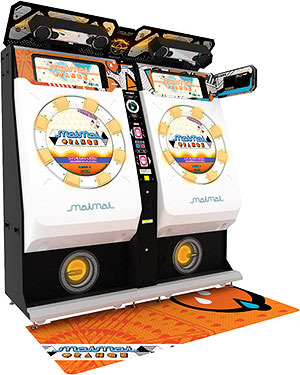
The game is perhaps best known for its cabinet design, which resembles a front-loading washing machine. Some cabinets also have a camera that allows players to record their performances; however, not every song allows recording.
There have been eleven main versions of maimai, each with an associated "plus" version with the exception of maimai FiNALE.
Originally, the series was exclusive to Japan, select parts of non-Japan East and Southeast Asia, and Australia, but several attempts were been made to bring the game to the United States. Two location tests in southern California were held for PiNK PLUS in 2016 and 2017, and maimai FiNALE cabinets without online functions were distributed to select Round 1 locations in the U.S. starting in late 2019. In 2025, Sega announced that the game would finally be coming to the United States, complete with network support, with a location test of maimai BUDDiES PLUS conducted at Amusement Expo International in Las Vegas, Nevada on March 19-20, 2025. Another location test, this time running offline maimai PRiSM PLUS, were conducted at Anime Expo in Los Angeles, California on July 3-7, 2025. After all these years of testing and demand, the game was finally released in the U.S. in fall of 2025, with Round 1 branches getting priority and non-R1 arcades (mainly those owned by GENDA GiGO Entertainment, which also owns many former Sega arcades in Japan) following suit.
In 2019, the original maimai line was retired in favor of maimai DX, updating the game's cabinet and hardware for the first time since the game's original release seven years prior. ALL.Net service for classic maimai was terminated in Japan in late 2019 and for overseas regions at the end of February 2020.
Games in the series:note
Original hardwarenote
- maimai (2012)
- maimai plus (2012)
- maimai GreeN (2013)
- maimai GreeN PLUS (2014)
- maimai ORANGE (2014)
- maimai ORANGE PLUS (2015)
- maimai PiNK (2015)
- maimai PiNK PLUS (2016, 2016-2017 U.S. location test)
- maimai MURASAKi (2016)
This version introduces "UTAGE" charts, which are charts that don't follow the balance of a conventional chart and may include gimmick levels such as an extreme focus on one note type or requiring multiple players on one screen to play the chart effectively.- maimai MURASAKi PLUS (2017)
- maimai MiLK (2017) — subtitled Natural & Fresh
- maimai MiLK PLUS (2018)
- maimai FiNALE (2018) — offline cabinets without licensed content can be found at some Round 1 USA locations
Deluxe hardwarenote
- maimai でらっくすnote (DX) (2019 Japan, 2020 International)
A revamp of the game, which uses new cabinets with improved hardware, and new note types. Several countries that previously only got offline builds of the game finally get an online build.- maimai でらっくす PLUS (2020)
- maimai でらっくす Splash (2020 Japan, 2021 International)
- maimai でらっくす Splash PLUS (2021)
- maimai でらっくす UNiVERSE (2021 Japan, 2022 International)
- maimai でらっくす UNiVERSE PLUS (2022)
- maimai でらっくす FESTiVAL (2022 Japan, 2023 International)
- maimai でらっくす FESTiVAL PLUS (2023)
- maimai でらっくす BUDDiES (2023 Japan, 2024 International, 2024 U.S. location test)
This version brings back UTAGE charts after they were removed starting with the original DX. In addition to introducing new UTAGE charts, some new UTAGE charts are classified as "Buddy" charts, which can only be played in 2-player mode and features separate charts for each player.- maimai でらっくす BUDDiES PLUS (2024, 2025 U.S. location test)
- maimai でらっくす PRiSM (2024 Japan, 2025 International)
** maimai でらっくす PRiSM PLUS (2025 Japan and International. First maimai game released in the United States.) - maimai でらっくす CiRCLE (2025 Japan, 2026 International)
This version of the game introduces "Circles", this game's take on video game clans. Additionally, Circles can participate in "Festa" events, where each Circle votes for one of several teams and then tries to earn event points for their team to unlock rewards for everyone in that team.
Chinese releases
Titles with years in them were released in the year indicated.
- 舞萌 (2012): Based on the first maimai game.
- 舞萌DX (2019): Based on the original maimai でらっくす.
- 舞萌DX 2021: A hybrid of the original maimai でらっくす and Splash.
- 舞萌DX 2022: Based on UNiVERSE.
- 舞萌DX 2023: Based on FESTiVAL.
- 舞萌DX 2024: Based on BUDDiES.
- 舞萌DX 2025: Based on PRiSM.note
Now has a character page. Please move any character-specific trope there.
maimai features examples of the following:
- Absurdly Short Level: Most tracks in the series are around 2 minutes long, give or take about thirty seconds. The shortest song in the game is "Takemoto Piano CM", which is only 58 seconds long! And even then, that's only because the song is repeated an additional time; the actual commercial is only half of that.
- Adjustable Censorship: The operator menu has a "Dress Code" option that replaces some of the more sexual album jackets and background videos with generic placeholders.
- all lowercase letters: The "maimai" name itself, but subsequent versions' suffixes avert this trope.
- Alliterative Title: maimai MURASAKi and maimai MiLK. Also, maimai itself.
- Alternate Reality Game:
- BUDDiES has project raputa, which has the player go through a series of puzzles to unlock two hidden areas, with the song "Apollo" and "raputa" as Perfect Challenge songs at the end of the ARG. The methods to progress include equipping certain name plates, entering a certain set of numbers (which is also got by very obscure ways) in maimai.NET and playing a certain chart's all difficulties and only hit break notes.
- PRiSM PLUS: The finale of the KALEIDXSCOPE game mode. After the mode has "crashed" following the completion of Phase #??? , the player's Collection is glitched out and features a phrase instructing the player to "go find the last hope".
In the Japanese version, the player has to message a key phrase to the game's official LINE account to initiate a conversation with a scripted account that represents Acid, one of the game's characters, who warns that her world of 7sRef is facing imminent destruction. By following pre-made conversation prompts that shed light on the story behind the entire event, the player is cryptically instructed to go to the maimai FiNALE official website and click on a certain graphic, which takes them to a YouTube video that serves as a preview of the next song in the mode, "AFTER PANDORA". Then, upon clearing that song, they are eligible to print a "Key of Hope" from the Card Maker (as in, they have to print the physical card); inserting this special card into the DX Pass reader when starting a game grants access to the Final Boss of the event: the full version of "Xaleid◆scopiX", the Phase #??? song. With the same LINE account, the player can also ask Acid questions that don't progress the ARG, but which she will still answer to provide insight on the maimai verse.
In the International version (including the U.S. region), this ARG is simplified. The LINE ARG wasn't translated; instead, the player is instead given a title cryptically instructing them to play "Save This World νMIX" with the L-R Mirror modifier. Then, with the instructions from the title this unlocks, they visit the portal for the International version of the game and click on the Delukkuma icon in the lower-right corner of the screen seven times to watch the "last hope" video and a countdown to November 17, 2025, when the third act of the mode opens. Since the Card Maker and the DX Pass reader aren't available in non-Japanese versions, the player merely needs to complete Phase #8 to play "Xaleid◆scopiX".
- Anti-Frustration Features:
- Dropping or overholding hold notes only gives "good" timing judgement instead of missing outright. The same applies if the final segment of a slide path was not completed. In DX, dropped hold notes can be held again. Judgement will depend on how long you hold the note, and not the release timing.
- Prior to GreeN PLUS, hold notes have rounded ends, which can be mistaken as single taps sometimes. The hold notes are now hexagonal to make them easier to recognize from GreeN PLUS onwards. Later on this feature is exploited by having staccato notes, or very short hold notes which must be pressed and released immediately.
- As long as end of the sliding move coincides with the end of the moving star note, a "Just" (perfect) judgement will be given regardless how the player does it. This can be used to your advantage as you can leave the slide alone until it's about to end to avoid accidentally getting a "Fast" (Good) on it while focuing on other notes first.
- In a multiplayer match, as long as a player cleared a song, other players are who otherwise failed to do so are considered cleared the song for bonus track eligibility.
- While playing a song, the game will also play an "assist clap" sound for every note that needs to be tapped and the release point of hold notes, allowing the player to figure out the note timings more easily.
- Starting from PiNK, once you start a song, right before the song starts, you will hear four claps that will inform you about the song's speed and also help you determine exactly when the song starts and when to start tapping.
- The amount of life points the player is given to unlock Challenge Track songs increases every 2 days; after 2 weeks, the song is unlocked for everyone. Similarly, with MiLK's Survival Courses, the songs can be unlocked with "cheese" (the version's in-game currency) after the one-month window for the Course ends.
- With the release of PiNK, each difficulty level between 7 to 11 inclusive was split into the base level and a "+" level, such as 8 and 8+. All the charts in each difficulty level were re-sorted accordingly, reducing the problem of players encountering "difficult for level" charts when breaking into the next difficulty level. MURASAKi then also splits level 12 into 12 and 12+.
- Normally, Master charts have to be unlocked by getting an S rank on the Expert chart, but they can be made available without meeting that requirement under certain conditions:
- Exclusively in the "classic" line of games, if the cabinets are set to offline mode, all non-Re:Master charts for available songs will be available for all players.
- In Deluxe, only the Deluxe charts require an unlocking for Master and Re:Master, and you can directly play it if you use a boost ticket or have another player who has unlocked it play with you and choose it, and if you are able to get an S or higher on them, you can also unlock them.
- The course modes allow you to play Master charts that are in these courses whether you've unlocked them or not. Of course, in the case of the random courses, it's up to the game to decide which Master charts are available for your four-song session.
- If a Master chart appears in your "Recommended based on your Rating" folder, you can play it there regardless of if you've unlocked it or not.
- As of CiRCLE, Deluxe Master charts from at least two whole versions ago (i.e. BUDDiES and earlier) no longer require unlocking.
- In Deluxe, when choosing specific partners for song/icon unlocks within the island area, an auto set feature is available that puts all of the earned island-specific partners to make content unlocks faster.
- The international version of Deluxe had the duration of its Touhou limited-time area extended by two months (now ending in June 2020 rather than April) due to the coronavirus pandemic and the arcade closures that ensued. New content additions were also delayed before arcades gradually reopened due to loosening of restrictions.
- Starting from BUDDiES, if there is leftover distance from being blocked by a task track or finishing an area, they'll be stocked up and you can spend them elsewhere or after clearing the task track.
- PRiSM revamped the area system a bit so it's less frustrating. You move at the end of a credit instead of after every song, and you only need to earn a Full Combo/All Perfect and/or area song bonus, and said bonus will apply to all songs in that credit. Also, if there is a task track in front of you, you can clear it in any song in that credit.
- KALEIDXSCOPE gradually opens up easier difficulties over time, preventing lower skill players from being locked out of its content. KALEIDXSCOPE songs initially release with 1 LIFE/MASTER clear requirements on day of release, but the starting LIFE pool increases over subsequent days. After two weeks, the song's EXPERT map opens up with a 100 LIFE health pool, and after three weeks its BASIC map opens with a 999 LIFE health pool. CiRCLE makes the first six gates immediately available to play, although the player still needs to beat each one to unlock their respective boss songs, and still needs to beat these gates and complete 7sRefちほー4 to unlock the second stage of the event.
- April Fools' Day:
- 2015 brought "The Rhythm Sense Test". All this song's charts consist of tapping one button to a quarter beat rhythm until the "song" ends. However, on Master difficulty, the joke gets serious - you can't see the notes!
- 2016 brought the Wonderland Wars theme as a joke song. Charts in maimai normally only need you to use your 2 hands. This song's charts have ridiculous patterns, such as holding down 5 hold notes at once. Clearing the charts requires use of not only the hands, but the fingers, forearms, elbows and even your head. The next update then released the real crossover song from Wonderland Wars, "Garden of the Dragon".
- 2017 brought five UTAGE charts for "Garakuta Doll Play", each with a varying difficulty around level 12+ to 13.
- 2018 saw the announcement of maimai III, which features foot pedals and floppy disk support. Also, it features 3-player gameplay which is reflected in the UTAGE chart of the day. This became
 Hilarious in Hindsight when maimai splintered in a similar way in December 2018, with the unveiling of maimai DX (a branch of the series with updated cabinets and new mechanics to replace the "legacy" series a la IIDX, alongside a Grand Finale for the legacy game known as maimai FINALE).
 - 2020 brought maimai DX Tsukemen, featuring some yummy content and a black cabinet.
- 2021 saw the unveiling of maimai DX The Piano, with a new cabinet featuring a full ring of piano keys
 and the jingle of a Japanese piano retailer.
- Are You Sure You Want to Do That?: If attempting to enter certain modes like "PANDORA BOXXX" in FiNALE and "KALEIDXSCOPE" in PRiSM PLUS and CiRCLE, the player is asked to confirm if they want to enter, due to the high difficulty of these modes. This is especially necessary in "KALEIDXSCOPE" since it's a course mode selected at the start of the credit that, unlike other modes, ends the player's credit if they run out of life at any point, without any opportunity to keep playing the remaining number of songs, i.e. it is possible to waste the entire credit by missing the first handful of notes.
- The Artifact:
- When uploading song result images to the web portal, a warning appears informing players that they are solely responsible for the contents of the images, which may include photographs from the on-cabinet cameras (i.e. don't do rude or consent-violating stuff on the camera). This warning still appears in the American version of the game, which does not have the camera.
- During Circle Festa events, the Attract Mode shows an arcade-specific leaderboard for the three teams, since in the Japanese version, the winning team is determined by which team is leading in more arcades than the other two. In the International version, the winning team is simply dictated by which of the three teams has the most Festa Points across the network, but still shows the leaderboard UI, just completely blank.
- Ascended Meme: Since the original release, there have always been running jokes about the arcade cabinet looking like a washing machine. When version 1.21 brought unlockable titles, two of them were "A washing machine with coin timer." and "A washing machine with TV."
- Bait-and-Switch: One occurs in the background video for "ULTRA SYNERGY MATRIX". At one point, the main character has his house destroyed by the giant rampaging dinosaur. He's given a strange power that causes him to transform into Milk, one of the maimai mascotsnote ...only for that to be a disguise that he sheds, revealing that he's simply a larger and more muscular version of himself.
- Bait-and-Switch Boss: During the KING of Performai 5th's maimai segment, the finalists were tasks with a song whose details were not shown on the song select. After an introductory cutscene, the Final Boss of the tournament, "系ぎて", was introduced, with a Master chart rated level 14+. Except the song jacket and difficulty information were then removed, replaced with the same song but on Re:Master difficulty, with the number 15 abruptly shown in large, menacing red text. Welcome to the first Deluxe level 15 chart.
- "Blind Idiot" Translation: While the English versions generally have understandable English in their interfaces, the translations of song titles are sometimes iffy. For example, "Seyana.~何でも言うことを聞いてくれるアカネチャン~" ("Akane-chan who will listen to anything you say") gets translated as "Seyana.~AKANE's anything ok~".
- Boss in Mook Clothing: Jinglebell's Master chart, introduced way back in the first installment as a Christmas event song. It was rated 10 out of 10 when it was first released. It's now rated 14 in the current rating system (and this is the Standard chart; it gets a DX chart later which is rated 14+!). The chart is extremely hard for a festive song, featuring rapid taps for a 100 BPM song and delayed slides.
- Boss-Only Level: The final phase of the KALEIDXSCOPE event features only a single track: the true form of the Phase #??? track "Xaleid◆scopiX". And it turns out there is a good reason this is the only track: it is almost 4 1/2 minutes long. You do play one more track afterwards, "Ref:rain (for 7th Heaven)", but it's a Post-Final Boss that serves to wrap up the story without the same brutal conditions as the previous song, and it's also a double-length track at a little over 4 minutes long.
- Boss Warning Siren: After selecting a Challenge Track, the game plays siren sounds along with a danger warning displaying the amount of lives.
- Bowdlerise:
- The music video for "MopeMope", which features some absolutely horrific imagery like the flowers turning/distorting into Botanical Abominations with human arms for petals and chattering lips, had its video revised to use pixelation effects, before completely replacing the visuals with a peaceful video of a boat sailing across the sea, which seems to be a reference to "Nice Boat". The censorship is done by Optie, the same person who did the original background animation for "MopeMope".
- Like in the other Gekichumai games, Akuma no Odorikata has “レイプ” in the bridge replaced with a bleep censor.
- Videos that highly utilize parodies such as *litmus’s Rush-More and Rush-Hour, Rish's BMS songs like Take and Minami no Minami's Sekai-chan and Kafu-chan's Errand Ensemble have most non-Sega or Nintendo references removed or blurred.
- As with CHUNITHM, some songs like "8-EM" use an alternate jacket in the International and the Chinese versions.
- The International version and the Chinese versions don't use the music video for "God-ish" and Yoidore Shirazu for cigarette issues (although God-ish had the video on the base firmware version of Festival Plus for a few days). The Japanese version still keeps the videos, however.
- The music video for "MopeMope", which features some absolutely horrific imagery like the flowers turning/distorting into Botanical Abominations with human arms for petals and chattering lips, had its video revised to use pixelation effects, before completely replacing the visuals with a peaceful video of a boat sailing across the sea, which seems to be a reference to "Nice Boat". The censorship is done by Optie
- Breaking the Fourth Wall: "QZKago Requiem" has a brief break in it with a fake results screen (from a completely different version than FINALE, and also listing the song as "Garakuta Doll Play" instead), which then glitches and sends you right back into the song.
- Bribing Your Way to Victory:
- Deluxe versions let you spend extra credits to buy tickets that accelerate Chiho progress and make Master and Re:Master charts available without unlocking them with an Expert S rank.
- Exclusive to Japan, Deluxe also has the DX Pass that you can print from the Card Maker machine. It again makes Master and Re:Master charts available without needing to unlock them via Expert S ranks first, and also boost your active characters' EXP. In addition to the base "Gold" version of the pass that provides the aforementioned benefits, there is also a slightly more expensive "Freedom" version that adds two more minutes to the Freedom Mode timer, for a total of 12 minutes.
- The Bus Came Back: BUDDiES brought back UTAGE charts, and BUDDiES PLUS brought back the maimile shop from ORANGE.
- Colour-Coded for Your Convenience:
- The difficulty levels have associated colours: Easy is blue, Basic is green, Advanced is yellow, Expert is red, Master and Re:Master are purple.
- Single taps and holds are pink, single slides are blue (the touch portion could be set to pink) but when any of these notes are in an Each (two notes at once, it's called Both outside Japan), they are coloured yellow. Breaks are always colored orange.
- In addition to that, DX's touch notes are colored blue (yellow if multiple), while the hold touch note at the center is rainbow-colored.
- Colourful Theme Naming: The first five installments are all named after colours. The sixth one also fits in a way, as milk is white in general.
- Content Warning: At the start of each credit, the player is advised not to swipe or hit the cabinet hard to avoid injuring themselves, and that a "LIGHT TOUCH is enough!"
- Co-Op Multiplayer:
- Sync Play, a multiplayer mode where the entire group is scored based on how close they are to each other on timing. This was dropped in Deluxe.
- Several Utage charts explicitly require multiple players on one screen due to the designs of the charts, usually two or three, with a few even requiring four players (although this doesn't stop solo players from trying anyway). Some other Utage charts are "Buddy" charts that can only be played in 2-player mode, often featuring different charts on each side. Rather than each player having a maximum score of 101.0000% Achievement Rate, both players' scores are combined together, for a maximum of 202.0000%.
- Critical Annoyance: A screeching noise plays every time you lose a life when playing a challenge track. The screen (or the life indicator as of DX) also becomes redder when you have low life. The noise can be avoided by turning the sound effects off.
- Crossover: The game frequently makes these with other games and franchises. As of DX, there is an entire "limited time areas" section dedicated to these.
- The SEGA section. The songs are from SEGA games, like Live and Learn, Angels With Burning Hearts, and Save This World.
- An update to maimai ORANGE PLUS added tracks from Persona 4: Dancing All Night, such as Pursuing My True Self and Time to Make History.
- The TOUHOU PROJECT section consists entirely of rearrangements of Touhou Project tunes. The niconico section consists almost entirely of Vocaloid tracks.
- The GAME & VARIETY section borrows songs from other games or companies, such as Got more raves?, Kitasaitama2000, and FLOWER.
- The reverse also happened with Groove Coaster, Taiko, and jubeat, which received the maimai original song Garakuta Doll Play in a similar event to the above three songs.
- And then there's Karma by Bump of Chicken, from Namco's Tales of the Abyss. Although strangely, it was listed under Anime and used a custom-made PV instead of the game's opening cinematic.
- maimai PiNK added Gera Gera Po no Uta, the theme song from the anime and game of Yo-kai Watch.
- On the other end of the scale, maimai likes to appear in Phantasy Star Online 2 on occasions, allowing players to purchase replicas of the machine that also function as a Jukebox, as well as Music Discs for some of the game's original tracks. Appropriately, Quna's Our Fighting was added to maimai ORANGE in an update.
- Along with the other two Performai games, the game did one with Arcaea in 2021 and 2023.
- maimai includes several songs featured in Hatsune Miku: Colorful Stage!, including both covers featuring the in-game units and commissioned songs from the game. Hatsune Miku: Colorful Stage! in turn has featured songs from maimai as a result of the Performai collaborations.
- Death Is a Slap on the Wrist: You will always get a full set of tracks per credit, even if you fail all of them. In Splash PLUS' course mode, each dan or random course has a set number of lives. While it is still possible to clear all of the songs normally even though the number of lives have been depleted, the game will not mark it as completed due to failure.
- Survival Course, the new type of course that comes with the release of MiLK, eventually averts this trope. In this course, you are given a limited number of lives (50) for the entire course and 4 songs to play. For any "Good" judgement, you lose 1 life, and for any "Miss" judgement, you lose 5 lives. The number lives remaining after the end of a song is carried over to the next song, and if you run out of lives, the game immediately ends. So, specifically for this course, it's possible for the game to end without you being able to play the maximum number of songs. It is also used in the harder random and Shin Dan courses in Splash+ onwards.
- Developer's Foresight: Some UTAGE charts that require you to hold on multiple side buttons at once have the track skip function forced off because one of the ways to skip a track is to hold on the four side buttons at once for a few seconds, which these charts have.
- Double Unlock: Challenge Track. If you want to unlock the song early, you have to achieve S-rank or higher on the Expert chart, which will unlock the Master chart. Only after clearing the Master chart will the song be unlocked early.
- Dub-Induced Plot Hole: In the English versions of classic maimai, attempting a Challenge Track gives you a warning that you will get a Game Over after a set number of notes rated "below GREAT". This is incorrect, as getting a Great will also take away lives. This mistake is unfortunately repeated for the KALEIDXSCOPE game mode introduced in PRiSM; the text above the player's remaining Life before each song states "Life is reduced by below GREAT", even though hitting a note with a Great will again reduce your Life, not just judgements below.
- Early-Installment Weirdness:
- The original maimai's difficulty rating scale only goes up to 10, and all Master charts are rated 10. Later games would increase the scale, as well as give Master charts ratings besides just 10.
- In the original game, Break Notes are worth up to 2,500 points, and Achievement Rate can only go up to 100%. Later games introduce the mechanic of hitting Break Notes with finer accuracy to get up to 2,600 points, enabling Achievement Rates of more than 100%.
- Hold Notes have rounded ends, much like Tap Notes. It wasn't until maimai GreeN PLUS that Hold Notes were given a hexagonal shape to make them stand out better.
- Earn Your Fun: Level Grinding is more prominent in Deluxe than the OG versions, which new songs and icons can only be unlocked through accessing the specific island and playing songs to acquire mileage for unlock. Playing songs that have area-specific bonus mileage (such as in Touhou and VOCALOID areas) and using the right partners for each island are recommended to unlock contents faster.
- Easier Than Easy: Simple difficulty, below Basic. It was removed in Deluxe.
- Flawless Victory:
- The announcer lets you know if you get a Full Combo, all Perfectsnote , or, in cooperative multiplayer (Sync Play), a 100% Sync rating. However, averted with "perfect score" All Perfectsnote - while the upper display will confirm the perfect score, the announcer is the same as an ordinary All Perfect.
- MURASAKi added Max Fever, which is achieved when both players get Full Combo, though this is averted when both players achieved 100% Sync in Sync Play. DX changed this to Full Sync, which is in the same vein of Max Fever, and Full Deluxe (FDX), which is in the same vein of 100% Sync.
- DX adds Full Combo+ for a FC with no Goods, and now acknowledges maximum-Achievement (101%) runs (all Critical Perfects on Break notes and all Perfects or above on other notes) with an All Perfect+ status.
- Forced Tutorial: Using a new AIME or Banapassport card will prompt an unskippable tutorial through the Collections menu (averted with a shorter tutorial in DX), which takes several minutes and irritates people waiting to play. Averted with the gameplay tutorial itself.
- The Fourth Wall Will Not Protect You: "Clearing" Phase #??? in the KALEIDXSCOPE event causes the game to "crash" to a parody of the Windows XP Blue Screen of Death. The lights on the cabinet go out as well, to make it look like the game really crashed.
- Game-Breaking Bug:
- In PRiSM PLUS, the Akina Saegusa Area has "Hanbunko" as the Task Track at the 100-kilometer mark. However, this song is not available in the U.S. version, so when this area was released for the International version (which the U.S. version is a subset of) without U.S.-specific adjustments to account for this, American players' progress in this Area got softlocked until a patch was released a few days later.
- CiRCLE's Shin 6 course crashes the entire game in the U.s. version because its 4th song, "DO RORO DERODERO ON DO RORO", is missing from the U.S. version and the game doesn't know what to do as a result.
- CiRCLE's U.S. version has the track audio of "Link" by Circle of Friends mistakenly replaced with that of another song of the same name but by Clean Tears.
- In PRiSM PLUS, the Akina Saegusa Area has "Hanbunko" as the Task Track at the 100-kilometer mark. However, this song is not available in the U.S. version, so when this area was released for the International version (which the U.S. version is a subset of) without U.S.-specific adjustments to account for this, American players' progress in this Area got softlocked
- Game-Over Man: When you fall to 0 lives on Challenge Track, the screen closes, showing Happy the cat/dog thing doing variable things depending on how far you've gotten when you failed.
- Gimmick Level:
- Some charts exploit game elements heavily to create annoying charts, namely:
- Songs with almost entirely slide notes. Special mention goes to the Re:Master version of hiiro no dance, which takes this up to eleven with a whopping 229 slides.
- Slip Flip beats it by having 235 slides, though the song also has regular tap notes.
- That record is later surpassed by the MURASAKi track Selector (245 slides).
- Later, however, UTAGE charts still have the gall to take this even further. If you take UTAGE charts into account of the record, Future UTAGE chart has 256 slides, while CYCLES UTAGE chart has 361.
- Coinlaundry Disco has a Master chart that serves to show off all the curved slides introduced in GreeN PLUS, along with spirals of tap notes.
- CYCLES Master, with circular slide notes, especially at the last chorus.
- Fragrance Master and Nitrous Fury Master are a barrage of tap notes. In fact, the Fragrance chart only have 2 slides, and no hold notes.
- shake it! Master uses a pattern of hold and tap notes to force the player to repeatedly switch hands.
- Future Re:Master is almost completely composed of "delayed slide" patterns.
- Quite a few charts put many slide trails together, with the start of some trails being close to the end of others. Not only do you have to try to understand their timing and order, if you accidentally trigger the sensor for the end of the trails when starting other slides, you will also get goods.
- Boss songs "Our Wrenally" and "Straight into the lights" have a chart BPM which is half the song's perceived BPM. This results in the "slide delay" being twice as long as expected, and the higher difficulty charts take advantage of this expectation.
- UTAGE charts, introduced in MURASAKi, are full of these. So much so that there are a set of UTAGE "attributes", being a single kanji that lets you know what the chart is going to be like.
- The UTAGE chart of Oshama Scramble is one DAMN UTAGE level. One section requires you to hold all eight notes (one note up to all eight)
- Oshama Scramble (Cranky Remix) can only be played in UTAGE, and it somehow manages to take it further, resulting in an extremely chaotic chart where slides and notes can fill the screen.
- Some UTAGE charts require you to play with multiple people on one cabinet. Specifically on one player of the cabinet. Hand in Hand's UTAGE is the most noteworthy, requiring at least four people to play, and eight people to play effectively, as one section has all eight notes held at the same time alongside having tap notes appear during those holds, requiring the use of the screen and buttons simultaneously.
- The Master chart for the song Unclosed Human by Kaja (which itself is a Homage to the late wowaka's music) has a few sections ripped straight from or similar to the Master charts of Wowaka's featured songs: the first verse being exactly the same pattern as the first verse during the Re:Master chart for World's End Dancehall, alongside the eye shaped slide at the final chorus referencing the Master chart for Unknown Mother Goose during the line “あなたには僕が見えるか” (Can you see me?).
- The pattern of the first pre-chorus of Unclosed Human’s Expert chart references the Expert chart of Unknown Mother Goose's pre-chorus. The first verse patterns also resembles the patterns for the intro of World's End Dancehall's Expert chart.
- Some charts exploit game elements heavily to create annoying charts, namely:
- Guide Dang It!: There are hidden Collections that need highly specific and undisclosed requirements to unlock. The multi-stage superboss events (PANDORA BOXXX in FiNALE, project raputa in BUDDiES, KALEIDXSCOPE in PRiSM and PRiSM PLUS) have even more convoluted requirements.
- Harder Than Hard: Master difficulty. To unlock it, you have to score at least 97% (S or higher) on the song's Expert chart. To be fair, you're probably not truly ready for the Master chart if you can't S the Expert chart. Deluxe allows you to print a DX Pass that makes Master charts for unlocked songs available without having to S-rank the Expert first.
- Re:Master difficulty, available on some songs. To unlock it, either clear the Master chart, then purchase the Re:Master chart (ORANGE PLUS) or just clear the Master chart (PiNK). Starting from MURASAKi, just unlocking the Master chart (without having to play it) will also unlock the Re:Master chart as well.
- Idiosyncratic Difficulty Levels: Easy, Basic, Advanced, Expert, and Master. Some songs have a "Re:Master" chart.
- Inconsistent Spelling: ナイト・オブ・ナイツ, due to there not being a specific single way of reading the title (the artist accepts multiple ways of writing it in English), is shown as "Night of Knights / Knight of Nights" in the English version.
- Kaizo Trap:
- Some songs will throw you notes after you think they have ended. Notably:
- Life Feels Good has 2 more notes after the song apparently ends.
- A few Master charts, including Orpheus, Contrapasso -paradiso-, Kusare gedou to chocolate and gensounosateraito, appear to end with a slow, long circle slide... which is immediately followed up by a very fast slide.
- Caliburne ~Story of the Legendary Sword~, already a longer-than-average boss song itself, ends with an epic finale... followed by the song's real ending.
- VERTeX kinds fits into this trope. It seemingly stops at around the first minute mark, but it continues (First-timers be aware).
- Aiolos sets up a nasty one. In the middle of the song, there is a pair of slow q-shaped slides (slide from the start point, loop 360° around the middle, and then to the end point), marking a break in the middle. Near the end, it appears that an exactly identical pair of slides is coming up to end the song, but these are fast U-shaped slides, displayed exactly the same graphically, leading into the real ending!
- A rather cruel one appears in larva Master. After playing through a grueling chart with one of the highest note counts in the game, the song winds down with 5 full seconds without notes... and then the very last sound in the song corresponds to a final Break note.
- Xaleid◆scopiX, the Final Boss of KALEIDXSCOPE, has a particularly nasty trap, backed by the BGA, with a powerful buildup leading to a false ending at 2 minutes and 39 seconds, which is around the expected length of a track at this point. However, moments later, it reveals itself to be the series' first double-length track and the longest track in the entire series at close to 4.5 minutes. This trap was backed by an elaborate ruse in KALEIDXSCOPE concealing the trap. Completing the Phase #??? variant of the track throws an impossible pattern of notes right at the false ending, forcing a Non-Standard Game Over in the form of a fake Blue Screen of Death, prematurely ending the track and unlocking the next phase. Getting to the false ending again in the final phase on KALEIDXSCOPE leads to a long pause and what appears to be a victory animation... until the player's lives are restored and the song continues. Even when unlocked for normal play, the only warning of the trap is the track being marked a "long" track that uses up two plays.
- Hoshi Meguri, Hate no Kimi e Re:Master, introduced in Festival, places a touch note at the end of one of the slow slide tracks to trick anyone who would usually move the track to the end and wait until the star reaches it.
- Some songs will throw you notes after you think they have ended. Notably:
- Kyu and Dan Ranks: Grade Certification Course, with the ranks in 1dan to MG (Master Grade/Kaiden). You play a 4-song course, when you clear S on everything, you obtain the rank. Only up to 8dan is available to the player. Clearing the 8dan will unlock the 9dan up to MG, although you can skip it altogether by playing with someone who has your desired rank. Grades over 9dan will end your session if you score below S, but you can be saved if another player gets an S. Grade courses from older installments are available as well, starting at 8dan.
- Before PiNK, the rank system was in the form of maiCHALLENGE, that is more like a mission with a time limit to complete the objective.
- In Deluxe, Dan ranks can now be earned by playing in Otomodachi matching. Dan ranks also correspond to additional numbers in your rating. This is no longer the case in later versions.
- Last Note Nightmare:
- Helix of Garatia, both the song and the chart. Expert and Master give rapid streams of notes that are almost guaranteed to break your combo.
- At the end of Kusare gedou to chocolate is a very long beep... followed suddenly by a burst of static that will surprise first-listeners.
- Law of Chromatic Superiority: Deluxe's Rating system is divided into color-coded tiers. A short special cinematic plays when going up a color tier. They are as follows:
- Less than 1,000 is blue and white.
- 1,000 to 1,999 is blue.
- 2,000 to 3,999 is green.
- 4,000 to 6,999 is yellow.
- 7,000 to 9,999 is red.
- 10,000 to 11,999 is purple.
- 12,000 to 12,999 is bronze.
- 13,000 to 13,999 is silver.
- 14,000 to 14,499 is gold.
- 14,500 to 14,999 is a brighter gold.
- 15,000 and above is rainbow.
- Little Bit Beastly: Milk and Shama in "Oshama Scramble!". Maimai Milk added more mascots to the game that are made of this trope (Chiffon, Salt and Ras).
- Luck-Based Mission: The first three songs in MiLK's Survival Courses, and more recently, the Random courses in Splash+ onwards, are randomly chosen from a pool of songs matching the theme of the course (or per difficulty in Random), changing with every attempt. There is usually a significant spread of difficulties within the Master charts of the songs in the pool, often with a number of level 13s in there. The songs the game puts in your Course can easily make or break that attempt.
- Marathon Level: Certain tracks can be marked as "Long" tracks that are counted as two tracks instead of one for gameplay purposes (though in this game, it is presented as reducing the denominator of the "TRACK x / y" indicator by one) These tracks therefore cannot be played if you are on your final track of the credit, nor can they be played in Freedom Mode (as they could otherwise be abused to over-extend your gameplay past the timer expiration):
- The Final Boss phase of the KALEIDXSCOPE event features "Xaleid◇scopiX", a track that is four minutes and twenty-two seconds long (in a genre where 2 to 2 1/2 minutes is the standard length for songs), making it the longest track in the entire game.
- The Post-Final Boss track, "Ref:rain (for 7th Heaven)", is also a double-length track, being 4:05 long.
- Meaningful Name:
- 7thSense from PiNK and Ref:rain (for 7th Heaven) from PRiSM are in 7/8 time signature.
- GEMINI -M- is one half of a pair of very similar songs, the other being GEMINI -C- in Chunithm PLUS.
- Cycles has charts with lots of looping slide note patterns, i.e. your hand going in cycles.
- Meta Multiplayer: maimai Deluxe introduces Otomodachi Battle mode, in which you compete against a previously-recorded score set by another player. If you beat that score, you will gain ranking points.
- Non-Indicative Difficulty: Some songs on harder difficulties are rated lower than on easier difficulties. For example, the Master chart for "Flower, Snow, Drum'n' Bass" is rated 14,3., while the Re:Master chart is 13.8.
- Non-Standard Game Over: In the Phase #??? track (later revealed to be "Xaleid◇scopiX" by xi) of the KALEIDXSCOPE event in PRiSM PLUS, which is encountered as the third and final song of the course it's in, failing the track by running out of life gives you a big fat 0% for your Achievement Rate, regardless of your actual performance, unlike all other instances of failing out where at least you keep any score you got. All of your other stats like judgement counts, Deluxe Score, and combo are zeroed out too. The same Scripted Event will also happen if you challenge the Final Boss of the event, which is the full version of this song, and fail it.
- Noob Bridge:
- In maimai, unlike many rhythm games, hold notes MUST be released to get a "Perfect" judgement. First-timers, especially rhythm game veterans, tend to keep holding the note even after the note ends, resulting in a "Great" or "Good" judgement. This was dropped in Deluxe, where as long as you time correctly and hold all the way to the end, you can get up to "Critical Perfect" even if you over-hold the note.
- As stated in the tutorial, slide notes have to be tapped, then slid, and each action is judged separately. Quite a number of beginners forget to tap the slide note first and wonder why their combo keeps breaking despite getting a "Just" (perfect) judgement on the slide.
- Similarly, the "star" in a slide note does not start moving immediately after the note is tapped - it waits for a moment (a quarter note), then moves. By about level 10 in the current system, charts will exploit this by having the player tap notes after the slide note has been pressed, but before the star starts moving, resulting in combo breaks for new players who fail to notice this.
- It is possible to use both rim buttons and touchscreen at the same time. Some tracks have special sections, like Luze's Hera and Eta Beta Eta which utilize this trick which will trip players who encounter them the first time.
- Invoked and Played for Laughs in the 2016 April Fools' song (and later, some UTAGE charts). It requires you to utilize buttons and touchscreens at the same time by throwing you hold notes followed by tap notes on the same position as the hold note while the hold note is still going.
- When three or more adjacent Touch notes appear on the screen, touching about 51% of the clustered Touch notes at the right time will allow all the Touch notes to be hit. This can be seen in charts which utilize large swaths of Touch notes at one go such as Spider's Thread Master.
- Odd Name Out:
- The first four main games use the English names of colors, but the fifth game uses murasaki (lit. purple/violet) instead. The sixth game is even odder, as it doesn't use colors as name, while still keeping the Theme Naming.
- The International version of Splash is the only game in the entire series to have the subtitle being (officially) written in Japanese, being called "maimai DX スプラッシュ". This is never done again.
- One-Hit-Point Wonder: You get only one life to clear a Challenge Track on the first two days of its release. Get one note below Perfect, and it's over. You can also set life limits for normal chart plays and this is one of your options.
- One-Steve Limit: Averted with Heartbeats (a Joypolis song by RAMM feat. Wakai Yuuki), and Heart Beats (a niconico song by himawari ×emon (Tes.)). Outside Japan, you also have Heart beat, Serina Akesaka's character song from the Irodorimidori mixed-media project (the Japanese versions write the title in katakana). Also averted with the niconico & VOCALOID track Link and the ORIGINAL & JOYPOLIS track Link.
- Optional Boss: PiNK introduces the Challenge Track system. Score an S rank or above on all your songs before the last one, and you will get the chance to access a boss song as your final stage, with a limited number of lives. You lose one for any judgement that isn't Perfect. If you decide to attempt to unlock the song on the week that it is released, you only have one life. As of MURASAKi, the one-life challenge is available during the first two days of the challenge.
- Over 100% Completion:
- The Achievement rating appears to be a percentage of the maximum score for the song, with 100% meaning you got an All Perfect. However, most charts have "Break" notes that award bonus points, 100% Achievement is based out of getting all Perfects and 2500 points on each Break note, and you can get 2550 (2575 in DX in all exports versions and Japanese versions since the 1.02A update) or 2600 points on a Break if you hit it extra-accurately, which is called a Critical Perfect in the DX series. In practice, the vast majority of All Perfect performances have something like 101.44% or even as high as 105%, depending on the ratio of Break notes to other notes, and furthermore it's possible to get 100% or more without getting all Perfects if you get a lot of 2550 and Critical Breaks.
- Downplayed in Deluxe, where scores are now out of 101% regardless of chart.
- Play Every Day: Overlaps with Socialization Bonus below - before maimai PiNK, on the first play every day, the player will receive a mai-Friend bonus, which scales with every in-game friend, up to a maximum of 5, who has played recently. A mai-Neighbourhood bonus of 100 maimile will also be received simply by playing after someone!
- Power-Up Food: In the video for "Oshama Scramble!", drinking enough milk causes Milk to temporarily transform from a short, petite girl to a taller young woman with Jiggle Physics.
- Purple Is Powerful: Master, the hardest difficulty available on most songs, is colored purple. Re:Master uses purple as well.
- Rank Inflation:
- There's a whole range of grades from F upwards (since PiNK), but a borderline clear (80%) is an A. From there, there's AA (90%), AAA (94%), S (97%), SS (99%), and SSS (100%). DX though goes from D to SSS/SSS+, with two additional B-level BB (70%) and BBB (75%) ranks.
- While it looks like your Achievement Rate obviously tops out at 100%, 100% is calculated off of an All Perfect run with 2500 points on each Break; getting 2550- and 2600-point bonuses on Breaks will allow you to go over 100%.
- Deluxe introduces the Critical Perfect judgement rank above Perfect. Critical Perfects score maximum Achievement percentage on Break notes and are worth 3 Deluxe Points as opposed to 2 for regular Perfects. Beyond that, Critical/regular Perfect differentiation mainly exists to let you know if you're slightly off but without deducting Achievement points.
- Recurring Riff: Starting with the Deluxe series, the theme for the login menus for each game is an arrangement of the original maimai Deluxe's login theme.
- Regional Bonus:
- Unlike the JP version, Ongeki and Chunithm crossovers Titania & Toy Madness do not need to be played in their respective games to unlock in the international version, as two of these games are unavailable outside Japan. These songs can be played normally. Eventually Subverted by Universe Plus in the international versions where some songs starting from Good bye, Merry-Go-Round have to be played in Chunithm to be unlocked within its first two months of release.
- "Tsunagite" needs to be unlocked by playing with another player that has unlocked it on release (until March 21st when this song would be unlocked by default) in the Japanese version, but is unlocked by default in the International version for everyone.
- Retraux: The BGA for "Flower, Snow, Drum'n' Bass" looks like a good old Japanese karaoke BGA, even when it's glitching.
- Scoring Points:
- In the classic maimai games, Tap notes are worth up to 500 each (if you get a Perfect on the note), Hold notes are worth up to 1000, and Slide notes are worth up to 1500. Break notes are basically high-value Tap notes, allowing you to earn up to 2600 points on a Break note. Break Holds and Break Slide tracks introduced in maimai DX FESTiVAL are all worth up to 2600 regardless of the appearance. In addition to the game showing your score, it's also represented as an "Achievement" percentage; to clear a track, you need to finish with an Achievement percentage of 80% or higher.note
- In maimai DX, scoring has been split into two separate systems:
- The Achievement rate system, which is similar to the older system but now has four decimal places instead of two and is now out of 101% no matter the chart. 100% is based on an All Perfect with no Critical Perfects on Break notes; the last 1% is earned from getting CPs on those Break notes. Critical Perfect does not award extra on any other type of note.
- The Deluxe Score system, which is similar to the EX score system from DanceDanceRevolution: 3 points for a Critical Perfect, 2 points for a Perfect, 1 point for a Great, and 0 points for a Good or Miss. Under this system, Critical Perfects matter on all note types, not just Break notes. As of DX PLUS, you can also get a grade of 0-5 stars (at least 85% is needed to get the first star) based on your Deluxe Score.
- Season Finale: FiNALE, to the original maimai games and the hardware they run on.
- Sequel Song: There are a lot of these in the game, for both the original songs and songs from other sources (like BMS). Some notable examples include:
- "Glorious Crown" to "FREEDOM DiVE" (which is in the other two Performai games but not in maimai). It later gets another sequel called "Heavenly Blast".
- Excalibur~Revived Resolution to Caliburne~Story of the Legendary sword.
- "larva" to "PUPA".
- "7 Wonders" to "7thSense".
- Sequential Boss: The Re: MASTER chart of "Xaleid◇scopiX", the final boss song of the KALEIDXSCOPE event in PRiSM PLUS is first played with 1 life for how long the MASTER chart is played. After the timer ends, a cutscene plays where the player's health is increased to 100 and the song continues properly. But this time non-Critical Perfect will also reduce your health (although not nearly as much as Greats, Goods and Misses)!
- Short Title: Long, Elaborate Subtitle: "False Amber (from the Black Bazaar, Or by A Kervan Trader from the Lands Afar, Or Buried Beneath the Shiftin Sands That Lead Everywhere but Nowhere)" by Camellia. Camellia himself even posted an apology on X about how he doesn't realize that the title is too long.
- Shout-Out:
- The fastest scroll speed is called "Sonic".
- In maimai MiLK PLUS, Brain Power, formerly available on (and exclusive to) SOUND VOLTEX, arrived. Full combo its Expert chart and you receive a title, "mai騎士", a pun on Sound Voltex's Level 9 SKILL ANALYSER course ("魔騎士"). Equip that title and full combo its Master chart to unlock the title "ULTImai CHAIN", or achieve an All Perfect to unlock the title "PERFECT ULTImai CHAIN", references to the equivalents in Sound Voltex.
- Also in maimai MiLK PLUS, two past boss songs, Panopticon and Fragrance, received Re:MASTER charts. Once you get ALL PERFECT on the chart, you'll be given a title which reads "(Song Title)✝". The ✝ stands for LEGGENDARIA.
- "Tetoris" is already a reference to Tetris, taking its title and adding an 'o' to refer to Kasane Teto, but additionally, you can also get titles referring to the franchise's T-Spin mechanic: Get an All Perfect for "T-SPIN", get a Full Sync for "T-SPIN DOUBLE", and play the song three times in one credit (different charts are okay) for "T-SPIN TRIPLE".note
- Socialization Bonus:
- When playing with other players, both players can choose any song or chart that either player has unlocked.
- A number of cosmetic unlockables require playing specific songs in multiplayer.
- Since maimai PiNK, playing with a friend will give you a "Friend Fever!" bonus and double your in-game currency rewards for the session.
- UTAGE charts can be chosen from the first track when playing with other players with rating above 7 instead of S-clearing all tracks before the final track. Challenge track can also be chosen the first track with the same requirements but after the life is raised to 5 onwards.
- In DX, four songs can be played if two players are in the game, instead of three if played solo. You also move 1km more for each song (which can be replaced with Full Sync bonus). If they have no data yet in their Aime card, playing with a pair will receive four free songs.
- UNiVERSE PLUS introduces the Invitation Play mechanic. During a single-player game, the player can turn this feature on before starting a song to allow a guest player to play on the otherwise-unused side free of charge, though they can only play up to Advanced (Basic only until FESTiVAL PLUS) and cannot change their settings. The idea is for regular players to allow any friends they're with who don't regularly play maimai to play the game too. If both players achieve at least 80% Achievement Rate on the song, the inviting player will receive a boost to Area progress and an Area Progress 1.5x ticket. However, Invitation Play can only be enabled by each player once a day.
- Starting in Splash, players who reach LEGEND class in Otomodachi Matching unlock a song that they can subsequently gift to other players by playing the song with them on the same cabinet. However, only LEGEND players can spread this song to others, and if the non-LEGEND player plays the song on a different cabinet via Cabinet-to-Cabinet play, they will not receive the song.
- Sound-Effect Bleep: One near the start of the boss song CITRUS MONSTER. The Master chart even has a note corresponding to it.
- Suspicious Video-Game Generosity: When playing "Xaleid◇scopiX" as the Final Boss of KALEIDXSCOPE, halfway through the song the player's life is increased to a new maximum. As it turns out, this is because the second half of the song has a new gimmick where even non-Critical Perfects will also take away life!
- Temporary Online Content: maimai entices players to keep coming back with the Area system. At the start of each credit, you are given the choice of an Area, and at the end of your credit, you will earn kilometers based on your team's compatability with the Area and their levels, multiplied by the number of tracks played. Progressing through the Areas unlocks cosmetics exclusive to them, including nameplates, profile backgrounds, and profile cards. Many Areas are time-limited events, and if you miss a time-limited Area, you will not be able to get the cosmetics from that Area unless SEGA chooses to rerun it. Due to this, the US release missed a significant portion of the limited cosmetics since they were given the most recent version of PRiSM PLUS in SEA and Chinese regions at the time of release.
- Too Long; Didn't Dub:
- Most of the UI for the non-Japan versions is in English, but all info pertaining to UTAGE charts is left untranslated.
- In the international version of DX, song titles written in Hiragana aren't romanized and some interface elements remain untranslated. The descriptions for UTAGE charts are not included at all, instead all saying "Let's party!" with the number of the exclamation marks indicating how many players the chart is intended to be played with.
- The KALEIDXSCOPE Alternate Reality Game (in which the player talks to a LINE bot representing Acid) can be technically accessed by international audiences since it's a LINE account, is only available in Japanese.
- Trial-and-Error Gameplay: Challenge Track is this, as you play the song by sightread and will likely fail on your first try. It gets better the more you try the song as you memorize the chart and going further.
- Uncommon Time:
- 7thSense from PiNK and Ref:rain (for 7th Heaven) from PRiSM play in 7/8 time signature.
- Jack-the-Ripper plays in various time signature before ending with 13/8.
- Some of the parts of Helix of Garatia are in 4/4 and some others are in 3/4, the rest has uncommon time signature.
- Although many parts of System "Z" are in 4/4, there are parts in uncommon time signature.
- Brionac of Steel-flash also has parts in uncommon time signatures, particularly the ending, although most of the song is in 4/4.
- PANDORA PARADOXXX, FiNALE's superboss song, repeatedly changes time signatures, including odder ones such as 5/8, 7/8 and 15/8.
- Transcend Lights, an O.N.G.E.K.I. tie-in, whose BPM is 70 in the maimai series, is actually in 5/8 time with a BPM of 105.
- Video Game Cruelty Potential: Starting with MiLK, you have a navigator character of your choice that you can poke in menus. Unsurprisingly, they are not terribly pleased about it.
- Ras (MiLK-FiNALE): ふえぇん!!!
- "X" Makes Anything Cool: The boss song event that started in PRiSM is called "KALEIDXSCOPE". Similarly, the track "Xaleid◆scopiX" is spoken as "kaleidoscopics".
ALL PERFECT+
FULL SYNC DX+
