

This article assumes you have played Dragon Age Origins, II, and Inquisition and will have unmarked spoilers for those games.
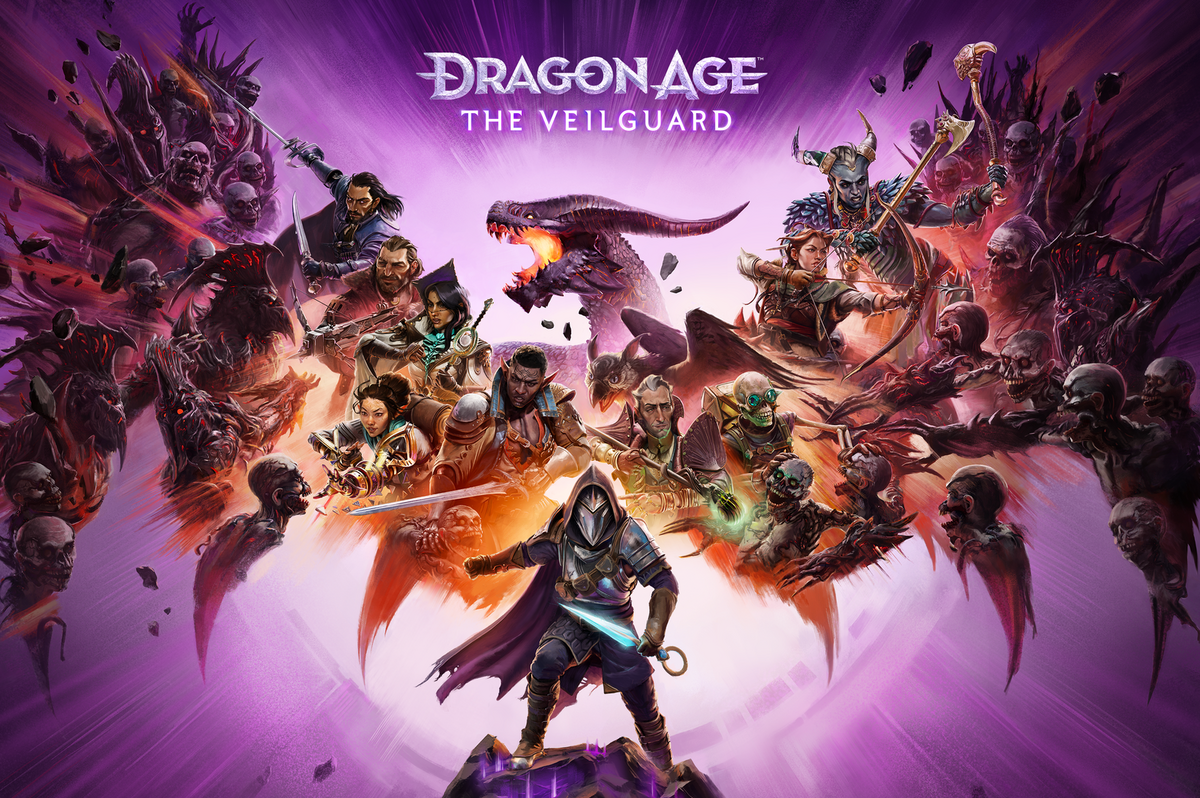
Glory to the risen gods that come to deliver this world!note
"This is Thedas. Enjoy it while it lasts."
Dragon Age: The Veilguard (originally titled Dragon Age: Dreadwolf) is the fourth installment of the Dragon Age video game series by BioWare. Set eight years after the end of Dragon Age: Inquisition's Trespasser DLC Expansion, the player assumes the role of "Rook" to lead the eponymous Veilguard in thwarting the plans of the Dread Wolf Solas, who plans to tear down the Veil separating the material world from the spirit world known as the Fade, to potentially catastrophic consequences.Unlike the previous games, which took place mostly in the southern part of Thedas, The Veilguard takes place in the hereto-largely-unexplored northern countries, including Rivain, the Anderfels, Tevinter, and Antiva. Like its predecessor Inquisition, The Veilguard is hosted on EA's Frostbite engine. The game released on October 31, 2024.
Ahead of the game's release, BioWare also released Dragon Age: Vows & Vengeance, an Audio Play Podcast set prior to The Veilguard, starring Mae Whitman, Armen Taylor, and Brigette Lundy-Paine.
These are the tropes in which legends are born, or slain:
open/close all folders
Tropes A To E
- Abnormal Ammo: When fighting the two blighted dragons that carried out the earlier city attacks, the faction from the city that you saved will arrive with some extra-powerful ballista bolts that hit harder than the usual mundane ballista bolts. The Shadow Dragons arrive with a supply of Tevinter-style magically enchanted ballista bolts, while the Antivan Crows bring a supply of poisoned ballista bolts.
- Aborted Arc: Numerous plot points that were set up in previous games are completely disregarded in The Veilguard:
- Regardless of the choice on who becomes the next Divine, the Circle of Magi always gets split into two different factions, with tensions brewing between both groups. None of this gets mentioned, however.
- In the Trespasser DLC, Solas' role as the Dread Wolf led to various elves joining him en masse with the implication that they'll be his agents, if not his army. In The Veilguard, however, every significant elf met in this game quickly agrees that the Evanuris are evil, and Rook never meets any of the Dread Wolf's agents, treating Solas as if he was a lone actor who has to rely on Rook with an Enemy Mine after he gets trapped in the Fade early on.
- Similarly, in the Dragon Age: Inquisition prequel novel The Masked Empire, it's established that there are some ancient elves who follow their pantheon, and that city and Dalish elves alike are joining their ranks. We see this force in Inquisition, led by Briala. In The Veilguard, since ten years have passed since the Evanuris were exposed as tyrants at the end of Trespasser and became Broken Pedestals to their people as a result, there are no longer any elf followers of any of the elven gods.
- The Warden, if still alive, tells the Inquisitor that they're going on a quest to see if they can avoid the Calling. Whether they succeeded or not is never brought up, however, and their existence is barely acknowledged.
- The existence of both the Architect and the Disciples is never mentioned, despite the fact that the Architect is possibly among the Magisters that caused the Blight, and the Disciples are darkspawn that have been made immune to the call of the Old Gods.
- Hawke is completely absent in the game because whether they're alive or dead is not a part of the established history. This means that Hawke is completely unaccounted for despite their Best Friend Varric getting killed by Solas in the intro, or their home city falling to the darkspawn.
- The impact of whoever drank from the Well of Sorrows is completely ignored despite the fact that the Inquisitor or Morrigan doing so would place them at severe risk given how it ties them to Mythal.
- Adjective Animal Alehouse: The Cobbled Swan is a dockside bar in Dock Town, Minrathous, and a favored haunt of the city's underworld. Many missions, including Neve's personal quest, involves the Swan in some form.
- All Your Base Are Belong to Us: Ghilan'nain assaults Weisshaupt Fortress alongside her archdemon Razikale and an army of darkspawn during the game's second act. The Veilguard and the Grey Wardens manage to barely hold them off, though not before killing Razikale and rendering Ghilan'nain mortal in the process.
- Ambiguously Evil: Downplayed. Solas wants to restore the elves back to power by any means, and he's willing to tear down the world to do it. Despite this, the Inquisitor can mention how for all Solas is driven to accomplish his goals, he left behind clues for the Inquisition to find, as if to imply he wants them to stop him. They even bring up the possibility Solas himself wants to be stopped, but he can't bring himself to do it of his own accord because he's too proud to admit he's wrong.
- Ambiguous Situation:
- The nature of the relationship between Solas and Mythal. The team will debate if they were lovers, platonic lovers, or just close friends. Mythal does call him "love" in one of his memories, and Solas generally has a blind spot to her part in all the actions he carries guilt over. However, the fragment of Mythal's spirit that can speak to Solas in one of the game's endings refers to him as "my friend". Bellara believes that there's no real equivalent because the elven gods experience emotions much more freely than mortals do. Taash is very blunt about their stance about this issue and believes that the two got it on.
- Whether because of Ghilan'nain's experiments with it or some other unknown factor, Antoine discovers the Blight has begun to change and is also answering to an unknown third party. He later posits the theory that whatever's happening to the Blight is also affecting the Grey Wardens, though even he's not sure what will come of it.
- The sidequest "Regrets of the Dread Wolf" sees the party learning more about Solas' past and his relationship with Mythal. In particular, they learn the Black City was originally an elven palace. This puts everything about Andraste and the Maker into question, especially whether the Maker himself even exists. Harding is especially shaken by this revelation and undergoes a Crisis of Faith. It is implied the Maker could exist, but if he does, it's unlikely to be in the shape the Chantry knows.
- And the Adventure Continues:
- The conclusion of the subplot involving the Grey Wardens. With the last two Archdemons dead, the Grey Wardens' main mission is basically finished. Even then, the members of the order resolve to eliminate what remains of the Blight as well as fight off any darkspawn that continues to terrorize Thedas.
- The very final ending slide reads "The Veilguard remains vigilant..."
- Anti-Frustration Feature: At certain points in the game, you'll come across an obstacle that requires a specific party member; Bellara tinkers with elven artifacts, Harding manipulates piles of rock, Lucanis senses instabilities within the Veil, etc. Thankfully, if you encounter these obstacles without the required party member, you can still interact with them by using Solas' ritual dagger, negating the need to bring along specific party members for any area you're exploring.
- Anyone Can Die: In Inquisition, even if the Inquisitor isn't on good terms with their companions or hasn't completed their personal quests, said companions still get to live past their last confrontation with the Big Bad (and only one can get potentially killed off in the Trespasser DLC if a certain choice was made). By comparison, The Veilguard follows in the footsteps of Mass Effect 2 and Mass Effect 3 where focusing solely on the main quests and neglecting to do the side quests or the companion's personal quests will lead to a borderline Downer Ending where the Big Bads are defeated, but at a terribly grave cost. Even if the player does do the other quests, if they don't play their cards right, the same outcome can still happen in the worst-case scenario. In the best-case scenario, only some companions will die, resulting in a more Bittersweet Ending. And in the good ending, one companion (either Davrin or Harding) will still have to die for the others — the protagonist included — to survive. And even before all this, The Veilguard proves that it won't hesitate to pull punches by killing off Varric early in the game, with his death only being revealed halfway through the story.
- Arc Words: Multiple.
- For Harding, "Isatunoll", meaning "I am (or 'we are', but that's not right either) here". It is repeated in both outcomes of her quest at the very end, as a proclamation of the legacy of the titans and dwarven heritage.
- For Taash, "Shokra toh ebra", meaning "you must struggle with who you are". Initially, Taash's mother, Shathann, said this to them to get them to stop breathing fire for their own safety. Taash later repeats it angrily to their mother, demanding to know if it is demanded of them to forever struggle against their own identity. The Dragon King likewise repeats the same meaning of the phrase to condemn the Qun, saying they have been asked to struggle against their own nature and heritage. But finally, Shathann repeats the phrase once more but this time the real meaning behind it, stating that to find ourselves, we must all struggle, as Taash has, and as the Dragon King failed to.
- "Whatever it takes" shows up frequently in the later half of the game, especially in the endgame. Its typically used whenever the party discusses how dire things are getting and how they need every possible advantage they can get, even if they have put their lives on the line. This line is repeated by Davrin or Harding as they prepare to sacrifice themselves to distract Ghilan'nain for Lucanis to deal a fatal blow with the lyrium dagger.
- Armor and Magic Don't Mix: Downplayed. Heavy armor provides the most protection but at the cost of the smallest ability damage bonus, while light armor is the reverse, providing little protection while empowering abilities. Medium armor strikes a balance between the two.
- Arson, Murder, and Jaywalking: Rook Mercar of the Shadow Dragons has a warrant out for their arrest for "theft, murder, and wanton property damage". Rook says that that when you're fighting against a corrupt regime, you end up with a few bogus charges.note In this case, "theft" is for freeing a number of slaves, and "murder" is for killing the Venatori captors who objected to the freeing of their slaves.First Warden: And property damage?
Rook: (smirks) Just felt like it. - Art Evolution:
- The hair models can go beyond the shoulders and actually move in this game compared to Inquisition, where the hair models are noticeably static and were generally kept short to save the trouble of animating them all.
- The darkspawn look noticeably different in the game, with the most notable change being their use of an Anatomy Arsenal as opposed to the more standard weapons they used in previous games. This is because Ghilan'nain is experimenting with the Blight, creating a new type of darkspawn that even the Grey Wardens are struggling against. A statue that shows up in a few places shows a Warden killing an ogre and uses the Origins design, highlighting the changes.
- Qunari have had (another) redesign. This time with generally smoother skin and features than in previous games where Qunari tended to have aquiline noses and very sharp, sometimes even bestial or caveman-like features. Their horns also now smoothly grow out of their foreheads, with the skin gradually changing color to match the black horns, as opposed to before where there were jagged separations where the skin ended and the horns began. Their foreheads are also larger and more pronounced (due to the aforementioned lack of hard transition to the horns, and a general lack of hair bangs). Male Qunari tend to lack the more pronounced brow they used to have in II and Inquisition. Horns also exclusively grow backwards from their foreheads (though they may then curl around), unlike say Iron Bull and his horns who grow sideways. Furthermore, Qunari skin colors are more fantastical. While before they leaned towards grey to regular flesh tones but with a slight metallic tinge, Veilguard Qunari rarely have a metallic color to them, and can range from anywhere from grey to purple to blue to regular skin tones. Lastly, male Qunari are generally less bulky than they were in Inquisition, with more of a variety of body types shown.
- Strangely, the Antaam look a lot closer to the Qunari in previous games, with sharper features and a bulkier build (they are significantly larger than even the most muscle-bound Qunari Rook, for example). This may be deliberate, as the Antaam are the Qunari bred for war and are the majority of the Qunari seen in the games up until now.
- While Dragon Age II and (to a lesser extent) Inquisition gave the elves very distinct facial features, The Veilguard has them return to looking just like shorter humans with pointy ears (as was the case in Origins). There are a few exceptions, such as Solas (as his appearance wasn't changed much from Inquisition).
- As You Know: Whether or not The Veilguard is the first Dragon Age game the player picks up, the game won't waste an opportunity to remind them over and over (and over) via the characters explaining how the Evanuris are insanely powerful and malevolent elves revered as gods. Varric will remind Rook early that Solas is an elven god, despite Rook having ostensibly worked hand in hand with Varric for a year to hunt Solas down.
- Awful Truth: For the elves, especially the Dalish, learning their gods are nowhere near as benevolent as the stories portray them has dealt them a huge blow in their morale. Bellara herself is aghast by the sheer depths of the Evanuris' cruelty, especially when she gets to see their handiwork up close and personal. Unsurprisingly, many have since denounced the Evanuris and actively oppose them.
- Bad Guy Bar: The game opens with Rook and Varric looking for Neve in the seediest bar in Minrathous (Varric's words). Turns out, the bar owner sold Neve out to the Venatori in exchange for a hefty sum of gold. Rook can either persuade her to share what she knows peacefully, or beat up the entire bar to get the information.
- The Cobbled Swan, scene of many clandestine meetings throughout the game, is a downplayed example. It's actually a reasonably high class joint, at least by Dock Town's standards, but it's also run by the Threads crime syndicate and the clientele are the types to studiously ignore a kidnapping in progress.
- Bar Brawl: One possible outcome of the opening scene, if Rook chooses the direct approach instead of talking things out. They warn the bar owner to "Be ready to talk by the time I get to you", then make good on their threat by beating up all her bodyguards, even using a bar stool as an improvised weapon. By the time Rook vaults over the bar counter to reach her, she has decided to share what she knows.
- Beam-O-War: Neve and Aelia engage in one during their final confrontation during the former's quest line.
- Behemoth Battle: Solas in Dread Wolf form, a dragon-sized wolf, and Elgar'nan's Archdemon come to blows during the final segment of the game.
- Beta Couple: Assuming neither half of either couple is romanced by the player character, Neve and Lucanis will end up together, as will Harding and Taash.
- Bittersweet Ending:
- The worst possible ending is still this. The entire party is wiped out, including Rook, who gives their life to seal both themself and Solas in the Veil to maintain it. All the factions are devastated, and Rook and all their companions are dead, but the Blights are over, the Veil remains standing and Thedas knows peace. A monument is built to recognize the sacrifices necessary to get there.
- Even the better endings are still bittersweet to some degree. At least one companion, possibly more, is dead and, depending on how sympathetic you find him, Solas is imprisoned to hold the Veil in place, with or without his consent. Furthermore, even if the best possible outcome is achieved, much of Thedas already suffered greatly and, if the Inquisitor's final correspondence is any indication, it will take many years to rebuild Thedas's many nations to their former prosperity. And the post-credit scene suggests that sooner or later, a new threat will arrive.
- Black-and-White Morality: The game treats the fight against the elven gods and their supporters as irredeemably evil and the parties opposing them as morally good. The latter category includes groups such as the Antivan Crows, a bunch of contract killers, who had their worst traits scrubbed out and are reimagined as freedom fighters and patriots. The fact that they buy child slaves and torture them into becoming assassins is never brought up. The Venatori and the Antaam also side with the Evanuris, despite the former regarding elves as subhuman and the latter despising magic (even taking their defection from the Qun into consideration), making either group joining the elven mages elevated to gods via magic rather odd. The revelation that the Evanuris dominated the high dragons that ancient Tevinter revered as their gods and claimed their names for themselves helps explain the Venatori's alliance, and Elgar'nan is also revealed to possess the ability to influence people's minds. There are some more morally grey groups fighting against the gods and their forces, such as the Tevinter gang known as the Threads, and Solas is a morally grey antagonist himself, but the conflict largely runs on this trope.
- Blacksmith Upgrade Service: The Caretaker can upgrade the party's equipment when given certain materials, and their maximum upgrade level depends on the Caretaker Power stat which increases when Rook and company find artifacts throughout Northern Thedas.
- Bling of War: The armor sets for the Lords of Fortune are adorned with lots and lots of gold and miscellaneous jewellery. The light armor sets, in particular, are elaborate necklaces and belts adorned with jewels and gold worn over a nice set of undergarments.
- Blue Is Heroic:
- When it comes to the allied factions the Wardens, Crows and Shadow Dragons all favour shades of blue as their main colour and blue is probably the second most common colour in the Lords of Fortune outfits after gold.
- On Harding's questline the rage fueled Titan magic is red while Harding's more serene magic is blue.
- Bookends: Two companion quest lines end in the same place where they begin.
- Taash's quest line starts with them and Rook visiting an area of the Rivain Coast where Taash gives Karash food, meets with the local birds, and practices their fire breathing. It ends with Taash giving Karash food that they had prepared in lieu of Shathann after her death, meeting with the local birds, and coming to terms with their mother's death.
- Lucanis' quest line starts with him and Rook having some coffee in a cafe in Treviso. The quest line ends with almost the exact same situation, only with a third coffee cup for Spite as Lucanis develops a rapport with his inner demon.
- The game begins with Rook, Varric and Harding chasing through the streets of Minrathous in search of Neve who can help them investigate clues on Solas. The game ends in Minrathous, with the Veilguard and their allies fighting Elgar'nan and his army — and with Solas in support.
- Bow and Sword in Accord: In this game, rogues now equip a bow and twin weapons simultaneously and can switch between them in real time.
- Breaking Old Trends:
- In the last three games, the player could always bring a maximum of three companions with them. In The Veilguard, they get to bring only up to two instead.
- It's the only Dragon Age game where the player cannot cause the extermination of a Dalish Clan.
- Every major installment prior to The Veilguard has a companion who had also been a companion in the previous installment note . The Veilguard is the first time this isn't the case. This is Downplayed, however, as while there is no permanent companion in this game who had also been a companion in the previous game, Varric and Solas (both companions in Inquisition) are Guest-Star Party Members at the start and end of this game, respectively. Furthermore, Harding (one of this game's permanent companions) was a fairly significant character in Inquisition given her vital job as the lead scout of the eponymous organization, though not a companion.
- This is the first Dragon Age game that has two elven party members (Bellara and Davrin) who actually get along pretty well, unlike with Fenris and Merrill in II and Sera and Solas in Inquisition.
- This is the first Dragon Age game where the Player Character can romance a dwarf companion, that being Harding. Downplayed, in that the Inquisitor could flirt with Harding and even propose going on a date with her, but she is not counted as an official romance option in Inquisition. The game also includes the first non-binary romance option, in Taash.
- This is the only main game where Leliana, Alistair, Cullen, and Flemeth don't/can't appear. By extension, this also means that this is the only main game that has only one of the returning party members in Origins as II had Alistair, Leliana, Zevran and Anders while Inquisition had the former two plus Morrigan who returned in this game. Downplayed in the case of Flemeth, as while the woman doesn't appear (due to her death), the fragment of Mythal that had lived inside her appears via Morrigan.
- This is the first game where the Player Character won't be declared "basalit-an" by the Qunari.note Justified; the Antaam breaking away from the Qunari at large leaves them without infrastructure and in no position to intervene in Thedosian affairs, let alone be on good terms with the Veilguard.
- Due to the game shifting to a full Action RPG, Dragon Age's "six stats" (namely Strength, Dexterity, Magic, Willpower, Cunning, and Constitution) are absent altogether for the first time, with equipment and skill bonuses being direct bonuses rather than being tied to these stats.
- This is also the first game where a permanent companion death is guaranteed to happen even with Golden Ending where the player did extensive preparations and pick the right choices. Previous instalments could also cause a companion to die, but only if the player actively chooses certain actions and choices.
- This is the first game where neither Warrior companion specializes in two-handed weapons, with Taash and Davrin specializing in Dual Wielding and weapon and shield respectively. This thus leaves two-handed weapons as the sole province of a Warrior Rook.
- Speaking of two-handed weapons, greatswords have been left out of the two-handed weapon selection, being pared down to greataxes and mauls instead.
- After three games where a mage companion turned out to be hiding a secret agenda from the protagonist, Veilguard breaks the pattern: while every companion is a mandatory recruit, none will betray Rook or permanently abandon the party.
- Broken Echo: A sidequest in the Hossberg Wetlands has Rook investigating the disappearance of an entire family. Close to the family's home, Rook finds a well that echoes whatever they shout in it. Rook has fun for a bit, shouting "Hello!" and "Echo!" down the well. Then, they notice that something is off.Rook: (alarmed) That's not my voice.
"Echo": Not your voice. - The Bus Came Back: The darkspawn have had an increasingly minor presence in the franchise following their role as the primary threat in Dragon Age: Origins. The Veilguard brings them back in a big way, following the release of the corrupted Evanuris. Likewise, the Blight has a much heavier focus in the story as its become a constant, corrupting threat found throughout the game. The origins of the darkspawn and the Blight are also revealed, and the Sixth and Seventh Blights effectively become a single event when the last two remaining Tevinter Old God Dragons are rendered unto Archdemons.
- Canned Orders over Loudspeaker: The Minrathous segment of the prologue has a booming voice notify all civilians to stay indoors while the magical anomaly is dealt with.
- Cassandra Truth: Discussed. The sidequest "Regrets of the Dread Wolf" drops numerous revelations, most prominently: the reveal that the Black City, once thought to be the seat of the Maker when it was the Golden City, is actually an elvhen palace; the Blight is the result of the Titans being made Tranquil and their dreams devolving into maddening, screaming nightmares; and the ancient elves were originally spirits who created physical bodies from the Titan's blood, also known as lyrium. Emmrich wants to share this information with the rest of the world as it changes everything they know, but it's precisely because of that that Davrin and Lucanis argue otherwise. The former says revealing the elves were originally spirits will only make prejudiced humans worse and treat the elves as if they were demons, whereas Lucanis states no one would take it seriously. Rook ultimately decides they're better off keeping the information to themselves and trusting it to those who would believe it.
- The Cavalry: After the second blighted dragon shows up when fighting the first one in the Hossburg Wetlands, the faction from the city that you fended one of the blight dragons away from will show up with a supply of extra-potent ballista bolts distinct for each faction, which the Wardens readily load into their ballistae. From then on, you have the option order the firing of a ballista bolt at the designated dragon that does a hefty amount of damage and stagger per shot.
- Central Theme:
- History and legacy, primarily, what we inherit and how we pass it on.
- All the major antagonists fall into this theme one way or another. Solas aims to restore the elves to their former glories. The Evanuris embodies the worst excesses of those former glories. The Venatori wishes to bring Tevinter back to the worship of Tevinter's old gods which serves to further bind them to the Evanuris. The Antaam breaks away from the Qun, believing their rightful draconic heritage has been caged and tamed by this philosophy, instead embracing unchecked violence and conquest.
- If the first game's companions deal with their impending deaths, being haunted by their past that influences their current actions for better or for worse with the second game's companions, and Crisis of Faith with the third game's companions as the world contradicts their beliefs and notions, the members of the Veilguard is also dealing with legacy, of how to reconcile the past with the present in order to reach a better future:
- Harding's personal quest is about the legacy of the Titans, their Tranquility at the hand of the Evanuris, and her acceptance of this lost history as well as how she chooses to carry that history forward, whether in acknowledging and accepting her very justified anger, or in remembering that tragedy while acknowledging that it is the reason the dwarven people exist as they are now and there is no going back.
- Much of Bellara's character involves grappling with the depravity of her people's gods. While she immediately begins opposing the Evanuris and Solas, her brother aligns with Anaris, one of the Forgotten Ones who resented their power and sought to claim it. The final choice in her personal quest is whether to remember that history, or to burn it all to prevent these mistakes from being repeated and allow her people to forge their own future unburdened by this legacy.
- The same situation goes with Neve, who is a member of a resistance that recognizes Tevinter's spotty past as a despotic empire and wishes to steer it to a nation where meritocracy rules and justice is delivered fairly. She clashes against her nation's corrupt practices and later the Venatori, a group that wants Tevinter returned to the brutal empire of the past.
- Taash is torn between learning and embracing the history and culture of their mother or choosing to live as a Rivaini.
- Davrin discovers the griffons' history as both loyal allies of the Grey Warden and guardians of nature. His personal quest involves choosing which of these two legacies the griffons should embrace going forward.
- Despite his thanatophobia, Emmrich sees necromancy as a way to honor the dead and remember who they used to be.
- Lucanis is slated to take over the First Talon of the Antivan Crows, honoring his grandmother's wishes. But given his upbringing, this also brings him to conflict against people who will go against him leading the Crows. In general, this deals with how Antivan Crows were once patriotic resistance before they devolved into Murder, Inc.. With Treviso is under the Antaam occupation and the Crows trying to thwart them, they rediscover their roots along the way.
- Regret.
- Solas' driving force is his regret. Seeing what happened to the ancient elves as a mistake, his goal is to bring things back to how they used to be, even if it destroys the world as it currently exists in the process. For most of the story, he is trapped in a literal prison of regrets, and parts of his plan involves moulding Rook to feel enough regrets that they would be trapped in it instead, allowing him to escape.
- Rook makes many choices over the course of the story that cause them to second guess themselves, primarily whether to trust Varric's plan, which inadvertently leads to the Evanuris escaping and Varric's death, whether to save Treviso or Minrathous, and who would lead the second team come act 3, which leads to the death of a companion. After that last choice, Rook is trapped in the same prison of regrets that previously held Solas, but they are able to come to terms with their choices and accept the agency of others, allowing them to move past their regrets and escape their prison, unlike Solas.
- History and legacy, primarily, what we inherit and how we pass it on.
- Chess Motifs: The protagonist is called Rook but that isn't their actual name. Varric, continuing his streak as The Nicknamer, called them that because like the Rook chess piece they are powerful but tend to think in straight lines.
- Choice of Two Weapons: Unlike in the previous games, where the players can only stick to one fighting style at a time, The Veilguard gives each class access to two weapon types to freely switch between. Warriors get access to weapon and shield and two-handed weapons, rogues can wield bows and dual wield blades, and mages can use both staves and a combination of a dagger and magical orb.
- Clue, Evidence, and a Smoking Gun: If Rook romances Davrin, Emmrich will inquire about the two of them spending more time together.Rook: That obvious?
Davrin: You heard?
Emmrich: There were signs. Small glances. Intakes of breath. Though Harding also told me. - Cold Open: The game opens with Solas attempting to bring down the Veil, causing to chaos erupt across Minrathous. The prologue ends with Solas trapped in the Fade, Varric critically injured, and two sadistic elven "gods" now free to walk the Earth.
- Combat, Diplomacy, Stealth: In the finale, Rook is presented with three options for dealing with Solas.
- Lucanis advocates for Combat, saying that Solas has betrayed them time and again, so they shouldn't give him another chance to do so by trying to appeal to his better nature. If Treviso was saved and Illario was pardoned, Lucanis adds that he's not really one to talk since he showed mercy to the one who betrayed him. The normal ending can have Rook physically confronting Solas, forcing him to be tied into the Veil.
- Emmrich advocates for Diplomacy, saying that Solas, being a former spirit of Wisdom, is inclined to listen to arguments against his current plan. The Golden Ending is achieved in this way. If certain requirements are met, Rook can use Mythal's essence to convince Solas to abandon his current plan.
- Neve advocates for Stealth, saying that sometimes standing against the powerful means playing their game better than they can. A variant of the normal ending can be achieved by tricking Solas with the fake lyrium dagger, knowing that with his pride and with victory at hand, he'd overlook anything off until it was too late.
- Company Cross-References:
- One of Isabela's intros in the combat arena is saying that the match is sponsored by someone named Armax who trains shepherds. In Mass Effect 3's "Citadel" DLC, the combat arena that Commander Shepard could particpate in was owned by the Armax corporation.
- Another of her intros states that a former champion of the arena was "The Mysterious Stranger," a pseudonym used by the protagonist of Knights of the Old Republic during a combat arena side quest in that game.
- While fixing the Lighthouse Eluvian Bellara will tell Rook that she can't talk to them at the moment because she's "in the middle of some calibrations".
- Continuity Nod:
- Rook, Varric, and Harding first run into the Venatori during the Prologue. If Rook is a Grey Warden, they will express their hatred for the Venatori because they got a lot of Wardens killed a few years back. Varric responds with a dry, "I know. I was there."
- Morrigan is once again introduced while walking down a set of steps. She's now wearing the same kind of tiara her mother Flemeth and her sister Yavanna wear.
- The Descent concluded with the earth-shattering implication that dwarves were once capable of using magic, the same as any other lineage in Thedas. As of the events of The Veilguard, Lace Harding has also managed to somehow unlock this long-lost ability. The aftermath of her first use strongly resembles Sandal's "not enchantment" incident with a frozen ogre.
- One of the Mementos you can find in Minrathous is a "Small Painted Box". The flavor text implies that it's the same one the Warden found all the way back in Origins and Sera referenced in Inquisition.
- In Treviso, bards will sometimes play instrumental versions of the tavern songs from Inquisition. This includes "Nightingale's Eyes" and "I Am The One", both of which have music originating from Origins
- The Codex reveals that Lorelei, the Shadow Dragon fence, is one of the elves from Denerim's alienage that Teyrn Loghain sold to Tevinter slavers back in Origins.
- "Jenny's Belt", a unique belt you can find by solving the puzzle in the Dellamorte estate in Treviso, gives the debuff "Bees!" to nearby enemies every time you use a potion. The flavor text was clearly written by Sera.
- Contrived Coincidence: The twist of Varric being Dead All Along only works because Neve and Harding never mention Varric being dead in so many words. Rook also never mentions talking to "Varric", speaks to him during group talks, or acknowledges his presence during those scenes. However, Rook's behaviour is likely justified by the blood magic Solas is using to make Rook see and hear Varric, since that can also influence a person's actions.
- Creepy Good: The Mourn Watch are the guardians of the Grand Necropolis in Nevarra, and routinely deal with death, the undead, and spirits. The Necropolis itself is appropriately creepy, with green flames, cold winds, decorative statues of skeletons, and an eerie atmosphere; Emmrich's introduction has him animate a skeletal miner while wearing a spectral skeletal mask before he greets Rook. Nevertheless, they are (for the most part) genuinely good guys who care about others and about the safety of Thedas. Emmrich rescues a Venatori slave and gently tells him that he's a free man, while making arrangements for the Watch to house the man and rescue any family he might have back in Tevinter, and he generally proves to be one of the least morally compromised companions in the newly-formed Veilguard. And Rook Ingellvar was a Doorstop Baby that the Watch adopted and raised, regardless of race.
- Curb-Stomp Battle: During the final battle Rook briefly fights alongside Solas. With something like his full power restored any darkspawn or Venatori that approaches the Dread Wolf is basically chum.
- Cutting Off the Branches:
- Isabela was good friends with Hawke and returned to Kirwall with the Qunari relic, before turning over a new leaf and becoming a Lord of Fortune.
- Going by banter between Lucanis and Harding, Zevran was recruited by the Hero of Ferelden, was on good terms with them, and ended up leading a One-Man Army revolution against the Crows.
- Judging by the friendly banter between Harding and Dorian in the Shadow Dragon hideout, as well as letters by Dorian to Varric and Divine Victoria, he and the Inquisitor were on good terms and they never had a falling out. Furthermore, a conversation with Harding in the Lighthouse reveals that Iron Bull, Sera, Blackwall, and Cole joined the Inquisition, with Blackwall sticking around (either being pardoned or made a Grey Warden) after his real identity as Thom Rainier became public knowledge. Overall, choosing a character as the Inquisitor's romance partner (with the exception of Solas) pretty much guarantees that character received their "good" ending from Inquisition.
- Regardless of romance, one of the collectible codex entries reveals that there is a mysterious toymaker known only as "TR" who travels around Thedas making toys for children. Thom Rainier mentioned, either through his endings from Trespasser or through dialogue, that he did just that after either being free or drafted into the Wardens, confirming that the Inquisition got him out of prison.
- Damn You, Muscle Memory!: While the general control scheme is the same for each class, there are some notable differences. For example, the button Warriors use to block is the same Rogues use to loose arrows, while the button Warriors use for throwing their shield is the same Rogues use to parry attacks.
- Dangerous Deserter: Almost the entire Antaam, the army of the Qunari, has forsaken the Qun. The Arishok and a few loyalists survived and were absorbed into the Ben-Hassrath, but the horde of Antaam soldiers now flock to warlords and terrorize northern Ferelden. And then they rally to the Evanuris.
- Darkest Hour: Once Elgar'nan causes the eclipse, the plans Rook put together to stop him is thrown into disarray, Southern Thedas is in complete chaos and in danger of collapse, Minrathous is taken over and blighted, at least one companion is killed, and Rook discovers that Varric has been Dead All Along. All this on top knowing that should they fail, Elgar'nan (or Solas for that matter) will cause The End of the World as We Know It.
- Dead All Along: Varric did not survive being stabbed by Solas. The "Varric" Rook's been interacting with since arriving at the Lighthouse is actually a hallucination created by Solas to subtly guide them. Rook is not happy when they learn this.
- Dialogue Tree: As is the norm for the Dragon Age franchise, though Veilguard notably combines the dialogue wheel employed by II and Inquisition, respectively. There are times where Rook is required to reply in either a diplomatic, sarcastic, or blunt tone (like in II), and other times there's multiple types of responses aside from the aforementioned three that they can give in certain situations (like in Inquisition).
- Disproportionate Retribution: Outside Café Pietra in Treviso, there's a man who keeps humming to himself, annoying his conversation partner to no end. Eventually, she'll snap at him to stop it or she'll hire a Crow to kill him. He apologizes and stays quiet... for about ten seconds.
- Dominance Through Furniture: While the team is infiltrating a Venatori cult gathering, a few of the cultists can be seen using their slaves as chairs.
- Doomed Hometown: Depending on the player's choices, especially if they're a Shadow Dragon or Antivan Crow respectively, either Minrathous or Treviso can fall victim to the Blight at the end of Act I, which also affects their companions, Neve Gallus and Lucanis Dellamorte. And regardless of the choice made, Minrathous will always be the site of the final battle against Elgar'nan.
- Dramatic Irony:
- While updating Rook about what's been transpiring in southern Thedas, the Inquisitor mentions that Denerim had already fallen to the darkspawn, with Redcliffe being the one to continue holding the line. What makes it ironic is that in the first game, it was Redcliffe that had to be rescued from total annihilation by the Hero of Ferelden, and it was in Denerim where the Ferelden's forces had gathered and the fifth Archdemon was slain.
- Dragon Age II had the Hawke family, including Aveline, flee to Kirkwall to escape the Fifth Blight's reach. But in the Inquisitor's recount, Aveline had to evacuate Kirkwall some time after Ghilan'nain kickstarted another Blight, with the Free Marches now under threat of being completely overrun by darkspawn.
- A new light is shed on the long-standing animosity between the Dalish elves and the Tevinter Imperium once it's revealed that the Evanuris and the Old Gods are more connected than anyone would have liked to believe.
- The red lyrium idol was recovered by Varric during the expedition back from the second game and the existence of the red lyrium constantly plagued his mind. The lyrium dagger that Solas uses to stab him to death was made from that very idol, cleansed of its Blight.
- When the Fifth Blight happened, Loghain refused to ally with Orlais. Orlais refuses to ally with Ferelden when the Sixth Blight happens. For additional irony, Orlais is in the same place Ferelden was on the eve of the Fifth Blight: minimal Grey Warden presencenote , recovering from a devastating war, and suspicious that their neighbor/old enemy will try to annex them once the Blight is over. Amusingly, Ferelden is in the opposite state — they have multiple allies helping them survive during the Sixth Blight and even at one point help out Orlais, albeit it was so uncoordinated between the two nations that it didn't make a difference.
- It was stated as far back as Origins that the elves were the first people in Thedas, with the dwarves being slightly less ancient that them, and that the humans came later, a statement that can be echoed by an elf Rook when they examine the elven scroll in their room. Viewing Solas' memories reveals that the humans were the only race of mortals in Thedas until the Titans created the dwarves and some spirits made physical bodies for themselves and became the ancient elves.
- Early Fireball Spell: Rook's starting spell as a Mage is Arcane Shot, which launches five small fireballs wrapped in arcane energy at a single target, serving as the Mage class's introduction to the heavily altered ability mechanics.
- Early Game Hell: This applies in particular to mages, who start with very low HP and low maximum MP. The mage's block move consumes mana, as do several of their attacks and their abilities. Their starting mana generation is abysmal, and all their weapons do elemental damage, which at the start of the game can be a problem when you have a very small selection to choose from and encounter enemies resistant to the weapon you wield. Furthermore, enemies almost exclusively target the player, and mages having low HP, low armor, and a blocking move that taps into a very limited mana pool that's also used for their more offensive tools makes their defensive capacity lackluster. On top of all this, none of the starting companions are warriors, and in fact it takes a while before you unlock one who has access to the ability to taunt enemies away from you. Compare to the warrior, who starts the game with higher HP, can block indefinitely for free with a shield, has heavy armor from the start, deals physical damage which is never resisted, and whose resource, rage, is only used by their abilities.
- Earn Your Happy Ending: Achieving the best possible outcome with minimal casualties require completing every companion's quest as well as getting every factions to be as strong and resilient as possible to ensure most survive (at least one companion will die no matter what). And to redeem Solas, which also results in easing the Titans' pain, the player will also need to complete a series of side quests to earn the trust of a fragment of Mythal.
- Eldritch Location: The ruins of Arlathan and the forest around them are noted to feel wrong. The Veil Jumpers attribute it to the vast amounts of blood magic the Tevinter Magisters of old used when they sacked Arlathan millennia ago; the terms Bellara uses could be applied to a nuclear fallout zone. The wooden statues of people all over the forest are not really statues, but actual people turned to wood — and not all of them are ancient. The mushrooms and other plants are poisonous, so the Veil Jumpers don't forage there because they don't know what is safe to eat. There are dangerous artifacts that explode, invert gravity or transform people scattered all over the ruins. A codex entry you can find says that the ancient elves performed stabilizing rituals during the last days of the war with the hope that Arlathan would become habitable again for their descendants centuries later. And that was before the gods came back and the forest was flooded with magic, which made ruins float in the air and created fade rifts and time loops.
- Empathic Environment: When the team first arrives in the Lighthouse the "sky" around it is grey and overcast and the plants are all dead. As everyone settles in and begins to treat it as home, the clouds clear and something akin to sunlight shines, the trees grow leaves again and other plants start climbing up the buildings. Also, new rooms in the Lighthouse proper and links to other buildings open up to provide quarters for each new recruit.
- Enemy Civil War: The main servants of the Evanuris are the Tevinter supremacist Venatori cult and former Qun military the Antaam, two groups normally bitterly opposed to each other. The Evanuris are smart enough to mostly keep them seperate, barring the occasional joint venture with carefully picked members, but a letter from Charter to Harding details how the Inquisition's spies are managing to get the two to clash wherever possible, since most members of both groups are unaware they're now serving the same masters.
- Even Evil Has Standards: Nobody knows what "Vena Vitalis", the blood magic ritual Aelia plans to perform, does exactly. All Neve can tell Rook is that the ritual was considered so horrific that even the Tevinter Magisters of old, who considered blood magic and the ritual sacrificing of slaves to be just another soirée in the Imperium, were scared of it, so they purged all information about it.
- Everyone Is Bi: Zigzagged. All companions are romanceable by Rooks of any gender, and are referred to in promotional materials as pansexual. Five of them in game are confirmed to at least be bisexual: Lucanisnote , Taashnote , Harding, who is pansexualnote , Emmrichnote , and Bellaranote .
Tropes F To K
- Facial Dialogue: Sometimes, entire conversations happen without a single word spoken.
- During a conversation between Neve, Bellara, and Rook in the Lighthouse, Bellara picks up an Andrastian pendant the wisps knocked off Neve's desk. Neve says that the pendant is not important, but the tense look on her face implies otherwise. She later tells Rook that the pendant belonged to Brom, Rana's old partner who died while helping Neve deal with Aelia. Neve still carries a lot of guilt over his death.
- Rook has to face and come to terms with their greatest regrets during "A Cage for Gods". The scene where they remember what truly happened at the Ritual Site and realize that Varric has been dead the whole time conveys their heartbreak and sorrow without them saying a single word.
- If Rook chooses to trick Solas in the Finale, their companions will look at Rook concealing the real dagger, then realize what Rook is doing and proceed to act helpless to intervene, all while exchanging tense looks with each other. They quickly drop the act when Rook's plan takes effect and Solas is incapacitated.
- False Reassurance: Near the Finale, Solas assures Rook that the Veil will not fall by his hand. Rook can express skepticism at Solas suddenly changing his mind, but since the situation is urgent, they have no choice but to go along with it. Solas knows full well that Rook killing Elgar'nan will bring down the Veil, so he only needs to help Rook and wait.
- Fantasy Gun Control: Averted for the first time in the franchise. While gaatlok (a Qunari formulation for gunpowder) has been in use before the game, The Veilguard marks the first time that guns of any sort are used regularly in combat, with the Antaam deploying handgunners among their ranks. A Rogue Rook with the Saboteur specialization can make use of a BFG themselves with the Fortune's Fury ultimate ability including an in-universe explanation stating that Thedas is starting to reverse engineer Qunari technology, including gaatlok.
- Field Ability: Each companion has a special ability that they can use in the field to solve puzzles or help complete quests. Rook can mimic said abilities with the lyrium dagger if the companion in question isn't in the party. To wit:
- Harding can move certain rocks after she gains the ability to use magic from the lyrium dagger.
- Neve can manipulate wards using her ice magic, freeze lock mechanisms, or do some sleuthing with Fade echoes.
- Bellara can tinker with elven constructs, making them functional, as well as disable wards.
- Lucanis can channel Spite to raise objects, creating temporary bridges that the party can cross.
- Davrin can call on Assan to lower obstacles, destroy Blight abscesses and dig up hidden items.
- Emmrich can calm wayward spirits, allowing for their use as wisps to unlock certain portals, and reanimate certain dead for a brief chat.
- Taash can breathe fire to ignite various objects or melt obstacles.
- Fire/Ice Duo: The blighted dragons that Ghilan'nain sends towards Minrathous and Treviso respectively are the fire-elemental Seartooth Vyrantus and ice-elemental Corius the Icetalon. Fittingly, the mission where the Veilguard gets a rematch against them is called "Fire and Ice".
- Foreshadowing:
- During the prologue, Rook, Varric, Harding and Neve come across an ancient mural of elves binding a high dragon. This alludes to the true nature of the Archdemons as High Dragons the Evanuris captured and enslaved.
- Several clues hint that Varric died in the prologue when Solas stabbed him, and the one Rook is talking to is a projection conjured by Solas inside Rook's mind.
- When talking to Solas for the first time, Rook will mention "Varric is hurt", and Solas will reply "Varric is..." before pausing, hesitating, and continuing with "...quite practiced at shading the truth himself". Solas was going to correct Rook, but upon realizing that Rook doesn't know about Varric's death, he instead laid the groundwork for his plan to escape.
- Also during their first conversation, Rook will bring up that the blood magic Solas used to connect them could be used to control Rook's mind. Solas angrily snaps that he abhors blood magic, and if he could control Rook that way he would already have done so. He doesn't actually deny that he's using it.
- After his first conversation with Rook in the infirmary, Varric lies on his side to get some sleep... his injured side (where he's got a splint on his leg and a stab wound on his chest). It's the first visual clue that something is off with Varric, since putting his weight on his injuries would have been excruciating.
- After Varric is stabbed, falls, and gets dragged out by Neve, the dagger is seen still embedded in his chest. And yet, the group soon return to the ritual site to recover said dagger (which was somehow left behind). We later find Varric actually pulled it out in his dying moments, which Rook repressed.
- Whenever Rook goes to Varric for advice, Varric never offers any new information, merely encouragement or an alternative perspective. Because he only exists in Rook's head, and thus can't offer information Rook doesn't already have.
- Harding seems very broken up after the prologue, blaming herself and mentioning Varric paying the price of what they did (compared to Neve being more detached and Rook treating it as a new problem that needs solving). She's affected by her long-time friend's death, while Neve didn't know Varric as closely or for as long and Rook doesn't remember Varric died.
- Despite being the leader of the group, Varric's presence is hardly acknowledged by the rest of the party after the events of the prologue (and whenever he is, the mood is strangely somber). No one is ever seen having a conversation with him besides Rook, and during group meetings, he'll stand in the background, with no one responding or even turning to face him when he talks.
- Varric repeatedly excuses himself to "get some sleep" after conversations. A convenient way for Solas to drop the illusion without risking a slip-up.
- Solas mentions he can talk to Rook because Rook shed blood at the ritual site, linking them through blood magic. As Varric shed even more blood at the same place, Solas should be able to link to him too. But he can't because Varric is dead. Solas even alludes to this by asking Rook to give a message to Varric. Related to the above, it makes Solas the only person to directly acknowledge Varric is there.
- When Harding enters the infirmary to brief Rook about Antoine and Evka, she apologizes for interrupting but never acknowledges Varric’s presence. Varric, claiming to have forgotten the two Wardens, jokes that he’s getting too old. Not only does Harding’s failure to address Varric foreshadow that he’s a projection, but the “getting too old” line serves as Solas’ cover story for why Rook never heard about Antoine and Evka from "Varric", since Solas himself never met them.
- Varric's epilogues at the end of each main and companion quest have accompanying art. Keen-eyed players will note the art matching Solas' painting style from Inquisition (as he paints the mural of the Inquisition's adventures), as the paintings of his greatest regrets (hinting that this isn't Varric talking).
- Missives from the Inquisitor mention that while they heard of Rook through Varric, it's Harding who has been giving them updates on Rook's current events.
- Varric is well-known for being The Nicknamer (with Neve revealing that he gave her the nickname "Slick" during a conversation with her), and yet here only refers Solas as "Chuckles" (a nickname he gave him in Inquisition) once and still refers to Neve by her name. He never gives the later Veilguard members nicknames at all.
- In the missive Rook gets from the Black Emporium, Xenon complains that when he asked to see Bianca, "the little redhead" (Harding) threatened him. Varric has been incredibly protective over Bianca and wouldn't need Harding to answer for him. Now that Varric isn't around to raise any objections, of course Harding would be protective of his possessions in his place.
- Given that Varric says that his fieldwork days are over and later complains about being stuck in the infirmary, one would think he'd occupy himself writing a new book, but he never so much as mentions being a writer. No new Tethras is forthcoming for obvious reasons, and the complaints about being stuck might well be Solas' own feelings about being caught in the Fade prison.
- Bellara takes up writing during her downtime. When Rook asks about her work, she responds that she's writing her own kind of thing, "Not like Varric Tethras." Using his full name conveys a lack of familiarity, which is odd given how frequently she's seen talking to the rest of the team. Of course, she joined after he died, so to her he really is just a complete stranger that she knows only by reputation.
- Shortly after encountering Darkspawn in Arlathan Forest, Bellara is deeply unnerved and states they've never been found this deep in the area. Harding proposes the theory that, because the Evanuris are blighted, they can communicate and direct them. Excluding the fact the darkspawn are being experimented on by Ghilan'nain, it's a subtle hint the Evanuris are connected to the darkspawn via the Archdemons, originally high dragons the elven "gods" dominated.
- When freeing Lucanis from prison, the Venatori in his room will pray to Razikale the Dragon of Mystery and Lusacan, the Dragon of Night. It turns out they're Ghilan'nain and Elgar'nan's Archdemons, respectively.
- During one party banter, Bellara says that in the myths, Elgar'nan was said to be able to move the sun and moon. Guess what Elgar'nan does when he needs an eclipse to complete his plan.
- In one of Rook's talks with Solas in the Fade, the latter mentions how the bond between Rook and their team will grow to the point where they will be willing to lay down their lives for Rook, even if they don't give the order. This hints at the final mission where Rook sends either Davrin or Harding to distract Ghilan'nain, leading to their deaths. This also applies to any companions whose personal quests haven't been completed, which means they're guaranteed to die in the final battle.
- From Nobody to Nightmare: After the blighting of Minrathous or Treviso, Solas says that with him trapped in the Fade, Rook will have to lead the fight against the Evanuris and the blighted dragons they command — the same battle Solas himself fought millennia ago, which forever changed reality itself in Thedas. He wonders if Rook is ready to shoulder the consequences of their actions:Solas: They called me the "Dread Wolf". What will they call you when this is over?
- Full-Party Sequence: During the finale, specifically during the missions "Isle of the Gods" and "The Last Gambit", every single party member is given some kind of a task that occurs simultaneously with the Player Character leading the main party, similar to the Suicide Mission in BioWare's other game, Mass Effect 2.
- Gameplay and Story Integration:
- Rook de Riva can understand qunlat, regardless of their race, although it's unclear whether they can also speak it. Treviso has been under occupation by the Antaam for the better part of a year, so it makes sense that the Crows would learn the language so they can understand their enemies and outmanoeuvre them.
- A non-human Rook knows the language of their people, and sometimes chimes in with comment or a helpful translation for their companions who don't speak it. On that note, Elgar'nan will taunt an elf Rook in elven instead of the common tongue.
- Rook Thorne can hear the blight eruption talking to them just like it talks to Antoine during the quest "Something's Coming"; they also cry out in pain from the headache it gives them. Likewise, during the Siege of Weisshaupt they mention having a splitting headache because an Archdemon is nearby, explain the layout of the fortress and what the horn signals mean to the third party member, and argue with Davrin about which one of them will kill the Archdemon (Davrin "wins" the argument by claiming seniority and by pointing out that he's not the leader of the team).
- An elven Rook Aldwir is stated to be Dalish multiple times, yet a dialogue reveals that they were born a city elf before joining a Dalish clan. Multiple dialogues show that they're as familiar with Dalish customs as well as customs from other cultures in Thedas, such as Antivan coffee and tea and Tevinter khachapuri. An elven Rook that's part of the other factions such as the Shadow Dragons and Mourn Watchers will be just as ignorant of Dalish customs as a non-elven Rook, though due to the Inquisition revealing the truth about the Elven Gods after Trespasser, they do know elven history. This is also why it is optional for Aldwir to wear vallaslin, while for Mahariel and Lavellan vallaslin was mandatory.
- Gameplay and Story Segregation: Much is made of hunting down a Blighted dragon, presented as a major operation requiring support from two different factions. All well and good except that, depending on how much the player has been sidequesting, Rook and the Veilguard may have already taken on and defeated the much more powerful Blighted dragon in the Crossroads without any extra support. They may have also taken down the undead dragon in the Necropolis as well.
- Gladiator Subquest: The Lords of Fortune's arena is the Bioware-mandatory arena subquest. Just a series of repeatable fights. You finish a side quest by doing 10 of them, but you can keep doing more infinitely for XP and Faction rep.
- Genre Shift: Where Dragon Age: Origins was an old-fashioned RPG with tactical combat, Dragon Age II had faster-paced combat while still remaining tactical, and Dragon Age: Inquisition sought a middle ground, the combat in Veilguard is pure hack-and-slash. Several RPG elements, such as branching conversations and the ability to play a less heroic character, are minimised. This is unprecedented for a BioWare RPG, the most action-heavy of which (Jade Empire and Mass Effect 3) still featured those elements. As a result, The Veilguard leans a lot more into the action genre than any other game in the series.
- Gone Horribly Wrong: Solas' attempt to destroy the Veil he once created goes catastrophically wrong when Rook interrupts his ritual, which leads to Elgar'nan and Ghilan'nain escaping their ages-long imprisonment.
- Good-Guy Bar: The Cobbled Swan is an inn in Dock Town that serves as a place where Rook and the rest of the Veilguard can meet with their allies if secrecy is important. That said it is somewhat downplayed, since the place is a major hang out of the Threads, gangsters who are only on the Veilguard's side by circumstance.
- The Good, the Bad, and the Evil:
- The main characters roughly fall into this dynamic. The Veilguard represents the Good, being an overall benevolent team who aims to save the world by stopping the Elven gods from ruining the world. Solas represents the Bad, as a Well-Intentioned Extremist who served as the Veilguard's initial target and works with Rook in an uneasy alliance. Elgar'nan and Ghilan'nain represent Evil, as wicked Elven gods who seek to gain power to take over the world and, unlike Solas, have virtually no redeeming qualities.
- The dynamic between the major factions of Minrathous falls into this dynamic as well. The Shadow Dragons (including Neve) are the Good, being a group of Internal Reformists who seek to dismantle the institution of slavery. The Threads are the Bad, as a criminal gang who nevertheless have the city's best interests at heart. The Venatori are the Evil, who seek to take over Minrathous and immediately ally themselves with the Elven gods to gain the power to do so. Should Rook save Treviso, the Threads step into the role of a rather gray Good, as the Shadow Dragons take a major blow during the attack on Minrathous to the point where they can barely provide assistance.
- Heinousness Retcon: During the course of the game, the party allies with several factions to help against the new world-ending threat. However, the rough edges of these factions have been completely glossed over compared to how they were portrayed in the previous entries.
- The Antivan Crows, an assassination syndicate introduced in Dragon Age: Origins as a shady organization that purchases child slaves as recruits and tortures them into becoming killers and seducers (with all the horrible things that implies), are now presented as noble patriots who simply favor rogueish cloaks. Tevinter Nights revealed that the Crows started off as the patriotic protectors of Antiva before losing their way and becoming the cold-blooded assassins we see in Origins and some of the Talons, including Teia, wanted the Crows to go back to being Antiva's protectors. Presumably Teia eventually succeeded in returning the Crows to their roots, but this is never explained in-game.
- The Fantastic Racism that's endemic to so many cultures in Thedas and an important element to many storylines in the previous entries barely exists in The Veilguard, if it's even acknowledged at all. This even extends to the races being referred to as "lineages" instead. Of note is that Minrathous has many a Qunari resident, despite the Qun and Tevinter being technically at war for centuries (to the point where Dorian and Iron Bull have to jump through some hoops to maintain their romantic relationship, as Bull's presence in Minrathous would put both in danger). Similarly, Tevinter's persecution of elves (valued as slaves for their effectiveness in blood sacrifice) is alluded to, but left vague. This all may have something to do with the only Tevinter hub level being the poorer district of Minrathous, Dock Town, but again this can only be assumed.
- Helmets Are Hardly Heroic: Zigzagged for Rook. There's a toggle to show helmets in conversations, hide them all the time, or hide them in conversation (by default it's the latter, and even if the helmets are on all the time, some cutscenes will force helmets off). Enforced for the companions, none of them can wear any helmet. Only Neve wears various fascinators as headgear. Also enforced for a Qunari Rook, who wears Vitaar facepaint instead of helmets.
- Home Base: The Lighthouse becomes one for the Veilguard after serving as Solas' own base prior to the game. Bellara even takes down some notes about the prospect of turning it into a Cool Airship until Emmrich discourages her.
- Hope Springs Eternal: Completing all the Grey Wardens' quests lead to flowers to begin growing again in a previously blighted area, leading them to realize that despite how horrific the Blight is, it can be beaten, and the losses can be restored. Rook can do an additional, unmarked task of collecting three such flowers in areas previously blocked off because of the Blight, before laying them before a spirit found in a battlefield ravaged by darkspawn — a spirit of despair, now turned to hope.
- Horrifying the Horror:
- Solas, the millennia-old elven god, and possibly the most powerful mage alive, is visibly aghast when he sees the two figures that emerge from the Veil. He has every reason to, since he is facing the release of his two ancient foes, Elgar'nan and Ghilan'nain.
- Played for Laughs when Neve introduces Rook Ingellvar to Elek, the Threads' second in command. Elek tries his Friend in the Black Market shtick, asking Rook if he can get them anything on the downlow. Rook semi-jokingly says they're looking for embalming fluids and a bone saw, among other things, which leaves the career criminal gaping at them in horror and trying to stammer something in response before questioning Neve's choice in friends. Neve just chuckles at the whole thing. (For reference, Elek doesn't bat an eye when Rook de Riva asks for poisons during the same conversation.)
- At the end of Bellara's quest it is discovered that Anaris, another elven god and Sealed Evil in a Can, is attempting to escape something that terrifies him. What it is has yet to be revealed.
- Hub Level: The Crossroads, a part of the Fade to which eluvians connect to from the material world, serves as a method for the Veilguard to travel quickly around northern Thedas.
- Humanoid Abomination: The two elven gods who are accidentally released from their prison have evidently been warped by the thousands of years they spent in the Fade; Elgar'nan looks relatively normal, but Ghilan'nain's body is clearly twisted and mutated by the corruption. Regardless of their appearances, however, the threat they collectively pose to the entirety of Thedas cannot be understated.
- I Ate WHAT?!: Played for Laughs when Rook and Davrin enjoy a cup of gingerwort tea, and Rook tries to figure out what ingredients are brewed in it. Assan chirps, "Worms."
- Infinity -1 Sword: Among the tiers of loot Rook can acquire throughout the game are the special Unique equipment. While some offer beneficial effects like applying permanent Necrotic Weapons, others come with serious drawbacks. The Rogue-only Unique Longbow "Andruil's Chord", for example, greatly increases weak point damage, but as a trade-off, Rook's arrow count is reduced to 1 and arrow regen is cut by an atrocious -90%.
- Insult Friendly Fire: Davrin and Lucanis eventually bury the hatchet while simultaneously insulting each other. Davrin says that Lucanis is not so bad even though he's an assassin who kills people for money, and Lucanis says that Davrin is alright even though he's as judgemental and self-righteous as any Warden. If Rook is a Crow, Davrin will add a "No offense" after his dig at Lucanis; if Rook is a Warden, Lucanis will be the one to apologize to them.
- Interface Screw: Some demons will inflict "blindness" on the party, which takes the form of a severely reduced vision range as everything becomes dark. Party members also essentially stop existing and their skills are turned off for the duration of the effect — including any healing skill they might have — while enemies will duck in and out of sight to attack the player.
- Internal Reveal: A downplayed example on Davrin's companion quests. As they proceed, Davrin and Rook discover the true story of what happened to the griffons. This is new information to them and may very well be likewise to many players, but the information was already out there in the novel Last Flight.
- Insistent Terminology: Lucanis always corrects others when they refer to what the Crows are doing as "murder". It's not murder, it's assassination. Murder is for hobbyists and psychopaths. The Crows are professionals; they are hired to do a job and get handsomely paid for it.
- Irony: The majority group of people who sided with the Evanuris, the "elven gods," are not elves but the Antaam, one of the most intensely anti-magic factions in Thedas, and humans, specifically the Venatori, reactionary Tevinter supremacists who are extremely racist against elves. The elves themselves have generally rejected the Evanuris before they even showed up again, due to the discoveries made by the Inquisition in Trespasser.
- Know When to Fold 'Em: Discussed. Solas tells Rook that Elgar'nan is so powerful that retreating and living another day should be considered a victory against him. For that matter, Elgar'nan chooses to retreat after rescuing a wounded Ghilan'nain after the defeat of the two blighted dragons, knowing that he still needs her knowledge of the Blight as well as realizing just how much of a thorn in their side Rook has become.
Tropes L To Q
- Late-Arrival Spoiler: Marketing for the game has heavily emphasized Solas' identity as the Dread Wolf, his antagonistic role, and his plans to sunder the Veil, which would all be massive spoilers to anyone who hasn't completed Inquisition (where Solas is a companion and keeps his identity secret, only revealed in The Stinger).
- Leitmotif: A remixed version of the Dragon Age: Inquisition theme plays whenever the Inquisitor is present. A few bars from it also plays when Solas turns into the Dread Wolf and attacks Elgar'nan's Archdemon. In the Good Ending, "The Lost Elf Theme" from Trespasser makes a return, representing the friendship and potentially love between Solas and the Inquisitor.
- Limit Break: Each class and specialization has an Ultimate ability that gets charged up through combat which can then be deployed to deal massive damage to enemies.
- Warriors start with Flashing Fists, and can gain Warden's Fire, Spirit Storm, and For Gold and Glory from the Champion, Reaper and Slayer specializations respectively.
- Mages start with Destructive Light, and can gain The Crypt's Herald, Vortex of Shadow, and Thunderous End from the Death Caller, Evoker and Spellblade specializations respectively.
- Rogues start with Concussive Barrage and can gain Murder of Crows, Fortune's Fury, and Twin Gifts of Arlathan from the Duelist, Saboteur, and Veil Ranger specializations respectively.
- Limited Move Arsenal: Rook and their companions can equip only three skills at a time, though the player is free to switch them in and out as long as they're out of combat.
- Little Miss Badass: Mila, the preteen daughter of Holden, the civilian blacksmith in Weisshaupt Fortress had enough savvy to help Rook and company navigate the bedlam of the disastrous battle and also not get killed or blighted herself, despite the five-figure horde of mutated Darkspawn, an Archdemon, and Ghilan'nain herself being present.
- The Magic Comes Back: The return of Elgar'nan and Ghilan'nain reactivates a lot of ancient elven magic, though unfortunately a lot of it isn't working properly. Also Harding's awakening power seems set to reconnect the dwarves with magic.
- Magitek: Since magic is unrestricted in the Imperium, it is incorporated into the very design of the city of Minrathous, the capital of Tevinter. This is reflected in how the city is shown to have an almost Science Fiction or Cyberpunk aesthetic, greatly contrasting with the Medieval European Fantasy of the rest of Thedas seen so far. Ancient Elven crafts also are given such a depiction, especially with the companion Bellara, a Dalish elf artificer that's with the Veil Jumpers. She goes into a short ramble about fixing the Eluvian in the Lighthouse with something that blurs the line between Magi Babble and Techno Babble.
- Misplaced Retribution: It was always believed that humanity, and in particular human mages, were responsible for the Blights due to their corruption of the Golden City into the Black City, as well as the downfall of elvish civilization when they conquered Arlathan. It turns out that it was the fault of the Ancient Elves all along, due to their genocide of the dwarves' ancestors, which caused a lengthy domino effect that led to the creation of the Blights, the dwarves losing contact their gods and magical abilities, and the elves losing their own immortality. That said, the Blight getting free to bedevil the world was still due to power hungry human mages, albeit egged on by the imprisoned Evanuris. Also, the Golden City is a myth/urban legend all along and the Black City had always been black (on the inside at least), being a prison for the hatred of the dwarves' creators.
- Multinational Team: The seven companions all come from different regions across Thedas, including Ferelden (Harding), Tevinter (Neve), Antiva (Lucanis), Nevarra (Emmrich), and Rivain (Taash). Davrin and Bellara, meanwhile, are both Dalish, though from different clans.
- Multiple-Choice Past: Besides race and gender, players can pick which faction Rook belonged to before the game's events: Grey Wardens, Antivan Crows, Lords of Fortune, Mourn Watch, Veil Jumpers, and Shadow Dragons.
- Multiple Endings: The game has three different endings, all of which depend on the player's decisions:
- The good ending has Rook, the Inquisitor and Morrigan successfully talk down Solas and convince him to give up on his plans. Solas then seals the Fade for good by binding his life force to the Veil, thus keeping himself imprisoned for eternity. For this ending to be achieved, either Harding or Davrin has to die in a certain mission, and the rest of Rook's companions get to live the rest of their days in peace. While Bellara and Neve are put in a similar situation, as long as their personal quests are completed, whoever is picked will turn out to be Not Quite Dead and rejoin the team during the ending. A slight variation can happen with this ending if Solas was romanced by Inquisitor Lavellan. Instead of letting him stay trapped in the Fade alone and be forever separated from him, Lavellan chooses to go with him.
- The normal ending (which can be achieved with the same requirements as the Golden Ending except not using Mythal's essence to make Solas recant his plan) has two variations: one is where Rook tricks Solas into using a fake lyrium dagger, which causes his ritual to backfire, allowing Rook to bind his life force to the Veil and imprison him in the Fade; the other has Rook facing Solas head-on before stabbing him with the dagger, which results in the same outcome. The only downside in this ending is that Solas is not redeemed.
- The bad ending, which is achieved if the player doesn't do the companion and side quests to bolster the readiness of all six factions, has nearly every one of Rook's companions meet their end in the fight against Elgar'nan (with the two remaining companions that accompany Rook getting turned to stone by Solas), and Rook pulls a Heroic Sacrifice to imprison both Solas (and themselves) in the Fade.
- Murder Is the Best Solution: Even though the Crows are portrayed in a more heroic light, they still believe that any problem can be resolved with knives in their enemies' throats. For instance, Teia thinks that they should kill some small fries who betrayed Treviso to the Antaam. Viago disagrees; first they find the real traitor, then they go on a stabbing spree.
- N.G.O. Superpower: The Venatori are constantly described as "a cult" like they are a small organization plotting inside Tevinter's heart. Through the game it turns out the Venatori have enough armed forces to simultaneously occupy Minrathous and Val Royeaux (the two most populous cities in Thedas), all the while laying siege to Kirkwall, on top of running numerous other smaller operations inside Arlathan and Treviso all concurrently.
- Nice Job Breaking It, Hero!: When Rook dreams after entering the Fade for the first time, Solas berates them for interrupting his ritual, allowing two corrupt gods to break free from beyond the Veil. Rook shoots back they stopped him from causing any more chaos, regardless of what his plans actually involved. In any case, Solas charges Rook with dealing with the Evanuris in his stead and states the Evanuris are now their problem.
- Noodle Incident: If Rook is an Antivan Crow, they briefly reminisce how they killed an Antaam commander who tried to take over Treviso and freed his prisoners, including Varric. How or why Varric got caught by Qunari isn't explained or touched on, save that Rook's rescue led Varric to recruit them in his hunt for Solas.
- No Periods, Period: Averted. Bellara mentions her favorite herbal tea for dealing with her 'moon cycles' when talking with Neve, and it's mentioned in other places in the codex.
- Nothing Is Scarier: The codex entries obtained by collecting the mysterious discs involve an elf named Saeris investigating its origins. Although the Keeper of Clan Ersallae thinks they're elvhen artifacts, Saeris is convinced otherwise based on how wrong they feel to him. Not evil, wrong. The third and final codex entry involves Saeris and another elf named Taeryn encountering a figure clad in grey. In said encounter, the figure reaches for Saeris, but he realizes their arm is changing shape, and they seemingly get bigger as he and Taeryn escape them. The secret ending and
 Word of God make it clear these figures have been subtly influencing the antagonists from the last three games, and whatever the hell they are, they are not from Thedas.
 - Nothing Is the Same Anymore: The latest batch of threats to Thedas mean that the stakes have never been higher; Solas' schemes have wreaked havoc on the Veil separating the Fade from the waking world, and two of the Evanuris whom he sealed away millennia ago have broken free, thanks to the unwitting efforts of Rook.
- One Dialogue, Two Conversations: When talking to Harding during the initial exploration of the Lighthouse, she is upset at the group's failure to stop Solas... except what she is really upset at is that Varric has died, but since Solas suppresses that knowledge in Rook and Harding tries to deal with her grief without leaning on anybody else, her dialogue's true meaning only becomes apparent on a second playthrough.
- Out of Focus: Of all the factions, the Grey Wardens, the Shadow Dragons, the Veil Jumpers and the Antivan Crows get by far the most focus, and a Rook from any of them gets a lot more chances to have background-specific interactions. They have extended quest chains who are necessary to advance their companion-specific quest chains, and huge impact on the main story. Three of them also are headquartered in settlements where there's not only their faction merchants but several civilian merchants. They also play major roles during the ending battle with a lot of focus about how each faction is doing. The Mourn Watch and the Lords of Fortune meanwhile are this. The Mourn Watch's side quests are unconnected to Emmrich's plot and are basically just a series of small special battles spread across the game world for the player to hunt down. The Lords of Fortune have a few stories that do tie with Taash's story, but they have even fewer of them, with the main focus being arena fights which one can repeat endlessly. Both also only have the one faction merchant in their faction HQ and in the ending battle mostly only appear in large group shots rather than getting dedicated focus, and their role even in the last battle is to reinforce other factions in accomplishing their goals.
- Pair the Spares: If unromanced several companions will find other relationships. The potential couples are Neve and Lucanis, Harding and Taash and Emmrich with the Veil Jumper leader Strife, leaving only Davrin and Bellara without a romantic partner separate from Rook.
- Physical, Mystical, Technological: The three Rogue specializations available to Rook fit the bill. The Duelist uses agility and melee weapons to weave in and out of combat (Physical), the Veil Ranger uses magical artifacts from Arlathan to augment their long-range skills (Mystical), and the Saboteur uses turrets, traps and other machines to wreak havoc (Technological).
- The Pirates Who Don't Do Anything: Zig Zagged. Isabela, the beloved pirate companion from Dragon Age II and a member of the in-universe faction the Raiders of the Waking Sea, now heads the Lords of Fortune, a faction of treasure hunters with a pirate aesthetic. According to Taash, they are encouraged to steal from "assholes", but not from those that can't afford it. Otherwise, they acquire treasure by raiding caves, ruins, and dragon hordes, and if they find anything of cultural value then they trade it back to the relevant faction for a (what is implied to be a rather non-optional) finder's fee. Bizarrely, in the 2020 prequel book Tevinter Nights, the Lords of Fortune are still very much a thief and pirate guild that steals, including cultural artifacts, so this Heinousness Retcon came late in development.
- Plot Coupon That Does Something: The lyrium dagger features as the game's key artifact, playing a role in the plans of the Veilguard, Solas, and the Evanuris alike. Its relevance extends beyond the plot, as Rook can use it to emulate an absent party member's Field Ability while exploring.
- Plotline Death: Varric dies during the game's prologue and Rook spends nearly the entire game thinking he survived. In addition, as detailed above, either Davrin or Harding will die on Tearstone Island, and there's nothing the player can do to prevent it.
- Pyrrhic Victory: The heroes ultimately achieve quite a few of these, as most of their victories come at a terrible price.
- The Siege of Weisshaupt ends with the death of the Archdemon Razikale and Ghilan'nain being rendered mortal, but at the price of the Grey Wardens losing a good chunk of their strength including the First Warden, as well as Weisshaupt being rendered untenable as a fortification.
- The same battle can be seen as one for Ghilan'nain as well, since she achieves her goal of destroying Weisshaupt and devastating the Wardens but fails to wipe them out entirely and loses Razikale and her immortality.
- The attack on Tearstone Island ends with Ghilan'nain's death, but at the cost of one of the Veilguard (either Davrin or Harding) and Solas using the opportunity to escape his prison in the Fade, trapping Rook in his place.
- The Sixth Blight in general ends up being a close run for Thedosian society at large. Southern Thedas is devastated, and Northern Thedas isn't much better off. At the end of the day, however, the last of the Elven gods are now either dead or sealed in the Fade, and the prospect of any further Blights has ended.
- The Siege of Weisshaupt ends with the death of the Archdemon Razikale and Ghilan'nain being rendered mortal, but at the price of the Grey Wardens losing a good chunk of their strength including the First Warden, as well as Weisshaupt being rendered untenable as a fortification.
Tropes R To Z
- Rage Against the Heavens: Downplayed. Solas clarifies the Evanuris are not gods, but it's really the only way to describe the sheer power they possess. In any case, the game pits the protagonist against two elvhen "gods", with trailers even saying the player will be "defying the gods".
- Red Herring: Davrin's first mission involves a unique looking blighted creature, the Gloom Howler, capturing the griffons, declaring to Davrin that the griffons were "never yours." Given that Ghilan'nain has already been shown to enjoy creating unique monsters, often by combining biological traits (as a griffon is part lion, part eagle), this seems to imply she made the griffons. In fact the Gloom Howler is only tangentially connected to Ghilan'nain and meant something quite different by that remark. A record can be found that notes that Ghilan'nain has no idea where griffons came from, though she does suspect they might have been made by someone doing similar things to her and, if so, she admires their work.
- Ret-Gone: Solas reveals in a conversation with Rook that Elgar'nan once killed all of the spirits belonging to an emotion and thus rendered that emotion unknown to the world at large.
- The Reveal: The Veilguard has so many of them that it seems to set up a new direction of the series as many of the central lore questions are being answered casually without much or any build-up. The official artbook confirms that the worldbuilding reveals have been planned since Dragon Age: Origins, and were kept in a company document called the Black Codex that was only available to the writers.
- Solas casually mentions in a conversation with Rook that the Magisters' attempts to pierce his prison allowed some of the Blight to drip out and run amok. In other words, what was thought to be the Golden City corrupted into black, or even the old capital of Arlathan, was the Evanuris' prison all this time —something confirmed by unlocking one of Solas memories. This in turn cast doubt over the legends involving the Maker, especially regarding whether He truly exists.
- The Blight, the biggest source of evil and one of the biggest enigmas of the series, is mentioned to be the Titans' dreams, cut off from them by Solas to turn the tide in the Evanuris's war against the Titans. While undoubtedly harmful and dangerous, it is not actively malicious, simply a blindly destructive force after being disconnected from the Titans for so many centuries. Solas tried to make amends by putting the Blight inside the prison along with the Evanuris but as we know, the Magisters managed to let part of the Blight leak into the world when they entered the elven gods' prison.
- The revelation about the Blight's origins also indirectly answers another central question from The Descent DLC in Inquisition: the reason The Shaperate tried to remove all references to the Titans is that if it ever became public knowledge that the Blight that almost wiped them out was caused by the dreams of their creators, it could plunge the entire race into an existential crisis, with all the consequences that would entail. Not to mention, the hatred towards the elves would likely escalate, as their responsibility for removing the dwarves' ability to dream, to perform magic, and for killing their gods would probably ignite another war.
- The ancient elves were once spirits that chose to take a physical form, confirming a fan theory that had existed since the first game of the series. The Firstborn elves used lyrium to create their bodies. This triggered a devastating war with the Titans that Solas and Mythal ended by severing the Titans from their dreams, leading to the creation of the Blight. This also indirectly revealed that it wasn't the elves that were the first race or the dwarves (it was already a theory even in-universe that the Qunari were created sometime after the humans arrived in Thedas) but the humans.
- Varric is Dead All Along, having been stabbed to death by Solas during the prologue. Solas simply altered Rook's mind to think otherwise.
- Back in the Inquisition, Solas was strongly opposed to killing Archdemons, warning of the consequences if they were all destroyed, though he never specified what those consequences might be. It turns out that the Veil is sustained by the life force of the imprisoned Evanuris, all of who remained immortal because the Archdemons are also their thralls imbued with their essence (similar to how Corypheus managed to cheat death through his Red Lyrium Dragon). This means that if they were all to perish, the Veil would fall, allowing the full power of the Blight and plenty of other demons to enter the world.
- There were more, many more of the Evanuris than the ones that survived to the Pantheon and were bound to the Veil.
- The Old Gods that are also known as the Archdemons were no more than high dragons that were bound by the Evanuris and became vessels for their immortality and personality. They also served as conduits for the Evanuris to use to speak to dreaming minds, meaning that it was the elven gods that whispered to the Magisters Sidereal to release them from their prison. Virtually all of Tevinter's history up to that point was a Long Game by the Evanuris to escape their prison.
- After obtaining Solas' lyrium dagger, it’s revealed that said dagger is actually the red lyrium idol from Dragon Age II, having been reforged and cleansed of the Blight by Solas. This same dagger was used to sever the Titans from their dreams, to murder Mythal, and to create the Veil by binding it to the lifeforce of the Evanuris.
- The Veil was never supposed to cover all of Thedas. Solas only intended for it to contain the Evanuris and the Blight within an ancient elven palace, but when the Evanuris resisted their imprisonment, it disrupted the ritual enough to turn the Veil into a worldwide phenomenon.
- The end of Taash's personal quest reveals that the Qunari fled to Thedas to escape an "ancient enemy", and that fire-breathers like them are meant to be their champions to do battle with this enemy.
- Rule 34: In-Universe. One of the Mementos Rook can find is a... risqué retelling of the events of Inquisition — complete with pictures. Varric claims Solas kept a whole set of them in the Lighthouse.Well-Loved Book: A battered copy of the illustrated novel Inquisition Exposed. Rated five scarves fluttered in shock out of five, by the notorious Randy Dowager Quarterly.
- Running Gag:
- Harding's questionable cooking is a frequent topic of conversation among the members of the Veilguard. You can even find a codex entry with recipes of her favorites she wrote down for Bellara. One of these include Jam Ham Slam; a sandwich with ham and jam. The Jam Ham Slam also comes up in a scene with Emmrich, where she notes while preparing for a shared camping trip, that she's prepared Jam Yam Slams for him instead, since he's a vegetarian.
- The fascination with cheese wheels continues. During Bellara's personal quest, you can find one locked inside a magical force field in the vault the Veil Jumpers use to contain the dangerous, barely stable ancient elvhen artifacts they found in Arlathan. One of the shields that can be found in chests is a giant wheel of cheese. You can also suggest Taash get Harding cheese as a gift if neither of them are being romanced.
- Quests involving Emmrich and/or the Mourn Watch often begin or update their objectives when an [Eerie Scream] is heard in the distance and Rook decides to investigate.
- An entire room in the Grand Necropolis went missing the last time the city rearranged itself.note Myrna, Vorgoth and the other Watchers can be heard talking about the missing room and wondering where it went. Johanna Hezenkoss stole it. And after Johanna's defeat, Myrna sends a missive to Rook informing them that the Watchers recovered the room and put it back in the Necropolis.
- The wisps in the Lighthouse are following Neve around, no matter how many times she tried changing rooms. They also move her stuff around when she isn't looking.
- Sadistic Choice: Like with the protagonists that came before them, Rook (and by extension, the player) will be forced to make extremely tough choices in the game.
- At one point, Ghilan'nain sends two of her dragons to attack Minrathous and Treviso at the same time, which means that Rook will be forced to choose which city to save and which city to let fall to the Blight. This will permanently affect Rook's standing with Neve and Lucanis, who hail from those cities respectively, if you don't choose to save their home.
- In the Veilguard's final fight with Ghilan'nain, Rook has to choose who will lead a second team as a distraction: Davrin or Harding. Whoever gets picked will die, no exceptions, even if both their personal quests were completed beforehand. To make it even harder for players who have been fond of Harding since Inquisition, if Davrin dies, so does Assan.
- In the climax of Emmrich's personal quest, Manfred sacrifices himself to give Emmrich an opportunity to defeat Johanna for good. While Emmrich can have Manfred's soul be brought back, there's a catch: if Emmrich goes through with it, he himself can never turn into a lich, since being immortal requires that he needs to be at peace with the mortality of others. And so the option of whether to have Manfred be resurrected at the cost of Emmrich's lifelong dream or encourage him to pursue lichdom but let Manfred stay dead falls to the player.
- Scenery Gorn: Once Elgar'nan causes the eclipse to complete his lyrium dagger, the result is horrific, and rather spectacular.
- Before that whichever city is Blighted in the dragon attack ends up looking impressively horrific.
- Secret-Keeper: The Mourn Watch keeps many ancient and potentially dangerous secrets from the rest of the world. Notably, the team trusts them, along with a select few others, with the knowledge of the connection between the Titans and the blight, and the origins of the ancient elves.
- Sequel Escalation:
- The threat of a single elven god (i.e. Solas) was danger enough for the Inquisition during the events of Trespasser, but this instalment begins with the release of two more — explicitly more evil and dangerous than Solas could ever be.
- It's soon revealed that the Evanuris have on their side not one, but two Archdemons, namely the remaining Old Gods — Razikale and Lusacan. The threat of a single Archdemon caused a Blight that almost brought the nation of Ferelden to its knees; Thedas has never had to contend with two of them at once.
- The Breach was such a massive upheaval in the fabric of reality in Thedas that it led to multiple established "rules" of magic being thrown out the window. Solas wreaking havoc with the Veil, and the subsequent release of the Evanuris, has had an even greater effect. Among other things, this has enabled dwarves like Harding to be able to use magic — something that has been explicitly impossible for thousands of years in-universe.
- In Act 3, for the first time in the entire franchise, there is a guaranteed main companion death, not a temporary companion death like Daveth and Jory at the start of Origins, Mhairi at the start of Awakening, or Bethany/Carver (depending on Hawke's class) at the start of II, nor an avoidable death like all other companion deaths in the series, a companion who has been present throughout the entire game, who players have gotten to know, get attached to, and possibly even romanced, will die, and nothing can be done to prevent it.
- Another first for the series from this game is that this is the first game where it's possible for every single party member, including the protagonist, to die in a single playthrough. Even in Origins, the only other game where the protagonist can die, there are still at least some guaranteed survivors among the party note . The Veilguard aren't so lucky, and there's even a unique ending if the entire party gets killed.
- Sequel Hook:
- If you find all three mysterious discs, you'll unlock a hidden ending where an unknown group remarks on the events thus far, having seemingly influenced them, and are now getting ready to make their next move.
- At the end of the Grey Warden questline, Antoine discovers that whatever Ghilan'nain did to the blight, it's allowing something else to try and seize control of it.
- After viewing Solas' regrets, Rook and co. will wonder whether it's possible to restore the Titans' dreams by "healing" the Blight (which, in turn, would render the Veil's existence obsolete). It remains a hypothetical because, as Lucanis points out, it's a problem for after the gods are defeated.
- Both Taash and Bellara's questline end with references to a "devouring storm", something Bellara tries to look into, finding nothing.
- Shop Fodder: Used creatively — you can strengthen a faction by selling your "Valuables" to a vendor affiliated with said faction. Certain Valuables provide more faction strength if sold to a particular faction (e.g. the dragon-hunting Lords of Fortune value dragon teeth, while the Shadow Dragons value Venatori artifacts as bounty).
- Shout-Out:
- In Emmrich's companion quest "House of the Dead", it's mentioned that the Blackwell family found an ancient whistle inscribed with the words "QUIS EST ISTE QUI UENIT", which one of them blew, and subsequently started seeing a mysterious figure in the distance. This is a reference to the Montague Rhodes James ghost story, "'Oh, Whistle, and I'll Come to You, My Lad'".
- Taash describes a puzzle they encountered in an old elven armory: a floor made up of tiles with letters on them, which one could cross safely by spelling the name of a god. Probably.Rook: Probably?
Taash: I don't read elven. Found handholds in the ceiling and swung across. - After completing a Dragon Hunt with Taash a missive is sent to Rook thanking them for their help. It is sent from Garric and Leaf.
- One of the mementos you can buy from the Shadow Dragon merchant mentions a book with pages that poison the reader when they do the "lick a finger to turn the page" thing. The Shadow Dragons use it against the Venatori, but with limited success so far.
- When exploring Arlathan Forest, Rook and company can encounter a human male, elf female, and dwarf male cooking a deepstalker. They resemble Laios, Marcille and Senshi from Delicious in Dungeon.
- Arlathan Forest in general, with its shimmering atmosphere, bizarre wildlife and proliferation of person-shaped trees, bears a strong resemblance to Area X (though thankfully with no bears). For bonus points, the game's plot is centred in a lighthouse.
- From the pier in Arlathan forest you can see the giant statues of two ancient elven warriors drawing their bows on either side of the river coursing through the forest. Much like the Argonath, the two ancient elven warriors have been standing guard over the river for thousands of years.
- Near the shore on Tearstone Island, there's a half-buried statue of Mythal. Only her head with the spiked crown, her upper torso, and her hands (one of which is raised while the other is holding a tablet) are visible. It doesn't seem to surprise Rook and Co, given that Solas really did blow it all up.
- Sinister Surveillance: The Stinger reveals that an unknown group has been observing the events of the series, if not subtly influencing them.
- Soft Reboot: While the game is the continuation of Inquisition, very few choices are ported over from it (and none from II or Origins), returning characters pointedly avoid mentioning details of their life in the last decades, and there are plenty of Exposition Dump to make new players used to the setting. Finally, the end of the game sees the status quo massively changed in various ways (most of Southern Thedas is heavily damaged by the Blight, the Veil is closed in a renewed ritual, Tevinter has suffered massive setbacks once more) that could take the franchise in a variety of entirely new directions.
- Stat Stick: The game allows warriors and mages to swap between two different weapon types on the fly. The weapon not currently in use still has its stats and passive abilities applied unless the passive ability says some variation of, "with this weapon." Some weapons seem designed specifically to be used as a passive booster while the character uses a different weapon type. For example, it is possible to have a mage go the entire game using their orb and dagger exclusively, while still benefiting from the Magic Staff they never use.
- Stealth Pun:
- Rook Thorne doesn't reveal much about their past, only saying that they consider the Anderfels, and Weisshaupt Fortress in particular, to be their home. This makes Rook Thorne an Anders Grey Warden who's friends with Varric — not to be confused with the Grey Warden Anders who's on Varric's shit list.
- Taash's mother Shathaan has the same voice actress as the Inquisitor's female american voice, which is the default option for dwarves and Qunari. The Qunari Inquisitor's last name is "Adaar". So, Adaar is the mother of an adaari (fire-breathing Qunari).
- Stereotype Flip: The typical elf and dwarf stereotypes are flipped a couple of times:
- Harding, a dwarf, hangs out in the Conservatory and grows a magnificent garden. Meanwhile, Bellara (elf) sets up her gear in the Workshop and constantly tinkers with technology both old and new.
- Depending on Rook's race and class, it's possible for the party in the Prologue to be comprised of two dwarf archers (Varric and Harding) and an elf warrior wielding a huge warhammer (Rook). Later on, Davrin will join Rook's party and he's an elf who wears heavy armor and wields a sword and shield.
- The Stinger: When the player meets certain prerequisites (solving a certain puzzle in Arlathan Forest and defeating two Optional Boss dragons with endgame-level stats), they will unlock a secret cutscene of a mysterious organization with the strong implication they have been influencing (or at least observing) events across Thedas since before the beginning of Origins.
- Storming the Castle: The Veilguard decides to take the fight to the Evanuris by first going to Tearstone Island in an attempt to stop the gods from enacting their ritual. While they succeed in killing Ghilan'nain, it comes at the price of one of their own, another one abducted by Elgar'nan, and Solas freeing himself from the Fade. The final mission sees the Veilguard call in their allies from all over northern Thedas to take back Minrathous from Elgar'nan, with help coming from Solas himself.
- Story Branch Favoritism:
- Downplayed. Similar to an elven Inquisitor, who has the most race-specific dialogue in Inquisition, Rook Thorne of the Grey Wardens has the most faction-specific dialogue. Their faction is also the most heavily tied to the ongoing crisis in Veilguard due to the Evanuris using the Blight. Conversely, a Rook from either the Mourn Watch or Lords of Fortune has the least amount of faction-specific dialogue.
- In regards to the factions themselves, the Shadow Dragons, Veil Jumpers, Antivan Crows, and Grey Wardens have the most focus out of the six factions and have personal ties to the plot; the Shadow Dragons and Antivan Crows' respective cities Minrathous and Treviso are assaulted by blighted dragons sent by the Evanuris as a show of force, and both cities are fighting the Evanuris' forces consisting of the Venatori and Antaam. The Veil Jumpers have a personal connection to the Evanuris due to the latter being elven gods, and the Veil Jumpers' findings revealed to the world at large that the Evanuris were emphatically not benevolent. The Grey Wardens have the most experience dealing with the Blight, which the Evanuris are experimenting and using to dominate Thedas. By contrast, the Mourn Watch and Lords of Fortune receive the least amount of focus and are contacted because they have members the Veilguard needs, and whatever relevance they do have relates to sidequests and Emmrich and Taash's personal quests (though both factions do pitch in for the final battle).
- Strength, Sorcery, Finesse: As with previous entries in the series, players can choose to play a warrior, mage, or rogue, each with three distinct subclasses (shown in the Game Informer feature):
- The warrior subclasses are the Reaper, the Slayer, and the Champion.
- The mage subclasses are the Death Caller, the Evoker, and the Spellblade.
- The rogue subclasses are the Duelist, the Saboteur, and the Veil Ranger.
- String Theory: After fighting a Venatori mob during the quest "Shadows of Minrathous" in Dock Town, you can find a room hidden behind some breakable crates. On one wall there are several sketches, with the Inquisition emblem front and center, and purple strings connecting it to several other sketches including the emblem of the Grey Wardens, the seal of Kirkwall and Bianca (the crossbow). There are also a couple of red strings connecting the sketches of the Grey Warden emblem, the Kirkwall seal, the Inquisition emblem, Solas' lyrium dagger (representing the Hero of Ferelden, Hawke, the Inquisitor, and Rook, respectively) and a shadowed figure (likely representing the protagonist of the next game).
- Super Drowning Skills: If you even so much as touch water, you are instantly respawned after a short drowning sequence.
- Take a Third Option: In the final confrontation with Solas, the game offers you two choices: Trick Solas with the fake lyrium dagger, or fight him. The former ending sees Rook successfully trick Solas, with the fake lyrium dagger overloading from trying to bring down the wards and leaving Solas helpless long enough for Rook to bind him to the Veil. The latter ending sees Rook and his party challenging Solas, which can either end with Rook pulling a Heroic Sacrifice or Solas being overwhelmed depending on whether you raised each faction's fighting strength to the highest possible value and completed your companions personal quests. Completing the sidequest "Regrets of the Dreadwolf" unlocks a third solution, which has Rook use Mythal's essence to convince Solas to stand down and willingly bind himself to the Fade.
- Tempting Fate: In the prologue, no sooner does Solas state that this story does not end with his downfall than Rook and their chosen party member utterly destroy his ritual. Solas will also be defeated regardless of the ending; the only difference is how.
- This Cannot Be!: Solas' reaction when he sees the result of his interrupted ritual is two scary-looking humanoids coming out from the Veil. Likewise, he's in total disbelief when Rook and his party somehow overwhelms him in the ending where he's fought and pushed back.
- Those Two Guys: Most factions have two representatives with at least mildly quirky dialogue that serve as the Veilguard's contacts with them; Strife and Irelin for the Veil Jumpers, Viago and Teia for the Crows, Tarquin and the Viper for the Shadow Dragons, Evka and Antoine for the Wardens and Myrna and Vorgoth for the Mourn Watch. The exception is the Lords of Fortune, who are represented by Isabela alone in most cases, but then who could keep up with her? Rowan is generally used as the other representative of the Lords, but she and Isabella are seldom seen together.
- Throwing Your Shield Always Works: New to The Veilguard is the ability to throw one's shield in combat as a boomerang-like projectile, available to Warriors of all specializations.
- Time Skip: The game takes place in 9:52 Dragon, 8 years after the conclusion of Trespasser, and 9-10 years after the conclusion of Inquisition's main story. To show the passage of time, both Harding and especially Varricnote are visibly older than they were in Inquisition.
- Total Eclipse of the Plot: The Evanuris plan to bring down the Veil and flood the world with the Blight by crafting their own lyrium dagger during an eclipse. The Veilguard assume that time is on their side as the gods would presumably have to wait for the next eclipse, but Elgar'nan deals with the problem by simply aligning the sun and moon to induce an eclipse, forcing the heroes to move up their schedule.
- Towers of Hanoi: Bioware once again making fun of their former obsession with the puzzle. Taash and Rook can discuss exploring old tombs filled with puzzle and traps. Rook will describe the puzzle only for Taash to complain that it's really common and no one likes it.
- Trailers Always Spoil: The opening text of the high-level combat trailer casually drops the bombshell that one of the game's missions will entail an assault on the hitherto-unseen Weisshaupt Fortress from "Ghilan'nain and her Archdemon" — thereby confirming the link between the Evanuris and the Blight that had only been implied (and much speculated upon) beforehand.
- The Unchosen One: Varric states in the first trailer for the game that there's nothing inherently special about Rook. As he puts it, "no magic hand, no ancient prophecy." Solas feels the same, noting that Rook has absolutely no qualifications to fight the elven gods.
- Ungrateful Bastard: Even with the misdeeds Loghain had committed during the Fifth Blight (partly) to not seek an alliance with Orlais, a large group of Ferelden's forces would nevertheless end up aiding Orlais (as well as the Orlesian branch of the Grey Wardens) by the time of Inquisition, particularly regarding who would succeed as the next ruler of the nation. But regardless of the deeds the Inquisitor has done to help them, Orlais refuses to provide any support to Ferelden when the Sixth Blight starts and threatens the entirety of the South.
- We ARE Struggling Together: Notably averted with the Shadow Dragons; while Dorian and Maevaris may disagree on the best route to a better Tevinter they do agree on what that better Tevinter should end up looking like and whichever is chosen the other lines up behind them without a fuss.
- We Cannot Go On Without You: Unlike in the previous Dragon Age games, if Rook falls in battle, it's immediate Game Over unless a healer can revive them.
- Wham Episode:
- The whole game may as well count as one, given the amount of revelations that occur and answer several questions regarding the series' lore, while also bringing forth a slew of new questions.
- The sidequest "Regrets of the Dread Wolf" consists of Rook exploring Solas' memories from when he opposed the Evanuris and obtaining wolf statuettes. Said statuettes unlock memories, specifically his titular regrets, which carry startling revelations. The ancient elves were originally spirits who gained physical forms by consuming lyrium, which eventually led to a war with the Titans. To bring the war to an end, Solas created a lyrium dagger, which Mythal used to sever the Titans' "dreams", not only rendering them effectively Tranquil, but also unintentionally creating the Blight. After Mythal's death, Solas sealed the Evanuris within the Black City and bound their lives to the Veil, but the Evanuris resisted and disrupted the ritual enough that the Veil covered the entire world instead of just the prison. The last one causes Harding to suffer a Crisis of Faith as it challenges everything the Chantry taught about the Maker, even casting doubt as to whether the Maker exists; if He does, it's not in a form the Chantry recognizes.
- "A Cage for Gods" sees Rook trapped in the Fade by Solas, having used their connection to make them a suitable replacement for him while he goes off to deal with Elgar'nan and resume his plans. While there, Rook is confronted with the events that led to Veilguard, remembering the moment they went to stop Solas' ritual. It's then they realize Varric died. All this time, the "Varric" they've been talking to has been no more than a hallucination created by Solas using blood magic.
- The endgame. Whichever mage companion you had disable the wards back on Tearstone Island will be found controlling a mass of Blight while under Elgar'nan's thrall. Once freed, Neve/Bellara will inform you that the Evanuris' life force is tied to the Veil, meaning that if Elgar'nan dies, the Veil will come crashing down. Rook then realizes the only way to ensure the Veil remains intact is to bind another ancient elf to it. As Solas is the only ancient elf left, but is unlikely to bind himself to the Veil, Rook's only options are to either trick Solas or confront him.
- Wham Line: After Rook comes to terms with the loss of Neve/Bellara and Harding/Davrin in the Prison of Regret, Varric drops this line that all but confirms his true fate:Varric: Great job, kid. Now... what about mine?
- Wham Shot: During the "When Plans Align" quest, Rook describes to Morrigan the plan to infiltrate Tearstone Island to stop the gods' ritual. Confident that they have enough time to prepare for the next eclipse, Rook, Morrigan and everyone in Minrathous are suddenly greeted by the sky turning blood-red as Elgar'nan induces an eclipse to begin the ritual.
- Where It All Began: The game's prologue begins in Minrathous as Rook searches for clues on Solas. The endgame returns to Minrathous as Rook and the Veilguard confront Elgar'nan and deal with Solas afterwards.
- What the Hell, Player?: In the bad ending of the game, the final text that shows before the credits tells the player that had they taken more preparations and paid closer attention to their companions and allies, Rook and the Veilguard would have survived their Final Battle with the Evanuris. The atmosphere and soundtrack used make it all too clear that this outcome is essentially something of a Non-Standard Game Over.
- A World Half Full: By the epilogue, the Evanuris have been defeated, and all of the corrupt magisters in Tevinter are dead, allowing Dorian and Maevaris to make considerable progress in the nation's reformation. The Qunari have lost their army; the elves — having accepted the truth of their false gods — have begun to move on from the past and are on the cusp of finally getting their own nation, and the threat of the Blight has ended with the death of the last two Archdemons, resulting in once blighted lands such as the Anderfels beginning to heal. While there are still plenty of unaddressed issues, such as the Fantastic Racism, Thedas as a whole is in a much better position than it ever has been before.
- The World Is Not Ready: After the Veilguard learn the truth of the origins of the Black City and the elves, they decide to keep the information to themselves and a few trusted confidants, as revealing the information would jeopardize the fight against the Evanuris by destabilizing the Andrastian faith and the status of elves in Thedas.
- Wrecked Weapon: Solas destroys Bianca after Varric is forced to aim at him, after the latter's attempts at a peaceful solution fail.
- Year Outside, Hour Inside: It doesn't seem like a lot of time went by when Rook was trapped in Solas' prison, but a romanced Bellara says they had been gone for weeks.
- You Bastard!: Early on, the player is given the choice to prioritize saving Minrathous or Treviso from a Blighted Dragon. Neve and Lucanis argue for their respective cities and will not take it well if you don't choose their home. They will become permanently hardened, meaning they can no longer use their healing abilities (though their attack abilities are buffed to compensate) and their relationships will progress slower due to their mixed feelings on Rook. Citizens from the city that Rook abandoned will also express their anger against them, just to make the player feel more guilt.
- You Can't Thwart Stage One: Despite their best efforts, Rook and company fail to stop Solas from opening the Veil. Worse yet, two of the Evanuris end up escaping.
The Veilguard remains vigilant.
