

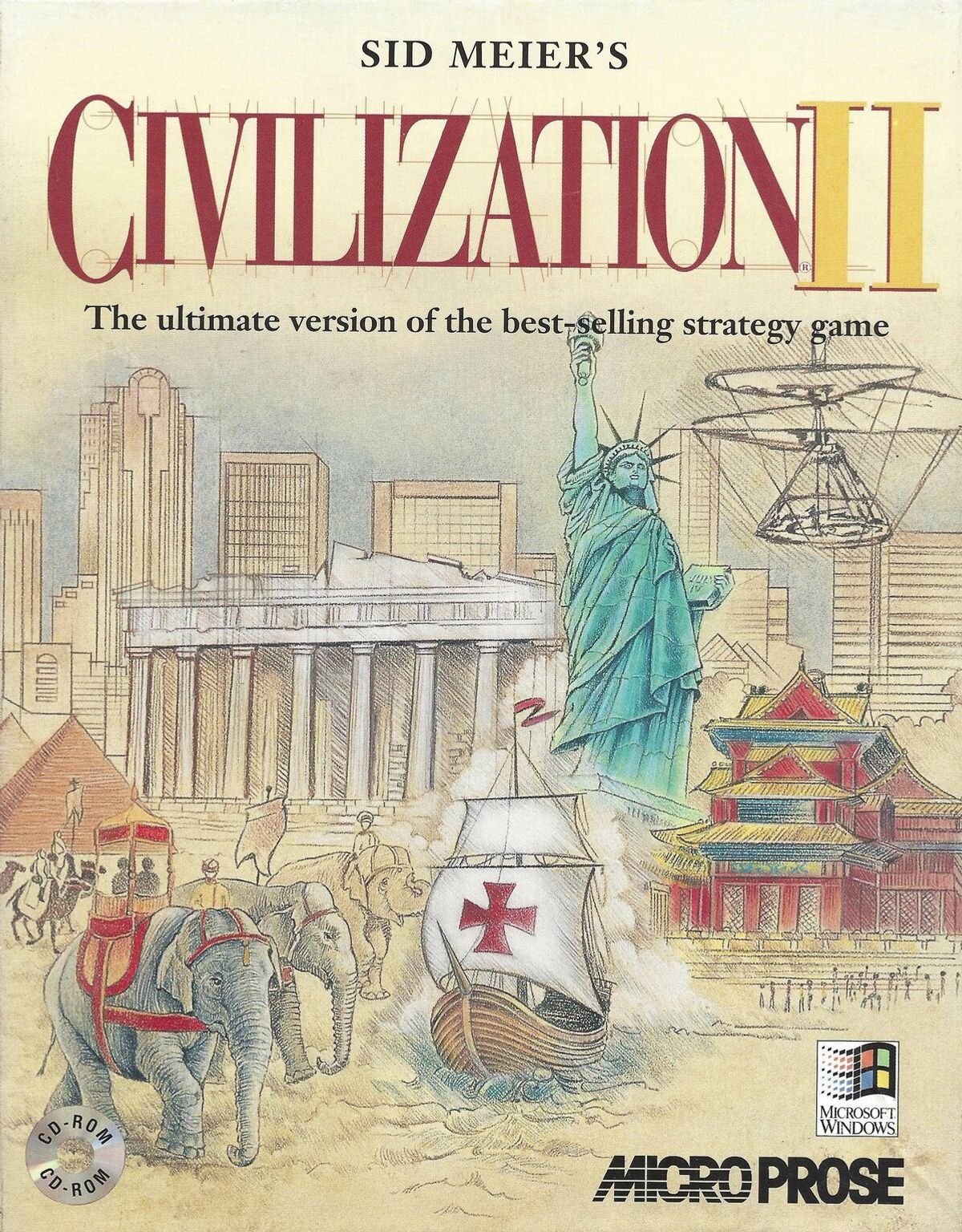
Civilization II is the second game in the Sid Meier's Civilization series, developed by MicroProse and initially released for Microsoft Windows on March 1996. Carrying on from the first game, this title introduced multiple innovations such as changing from a top-down view of the world map to an isometric view, improved diplomacy, and factoring in the effects of corruption and waste on a civilization. A third victory type, which involved surviving to the year 2020 and achieving the top score, was introduced in this game.
Two expansions have been released for the game, with Conflicts in Civilization including scenarios based upon historical conflicts, and Fantastic Worlds covering various fantasy and science fiction settings. The game itself would be remade in 1999 to coincide with the release of Sid Meier's Alpha Centauri. Civilization II: Test of Time would not only feature fantasy and science fiction modes, it would update the interface and introduce animated units which would become commonly seen in future installments.
Followed by Civilization III.
Civilization II contains examples of:
- After the End: The expansion pack Conflicts in Civilization includes an almost-exactly named scenario called "After the Apocalypse..." featuring an future Earth laid low by a war that employed both nuclear and mutagenic biological weapons. As such, many of the survivors aren't even human anymore: there's a "civilization" of Mad Max-esque bandits, another entirely composed of robots, still another of Mutants, and yet another of sapient dinosaurs . You're given 250 years, starting in 24 AD (a new calendar, "After Doomsday") to try and rebuild civilization. Microprose intended this scenario to be played as one of the three human tribes, as the non-human civs have a limited set of units and techs for themselves.
- Alien Invasion: The expansion packs Conflicts in Civilization and Fantastic Worlds each have one such scenario, with Conflicts in Civilization's quite literally named "Alien Invasion." It's set after the invaders—the Hodads, led by Reismark I—put humanity on the brink of extinction by wiping out most of the population with a plague, destroying most electronics with EMP, and finally moving in to colonize and mop up the survivors. The scenario starts at 1 AD (another new calendar, "Alien Domination") and, notably, splits the techs into mutually exclusive Human and Hodad research trees. Meaning that the Hodads will continue to develop stronger weapons—but so too can humanity, with a superweapon that can turn the tide if only they can hold on long enough to research it. (For the other alien invasion scenario, see Shout-Out below.)
- Anti-Air: Fighters and Stealth Fighters are still your only offensive anti-air option, but now they also automatically scramble to defend the city/airbase they're in if it's attacked. Also, AEGIS Cruisers get double defense when attacked by air units—which makes them the toughest sea unit (tougher than even Battleships) in that scenario, which makes them a great anti-air "stack defender" at sea. Although ineffective against aeroplanes and helicopters, the SAM missile battery and SDI defence can help garrisoned cities ward off cruise missile and ICBM attacks respectively.
- Artistic License – Linguistics: Alphabet is a prerequisite for the discovery of writing. Alphabets evolved from pictographic writing systems, so the discovery of writing came first by a margin of millennia.
- Blood Knight: The Military Advisor is always on the verge of turning into this, especially in the early eras. He absolutely will, if you happen to have the world's best standing army.Military Advisor (Ancient/Classical): We stand astride the world like a colossus, Noble Leader! Send forth our legions so that we may smash every army that would rise against us!Military Advisor (Medieval/Industrial): This bloody council be damned, Sire! We have mighty soldiers and the will to fight! Let us go forth!Military Advisor (Modern): You're lettin' our crack troops go to waste, General! Let's go bonk some heads, sir!
- Bunny-Ears Lawyer: The culture advisor is an Elvis impersonator who gives all of his advice in a ridiculous Elvis voice... and generally makes pretty solid points.
- Damage Over Time: Helicopters receive minor damage for every turn they spend in midair. This is intended to simulate their limited fuel reserves without requiring them to return to base every time. Later games remove this.
- Death of a Thousand Cuts: The hit point system allows units to be overwhelmed by enough less powerful ones, although the resource costs usually make doing this an impractical option.
- Disproportionate Retribution: Asking a civilization to withdraw their troops often leads to war. This is useful if you're running a democracy and wish to wage war without collapsing into anarchy.
- Distaff Counterpart: The Female leader of the Zulus is a genderswap of Shaka named Shakala
- Evil Laugh: The military adviser has a decent one. Particularly during the Ancient/Classical era, if he considers military matters to be going well.
- Famous for Being First: The first civilization to research Philosophy starts a "golden age" that grants them a technological advances immediately. Those who research it later get no immediate benefit, it's just a prerequisite for other technologies like universities and medicine.
- Fanservice: The Egyptian herald, a shapely, dark-skinned lady in a filmy, see-through dress (although Barbie Doll Anatomy keeps it from being too risqué).
- Fisher King: Your High Council changes appearance considerably depending on the technology level. Early in the tech tree they'll have Greco-Roman styling, then appear as medieval/early modern European in the mid game, and then suitably modern attire and personalities for the late game. The High Council's personalities also change with the technology level. For example, early on the Science Advisor appears as a stereotypical Greco-Roman philosopher, becomes a court jester in the mid-game, and then turns into a high-pitched nerdy scientist with a Labcoat of Science and Medicine in the late game. The one exception is the Attitude Advisor, who is always Elvis.
- Gender Bender: Leonardo's Workshop automatically upgrades all your Diplomat units to Spy units. The Diplomat is depicted as a little man in formal wear, the Spy as a Femme Fatale in a Little Black Dress.
- Guide Dang It!: Caravans and freights for delivering payoff in gold when it reaches a city with demand for the good it carries. The game doesn't explain how the wealth calculations operate and far more importantly, doesn't even mention caravans provide beakers to the currently researched technology, allowing to sky-rocked in research.
- Irony: The United Nations actually makes it easier to wage war on nations that aren't willing to fight.
- I Warned You: Attempting to consult with your advisors during a state of anarchy results in getting nothing but a chaotic mess as they all try to talk over each other at the same time—but one voice that stands out loud among the noise is your military advisor telling you that he knew this was coming and you should've paid more attention to his advice.Military Advisor (Ancient/Classical): Now—who knew this was going to happen? [draws shortsword] I knew this was going to happen!Military Advisor (Medieval/Industrial): Oh, great! [draws longsword] I knew this was going to happen! I knew it! You wouldn't listen to me! I tried to tell you...Military Advisor (Modern): Oh, fine! I coulda told you this was gonna happen! Listening to them, all the time...
- Large Ham: The Military Advisor
 is the largest.
 - Neutral No Longer: A Spy planting a nuclear device causes all civilizations to go at war against the perpetrator.
- Not-So-Omniscient Council of Bickering: Your civ's High Council of advisors is almost always like this, and it's a rare thing indeed for all of them to be in harmony. Each of them are only concerned with their field of expertise, and will almost always object to any suggestion another advisor makes which might interfere with their interests—such as lowering the Science, Tax, or Luxury rates in favor of another. On the other hand, they'll usually be more agreeable if another advisor's advice benefits them in some way—like whenever the Science Advisor suggests ways to boost research that involve another advisor's field. Taken to its logical conclusion if/when your civ falls to Anarchy, in which all of the advisors will be arguing with each other or ranting at you.
- Secret A.I. Moves: The AI can produce military units at will, units with multiple abilitiesnote , stealth unitsnote , and teleportation nukesnote . This could happen at the standard difficulty as well, but to a much smaller degree.
- Shout-Out: The SETI Wonder video features two Sectoids from the original X-COM: UFO Defense. The Fantastic Worlds expansion goes further and includes a full-blown X-COM: Assault scenario complete with cover of the original game's theme song (punctuated by gunfire and shouts of soldiers) titled "X-Com/They're Here." This scenario tries its best to replicate the X-COM experience in II, with most of the original game's alien roster up against you as X-COM.
- Sophisticated as Hell: A notable example happens in II if your civilization is at the Medieval tech level and lagging behind the rest of the world—Science Advisor: Sire... the very cobblestones of our streets possess more learning than we do! In truth, Sire... [gives the Trade Advisor a Death Glare]... we suck!
- Standard Snippet: "Also sprach Zarathustra" is played when you win by launching a spaceship.
- Suddenly Shouting: The Military Advisor verges on having NO INDOOR VOICE in all three time periods, but there are a few cases that particularly stand out:Military Advisor (Ancient/Classical): Give me better ships, Your Excellency, and watch the seas turn RED, WITH BLOOD!!Military Advisor (Medieval/Industrial): While the men of learning play with their quill pens, Sire, the city defenses stay as thin as parchment. BUILD CITY WALLS!!
- War Elephants: They become available when you discover Polytheism, for some reason.
- Water Source Tampering: Poisoning a city's water supply is a potential espionage action. Succeeding reduces the city's population.
- What the Hell, Player?: Try to perform certain impossible actions in the game, and you'll get some smart aleck notifications from the game.
- Trying to build a city at sea:"It may surprise you to learn that cities cannot be built at sea."
- Trying to airlift naval units:"Ships cannot be airlifted, silly."
- Trying to build a city at sea:
- World War III: One of the scenarios that comes with Civilization II's Gold Edition and expansions is "World War: 1979," modeling what a potential World War III might have been like in that time. The world is divided into several "Risk"-style power blocs, with the North Americans representing the United States, Canada, and South Korea; the Soviets, Chinese, and Indians each representing themselves; West Europe representing the (Western) European part of NATO; the Middle East representing Turkey, Pakistan, North Africa, and most of the Middle East (except Israel); and the Neutral Alliance representing Israel, Japan, Taiwan, and South Africa. (Most of Central/South America, Africa, Southeast Asia and Australia are not present, probably for game balance reasons.)
For the most part, the scenario includes little in the way of custom units, although the Fighter and Bomber are now contemporary jet fighters and bombers rather than propeller aircraft. Also, the scenario does not actually start with anyone at war. In fact, it's possible for the Americans and Soviets to remain at peace—it's even possible for relations to sour between the Americans and West Europeans. That being said, war is almost guaranteed to kick off from the start, and it will be a nuclear one. (As a side note, Nikita Khrushchev's "we will bury you" quote is used as an epigraph for the scenario.)
