

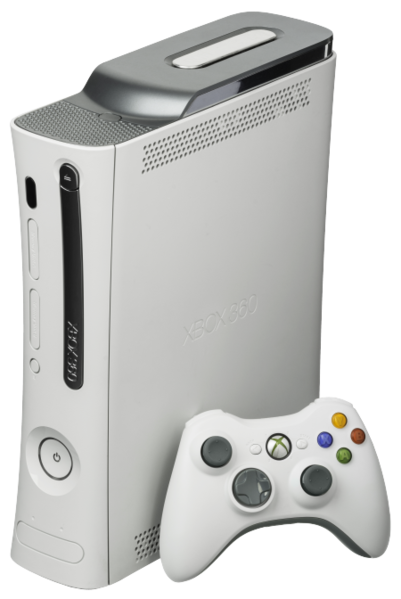


In 2001, Microsoft threw their hat into the console race with the Xbox. While it did decently and even managed to barely outsell the Nintendo GameCube, it only sold well in North America, didn't actually make Microsoft any money thanks to its high production costs, and still got walloped by the PlayStation 2 by a good 136 million units. Down but not deterred, Microsoft came back in 2005 with the Xbox 360note a year ahead of Sony's PlayStation 3 and Nintendo's Wii.
The 360 featured a new version of the Xbox Live service with improvements over the original. Though its hardware was not PC-based like its predecessornote , the software continued to be DirectX-based, thus it was still relatively easy to port games from the PC platform. This was greatly aided by Microsoft's developer tools; said tools have been praised by, among others, John Carmack of id Software as the best development environment he's ever seen on a console, which helped mitigate the change from the x86 CPU architecture, the same used in PCs, to PowerPC.
Unlike the original Xbox, the 360 initially outsold its Sony rival. The PlayStation 3 had an infamously bad start due to a high price tag, a delayed release the led to it coming out a full year after the 360, and a complex and unorthodox hardware architecture that developers found difficult to program, resulting in a dearth of games. As a result, the 360 began getting more exclusive titles as well as securing many of the third-party franchises that were once glued to PlayStation consoles. Microsoft was beating Sony so badly in the Console Wars early on that, for a while, their primary competition came from Nintendo's unexpectedly successful Wii.
By the end of 2008, the Xbox 360 was in second place behind the Wii and still comfortably in the lead over the PS3 in most regions. The only exception was Japan, where its more modest sales are blamed on a lack of exclusive content aimed at Japanese gamers. The lead would narrow as Microsoft would stop dropping prices in favor of upgrading hard drive sizes and bundling additional software and features. The 360's business model in general relied on selling consoles at a loss (although, unlike the original Xbox, the 360 console has turned the corner into profitability) while making money on accessories, Xbox Live Gold subscriptions and DLC. Online purchases were priced in "Microsoft Points," which allowed users to make purchases without a credit or debit card while reducing the credit card transaction fees Microsoft would otherwise have to pay should one be used. This lasted until near the end of the console's life, when Microsoft finally started the user's country's regular currency.
Microsoft's concern for cost-efficiency resulted in a powerful system without the complexity that made programming for the PS3 so notoriously difficult. However, in some areas, the cost-cutting went too far; the powerful hardware combined with inadequate cooling resulted in many machines produced early in the system's lifenote dying abruptly with "Red Ring of Death" (i.e. general system failure) errors.note . In the end, Microsoft reported that more than half (51.4%) of all original-production 360 systems were affected by the manufacturing defects. To prevent irreparable damage to the Xbox brand, Microsoft ultimately took the step of extending the 360's warranty to cover all general system failure issues for three years, at the cost of $3 billion. However, the problem still cost Microsoft their considerable lead against Sony and the PS3, as 360 sales heavily stalled for much of 2007 as a result. The "Red Ring of Death" issue gradually subsided thanks to improved hardware design, especially with the later "Jasper" and "Kronos" revisions.
As for hardware security, Microsoft learned their lesson from the original Xbox and locked the 360 down tight; for one, the boot ROM was contained directly inside the CPU, which also contained a unique CPU key that was tied directly to the motherboard. The CPU also utilized eFuses, which "blew" every time a firmware update was downloaded to prevent downgrading. Finally, Microsoft installed a Hypervisor (basically a virtual machine) in the console to prevent the execution of unsigned code, reading data from the buses, or editing RAM. However, it wasn't flawless. Firmware revision 4532 introduced an exploit that allowed hackers to modify a shader on the video game adaptation of King Kong (2005) to open the system up to arbitrary code execution, albeit you needed custom DVD drive firmware to run a DVD-R with the hacked game on it. But Microsoft responded quickly and patched out this exploit in the firmware before hackers could make this exploit public knowledge. That wasn't the end though. Hackers then discovered that the system's SMC chip disabled system debugging features upon startup, and found a way to bypass the disabling of the CPU and GPU "JTAG" ports, bypass the eFuses and downgrade to revision 4532, allowing the use of the "King Kong exploit". Other exploits involving the JTAG were discovered before Microsoft ultimately fixed them at the hardware level with the Zephyr, Opus, and Jasper models, and with the Red Ring of Death issues on earlier models, these earlier "hackable" models were undesirable and for years the Xbox 360 remained locked down until 2011, when the CPU's thread management code was brute-forced to allow for custom firmware, therefore cracking the system wide open. Despite this, the Xbox 360's security system still succeeded at what it set out to do, which was to protect the system from hackers until the system's twilight years.
A major firmware update (the "New Xbox Experience", or NXE) revamped the user interface and brought new features, such as Netflix integration and the ability to install games to the system's hard drive (although you still need to have the DVD in the tray to play the game, and some older games that cache their data on the hard drive anyway might not experience an increase in speed).
The release of the Xbox 360 is truly when online gaming came into its own. While internet connectivity for consoles had existed in some form or another since The '90s, it was the success of the 360 and its Xbox Live ecosystem that finally normalized online. Xbox Live has been praised for its large community and user-friendly friend management and game launching interface, and there's a large variety of content on offer for download. On the other hand, much of the multiplayer base has been characterized as juvenile and unfriendly and there's a relative dearth of free downloadable content, with the multiplayer service itself requiring a Gold membership unless a particular game (such as EA Sports games) has its own subscription service.
Region Coding is an optional feature for publishers. It's possible, though difficult, to change a console's region, but fortunately most games are published region free, Electronic Arts products and many Japanese releases being the notable exceptions .
.
Despite the usual 5-6 years of active life for a console, the 360 remained on the market until early 2016, just over ten years after its introduction and a little over two years after the release of the Xbox One.
A new hardware redesign, officially dubbed Xbox 360 S or Slim ("Valhalla" by its internal codename and Trinity by its motherboard name) premiered in the Summer 2010. The motherboard was streamlined further, even compared to the then-recent "Jasper" version, with the chipset shrinking to the just two chips (CPU, GPU and RAM all-in-one, made possible since they're now made by 45 nm process instead of original 90 nm), which greatly reduced costs and improved cooling. It also allowed the company to make the 250 GB HDD, encountered before only on the expensive Super Elite series, a standard equipment and install it inside the case itself rather than the outside cab. Wi-Fi is now standard inside-the-case equipment as well. While the console's outer dimensions were significantly reduced, it now has a much more aggressive design, reminiscent of a cross between an original Xbox and a PlayStation 2.
Although the RROD problem seems to have abated with the release of both the Jasper chip and the 360 S (which, at any rate, now uses a blinking red light and onscreen error display rather than the traditional rings), the lightweight design has led to disc scratching, particularly if the console is picked up, moved or shaken while a game is running, becoming a more significant problem.
Autumn 2010 saw the release of the Xbox 360's most significant peripheral: Kinect. Formerly dubbed "Project Natal," Kinect is essentially a camera capable of tracking players' positions with a high degree of accuracy, allowing controller-free gaming and menu navigation. This has paved the way for a series of experimental, family-friendly games, while some enterprising users have discovered other, surprisingly awesome applications for the technology. However, it failed to resonate with consumers other than casual gamers, alienating the hardcore gamer audience that Microsoft had expertly catered to in the first half of the console's life. Kinect's success led Microsoft to make it a standard part of their next console... only to later abandon it for being a contributing factor to that console's underperformance.
In 2012, Microsoft launched SmartGlass, a second screen experience similar to the capabilities of the Wii U only using a "bring your own device" setup, being available for Windows 8/RT PCs and tablets, Windows Phones, as well as select iOS and Android devices. All first-party and select third-party games in the future will make use of the system, the first of which being Halo 4 and Dance Central 3.
It's interesting to note that unlike most other consoles, Microsoft was not afraid to radically update the console's interface multiple times during its lifespan in order to allow room for more content, new features, and to keep the experience fresh. Microsoft's background as a software company (as opposed to a consumer electronics company like Sony) was likely the primary motivation for doing so. The original blade interface was scrapped in 2008 with the release of the NXE or New Xbox Experience based off the "Twist" UI used in Windows Media Center and Zune players of the time. The release of Kinect in 2010 saw a revised version of the NXE based off Microsoft's then-relatively new "Metro" design standard, although for the most part functionally was unchanged save for the addition of the Kinect hub. The fall 2011 update featured the second major overhaul, expanding on the Metro concept and keeping it consistent with that of Windows Phone and Windows 8. It also has the functional advantage of being able to navigate with either controller or Kinect in the same UI, and adds a new search function powered by Bing for more easily finding game and video content from the ever-growing list of providers. However, later firmware revisions did attract criticism for introducing advertisements and unneeded elements that slowed the console down and got in the way of its core functionality of playing games.
Microsoft, after some rumors about a successor, announced the Xbox One in 2013. Its reception, however, was far from good. Check the correspondent page for details. Around the same time, they introduced the Xbox 360 E model, a smaller model intended to look similar to the Xbox One, with a slimmer, more boxy formfactor, another upgrade to the cooling system, a return to actual eject and power buttons as opposed to the touch sensors, redesigned AV outputs and all of the improvements from the Slim model.
For the Xbox 360's online video game store (which has since migrated to it's successors), see Xbox Live Arcade. The Xbox 360 store was finally retired on July 29, 2024; officially bringing the 360's life cycle to an end at least as far as Microsoft is concerned, though servers for a handful of online games are still up and running.
Technical specifications
Processors
- The CPU is an IBM POWER5 based Big Endian tri-core processor codenamed Xenon that runs at 3.2 GHz. Each core can service two threads in hardware. In a interesting twist, the cores are a modified version of the PlayStation 3's Cell processor's Power Processing Elements. The Xenon is essentially 3 of the CELL's PPEs with 2 threads on each core, for 6 threads total and hard locked to in order execution. note
- 32KB of L1 cache with each physical core and 1MB of L2 cache that can be lockstepped by Xenos to run at half speed with up to 51.2GB/s per second for bandwidth and a theoretical 115 GFLOPS performance. 768 eFUSE's are also embedded on the CPU die that can be blown by software updates to prevent hackers from downgrading to older software kernels.
- The name of the console also leads to a common misconception that the system's CPU is 360 bit, when it is actually 64 bit.
- The GPU is an ATI designed chip codenamed Xenos running at 500 MHz.
- 48-way parallel floating-point dynamically scheduled shader pipelines split between 3 SIMD engines running 16 shader stages per unit with 4 ALU's per pipe for Vertex or Pixel Shader processing and a unified shader architecture derived from Shader Model 3.0.
- Its architecture is very similar to the Radeon X1800 released for computers, but it had an interesting property. Back in the day, GPUs had two distinct pipelines for geometry and pixel processing. The Xenos had those same pipelines, but they were reconfigurable to do either geometry or pixel processing. This allowed better efficiency of the resources.
- The S and E models combine the two into one chip dubbed the XCGPU.
- Custom XSB or "Xbox Southbridge" processor for system and I/O management.
- Custom ANA and later "HANA" video encoder to render GPU framebuffer to video output. Supports Composite, S-Video, RGB SCART, Component, VGA and HDMI out.
Storage
- The 360 has 512 MB of unified GDDR3 memory clocked at 700 MHz for a transfer rate of 22.4 GB/s.
- On the GPU was 10 MB embedded DRAM running at 500 MHz but had a transfer rate of 32 GB/s. All the Post-Processing Video Effects happened on here because it could do it really fast.
- 20GB SATA Hard Drive via a custom external caddy. This was initially kept to the higher SKUs at launch although users could buy them separately for the lower end "Core" SKU. As revisions were made to the system hard drive sizes were increased to 60, 120, 250, 320 and finally 500GB in size. note Later software updates around the launch of the Slim and the Xbox One allowed the user to use external USB hard drives up to 2TB in size to install games and save data. Most games can run directly off the disc but some bigger titles released late in the console's life like Grand Theft Auto V and Metal Gear Solid V must be installed to a HDD, and some others (like Forza 4) have an another disc with extra content that isn't required to be installed to run the game, but the game will be missing a lot of content without it.note Installed games will still need the disc to work unless the content was purchased from the Xbox store.
- The Xbox 360 can take any 2.5" SATA hard drive, including SSD's with some tweaking to format it correctly.
- 64MB to 512MB of external flash based memory storage using a "Memory Unit". These very much act as memory card's do on the PlayStation 2 and Original Xbox for storing save data. Technology Marches On however as games quickly started required far more space than even the biggest Memory Unit could offer for save data, patches or downloadable content, leading to Microsoft to phase out the Memory Unit all together and removing the connectors for them in the S revision console in favor of integrated internal flash memory or external and internal hard drives. Barring that, the Memory Unit was rendered a bit redundant considering that you could store saves on non-proprietary USB flash drives, and Microsoft even sold Xbox-branded flash drives for the 360 after phasing out the Memory Unit.
- 16MB of internal NAND based flash memory used for storing the dashboard .Xex note and kernel files. Starting with the "Arcade" Jasper revision models this was upgraded to 256MB and later 512MB to accomodate the "New Xbox Experience" dashboard that would otherwise require a hard drive or large Memory Unit. This was further upgraded with the S and E series revision console to 4GB in size with 64MB reserved for system files and the remaining space used as an internal Memory Unit.
- Games are stored on regular dual layered DVDs, which have 8.5 GB of space. However, some space on each disc is reserved for Copy Protection and other data such as SDKs or API libraries, leaving about 7 GB for the games themselves, which was increased to 8 GB by a system update in 2011.
- Neither the Blu-Ray nor HD DVD format was finalized soon enough to be incorporated in the 360's design. Microsoft therefore produced an HD-DVD add-on that was released a year after the console, and whose functionality was exclusively limited to playing video discs, due to similar such add-ons in the past (most notably the Sega CD and Atari Jaguar CD) having invariably proved to be commercial failures when games were released on them. Ultimately, HD-DVD lost the format war to Blu-Ray quite handily, and Microsoft declined to produce a Blu-Ray add-on, citing that such a device would probably have had no commercial potential. The limitations of the DVD format would have ripple effects throughout the rest of the generation, as developers would have to produce games with the storage limitations of the Xbox 360 (and, where applicable, the Wii) in mind, meaning that only Sony's exclusives really exploited the full potential of Blu-Ray on the PS3.
Graphics
- The 360 is capable of outputting all the way up to 1080p. However, games are usually rendered at 720p or 640p and then scaled to the desired resolution.
- The graphics API is an enhanced version of DirectX 9.0. with some parts later backported from DirectX 10.
- Maximum polygon throughput is 500 million per second and 16 gigapixels per second. However, this is only achievable if the GPU is doing one or the other.
Connections
- AV output is either through a proprietary analog AV connector which can support HD resolutions or HDMI. note Curiously the optical out is on the AV connector, even though it's a digital signal.
- The E model's analog output was reduced to just composite output, using a standard 3.5mm" TRRS connector.
- There's two USB 2.0 ports in the front and one to three ports in the back depending on the model. These are used for wired controllers, memory sticks, wireless adapter, the Kinect, or other supported devices.
- The original model had one USB port in the back. Originally intended for the optional Wi-Fi or HD DVD add-on and later used for the Kinect via a special adapter.
- The S model increased it to three and later added an exclusive USB-based port for Kinect
- The E model went down to two, though maintains the S model's Kinect-exclusive port. There is a third one, but it's used for the wireless adapter.
- The console was the first to have built-in support for wireless controllers, though wired controllers were also available. The wired controllers connected via USB while the wireless ones used a proprietary 2.4 GHz protocol. Microsoft also made a driver and the API for reading inputs from the controller available on Windows, which had the benefit of giving most PC games released after the console plug-and-play support for Xbox controllers.
- Network connectivity includes Ethernet and 802.11 wireless LAN. Prior to the S model, if one wanted 802.11 wireless capabilities, they had to buy a receiver for the 360.
- The controller has a port on the center bottom edge to attach a headset or keyboard.
List of games:
Exclusive to Xbox 360:
- Ace Combat 6: Fires of Liberation
- Akai Katana Shin
- Attack of the Movies 3D
- Banjo-Kazooie: Nuts & Bolts
- Beautiful Katamari
- Blue Dragon
- Bomberman Act:Zero
- Bullet Witch
- Chrome Hounds
- Crackdown
- Crackdown 2
- Dead or Alive 4
- Death Smiles
- DeathSmiles IIX
- Eschatos
- Fairytale Fights
- Far Cry Instincts: Predator
- Forza series:
- Forza Motorsport 2
- Forza Motorsport 3
- Forza Motorsport 4
- Forza Horizon
- Forza Horizon 2
- Forza Horizon 2 Presents Fast & Furious
- Full Auto
- Gal*Gun
- Gears of War 2
- Ghost Recon: Advanced Warfighter
- Ghost Recon: Advanced Warfighter 2
- Ghost Recon: Future Soldier
- Ginga Force
- Guilty Gear 2: Overture
- Halo series:
- Halo 3
- Halo Wars
- Halo 3: ODST
- Halo: Reach
- Halo: Combat Evolved Anniversary
- Halo 4
- Infinite Undiscovery
- Kameo: Elements of Power
- Kinect Adventures!
- Kinect Star Wars
- Lost Odyssey
- Magna Carta 2
- Marlow Briggs and the Mask of Death
- MorphX
- Nin²-Jump
- Operation Darkness
- Perfect Dark Zero
- Phantom Breaker
- Project Gotham Racing 3
- Project Gotham Racing 4
- Project Sylpheed
- Radirgy Noa Massive
- Raiden Fighters Aces
- Raven Squad: Operation Hidden Dagger
- Rumble Roses XX
- Scourge: Outbreak
- Saints Row 1
- Sakura Flamingo Archive., a compilation of:
- Chaos Field
- illvelo
- Karous
- Radirgy and Radirgy Noa
- Senko no Ronde (as WarTech: Senko no Ronde in North America and Europe)
- Strania -The Stella Machina-
- Tenchu Z
- Tetris: The Grand Master Ace
- Too Human
- Yaris
Exclusive to Xbox 360 and PC:
- Alan Wake
- A.R.E.S. Extinction Agenda
- The Battle for Middle-earth II
- Battlestations Midway
- Bleed
- Condemned: Criminal Origins
- Dark
- Darkest of Days
- Dark Messiah of Might and Magic (known as Dark Messiah of Might and Magic: Elements in the Xbox 360 version)
- Darkstar One
- Dusty Revenge
- EvilQuest
- Fable Series:
- Gears of War
- Gyromancer
- ilomilo
- The Last Remnant
- Left 4 Dead
- Lost Planet
- Lucidity
- Metro 2033
- Monster Hunter Frontier
- Monster Madness: Battle for Suburbia
- Ninja Blade
- Quake IV
- Quantum Theory
- Risen
- Shadowrun
- Splinter Cell: Conviction
- The Witcher 2: Assassins of Kings
- Two Worlds
- Umineko: Golden Fantasia (Also known as Ougon Musou Kyoku X in the Xbox 360 version)
Multiplatform games:
- Ace Combat: Assault Horizon
- Alien: Isolation
- Aliens vs. Predator
- Alone in the Dark (2008)
- Alpha Protocol
- The Amazing Spider-Man (Activision)
- American McGee's Alice
- Anarchy Reigns
- Angry Birds Trilogy
- Arcania: A Gothic Tale
- Armored Core:
- Armored Core 4
- Armored Core: for Answer
- Armored Core V
- Armored Core: Verdict Day
- Army of Two
- Army of Two: The 40th Day
- Assassin's Creed:
- Asura's Wrath
- Avatar: The Last Airbender – The Burning Earth
- Back to the Future: The Game
- Backyard Sports
- Barbie and Her Sisters: Puppy Rescue
- Batman: Arkham Series:
- Batman: The Telltale Series
- Battle Fantasia
- Battlefield series
- Bayonetta
- Bee Movie Game
- Binary Domain
- Bionic Commando (2009)
- BioShock:
- Black Knight Sword
- Blacksite Area 51
- Blades of Time
- Bladestorm: The Hundred Years' War
- BlazBlue:
- Blitz: The League
- Blitz: The League II
- Blood Drive
- Bloodforge
- BloodRayne: Betrayal
- Blur (2010)
- Bomberman Live
- Borderlands:
- Bound by Flame
- The Bourne Conspiracy
- Braid
- Brink!
- Brothers in Arms: Hell's Highway
- Brütal Legend
- Bully: Scholarship Edition
- The Bureau: XCOM Declassified
- Burnout series:
- Burnout Revenge
- Burnout Paradise
- Caladrius
- Call of Duty:
- Call of Juarez
- Captain America: Super Soldier
- Cars
- Castle of Shikigami III
- Castlevania: Harmony of Despair
- Castlevania: Lords of Shadow
- Catherine
- Child of Eden
- Civilization Revolution
- Clash of the Titans (2010)
- Clive Barker's Jericho
- The Club
- Cobalt
- Command & Conquer:
- Conan (2007)
- Condemned 2: Bloodshot
- Contrast
- Counter-Strike: Global Offensive
- Crash of the Titans
- The Crewnote
- Cro-Mag Rally
- Crystal Quest
- Cthulhu Saves the World
- Damnation
- Dante's Inferno
- The Darkness
- The Darkness II
- darkSector
- Darksiders I
- Dark Souls
- Dark Void
- Darwinia+
- de Blob 2
- Deadly Premonition
- Dead Island
- Dead or Alive 5
- Dead or Alive 5 Ultimate
- Deadpool
- Dead Rising
- Dead Rising 2
- Dead Rising 2: Off the Record
- Dead Space series:
- Dead to Rights: Retribution
- Death Smiles
- DeathSpank
- Defenders of Ardania
- Destiny
- Devil May Cry series:
- Devil May Cry: HD Collection note
- Devil May Cry 4
- DmC: Devil May Cry
- Deus Ex: Human Revolution
- Deep Black: Reloaded
- Diablo III
- Diner Dash
- DiRT
- DiRT 2
- DiRT 3
- DiRT: Showdown
- Dishonored
- Disney Universe
- DoDonPachi Dai Fukkatsu
- Doom:
- Doom (1993)
- Doom II
- Doom³: BFG Edition
- Dragon Age:
- Dragon Ball:
- Dragon Ball: Raging Blast
- Dragon Ball Z: Budokai HD Collection note
- Dragon Ball Xenoverse
- Dream C Club
- Dream Chronicles
- DreamWorks Super Star Kartz
- Driver: San Francisco
- Duke Nukem Forever
- Dungeon Defenders
- Dungeon Siege III
- Dynasty Warriors
- Earth Defense Force series:
- Earth Defense Force 2017 (the first game in the Earth Defense Force series to receive a North America)
- Earth Defense Force: Insect Armageddon
- Earth Defense Force 2025
- Eat Lead: The Return of Matt Hazard
- The Elder Scrolls IV: Oblivion
- The Elder Scrolls V: Skyrim
- El Shaddai: Ascension of the Metatron
- Enchanted Arms
- Enemy Front
- Enemy Territory: Quake Wars
- Enslaved: Odyssey to the West
- The Escapists
- Espgaluda II
- Eternal Sonata
- Fallout:
- Fantastic Four: Rise of the Silver Surfer (2K)
- Farming Simulator 2013, 15
- First Encounter Assault Recon
- 50 Cent: Blood on the Sand
- Final Fantasy XIII
- Fist of the North Star: Ken's Rage
- Fist of the North Star: Ken's Rage 2
- FlatOut: Ultimate Carnage
- Fracture
- Front Mission Evolved
- FUSE
- Gal Gun
- Game of Thrones (Telltale)
- Ghostbusters: The Video Game
- Ghost Recon Advanced Warfighter 2
- Ghost Recon Future Soldier
- Gotham City Impostors
- Grand Theft Auto:
- Green Lantern: Rise of the Manhunters
- Guitar Hero II and its sequels
- Gun
- Half-Life 2note
- Hannah Montana
- Hannah Montana: The Movie
- Harry Potter:
- H.A.W.X.
- H.A.W.X 2
- Hellboy: The Science of Evil
- Herald: An Interactive Period Drama
- Homefront
- Hot Wheels: Beat That!
- Hour of Victory
- How to Survive
- Hunted: The Demon's Forge
- Hurdle Turtle
- Ice Age
- The iDOLM@STER and its sequels
- The Impossible Game
- The Incredible Hulk (Sega)
- Infernal
- Infinity:
- Infinity Danger
- Injustice: Gods Among Us
- Iron Man
- JASF: Jane's Advanced Strike Fighters
- Joe Danger 2
- Juiced 2: Hot Import Nights
- Jurassic Park: The Game
- Jurassic: The Hunted
- Just Cause
- Karous
- Ketsui: Kizuna Jigoku Tachi
- The King of Fighters:
- Kingdoms of Amalur: Reckoning
- Knight's Contract
- Kung Fu Panda
- L.A. Noire
- Leela
- Legendary (2008)
- The Legend of Korra
- LEGO Adaptation Game:
- LEGO Star Wars
- Lego Star Wars II: The Original Trilogy
- Lego Star Wars: The Complete Saga
- Lego Star Wars III: The Clone Wars
- Lego Star Wars: The Force Awakens
- LEGO Indiana Jones
- LEGO Batman Series:
- LEGO Harry Potter
- LEGO Marvel Super Heroes
- LEGO Marvel's Avengers
- LEGO Jurassic World
- LEGO Dimensions
- LEGO Star Wars
- Leisure Suit Larry: Box Office Bust
- Life is Strange
- Lollipop Chainsaw
- Looney Tunes: Acme Arsenal
- The Lord of the Rings: Conquest
- Lost Planet 2
- Madagascar
- Mafia II
- Majin and the Forsaken Kingdom
- Mars: War Logs
- Marvel vs. Capcom 3: Fate of Two Worlds
- Ultimate Marvel vs. Capcom 3
- Mass Effect series:
- Mass Effect 1 (initially an exclusive, later ported to PC and the PS3)
- Mass Effect 2
- Mass Effect 3
- Max Payne 3
- Medal of Honor:
- Medal of Honor: Airborne
- Medal of Honor
- Medal of Honor: Warfighter
- Meet the Robinsons
- Megamind
- Metal Gear:
- M.I.A.: Missing In Action
- Middle-earth: Shadow of Mordor
- Mighty No. 9
- MindJack
- Minecraft
- Mini Ninjas
- Mirror's Edge
- Monster High
- Monster High: New Ghoul in School
- Monsters vs. Aliens
- Mr. Driller Online
- Muchi Muchi Pork
- Murdered: Soul Suspect
- Mushihime-sama Futari
- Naruto Shippuden: Ultimate Ninja Storm 2
- Naughty Bear
- Need for Speed:
- Need for Speed: Most Wanted (2005)
- Need for Speed: Carbon
- Need for Speed: ProStreet (also released for PlayStation 2)
- Need for Speed: Undercover (also released for PlayStation 2)
- Need for Speed: Shift (both Shift and Shift 2: Unleashed)
- Need for Speed: Hot Pursuit (2010)
- Need for Speed: The Run
- Need for Speed: Most Wanted (2012)
- Need for Speed Rivals
- Never Dead
- Nexuiz
- NHL Hockey (07 through 15)
- Nicktoons MLB
- NieR
- Ninja Gaiden
- No More Heroes Paradise (Japan only)
- Of Orcs and Men
- Omerta: City of Gangsters
- Open Season
- Operation Flashpoint
- Outland
- Overlord:
- Pac-Man and the Ghostly Adventures
- Persona 4 Arena
- Persona 4 Arena Ultimax
- Peter Jackson's King Kong
- Phantasy Star Universe
- Phantom Breaker: Extra
- Phantom Of Inferno
- Phineas and Ferb: Quest for Cool Stuff
- Pid
- Pink Sweets
- Plants vs. Zombies:
- Platypus
- Portal:
- Prey
- Prince of Persia:
- Prison Architect
- [PROTOTYPE]
- Psycho-Pass: Mandatory Happiness
- Qix++
- Quantum Conundrum
- Rage
- Rainbow Six: Vegas
- Rainbow Six: Vegas 2
- Ratatouille
- The Raven
- Raven Squad: Operation Hidden Dagger
- Rayman:
- RBI Baseball 14
- Red Dead Redemption
- Red Faction:
- Red Faction: Guerrilla
- Red Faction: Armageddon
- Remember Me
- Resident Evil:
- Resonance of Fate
- Ride to Hell: Retribution
- Rise of the Argonauts
- Rock Band and its sequels
- Rock of Ages
- Rocket Knight
- Rogue Warrior
- Rush'n Attack: Ex-Patriot
- The Saboteur
- Saints Row:
- Sanctum 2
- Saw
- Scene It?
- Scene It? Lights, Camera, Action!
- Scene It? Box Office Smash
- Scene It? Bright Lights! Big Screen!
- Scene It? Movie Night
- Section 8 series
- Sega Rally Revo
- Sega Superstars
- Serious Sam series:
- Shadows of the Damned
- Shaun White Skateboarding
- Shellshock 2
- Sherlock Holmes:
- Shikigami no Shiro III (Japan-only)
- Shmups Skill Test (as part of the Shooting Love 200X Compilation Re-release disc; Japan-only)
- Shrek the Third (Activision)
- Silent Hill: Homecoming
- The Simpsons Game
- Singularity
- Sleeping Dogs (2012)
- Skullgirls
- SkyDrift
- The Smurfs 2
- Sniper Elite V2
- Sniper: Ghost Warrior
- Snoopy Flying Ace
- Soldier of Fortune: Payback
- SpongeBob SquarePants:
- Sonic the Hedgehog:
- South Park: The Stick of Truth
- Space Invaders Infinity Gene
- Spec Ops: The Line
- Splinter Cell: Double Agent
- Splinter Cell: Blacklist
- Soul Series:
- SoulCalibur IV
- Soulcalibur V
- Spider-Man:
- Splatterhouse
- Spyro the Dragon:
- SSX
- Star Ocean: The Last Hope
- Star Wars: The Force Unleashed
- Stormrise
- Street Fighter:
- Strider
- Superman Returns
- Super Robot Wars XO
- Sword of Rapier
- Syndicate
- Tales of Vesperia
- Team Fortress 2 note
- Teenage Mutant Ninja Turtles:
- Tekken 6
- Tengai Makyō: Ziria: Harunakaru Jipang
- Thor: God of Thunder (2011)
- Thunder Wolves
- TimeShift
- Tokyo Xtreme Racer
- Import Tuner Challenge
- Tomb Raider series:
- Tomb Raider: Legend
- Tomb Raider: Anniversary
- Tomb Raider: Underworld
- Lara Croft and the Guardian of Light
- Tomb Raider (2013)
- Lara Croft and the Temple of Osiris
- Rise of the Tomb Raider
- Toy Story 3
- Transformers: The Game (Console)
- Transformers: War for Cybertron
- Trine 2
- Tropico:
- Tropico 3
- Tropico 4
- Tropico 5
- Turning Point: Fall of Liberty
- Under Defeat HD
- Universe at War
- Unreal Tournament III
- Vampire Rain
- Vanquish
- Velvet Assassin
- Viking: Battle for Asgard
- The Walking Dead:
- The Walking Dead: Survival Instinct
- Wallace & Gromit's Grand Adventures
- Wanted: Weapons of Fate
- Watch_Dogs
- Way of the Samurai 3
- WET
- The Wolf Among Us
- Wolfenstein (2009)
- Wolfenstein: The New Order
- Wolf of the Battlefield: Commando 3
- Worms Revolution
- ''WWE Legends of WrestleMania
- X-Blades
- X-COM:
- X-Men: Destiny
- X-Men Origins: Wolverine
- You Don't Know Jack
- Young Justice: Legacy
- Zone of the Enders HD Collection
Special Versions / Remakes for Xbox Live Arcade:
- Beyond Good & Evil HD
- Bionic Commando Rearmed
- * Virtual-ON: FORCE
- Cyber Troopers Virtual-ON: Oratorio Tangram Ver.5.66
- Guwange
- Guardian Heroes
- Heavy Weapon: Atomic Tank
- Ikaruga
- Lumines Live
- Radiant Silvergun
- Rayman 3: Hoodlum Havoc HD
- RayStorm HD
- Resident Evil 4 HD
- Rez
- Valiant Hearts
