

- Mariah Carey, Usher, Chris Brown, Justin Timberlake, *NSYNC, Destiny's Child, Beyoncé, Kelly Rowland, Michelle Williams, The Weeknd, Insane Clown Posse, Kanye West, Jay-Z, Justin Bieber, Sean Combs, Ciara, Ne-Yo, Bruno Mars, and far too many more to count.
Originally a member of the Motown act The Jackson 5, Michael Joseph Jackson (August 29, 1958 – June 25, 2009) debuted as a solo artist in 1971 — the year he turned thirteen. His full-fledged solo career took off in the late '70s. Though songs from his first serious solo effort, Off the Wall (1979), were extremely popular, he reached unprecedented superstardom in 1982 with his album Thriller. Thriller is still the best-selling album of all time today, and won a total of 8 Grammy Awards, a record which would not be surpassed for fifteen years, when Santana's Supernatural won 9.
Jackson was, perhaps, the definitive celebrity of The '80s — his level of popularity in that decade is comparable only to that of The Beatles in The '60s. His singing voice and dance moves (especially his Signature Move, the Moonwalk Dance) gained iconic status, and his unusually elaborate music videos were somewhat of a Killer App for the emerging MTV. In particular, the one for "Thriller", probably the most famous music video ever made, has inspired an entire slew of homages and parodies. Jackson was also notably the first African-American artist to receive heavy rotation on the channel.note By the end of the decade, he had another successful album in Bad (the first album to yield five number one singles on the Billboard charts), a direct-to-video movie, and even video games.
As The '90s rolled around, Jackson had another success with the album Dangerous. However, within a few years, media attention had turned on his personal life, health and appearance. It was noted that his facial features were slimming down and skin tone had considerably lightened up, with claims of extensive plastic surgery and bleaching his skin. By the mid-90's he was quite pale and with a gaunt appearance, which garnered discussions of race and celebrity life. It was later revealed that he had Vitiligo which causes pale pink coloration in the skin, with cosmetic work done to try to hide it from the public. He had a high-profile marriage to Lisa Marie Presley (daughter of Elvis Presley) that ended up only lasting two years.
But this would be Overshadowed by Controversy through allegations of sexual abuse against children made against him, as he would have numerous parties at his Neverland Ranch. Although Jackson was either acquitted of most of these accusations or otherwise not formally charged, this perception would follow him the remainder of his life, even after releasing two more albums. In 2009, he looked set for a comeback after booking a 50-show farewell concert engagement in London, England.
It was not to be. He died on June 25, 2009 due to an overdose of propofol (a hospital-grade anaesthetic) a few weeks before the first concert, at the age of 50. The doctor who administered the medication was later found guilty of involuntary manslaughter. Jackson's family sued tour organizer AEG for negligence but lost that case in 2013. Jackson's memorial service that July 7 was broadcast live around the world; he is interred in Forest Lawn Memorial Park Cemetery in Glendale, California. Later that year, the first of many posthumous Jackson-related projects, This Is It, compiled from rehearsal footage of the aborted London shows, was released. Shortly after his death, Jackson would see renewed critical and public popularity, though the child molestation accusations would still float around here and there in the public consciousness.
This would eventually culminate in the release of the 2019 documentary Leaving Neverland, which went into detail about two new allegations against him. It was released with renewed interest; however, it was still incredibly controversial. Some public figures and many fans heavily criticized and denounced the documentary, saying it was significantly one-sided and full of lies and factual errors. Regardless of its accuracy, Leaving Neverland prompted a second public reevaluation of Jackson's life and legacy. A followup titled Leaving Neverland 2: Surviving Michael Jackson was released on March 18, 2025.
Trope Namer for Michael Jackson's Thriller Parody and Michael Hackson, Trope Codifier for Moonwalk Dance.
Studio Discography:
The Motown era:- 1972 - Got to Be There
- 1972 - Ben
- 1973 - Music and Me
- 1975 - Forever, Michael
- 1979 - Off the Wall
- 1982 - Thriller
- 1987 - Bad
- 1991 - Dangerous
- 1995 - HIStory: Past, Present, and Future, Book I note
- 2001 - Invincible
Remix albums:
- 1986 - The Original Soul of Michael Jackson
- 1997 - Blood On the Dance Floor: HIStory in the Mixnote
- 2009 - The Stripped Mixes
- 2009 - The Remix Suite
Notable Compilation albums:
- 1972 - A Collection of Michael Jackson's Oldies note
- 1975 - The Best of Michael Jackson
- 1981 - One Day In Your Life note
- 1986 - Anthology note
- 2000 - 20th Century Masters - The Millenium Collection: The Best of Michael Jackson note
- 2001 - Greatest Hits: HIStory, Vol. 1 note
- 2003 - Number Ones note
- 2004 - The Ultimate Collection note
- 2005 - The Essential Michael Jackson note
- 2008 - King of Pop note
- 2009 - Hello World - The Motown Solo Collection, The Definitive Collection, The Collection, Michael Jackson's This Is It
- 2013 - The Indispensable Collection
- 2017 - Scream
Films:
- 1978: The Wiz
- 1986: Captain EO
- 1988: Moonwalker
- 1997: Michael Jackson's Ghosts
- 2009: Michael Jackson's This Is It
Specific Songs and Music Videos
- Michael Jackson's Thriller
- "Bad"
- "Beat It"
- "Billie Jean"
- "The Way You Make Me Feel"
- "Remember the Time"
- "Scream"
- "She’s Out Of My Life"
- "You Rock My World"
Advertisements
Portrayals in Media
- MJ (2022), a musical about his Dangerous tour.
- Michael (2026), a biopic directed by Antoine Fuqua that was approved by some members of his family. He is portrayed by his nephew Jaafar Jackson (one of Jermaine's children).
Troper, are you OK?:
- '70s Hair: The afro he sported from when he was with The Jackson 5 up until somewhere around the time Off The Wall was released.
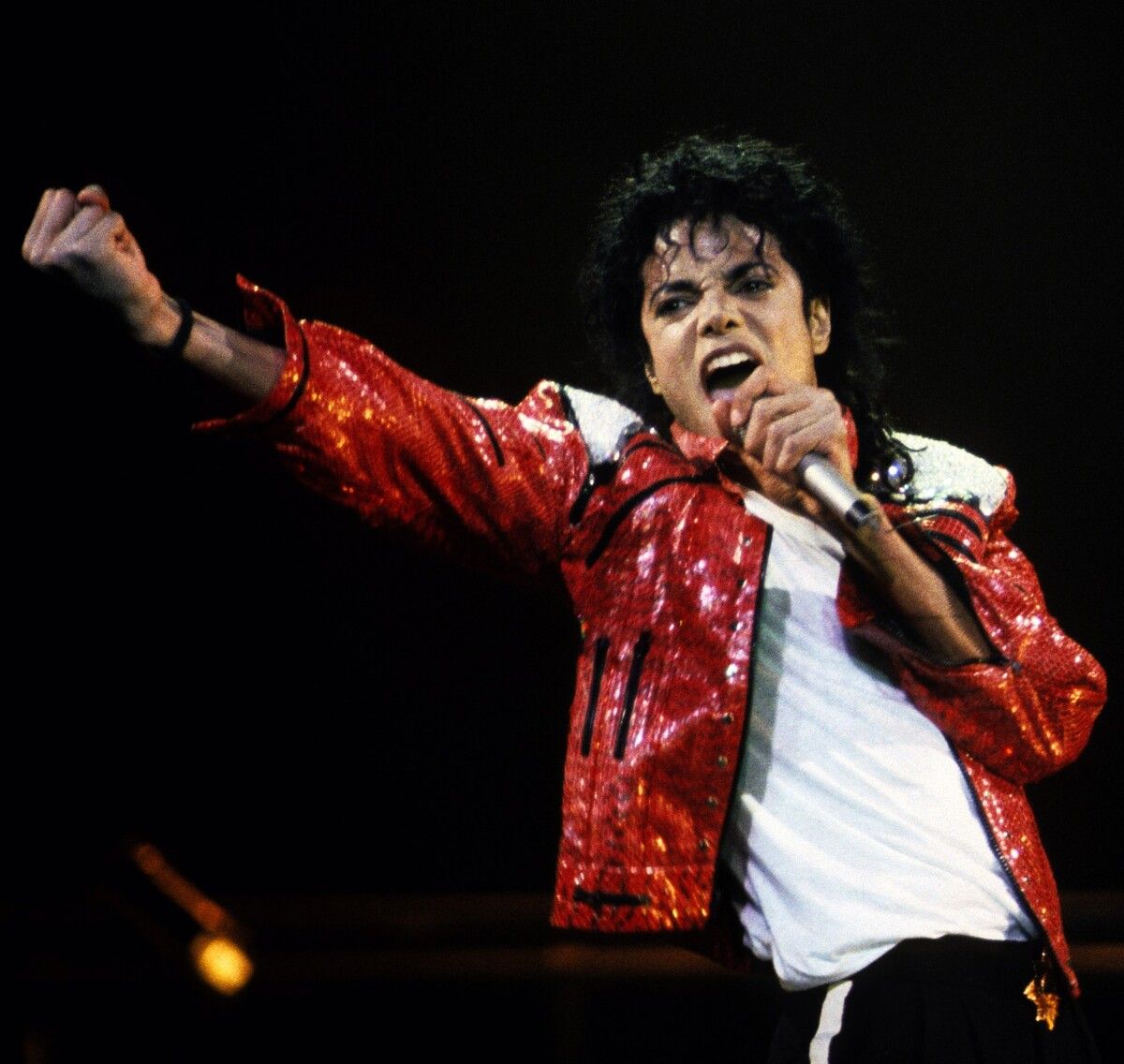
- '80s Hair: His trademark Jheri Curl, as seen in the image above.
- The Ace: He is the highest-selling individual musician to date, Thriller is the best-selling album ever made, and his Super Bowl Halftime still holds the record for the most watched televised concert.
- Album Filler: Or more specifically, a noted lack thereof early on. In later interviews towards the end of his life, he specifically noted this trope as the impetus to his work on his three biggest albums Off the Wall, Thriller, and Bad. He stated he asked himself, "Why can't there be an album where every song could be released as a single?" He seems to have done well with his goal there: Off the Wall was the first album ever with four Top Ten singles, Thriller had seven Top Ten singles (of nine total songs on the album), and Bad was the first album to have five #1 hits in America (only Katy Perry matched it, nearly 25 years later), seven Top 10 hits in the UK (a record that also stood for nearly 25 years until Calvin Harris beat it) and nine singles released from it in total (a record that still stands).
- Alternate Music Video: He had a few of his videos be recut or refilmed entirely:
- "Smooth Criminal" had three different cuts, all of which aired on TV in some form:
- The full ten-minute video from Moonwalker, which featured a spoken interlude. This version is considered the "official" version, and is featured on Jackson's YouTube channel.
- A shortened version set to the album mix, featuring alternate camera angles from the movie with a motion blur effect. This was shown in the credits of Moonwalker, and was the main version that aired on TV for a time.
- And a shorter edit of the Moonwalker cut that was condensed to 4 minutes for TV airplay. This one is the rarest of the three, and has only been seen sparingly.
- The original David Fincher-directed video for "Who Is It" wasn't aired in the US during its initial release, and was instead replaced by a compilation of footage from Jackson's previous music videos.
- "They Don't Care About Us" has three different versions, all filmed by Spike Lee: The well-known version that was filmed in Rio de Janerio, Brazil, and a version set inside a prison that was rarely shown on television, but was later included on the compilation Michael Jackson's Vision. The prison version was the first time in Jackson's career that he had filmed two music videos for the same song. In the summer of 2020, in light of the Black Lives Matter protests happening around the world, Lee released a supercut combining both versions of the video, with new footage of the BLM protests that were happening.
- "Smooth Criminal" had three different cuts, all of which aired on TV in some form:
- Ancient Egypt: The "Remember the Time" music video took place in an ancient Egyptian court, full of pharaohs and the like. No mummies, though.
- The Baby Trap: "Billie Jean," where the title character claims her child is his. Michael claimed that it was based on all the groupies trying to pull this on him or his brothers, though the song implies that he did spend the night with her.
- Being Watched: Rockwell's "Somebody's Watching Me" as well as his own "Who Is It" video has a face in the wall of the main character's apartment. The face seems to imply he knows what his lover has been doing to him. The lover in the short film is a high-profile prostitute.
- Black and Nerdy: He filled his homes with various forms of video games, not to mention that the whole spoken-word bit at the beginning of "Don't Stop 'Til You Get Enough", when Michael is talking about a "force", is about "the Force" from Star Wars, of which Michael was a fan.
- Bowdlerise:
- The original version of the "black panther" scene from the "Black or White" music video became controversial due to Jackson being shown to destroy glass from cars and walls. An altered version with racist text added on the glass (as in vandalism) exists, as if Jackson was an anti-Racism protester and wanted to remove all evidence of racism jokes.
- Later releases of HIStory censor antisemitic slurs that were included in "They Don't Care About Us," replacing them with synthesized percussion sounds after Jackson attracted criticism for their use. Jackson claimed that the use of such language was meant to connect to his own dilemma at the time, but accusations of Jackson being an antisemite persisted nonetheless. Versions of the album with the uncensored version of the song are now considered collector's items.
- Brother–Sister Incest: Latoya Jackson plays Michael's love interest in the video for "Say Say Say". In the video, however, they are not (apparently) related, and thankfully they only flirt.
- The Cameo: Did a disproportionately small amount of these considering his level of fame. Some memorable examples:
- Appeared in both Space Channel 5 video games as "Space Michael." Arguably, only the first one qualifies as a cameo appearance; his role in Part 2 is much more substantial.
- He also appeared as himself in Men in Black II, and as a hidden boxer in Ready 2 Rumble Boxing: Round 2.
- He also had a role in Miss Cast Away, made in 2004. He was prominently featured on the cover as a selling point (but then, according to reviews, it had nothing else to offer).
- Lampshaded in the "Liberian Girl" video, which is packed with so many celebrity cameos that Jackson himself had an equally small part in his own video.
- Canon Discontinuity: Michael didn't consider his first four albums to really be "his" as they consisted mostly of covers and featured no songwriting contributions from him at all. It wasn't until Off the Wall where he began to play a role in the songwriting process, though the album was still mostly written by other artists. By the time Bad came around, Michael had become the principal songwriter of his albums.
- Celebrity Star: The Simpsons episode "Stark Raving Dad" has Homer meeting a man named "Leon Kompowsky" who thinks he's Michael Jackson. The voice actor credited with the role was "John Jay Smith," but aside (ironically) from his singing it is Jackson's actual voice — he was a huge fan of the show and produced "Do the Bartman".
- And even though he didn't sing it, the episode also gave us one of the show's Crowning Moments of Everything in "Lisa, It's Your Birthday". He apparently didn't do the singing parts because Sony would not allow him to, though another story floating around is that Michael wanted to prank his family with the sound-alike singer (Kipp Lennon).
- And even though he didn't sing it, the episode also gave us one of the show's Crowning Moments of Everything in "Lisa, It's Your Birthday".
- Child Prodigy: His knack for performing reportedly started as early as the age of four, where he was described as being able to "sing love songs as if he knew what they meant." While he did not yet write his own songs, he danced and sung with such skill that rivalled professional dancers and singers.
- Children Are Innocent: Jackson took every opportunity to express this sentiment, whether in his songs, interviews, concerts, etc.
- Claymation: In the video for Speed Demon, Michael encounters several claymation characters and ends up on the run from them. When he enters the wardrobe, he becomes one himself — a motorcycle-riding rabbit named Spike.
- Clothes Make the Legend: White socks, short trousers, black trilby, and single sparkly white glove; also a red leather jacket, military jackets, etc. And let's not forget his "Smooth Criminal" attire.
- His vests and floppy hats during the Jackson 5 period, too.
- Cloud Cuckoolander: Regardless of how one feels about his unquestionable musical talent, it's generally agreed that Michael could be a bit...odd. Among other things, he owned a chimpanzee named Bubbles, repeatedly altered his appearance with plastic surgery and later heavy makeup (the latter to disguise the skin disease vitiligo, which in African-Americans, causes the affected areas to turn pink from depletion of pigment), turned his home Neverland into an amusement park (okay, that one sounds pretty cool), and was known for prank calling various celebrities including Russell Crowe and Lou Ferrigno. He also was infamous for giving borderline nonsensical replies to questions in interviews.Chris Rock: I saw Michael on 60 Minutes, Ed Bradley tried his best to make Michael look like a mammal. Like somebody that drank water and breathed air, right? He gave Michael the easiest questions in the world, the easiest GED questions in the world, and Michael could not pass the test.
- Concept Album: Off the Wall is about the ups and downs of partying while Blood on the Dance Floor as an EP (without the remixes) could very well be a concept album on inner demons such as lust, addiction, jealousy, and masochism.
- Concept Video: Most of his music videos, which he preferred to call "short films".
- Michael Jackson's Thriller: Where a date turns into a real, live, dancing horror movie.
- "Bad": Features Mike as a young man coming home from a prep school, and confronting his old friends from the 'hood.
- "Beat It": Michael intervenes and stops a Mob War through the power of dance.
- "Billie Jean": A mysteriously powered Michael is being stalked by a paparazzo around a barren city.
- "Speed Demon": Michael becomes a claymation rabbit named Spike in order to escape obsessive claymation fans. (Part of the Moonwalker anthology film.)
- "Remember the Time": He's a magician who tries to rekindle the flame with an old lover... who is now married to the Pharaoh of Egypt.
- "Who Is It?": Directed by David Fincher, as Michael realizes his lover is actually a wildly successful prostitute. The darkest and most adult video he ever made and, possibly due to his kid-heavy fanbase at the time, it was never shown on U.S. television and appears only on the Dangerous: The Short Films compilation video.
- Ghosts, a pastiche of black-and-white horror films combined with an allegory about his treatment by...well, everyone who wondered about his conduct with children, incorporates three songs ("2 Bad", "Ghosts", and "Is It Scary") and runs 38 minutes total, qualifying as an actual short film.
- Consistent Clothing Style: He liked clothing that evoked military tunics, be it actual blinged-out tunics or shirts embroidered to look like tunics. These also usually featured sergeant's stripes on the sleeves. He also favored shirts and jackets with very structured shoulders, sometimes even with exaggerated shoulder pads that swooped up toward his head.
- Control Freak: Jackson was always extremely meticulous about how his songs should sound, and was always personally and deeply involved in the production process, though would often defer to his producers or other musicians for a second opinion, just to be sure. This initially led to him cranking out record-breaking hits, but his increasing perfectionism and creative control gradually slowed down his output in later years.
- Cooking Duel: Several of his appearances and works has Michael's character resolve a potentially violent conflict through dance battles:
- Also in "Beat It," where he defuses a gang battle by stepping in and starting to dance, and in "Bad."
- His appearances in Space Channel 5 and its sequel, which is a game of dance battles.
- Cool Shades: Ray Bans aviators, which he adopted during the recording of Thriller, and quickly became one of his signature items. During live shows, particularly the Dangerous tour, he would toss his aviators into the crowd before launching into song.
- Crucified Hero Shot: Jackson often did this at the end of performances for his more inspirational, “world-saving” songs, such as “Man in the Mirror,” “Heal the World,” and “Earth Song.”
- This performance of “Earth Song” especially helped feed accusations of having a Messianic complex. Jarvis Cocker certainly thought so, invading the stage and giving Jackson the V sign.
- This performance
- Cute Kitten: On the 25th anniversary edition of Thriller's cover, Jackson is holding a tiger cub.
- Dark Song, Lighter Bridge: "Morphine" is a harsh industrial rock track describing his addiction to the titular drug during the late '90s, and its effects on him in unflinching detail. During the song's bridge, the industrial beat cuts out and switches to a gentle piano and string orchestra, where Jackson solemnly talks about how he got addicted and how it strained his marriage to Lisa Marie Presley, before the industrial track slams back in.
- Darker and Edgier:
- Bad was supposed to give him an "edgier" image, but it didn't really take. Later albums delve into this trope more effectively with darker themes and aesthetic (e.g. "Who Is It" from Dangerous).
- Also, while Thriller is still pretty light-hearted, it's considerably edgier than his preceding albums, with its main hits having the subjects of horror fiction ("Thriller"), babies trap ("Billie Jean"), and gangster violence ("Beat It").
- The Dead Can Dance: His Thriller video is the Trope Codifier, with many subsequent "zombie dances" mimicking moves from the video. Done again in Ghosts.
- Deliberately Monochrome: The videos for "Scream," "Stranger in Moscow" and the Talky Bookends of "Bad."
- Digital Piracy Is Evil: Downplayed. While MJ didn't support piracy, he was far harsher and critical of the Digital Millennium Copyright Act that was meant to combat it than the practice itself. He believed solutions like iTunes to be a far better option.
- Dirty Old Man: The press started to categorize him as this in the 1990s and 2000s, especially 1993 and 2003-2005, due to the major accusations of child molestation and sexual abuse. 2019's Leaving Neverland posthumously reignited the controversy over his legacy, with some feeling he evaded justice, and others believing the documentary was unfair as he was no longer alive to defend himself.
- Distinct Double Album: HIStory, one disc being old "greatest hits" material, the other being new music.
- Door Slam of Rage: At the beginning of the music video for "Black or White", the father orders his son to go to bed and slams the door to his room so hard, a picture frame hanging above comes down.
- Dude Looks Like a Lady: Due to his constant plastic surgeries and rather high voice, Jackson often came off as somewhat androgynous.
- Early-Bird Cameo: A demo version of "Another Part of Me" appears at the end of the 1986 short film Captain EO in which Michael starred. It has different synth sounds to the final version, although similar vocals. The following year, the final version of it appeared on Bad, and the year after that, as a single.
- Early-Installment Weirdness:
- Michael's first solo album, Got to Be There, was released when he was only 13 years old and best known for being the lead singer of The Jackson 5. It kicks off with a more-than-respectable cover of "Ain't No Sunshine," but from that point forward is very ballad-heavy. Even the more well-known stuff ("Rockin' Robin" and the title song) don't hint at any aspect of the post-disco dance pop that defined the style of his '80s albums. His next three albums are more of the same, and even Off the Wall was far more disco/quiet storm than one might expect from his later work, without any rock crossovers or anthemic ballads about saving the world.
- For that matter, Michael's first chart-topping single, "Ben," sticks out like a sore thumb compared to what followed — not just because of his age (he was 14 when he recorded it), but because it's a movie tie-in about a boy and his violently-protective pet rat. This is probably why the different versions of his Number Ones compilation album either omit the song or use a later live recording from when Michael was an adult.
- Earth Song: "Earth Song" is a song made to promote environmentalism and animal welfare, originally made for Dangerous before it was cut and later featured on HIStory: Past, Present, and Future, Book I.
- Embarrassing Nickname: His detractors in broadcasting and tabloids would often call him "Wacko Jacko" due to his eccentric lifestyle.
- Epic Rocking: Dangerous has ten songs over five minutes long (though "Will You Be There" stole some Beethoven for its intro). Disc two of HIStory has three numbers over six minutes (including "Earth Song"), and Invincible opens with the 6:25 "Unbreakable".
- Would also draw out live performances, fake-ending them several times, similar to James Brown.
- Everything's Better with Sparkles: He wore silver sequins on his glove and socks for this reason; with sparkly white socks, viewers could pay attention to his dance moves more easily.
- Everything's Deader with Zombies: Thriller features not only dancing zombies, but Jackson himself becoming a zombie.
- Face-Revealing Turn: The music video for "Thriller" has possibly the most famous (and most frequently parodied) use of the trope of all time.
- Failed Future Forecast: The song "Stranger In Moscow" has Jackson being stalked by a KGB agent with the song presumably ending with the KGB agent interrogating him about trying to subvert the pro worker regime. The song came out a few years after the USSR collapsed in 1991, making the KGB and the Soviet regime a thing of the past. Although it apparently takes place in pre-Glasnost Russia.
- Fake Shemp: Famously, when he wasn't available, the video for the Jacksons' "Torture" used a wax dummy and elaborate costumes.
- Michael had also used an impersonator for certain shots in his "Who Is It" video because he was busy with the Dangerous tour at the time. That same impersonator (E'Casanova Evans) also stood in for MJ in Back to the Future Part II.
- Forced Meme: Wanting a title akin to "The King of Rock N' Roll" or "The Boss", Jackson had "King of Pop" thought up by his handlers (albeit a longer version, "The King of Pop, Rock, and Soul"). During the promotion of Dangerous, Jackson's management urged MTV and Fox to refer to him as the King of Pop basically whenever they mentioned him. It caught on, even if during his downturn years the media took to calling him "the self-proclaimed King of Pop" to show it was mostly a demonstration of Small Name, Big Ego.
- Free-Handed Performer: Though he contributed conga, tambourine, and percussion parts as a member of The Jackson 5, as a solo artist, his stage presence consisted solely of singing and dancing (ironically while dealing with lupus-induced respiratory issues).
- Friend to All Children: No other pop star in history utilized this trope as much as Jackson. Many of his works portray him as this.
- Gem-Encrusted: Most of his costumes as time went on. The ones he would have worn in the This Is It tour would bring it up to eleven.
- The Generalissimo: Jackson’s motif for the HIStory album, but even for years prior to this album, he was known to wear fancy military attire.
- Giant Spider: This is It features a giant black widow spider in the Thriller segment. Not only is one on screen (this would have been in 3D, no less), but one scurries on stage that opens up to reveal Jackson.
- Grand Finale: This is It was going to be a Grand Finale for his career; he died before it could start.
- Greatest Hits Album:
- The double album HIStory has this as a first disc and an album of new material as a second disc. The first disc became available separately in 2001.
- For straighter examples, popular examples are Number Ones, The Ultimate Collection (actually a career-spanning box set), The Essential Michael Jackson (which is part of Sony's acclaimed Essential series), and King of Pop (which had different versions in many differeny countries due to fans voting their own selection of songs). There's also all manner of compilations covering his material as a child star.
- Guyliner: Wore it from the mid-80s onward, allegedly having tattoos on his eyelids to resemble this in his later years.
- Halloween Episode: "Thriller" and "Ghosts" lean into the Halloween spirit in their music videos with eerie imagery and creepy lyrics to match.
- Hates the Job, Loves the Limelight: Jackson openly admitted he hated touring; both because of the stress it caused, and because it was a record label requirement. However, he did love getting to interact with and entertain fans because of it, as well as getting to see different countries around the world.
- I Am the Band: Jackson was the front man of the Jackson 5, and once he left the contrast between him and his brothers became exponential.
- Important Haircut: He usually changed his hair when he did the same to his wardrobe.
- From childhood up until Off the Wall, Michael had a sizable afro, like his brothers.
- During the 80's, Michael famously sported a jheri curl, which was medium-length during the Thriller-era, but longer and looser by the time he released Bad.
- During the 1990's, leading up to his eventual death, Michael experimented with straight hairstyles of varying length, most famously a straightened, shoulder-length do.
- Increasingly Long Installments: During his solo career under Epic Records, Jackson's main studio albums became progressively longer and with more tracks over time. Off the Wall and Thriller are both a little longer than 42 minutes (with 10 and 9 tracks, respectively), Bad is about 46 minutes long with 11 tracks, Dangerous is over 76 minutes long with 14 tracks, and the "HIStory Continues" disc of HIStory: Past, Present, and Future, Book I and Invincible both clock at over 77 minutes (with 15 and 16 tracks, respectively). Jackson had ambitions to drastically extend his album lengths as far back as Thriller, but he was restrained during the productions of Thriller and Bad by Quincy Jones, his then-producer who wanted the albums to fit within single discs of the then-predominant vinyl format in order to ensure that the albums could have a good commercial performance; it was with Dangerous, his first album without Jones and produced during the rise of the Compact Disc, when Jackson was granted greater liberty in album length, though he sticked to making every album from there on fit within a single disc on CD format. Fittingly, the amount of written and recorded material for each studio album (be it released officially, leaked unofficially, or reported) also grew concurrently with their final lengths, ranging from just a bit more than 20 total proposed songs for Thriller to a maximum of 87 songs for Invincible.
- Intergenerational Friendship: He was close friends with Elizabeth Taylor, Gregory Peck and Marlon Brando who were all decades older than him. In the other direction he was also friends with Macaulay Culkin (who he later named as godfather to his two oldest children), Corey Feldman and Emmanuel Lewis and was at least a decade older than them.
- Involuntary Charity Donation: Happens in the "Say Say Say" video with Paul McCartney. McCartney and Jackson play Mac and Jack, a pair of old-time con men who travel around selling snake oil, hustling pool, and performing reckless vaudeville shows. They donate the money they take in from their victims to an orphanage.
- Insistent Terminology: From the Dangerous era onwards, he stopped calling his music videos "music videos," exclusively referring to them as "short films" (technically he wasn't wrong, but by and large they still wholly fit into the "music video" category), even the ones that were just bare-bones footage of him performing; even his official Vevo channel gets in on the act! Similarly, his songs with the Jackson 5 were always called "the Old Songs," with his solo works being "the New Songs."
- Intercourse with You:
- A few songs seem romantic, but are clearly this trope. At the very least, Invincible's "Break of Dawn" doesn't hide it, despite the sombre mood.
- Subverted with "The Lady in my Life,". It was one of two tracks not released as a single from Thriller, and has uncharacteristically sexual lyrics.
- Japandering: Not often, but his massive popularity in Japan landed him a few commercials there; the most famous one being a commercial for Suzuki scooters. Jackson was also a crucial part of the Sega Genesis' pre-Sonic the Hedgehog marketing in Japan, though that also made its way to the west as part of the "Genesis Does" campaign.
- Jerkass Realization: "Man In The Mirror" is about someone who realizes he's been self-centered and vowing to change for the better.
- List Song: "Why You Wanna Trip On Me" is a list of things Michael thinks people should worry about more than his personal life. "Earth Song" has a similar list near the end of the song of things Michael thinks we should worry about involving the Earth's ecology.
- Long-Haired Pretty Boy: Between the afro he sported in the 70s, and his signature long hair in different variations from the 1980s and 90s, Jackson was very popular with his female fans.
- Loony Fan: Billie Jean was reportedly inspired by a fan who claimed Michael was the father of one of her twins, when Michael ignored her she sent him a photograph of herself and a gun, that she told him to use on himself on a certain date. Michael was so scared of her he carried this woman’s photo everywhere, memorizing it in case he ever saw her.
- After the song came out another mentally unstable fan would change her name to Billie Jean and spend her entire life stalking him, staging regular break ins to both Encino and Neverland, suing him for spousal support and even after his death, suing and demanding custody of his children.
- Loophole Abuse: After the 1994 civil settlement, Jackson was forbidden to ever explicitly reference the trial, or the accusers by name. So on his album HIStory, he threw subliminal disses at everyone involved, sans the actual kid who made the claims. Jackson also called out Santa Barbra district attorney Thomas Sneddon by name, and got away with it by changing the name to "Dom S. Sheldon" in the liner notes. This was soon taken to the extreme when Jackson actually managed to get a lawsuit thrown out over breaching the confidentiality agreement on the album a year later.
- Loud of War: The video for "Black or White" opens with a father insisting his son turns his music off, only for the son to set up a ridiculously large guitar amp and crank it all the way to "Are You Nuts!?!", with rather destructive effects.
- Lyrical Dissonance:
- "The Girl is Mine" is a light '80s pop song about two guys fighting over a girl, who's probably playing them both for someone less obsessive than either of them.
- "Billie Jean" is an upbeat dance number about an obsessive fan.
- "Smooth Criminal" is a dance-pop song narrating a woman being attacked in her apartment by a criminal and presumably murdered.
- Madonna-Whore Complex: Jackson's songs involving women are typically either saccharine love songs—"Lady in My Life," "The Girl is Mine," "I Just Can't Stop Loving You," "You Are Not Alone"—or portrays them as overly sexualized, untrustworthy manipulators—"Billie Jean," "Dirty Diana," "Dangerous," "In the Closet". Given that he never really had a chance at a normal dating experience and his only relationships were with obsessive female fans or other pop superstars.note
- Medium Blending: The claymation, blended with real backgrounds and people, in the video for "Speed Demon."
- Metal Scream: "Dirty Diana" has some surprisingly epic ones toward the end.
- Michael Jackson's Thriller Parody: Trope originator, obviously. There are countless parodies of dancing zombies that can be directly traced to "Thriller."
- Moonwalk Dance: Never claimed to invent it, but popularized it; performed it at every live concert, and it became one of his immortal trademarks.
- The Movie: Moonwalker and/or This is It can apply.
- New Jack Swing: The undisputed best selling artist of the genre during the 90s, with a combined total of 58 million albums sold worldwide between 1991-97note Jackson also wrote and produced tracks for several new jack swing artists such as Ralph Tresvant and Blackstreet.
- New Sound Album: Off the Wall, a pop-R&B album, was this to his previous solo work as a "bubblegum" child act. From that point on, his work followed the trends of pop music in general, with each subsequent album taking on a new sound.
- No Animals Were Harmed: A disclaimer at the end of the music video for "Earth Song" says that no animals were harmed during the making of the video, though an unnamed poacher had killed an elephant within a mile of the shot.
- Obsession Song: "Baby Be Mine", "Billie Jean", "The Girl Is Mine", "I Just Can't Stop Loving You", "Dirty Diana", "Streetwalker", "Can't Let Her Get Away", "Remember the Time", "Who Is It", "Give In to Me", and "Dangerous".
- One-Man Song: "Ben," although the "man" in this case is actually a pet rat.
- One-Woman Song: "Billie Jean," "The Lady in My Life," "Liberian Girl," "Dirty Diana."
- Only Known by Their Nickname: His youngest son, Prince Michael Jackson II, is known as "Blanket." He would eventually drop this as he grew up and go by "Bigi" instead.
- Ordinary People's Music Video: "Black or White" has dancers from all around the world, wearing traditional garb and performing traditional dances. The final segment features several people of different races and gender morphing into another person.
- Our Founder: The trailer for his HIStory album shows him heading an army and erecting a giant statue of himself. That statue trick (it served as the cover of the album, and actual replicas of it were circulated on his tour) was criticized even by his fans as being too Small Name, Big Ego.
- Parody Assistance: Jackson was a strong supporter of "Weird Al" Yankovic, allowed Yankovic to use the “Badder” set from Moonwalker to film his "Bad" parody, "Fat", had Al as one of the many celebrity cameos in the video for "Liberian Girl", and preemptively gave Al permission to parody nearly every song in Jackson's library. The only exception was for "Black or White", because Jackson felt the song's subject matter was too serious to be parodied.
- Pass the Popcorn: Sorta does this in the "Thriller" video, noshing away at popcorn while his girlfriend recoils in terror during the movie. An animated gif featuring this scene has become a massive meme.
- The Perfectionist: Notoriously so, to the point where it got him in trouble with his label. According to many of his producers and session musicians, the general rule of thumb was that if Mike wasn't dancing in the booth as he was recording, he wasn't feeling the record, and would tweak it and re-record it constantly until he was fully satisfied. Unfortunately, this led to his album cycles taking longer than they'd typically need to, eventually forcing Epic/Sony to impose deadlines on him twice in order to get records from him out on time.
- Photographic Memory: Those close to him claim that he could remember names, stories, info relating to encounters with people many years before.
- Pop-Star Composer: In the mid 2000s, it was discovered that Jackson had a hand in composing some of the soundtrack of Sonic the Hedgehog 3, with most evidence pointing to the fact that most of the songs are either uptempo or
 Suspiciously Similar Songs of tracks from his Dangerous album. He is not credited in the game itself, with the official reasons being that he disliked the low-grade sound equipment used to make Sega Mega Drive music, but given that he had somewhat bigger things to worry about in early 1993, it's easier to see the true reasons behind his abandoning the project. He later lent his voice and likeness to another Sega project, Space Channel 5, and provided beatboxing to his mission theme, but otherwise didn't compose it himself.
- Shortly after his death, it was revealed that he did work on ''Sonic 3'', and his estate gradually became aware of the fact; which reportedly led to legal issues preventing Sonic 3 from being re-released for years afterward. Sonic co-creator Naoto Ohshima also revealed that Jackson had sent Sega a demo tape of tracks for the game, but it went unused, and was locked away in a vault.
- Shortly after his death, it was revealed that he did work on ''Sonic 3''
- Precision F-Strike:
- During the 2nd chorus of "Scream":
"Stop pressuring me, stop pressuring me, stop fucking with me."- The very last line of "Earth Song": “Do they give a damn?!”
- In a interview around 2004, Michael was asked about his depiction in Eminem's "Just Lose It" music video. Though he kept it fairly civil throughout, he quoted Stevie Wonder's stance on Eminem:
- Michael: Stevie said "He's bullshit", that's what he said...
- Protest Song: "They Don't Care About Us" addresses several political subjects such as police brutality, racism, and corruption. "Earth Song" similarly calls out pollution, deforestation, and animal cruelty.
- Pun-Based Title: HIStory, which can be interpreted as "history" or "his story".
- Rearrange the Song: From the ground up! The demo for "P.Y.T. (Pretty Young Thing)" was a smooth R&B jam, virtually an entirely different song to the fast-paced dance number on Thriller. In actuality, frequent collaborator Quincy Jones wasn't keen on the demo itself but loved the title so much that he created a much more upbeat song with the same title. Thanks to The Ultimate Collection, fans got to hear the original in 2004.
- Remix Album: Four of them. The Original Soul of Michael Jackson (1986), Blood On the Dance Floor: HIStory in the Mix (1997), and The Stripped Mixes and The Remix Suite (both 2009).
- Real Life Writes the Plot: "Leave Me Alone," of course, directed at the media and tabloids, who in 1987 had already begun playing up the whole Wacko Jacko schtick.
- Scatting: Jackson was known for his impressive beatboxing skills, and not only was it prevalent in his material as an adult, he also used beatboxing to create rough demos of his songs, before giving them to his producers to flesh out; "Beat It" being a well known example. This particular skill actually helped him win a plagiarism lawsuit because he was able to demonstrate how he composed his songs in such a way.
- Self-Backing Vocalist: You can pick up his own distinctive voice in the backing vocals to a majority of his songs, starting as early as "Got to be There" and "Rockin Robin". He also commonly provided his own backing "vocal instrumentation" with beatboxing and the like (as in Tabloid Junkie).
- Shout-Out:
- Bad is a shout-out to Cool from West Side Story.
- "Smooth Criminal" is a shout out to Fred Astaire.
- "Beat It" is reminiscent of West Side Story: What if Tony had stopped the fight?
- The "Thriller" section of This Is It starts out in The Haunted Mansion — ghosts having a party in a ballroom, and the "narrator" implied to have hanged himself — and ends like Night on Bald Mountain/Ave Maria — the ghosts return to their graves at sunrise; there's also "dead bride and dead groom" "kites" that resemble the ghosts in "Night on Bald Mountain."
- Signature Headgear:
- His black Trilby. During some concerts, he threw it into the audience.
- The white fedora from "Smooth Criminal" and "You Rock My World" can also qualify.
- Signature Move: The moonwalk. Also, to a lesser degree, his pelvic thrust, right-leg kick, and tiptoe stance.
- Singing Voice Dissonance: Zig-zagged. As mentioned above, the powerful, masculine-sounding voice he talked with in private was also his real speaking voice. That famously feminine-sounding falsetto he was known to sing with? That was a put-on.
- Solo Duet: Re-recorded "I'll Be There" for a Pepsi commercial as a duet between his younger, Motown-era self, and his adult self.
- The Something Song: "Earth Song."
- Space Episode: "Scream" features Jackson and Janet together floating through a massive futuristic spacecraft.
- Take That!: The song "D.S.", from the HIStory album. The lyrics say that someone named "Dom Sheldon" is a cold man, but if you listen to the song, he's clearly saying "Tom Sneddon", the Santa Barbara DA who went after him for child molestation back in the '90s and again in 2005 — in fact, some people believed that Sneddon had a vendetta against Jackson because of this song, and it was at least part of the reason he took him to trial.
- Talky Bookends: Popularized this trope with the "Thriller" clip. The film opens with a short skit, ends with a short skit, and in between is music video magic.
- Technician Versus Performer: MJ was both, but is generally considered the more performative artist compared to Prince. While both were very meticulous about their music, and had amazing stage presences, Prince was a multi-instrumentalist, and produced all of his tracks by himself. Jackson, while able to play some instruments, sometimes relied on other producers to make some of his tracks.
- Think of the Children!: Claimed that some of his creative output was based on this trope.
- Title: The Adaptation: Michael Jackson: The Experience (a video game).
- Trope Codifier: For the modern, plot-driven type of music video (ones previous to him were mostly just shots of the band playing), for the modern style of pop performances (one of the first to have synchronized choreographed dance while singing), and for the modern pop artist image and persona.
- Truck Driver's Gear Change: "Man in the Mirror" contains a key change on the word “change”. Also happens towards the end of "Rock With You".
- Unique Enemy: The full, 18-minute cut of the "Bad" video is this, compared to the rest of Jackson's videography. His music videos occasionally touched on social issues, but usually kept things pretty light, and always stayed firmly within the realm of polished escapism. "Bad," on the other hand, is a gritty and surprisingly intense social drama directed by Martin Scorsese. Jackson plays a teenager in pre-gentrification Brooklyn, on break from his exclusive private school. His character is pressured into a life of petty crime by his ghetto friends, refuses to join in, and finally snaps under the stress.
- Verbal Tic: "HEE HEE!", "I don't know!", "CHAMONE!", "WOOH!" and his fairly unique vocal "hiccup" style also qualify.
- Vocal Evolution: Since he spent virtually his entire life being recorded, one can follow this quite precisely as he went through puberty, etc. This is It is sometimes held up as a late-in-life example, but Jackson made it clear that he would not stress his voice too much during rehearsal sessions, so there's really no way of knowing what he was still capable of by that point.
- What Measure Is a Non-Cute?: Averted with his song "Ben", which, despite being about a rat from a horror movie of the same name, is quite heartwarming.
- Zipperiffic: The red jacket he wore in the "Beat It" video was covered in zippers, and was iconic enough that it's a likely trope codifier.
