

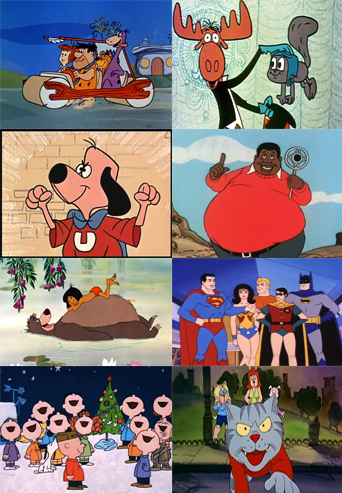
The unfortunate successor to The Golden Age of Animation, starting in the late 1950s and lasting until the mid 1980s. Limited Animation, as well as the limitations of Mismatched Atomic Expressionism, was the rule, not the exception, during this time. Its start coincided with the Fall of the Studio System in Hollywood. The theatrical short slowly died off, and cartoons moved to television. Naturally, this era would leave a lasting impression on American culture, for better or for worse, as the primary target audience for cartoons became children.
Originally, Limited Animation was primarily an artistic choice for filmmakers like Chuck Jones, Robert Cannon, and John Hubley who were tired of Disneyfication. With the closures of UPA and MGM's animation studios, it became primarily about saving time and money.note Hanna-Barbera – founded by the eponymous duo in response to MGM abruptly shuttering its animation unit and firing them – was very prominent during this time (to the extent of holding a monopoly over the Saturday morning animation market by the '70s), thanks to how cheaply produced and rushed their television cartoons were. Given how these series used dialogue over visuals to move the stories forward, they rapidly became what Jones would describe with justified derision as "illustrated radio". Still, they created not only successful kids fare in the 60s like Yogi Bear, but prime time series like The Flintstones and The Jetsons and the influential Adventure Series Jonny Quest, which created a whole new television animation genre. Unfortunately, the studio soon fell into a crippling creative rut with the Saturday-Morning Cartoon timeslot, which led to them endlessly copying the concepts of their most successful shows, and filling in the rest of the time with reruns, with Scooby-Doo and the long-running, oft-retooled Super Friends the most prolific templates.
Filmation also got its start during this time, although it wouldn't hit prominence until much later during the '80s. In the meantime, it did give us shows like Star Trek: The Animated Series (which was a continuation of the original show after it was cancelled), Flash Gordon, and Tarzan, Lord of the Jungle which were wonderfully respectful of their source material, while Bill Cosby's Fat Albert and the Cosby Kids was a surprisingly enduring Edutainment change of pace. However, like Hanna-Barbera, they also relied on notoriously low budget animation (even more so than H-B) and corner cutting to get their cartoons out as quickly and cheaply as possible. Hanna-Barbera writers Joe Ruby and Ken Spears also formed Ruby-Spears around this time and churned out a number of properties based on celebrities, toys, and other Animated Adaptations of sitcoms, mimicking their former employer's animated style to a T. Former WB director Friz Freleng kept his own hand in the field with DePatie-Freleng Enterprises, which supervised the final batch of theatrical Looney Tunes shorts and then created The Pink Panther and various series before being purchased by Marvel Comics to become Marvel Productions.
Unfortunately, the budgetary constraints became ever more onerous on producers, with rock bottom arguably being Clutch Cargo with its ridiculous "Synchro-Vox" method of using live action lips speaking the dialogue; while scarcely less limited in terms of animated motion otherwise, Grantray-Lawrence's xerography method for The Marvel Super Heroes at least largely captured the heady energy of artists like Jack Kirby to make it look like the comic artwork comprising their source material had come to life. Furthermore, the Animation Age Ghetto was exacerbated with parents groups pressuring the networks to impose increasingly onerous content restrictions that occasionally come off as rather arbitrary in nature — e.g., The Complainer Is Always Wrong, Never Say "Die" — while classic cartoons like Looney Tunes were heavily Bowdlerised to appease such demands. However, this lobbying did have some positive results, with the push for educational programming helping create the classic Schoolhouse Rock! shorts, which taught whole generations with wonderfully tuneful songs.
In somewhat better artistic position was the realm of primetime TV specials, which didn't have the overwhelming budgetary and production time demands of a full series. For instance, there was Rankin-Bass, which created a large series of Stop Motion productions in a process called Animagic, such as Rudolph the Red-Nosed Reindeer and Santa Claus Is Comin' to Town, spanning from the former's debut in 1964 to the mid-'80s. There were also the animated adaptations of the Peanuts comic strip by Lee Mendelson and Bill Meléndez beginning with the instant-classic A Charlie Brown Christmas, whose rushed production was more than compensated by a profound artistic sincerity and the jazz music compositions by Vince Guaraldi.
However, this does not mean everything from this era was bad. Disney's output remained respectable and generally well animated. Walt Disney, had, by this time, begun to draw away his focus on films due to his increased interest for television and theme park projects during the '50s. Disney had been feeling more and more creatively stifled as the decades moved on; the bold, experimental projects that had made him a household name in the 1920s and 1930s nearly ruined him in the 1940s as audiences' tastes changed and his artists experienced the strain of appeasing his demands (while receiving virtually no on-screen credit, none the less) within an increasingly industrialized working environment, as opposed to the more close-knit familial atmosphere of the studio's early-'30s incarnation, climaxing in a 1941 strike depriving Disney of over a thousand staff members, including master animators Art Babbitt and Bill Tytla. Resultantly, Disney's lofty ambitions for the medium rapidly eroded over the following decades, increasingly delegating the creative tribulations of his feature films to directors such as Gerry Geronimi and the emergent group of directing animators dubbed the 'nine old men' and shifting to an emphasis on generally more family-friendly and formulaic material while pursuing other creative ventures. He attempted one last shot at a more experimental animated film at the end of the decade with Sleeping Beauty (1959), an enormously high-cost attempt to craft a film coherently translating the angular, stylized concept art of staff background artist Eyvind Earle into an hour of full animation. Despite Disney's initial high ambitions for the film, its mammoth cost, compounded by creative conflicts between Earle and the film's directors, elongated production across almost a decade and resulted in the film's box-office 'failure', given the magnitude of earnings required to recoup its budget. Subsequently threatened by bankruptcy, Disney laid off a number of his staff members (including several longtime animators), retreated from fairy tales for the next 30 years, and reluctantly ceded to using the xerography process, a dry photocopying process that eliminated the need to hand-ink the animation, which was both a cost-cutting measure and the only practical way to produce a film with such visual complexity as their next feature, 101 Dalmatians. However, the technology only allowed for black outlines, which forced a hard scratchy visual style for years (at least until The Rescuers, when softer outlines with various colors became technically possible). These changes had a noticeable effect on the quality of the 1960s Disney films, and the death of Walt in the middle of the decade hit the company extremely hard, sending their studio into a hard slump post-Jungle Book. Although they would release a few features that critics enjoyed and made moneynote , Disney continued to struggle, forced to use re-releases and the theme parks to stay afloat, until the release of two movies in the late 80's that were huge hits with critics and audiences and showed that they finally recovered enough to be compared to their Golden Age heights.
Looney Tunes was still producing some decent and entertaining shorts late in The '50s, as some of its most memorable shorts were from this decade. While the animation was increasingly limited following the studio's re-opening (after a six-month closure in the wake of the 3-D craze) in 1953, the writing, along with the continued high-quality output emerging from the unit under the directorial wing of Chuck Jones, managed to produce some timeless classics in spite of that. However, due to budget problems, Warner Bros. forcibly shut down its animation studio for good in 1963 (though a brief revival was unsuccessfully attempted in the late 1960s). The characters would get a revival in the form of the smash hit anthology repackaging series The Bugs Bunny Show, which reaired many of their old theatrical cartoons and, being exposed to younger audiences, ultimately helped to immortalize the characters as pop culture icons. In syndication, The Porky Pig Show did the same for many other shorts that weren't shown on its parent series. (And not just Warner Bros., either; if any motion picture company had a theatrical short to their name, animated or not, they would be on the bandwagon). With the onset of the 1980s, the surviving players of the Golden Age were about to get back in the game in a big way.
Limited Animation pioneer John Hubley did his best work at UPA in the early '50s, with theatrical shorts such as Rooty Toot Toot. After falling victim to a HUAC blacklisting at the height of the Second Red Scare in 1952, Hubley was fired from UPA and became a noted independent animator, producing a series of distinctive and personal films with his wife Faith as well as educational shorts for PBS shows. This was a booming period for trippy, avant-garde European animation such as Fantastic Planet and Yellow Submarine. In Canada, the National Film Board of Canada encouraged exploration in all kinds of Deranged Animation techniques, most famously with the work of Norman McLaren who produced wildly creative shorts like Begone Dull Care (drawn-on-film animation set to Oscar Peterson's jazz music), Neighbours (pixilation) and Pas de deux (ballet with optical printing enhancements).
Animator Ralph Bakshi, who got his start in this era in the twilight years of Terrytoons working on the Sad Cat shorts and the Mighty Heroes TV show, rose to prominence during this era thanks to his breakout hit Fritz the Cat. This film, along with Watership Down, challenged the idea that cartoons were solely "kids' stuff", an idea that was becoming increasingly popular at the time due to the diminishing quality of the cartoons of that time period, as well as people becoming overly familiar with the Disney style of family oriented entertainment coming out.
Bakshi would also go on to make a variety of animated features that challenged the Animation Age Ghetto such as an animated adaptation of The Lord of the Rings (1978), which despite extremely mixed critical reaction was ultimately a box office success. Lesser films included the downbeat urban drama, Heavy Traffic, the musical history drama American Pop and the Frank Frazetta-inspired fantasy, Fire & Ice. The Canadian Heavy Metal would create its own cult interest late in the game (1981) with its erotic dark fantasy stories set to throbbing music. Even Hanna-Barbera brought a respectable adaptation of Charlotte's Web to the big screen in 1973. Some cartoons from this era may have had mediocre to poor animation but were ultimately saved by good writing; shows like Rocky and Bullwinkle would be a particularly good example of that. Likewise, Terry Gilliam's surreal animated skits in Monty Python's Flying Circus – utilizing his own artwork, antique photographs, and classical music and military marches played at double speed – would prove to be enormously influential.
Also, Anime was making its first impact in North America with such imports as Astro Boy, Speed Racer, Space Battleship Yamato (aka Star Blazers), Kimba the White Lion, Battle of the Planets and, toward the tail end of the era, Voltron. Not to mention the various kiddie series that populated basic and pay cable channels, such as Superbook, The Little Prince, and Honey Honey. While it often was crudely Bowdlerized, the form's distinctive look and content created a cult following that would eventually grow into much more, although production quality – following the tricks of the trade pioneered by Osamu Tezuka – started and remained very low-budget and corner-cutting until the medium blossomed in the early 80's in tandem with Japan's rising economic fortunes. In Japan itself, animation as a medium began to slowly break out of its version of the Ghetto with Tezuka's Mushi Productions' "Animerama" films plus 1971's Lupin III: Part 1, the first anime specifically for adults… which failed in its initial run but was later vindicated by reruns and served as a green-light for networks to air less-kiddy shows from the likes of Go Nagai and Leiji Matsumoto. Many popular animated franchises (some still going to this day) got their start in this era, like Sazae-san, Doraemon, World Masterpiece Theater, Urusei Yatsura, and the Gundam franchise.
The Soviet Russian Reversal, however, was still in effect. Behind the "Iron Curtain", many Soviet cartoons saw light at the end of the tunnel. Some are dark, some are educational, some are just damn fun. And not only were they successful inside the country (Not even talking about a huge amount of fans who love them even today and make English translations), one of them even got a ton of awards. Considerably, Limited Animation was not an option for Ivan Ivanov-Vano's cartoons made in this era, every one of which felt like a throwback to the time of Disney's golden era when hand-drawn people and animals moved as smoothly as never before (or after). Over in Yugoslavia, the animators of Zagreb Film, inspired by the work of UPA, took that style further, producing a slew of clever, strikingly designed shorts; one of them, Ersatz, was the first non-American cartoon to win the Academy Award for Best Animated Short Film. However, the Eastern European industry also brought forth Gene Deitch's Tom and Jerry shorts in the 1960s, which were… interesting to say the least.
Animation Age Ghetto is a trope that has its roots firmly planted in this era, due to a growing emphasis on conservative values from the 50's onward that led to Moral Guardians attacking anything that they didn't consider child-friendly. Check it out to see the full impact of this era on the typical viewer's idea of a cartoon nowadays.
The end of this period is usually believed to be the mid/late1980's, though the exact year is debated. Some say the dark age ended in 1983note , while others say in 1985note , 1988note ; the latest ending given for it is generally 1989.note
For this era's successor, see The Renaissance Age of Animation (which lasted from the mid-1980s through the early 2000s).
Chances are whenever you see a parody of this era or something that was made during it, it's either a Take That! or an Affectionate Parody at the least.
- Ralph Bakshi: Got his start early in this era as a worked at Terrytoons during its late years, later became the most prominent independent animator in this time period, whereupon he hired (and fired)…
- Don Bluth resumed working during this era, after leaving Disney in the early 60s to go on his Mormon recruitment mission, eventually getting fed up with the public's complacency with mediocracy and was famously the first animator who did something about it.
- Bob Clampett
- Gene Deitch
- David DePatie and Isadore "Friz" Freleng
- Osamu Dezaki: Started at Mushi (Osamu Tezuka's studio) in this era.
- William Hanna and Joseph Barbera
- John Hubley: helped pioneer Limited Animation as high art during his tenure at UPA studios before being shown the door; died prior to release of Watership Down.
- Chuck Jones: One of the few creators equally associated with both the Golden Age and Dark Age.
- Yōichi Kotabe
- John Kricfalusi got his start late in this era as a worker at Filmation. He does not have fond memories of the place.
- René Laloux
- Norman McLaren
- Bill Melendez: Lead animator for most of the Peanuts films & specials.
- Hayao Miyazaki: Started at Toei Animation in this era.
- Jimmy Murakami, Fred Wolf and Charles Swenson
- Yasuo Ōtsuka
- Norman Prescott and Lou Scheimer
- Arthur Rankin Jr. and Jules Bass, producers of most of the classic Christmas Specials
- Joe Ruby and Ken Spears, who founded Ruby-Spears around this time.
- Isao Takahata: Though he came from Nippon Dōga-sha during The Golden Age of Animation of the 1940s (post-World War 2), he did many things when Nippon Dōga-sha became Toei Animation in this era.
- Osamu Tezuka: Started doing animation in this era, founding his studio Mushi Productions.
- James Wang: Former Hanna-Barbera employee who'd go on to form Taiwanese animation company Wang Film Productions near the tail end of the 70s.
- Jay Ward: Creator of Rocky and Bullwinkle.
- Richard Williams
Voice Actors
- Jack Angel (The Transformers, G.I. Joe: A Real American Hero)
- Jim Backus (Mr. Magoo)
- Bea Benaderet (Looney Tunes, The Flintstones)
- Mel Blanc (Looney Tunes, The Jetsons)
- Daws Butler (Huckleberry Hound, Quick Draw McGraw, Wally Gator and various other Hanna-Barbera productions)
- Roger Carel (Asterix, many French dubs of foreign films and TV shows)
- Peter Cullen (The Transformers, Saturday Supercade)
- John Erwin (He-Man and the Masters of the Universe (1983))
- Paul Frees (Rocky and Bullwinkle, Disney's Wonderful World of Color, Rankin/Bass Christmas specials
- Phil Harris (The Jungle Book, The Aristocats, Robin Hood)
- Sterling Holloway (Winnie-the-Pooh, The Jungle Book)
- June Foray (Looney Tunes, Rocky and Bullwinkle, How the Grinch Stole Christmas!)
- Casey Kasem (Scooby-Doo, The Transformers)
- Don Messick (Scooby-Doo, Yogi Bear, Snagglepuss and various other Hanna-Barbera productions)
- Clarence Nash (Donald Duck)
- Alan Oppenheimer (He-Man and the Masters of the Universe (1983), Blackstar, Flash Gordon)
- Hal Smith (Winnie-the-Pooh, Mickey's Christmas Carol)
- Janet Waldo (The Jetsons, Josie and the Pussycats)
- Paul Winchell (Wacky Races, Winnie-the-Pooh, The Smurfs)
- Aardman Animations was founded in 1975, and its first recurring character, Morph, debuted soon after.
- Araki Productions
- Artland: Founded in 1978.
- Asahi Production: Founded in 1973.
- Ashi Productions: Founded in 1975.
- Atkinson Film-Arts: Worked on mostly TV specials and series such as The Adventures of Teddy Ruxpin, the first two Care Bears specials and The Raccoons.
- Belvision: Belgian animation studio who worked on Asterix the Gaul, The Smurfs and the Magic Flute and the various Tintin adaptations of the era.
- Broadcast Arts: Founded in 1978, producing mostly station idents and commercials.
- Cambria: The studio behind the infamous No Budget show Clutch Cargo, which attempted to utilize the infamous Synchro-Vox technique (as well as a slew of other Limited Animation tricks) in order to cut costs.
- Caprino Filmcenter A/S: Norwegian studio responsible for Pinchcliffe Grand Prix and a series of short film Asbjørnsen and Moe adaptations.
- Cosgrove Hall: Founded in 1976.
- DC Comics: Many DC characters, such as Batman, Wonder Woman and Aquaman would make their animated debut during this era.
- DePatie-Freleng Enterprises: Created The Pink Panther, The Ant and the Aardvark and many other animated series of this era.
- DiC: Began producing some of their most well-known series towards the end of this era, such as Inspector Gadget and Care Bears.
- Disney: Despite having shut down their short cartoon division in 1962, they would continue producing features and featurettes throughout this era, along with a few TV specials. Eventually, Walt Disney Television Animation would be founded in 1984 to produce original long-form TV animation, directly contributing to the end of this era and the beginning of The Renaissance Age of Animation.
- Don Bluth Animation: Got its start towards the end of this era as its founder left Disney to create movies his own way. One of the main instigators of the end of this era.
- Dong-Seo: Worked as an outsourcing studio for Hanna-Barbera, Ruby-Spears and Ralph Bakshi during the '70s and early '80s. Its founder later went on to found Hanho Heung-Up.
- Easy Film
- Filmation: Infamous studio of this era, responsible for many low-budget yet highly popular productions like He-Man and the Masters of the Universe (1983), She-Ra: Princess of Power, Star Trek: The Animated Series and Fat Albert and the Cosby Kids.
- Group TAC: Creators of Night on the Galactic Railroad.
- Hanna-Barbera: One of the quintessential studios of the era, who helped define many of its animation techniques and sensibilities. Creator of, among others, Yogi Bear, The Flintstones, Scooby-Doo and Jonny Quest.
- Jay Ward Productions: Creator of TV series such as George of the Jungle, Rocky and Bullwinkle, Dudley Do-Right and Crusader Rabbit.
- Jiri Trnka Studio: One of Czechoslovakia's most prominent animation studios during this era, continuing from the Golden Age.
- Kaname Productions: Short-lived animation studio founded in 1982 by several young ex-Ashi Productions animators.
- KK C&D Asia: Established in 1983 as an outsourcing studio for DiC.
- Kobayashi Production: Founded in 1968, worked as a support studio for many prominent animation companies,
- Kyivnaukfilm: Debuted their highly popular Cossacks series during this era, becoming Soviet Ukraine's prime animation studio.
- Luk Film: During the '60s, this Korean studio was responsible for colorizing many black-and-white Golden Age cartoons by sloppily tracing each individual frame, to predictably poor results.
- Madhouse: Founded in 1972 by ex-Mushi Productions staff.
- Marvel Comics: Many Marvel characters, such as Spider-Man, The Fantastic Four and The Avengers would make their animated debut during this era.
- Mihahn
- Murakami-Wolf-Swenson: Originally founded in 1967 as Murakami-Wolf, worked on The Point, Down and Dirty Duck, Puff the Magic Dragon and some of the Strawberry Shortcake specials.
- Mushi Productions: Was founded during this era to produce Osamu Tezuka's shows.
- National Film Board of Canada: Produced many of their most acclaimed shorts during this era.
- Nelvana: Founded in 1971, created mostly films and TV specials such as Rock & Rule and The Devil and Daniel Mouse during this era, slowly cementing them as a powerhouse in Canadian animation.
- Oh! Production: Founded in 1970
- Pacific Animation Corporation: A Japanese studio that almost exclusively did outsourced work for Western studios. They would be bought out by Disney in 1988, becoming Walt Disney Animation Japan.
- Pannonia Film Studio: Produced their most memorable works, such as Foam Bath, TheFly and Son of the White Horse during this era.
- PennFilm Studio: Swedish animation studio responsible for Sagan om Karl-Bertil Jonssons Julafton and Resan Till Melonia.
- Rankin/Bass: Operated primarily during this era.
- Rembrandt Films: Gene Deitch's animation studio in Czechoslovakia. Essentially an outsourcing studio for Western studios, this was where Deitch made his infamous run on Tom and Jerry.
- Ruby-Spears: Creators of Thundarr the Barbarian and The Chipmunks.
- Sanrio Animation: Japanese animation studio by Sanrio that worked on Ringing Bell, Unico: Black Cloud and White Feather, The Fantastic Adventures of Unico, and Unico in the Island of Magic.
- Sei Young: Founded in 1981.
- SEK Studio: North Korea's primary animation studio. During this era, it premiered the infamous Squirrel and Hedgehog, a pro-DPRK, anti-everywhere else Propaganda Piece and the studio's main claim to fame.
- Se-Ma-For Studios: Polish animation studio responsible for Colargol and The Nut.
- Shanghai Animation Film Studio: Cemented itself as the face of Chinese Animation during this period with numerous acclaimed feature-length and short films, such as Havoc in Heaven and Nezha Conquers the Dragon King; towards the end of the Dark Age, they'd start venturing into commercial animation with series like Black Cat Detective and Calabash Brothers before switching over entirely in the Renaissance Age.
- Shin-Ei Animation: Established 1976. Made a name for themselves as the producers of the long-running Doraemon anime.
- Sib Tower 12: Chuck Jones ran this studio for Metro-Goldwyn-Mayer during the late '60s/early '70s.
- Soyuzmultfilm: Produced many of their most popular works, such as Nu, Pogodi!, during this era. As during the Golden Age, it acted as the Soviet Union's most prominent animation studio until the end of the Cold War.
- Studio DEEN: Established in 1975.
- Studio Filmów Rysunkowych: Creators of Bolek & Lolek.
- Studio Junio
- Studio Miniatur Filmowich: Creator of Pomysłowy Dobromir.
- Studio Pierrot: Established towards the end of this era, in 1979.
- Studio Nue: Worked on many influential mecha and other science fiction series of the era, such as Mobile Suit Gundam, Super Dimension Fortress Macross and Galaxy Express 999.
- Studio Shaft
- Sunwoo & Company: Established in the 70s to work on domestic Korean productions, would later take on outsourced work from Western studios beginning in the 80s.
- Tatsunoko Production: Creator of Speed Racer.
- TMS Entertainment: Their animation studio was founded in 1964. Worked on, among others, Attack No. 1, Panda! Go Panda! and most Lupin III adaptations of the era, including The Castle of Cagliostro. Hayao Miyazaki and Isao Takahata worked here during this era.
- Toei Animation: Produced many beloved anime series from this era.
- Topcraft: Japanese animation studio that worked on The Hobbit (1977) and Nausicaä of the Valley of the Wind. This was where Hayao Miyazaki and Hideaki Anno worked right before leaving to found Studio Ghibli and Studio Gainax, respectively.
- TVA Dupuis: Belgian animation studio owned by the publishing house Dupuis, responsible for adapting a few of their comic books such as The Smurfs.
- TVC London: Creator of Yellow Submarine and The Snowman.
- Walter Lantz Studios: Kept making theatrical Woody Woodpecker shorts until 1971.
- Wang Film Productions: Founded in 1978 to provide outsourced work to American studios.
- Warner Bros. Animation: Was shut down at the beginning of this era, then briefly reopened before being shut down again in 1969, with Looney Tunes productions from this era being outsourced to other studios before the current WB Animation was established in 1980 and Looney Tunes were brought back in-house.
- Yoram Gross: Founded in 1968, would enter the animation business in 1977 with Dot and the Kangaroo.
- Zagreb Film: After winning an Academy Award for Best Animated Short Film with Ersatz in 1961, being the first non-American studio to do so, went on to create several other animated works throughout this era, such as Professor Balthazar.
Tropes associated with this era include:
- All-CGI Cartoon: A far more primitive version of this in the form of Scanimate existed during this period. Unlike later eras, it was usually limited to just commercial and title work due to the cost of producing and maintaining the machines to make them combined with the technical limitations of the era.
- Animal Superheroes: Mighty Mouse, Atom Ant, Underdog, Batfink…
- Animated Adaptation: for example, The Three Stooges cartoons, Star Trek: The Animated Series, Filmation's adaptations of Batman, Superfriends, The Beatles (1965), etc.
- Animated Shock Comedy: Ralph Bakshi and his X-rated animated film Fritz the Cat, which inspired a number of other adult comedy animated films, can be considered an Unbuilt Trope example..
- Animation Age Ghetto: While the stigma didn’t really originate from this era, as early forms began to emerge in the previous eras, this era is where the stigma truly began to become strong, and it’s therefore associated with this stigma, particularly after the mid-1960s, as most of these cartoons became directed for children, with a few exceptions.
- Animesque: Though far more readily associated with The Renaissance Age of Animation and The Millennium Age of Animation, this concept actually has its roots here. The first American animated series to deliberately employ anime tropes was Frankenstein Jr., which was closely based on Gigantor.
- Audience-Alienating Premise:
- The idea of an adult oriented cartoon in general was a no-go for producers during the 70s and 80s. Hanna-Barbera had to learn this the hard way.
- Averted with Ralph Bakshi who practically kick-started the adult animation industry in the U.S. with a series of financially successful films.
- Boring, but Practical: The animation techniques pioneered in this era were intended to accommodate the more restrictive circumstances of the contemporary market; Limited Animation was codified, art styles became simpler and cruder, and frame rates were reduced. Even major film releases used the newest technology of their day (i.e. the Xerox process) to make production easier, even if it came at the expense of the film's quality. In the best-case scenarios, they were compensated by good writing and voice work, but all too often that wasn't the case.
- Christmas Special: These were in vogue during this era, and most of the classics we know today were made during this time.
- Deranged Animation: It was The '60s (and The '70s) after all. Many people mistakenly think this trope started during this era, which is not the case.
- Everybody Do the Endless Loop: A byproduct of all the Limited Animation.
- "Everybody Laughs" Ending: Though this trope arguably predates the Dark Age by a few years, it's here where it was used in particular abundance.
Scooby-Doo: Scooby-dooby-doo!
Everyone else: Ahahahahahaha! *iris out on Scooby's face, occasionally with a wink* - Expy: If a character was popular and successful during this era, another cartoon show would make a character very similar to that character.
- Follow the Leader: Half the Saturday morning cartoons in the '70snote can be summed up as "Scooby Doo, but instead of a dog they have…"
- ...A car (Speed Buggy)
- ...A shark (Jabber Jaw)note
- ...A ghost (The Funky Phantom)
- ...More dogs and another ghost (The Buford Files and the Galloping Ghost)
- ...A dog with invisibility powers (Goober and the Ghost Chasers)
- ...Two dogs! (Clue Club)
- ...A band manager (Josie and the Pussycats); they also had a cat, but the Scooby role was basically filled by the manager.
- ...A caveman (Captain Caveman and the Teen Angels)
- ...A bunch of cavemen (The Pebbles and Bamm-Bamm Show)
- ...A werewolf (Fang Face)
- ...A tiny man (Inch High, Private Eye)
- Gratuitous Animal Sidekick / Team Pet: A staple of the "Teens solving mysteries"-genre of cartoons. Characters such as sharks, pandas, and more mutts were the norm during this era.
- Humans Are White: Non-white characters were rare during this era, but they were more common than they were during the Golden Age. Hadji, from Jonny Quest, was the first non-white main character in an American animated TV show.
- Laugh Track: Why they'd need it in animation, who knows. But many of the shows were basically sitcoms on lower budgets than live action.
- Limited Animation: Very much an understatement here, but it's generally agreed upon that Filmation was the absolute worst at it.
- Massive Multiplayer Crossover: Hanna-Barbera, which owned most of the popular cartoon characters on television at the time, was able to do this a lot.
- Motionless Chin: This era's limited animation constraints meant that animated characters went from expressive chins that warped alongside the mouth to fixed head shapes.
- Off-Model: Due to the low budgets of the time, animation not only would move jankily, but look the part too. Hanna-Barbera would eventually intensify it by farming some of their work out to Australia (and later, Taiwan) to mixed, but often sub-standard, results.
- Prime Time Cartoon: This trend lasted until the late 1960s (save for numerous animated specials), though it has been revived during the beginning of The Renaissance Age of Animation.
- Recycled with a Gimmick: A recurring theme (Jabberjaw is Scooby-Doo under water, The Mighty Mightor was Space Ghost as a caveman, Gilligan's Planet literally had the Castaways in space, etc.), particularly for the Sat AM Hanna-Barbera and Filmation cartoons.
- Saturday-Morning Cartoon: Saturday Morning cartoons experienced their heyday during this period, which continued for quite a few years afterward. Not only were Hanna-Barbera cartoons regular airings, but cartoons from The Golden Age of Animation would be exposed to a new generation, and in some cases, become even more widely popular than they were originally.
- Show, Don't Tell: Most cartoons of this time were seriously bad about following this. In addition to the paltry budgets the studios worked with, some of them such as Filmation were so rigid that you were literally never allowed to draw anything but a handful of stock expressions and poses without being considered "off model". This regimented system precluded any kind of expressive animation or real character acting, so more often than not, studios fell back on the soundtracks of their cartoons (namely the voice acting) as the backbone of cartoons (as Chuck Jones called it, "illustrated radio").
- However, there were some exceptions that followed the classic animation pantomime tradition, such as Chuck Jones' Tom and Jerry shorts and Sib Tower 12 shorts, Disney's cartoons, Richard Williams's early works and DePatie-Freleng's Pink Panther shorts (indeed, while Dark Age aspects like crude artwork, Limited Animation, and a Laugh Track crept into them over time, Pink Panther always averted this and remained almost entirely free of dialogue throughout its run). Independent animators like Norman Mclaren and Ralph Bakshi, despite eschewing the old fashioned tradition of animation acting, also relied on heavy visual storytelling to put their ideas across instead of the soundtrack alone.
- Wacky Racing: The Trope Namer is Wacky Races which was one of a number of Hanna Barbera shows that saw a number of their most famous characters competing in races and similar endurance competitions.
