

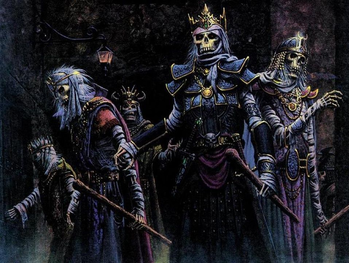
It's the literal version of Skeleton Government. That is, a government staffed by actual dead or undead: liches, vampires, undead spirits and the like. The main variations are whether the rulers are fully dead or undead, whether the subjects are also all or mostly undead, and whether the nation as a whole is good-aligned, evil-aligned, or neutral.
Malevolent examples usually overlap with The Hive (although a handful of Elite Mooks might have more free will), with a diabolical Necromancer or two as their Hive Queen. Non-malevolent examples are usually Dark Is Not Evil, oftentimes with a dash of Not Evil, Just Misunderstood. If you come across a city or fortress named Necropolis (Greek for "city of the dead") in a fantasy setting, chances are you're dealing with this trope. Stay away from these places.
A Necrocracy usually comes in one of several flavors:
- Total Necrocracy: (Un)dead rulers with undead subjects.
- Rule of the Dead: (Un)dead rulers with living subjects.
- Half-and-Half: (Un)dead rulers with living subjects and undead subjects.
- Rule of the Living: Living rulers with undead subjects.
The considerable variety of common undead types in fantasy means that it's common for a caste system of sorts to exist. Usually, the rulers and upper class consist of more "refined" and powerful undead, mainly liches and vampires. The next steps down are filled by some combination of Revenant Zombies, spirits, and the smarter types of undead ghouls. Living mortals tend to be at the bottom, with only mindless zombies lower than them. The living underclass may be anything from a regular peasantry to a glorified source of blood and souls, although enterprising living may be able to do a bit of social climbing if they're willing to become undead themselves.
If they have a military structure, the mooks are probably undead too.
A Sorcerous Overlord who is also a Lich would be an example, as is a Magocracy of undead wizards. Societies led by Vampire Monarchs also qualify. See also Immortal Ruler, who needn't be a corpse, and Undead Servant and Undead Laborers, for when the living dead serve either living or undead masters.
Real Life examples are of the "Rule of the Dead" flavor by necessity, and the rulers are actually dead. Not related to necropolitics . We hope.
Examples:
- Dance in the Vampire Bund: The titular extraterritorial concession is a miniature vampire nation sitting in Tokyo Bay. As of Volume 8, there are even people in Tokyo seeking to get bitten in the hopes of moving there.
- Overlord (2012): Ainz the skeleton Overlord rules the Great Tomb of Nazarick, which is filled with undead, demons, and all sorts of monsters completely loyal to Ainz. Later on, he forms the Sorcerous Kingdom, which contains the human city of E-Rantel and by Volume 12 is home to humans, nagas, giants, dwarves, undead, dragons, and other races, with all the bureaucrats replaced with liches. Ainz himself justifies this by saying a ruler who can't die won't cause a Succession Crisis or be prone to emotional outbursts like lust or rage. While this is true, the fact is that Ainz doesn't have the skills to make a good ruler (he was a lowly salaryman before being transported to the New World) and is more concerned with improving work conditions for his underlings, depending on his minions to carry out his orders while remaining completely unaware that they have zero empathy for non-Nazarick residents. That being said, it seems that the city is running surprisingly fine.
- Sunday Without God has Ortus, a city for the deceased with over a million undead inhabitants.
- Trinity Blood: In the New Humankind empire, the living "Terrans" are second-class citizens, but most of the ruling vampire nobles try to treat them decently.
- Vampire Hunter D: Count Magnus Lee effectively rules the Kingdom. Technically he doesn't rule it anymore — people just fear him too much to actively fight against him, but he can't really go and order them around like he used to, either. In the original worldwide vampire nation, the vampire population density was relatively high, but humans remained a major group of second class citizens, who could be treated anywhere from decent subjects to mere cattle depending on their local vampire lord's personality.
- Black Moon Chronicles:
- Wismerhill and his entourage go on an unapproved mission to the southern provinces to invade a kingdom of the living dead. They mow down the skeletal armies outside the tombs fairly easily but are almost killed by its lich prince and his vampire and ghost lieutenants, surviving only thanks to their boss Haazheel Thorn's intervention.
- Wismerhill himself, despite looking fully human, became a type of crypto-zombie when he became one of the Lords of Negation, Black Knight super-warriors loyal to Haazheel Thorn. Long after Haazheel's grip on them has been broken and Wismerhill has become the Emperor of all humanity, he has to resort to consuming human lifeforce for a while until his mages find a way to supply him some other way.
- Judge Dredd:
- In the dimension of Deadworld, life itself was outlawed by a group of undead lawmen known as the Dark Judges, who remained as its custodians after completing their global genocide.
- During the "Necropolis" arc, Mega City One is conquered by the Dark Judges and the Sisters of Death and turned into a slaughterhouse. Judge Death is installed as Chief Judge, the Sisters use their powers to blot out the sun, and the regular Judges are brainwashed to assist their new masters in exterminating the whole population. Before Judge Dredd and his allies manage to take back the city, 60 million people have died.
- After "Necropolis", a constitutional crisis occurs when a zombified Chief Judge Silver returns to reclaim his post from the incumbent McGruder. Judge Dredd rules that the post was legally still occupied by a dead man, but then deposed and formally executed Silver for criminal neglect of duty during the invasion.
- Monsieur Mardi Gras Descendres is a French comic by Eric Liberge featuring purgatory as a city populated with skeletons, which is the appearance of dead people un-living there, surrounded by a lunar desert and ruled by a strange Kafkaïan bureaucracy.
- Nemesis the Warlock: After he was killed in a teleporter accident, Torquemada returned to rule his empire as a phantom. He would possess human hosts by devouring their lifeforce if he needed a body.
- Requiem Vampire Knight: Count Dracula governs an afterlife dimension known as Résurrection where all its denizens are undead. While the most powerful ruler, he is not the only one around as other nations exist ruled by their respective rulers who also happen to be dead too.
- The Sandman (1989): The Necropolis Litharge is a great metropolis where the only job that anyone seems to have is the ritual disposal of dead bodies. Their entire society is funeral-based, and it's almost all they do. Its crypts are haunted by important and scary voices.
- Zorn Et Dirna is set in a world where Death was trapped in a mirror, so that whoever looks into it becomes immortal. Unfortunately, for those of the ruling class who aren't the king, it means they become increasingly mummy-like as time goes on and they can't die, while everyone else is stuck with a very crappy version of immortality where their bodies keep aging if they aren't decapitated (and decapitation only causes the soul to go into the killer's body). The titular twins were specifically birthed in front of the mirror in the hopes of a child who could truly kill people, but it turns out they share their power.
- FFS, I Believe in You: Played with, but ultimately subverted. When Link and Sidon encounter the skeleton of the old lizalfos king in the Water Temple, it reanimates and, from what Sidon can understand of its angry ranting, seems intent on continuing to rule over his living subjects as a stalfos. However, after Gerald arrives and manages to speak to the king, it turns out that he's quite unaware of his undead status and, on being informed, simply says "oh." and collapses into a pile on inert bones.
- Game of the Ancients: Played with; the Undying Court, reanimated elven ancestors, don't rule Aerenal per se, but they do guide its overall course and have a great deal of influence over the religious and cultural lives of the Aereni people. However, as they are animated by positive, rather than negative, energy, they are not technically undead per the setting's definition of the term.
- The Necrocracy situation in Warhammer 40,000 is played even straighter in the parody If the Emperor Had a Text-to-Speech Device, where he is able to actually start ruling the Imperium.
- The Black Cauldron: The Horned King is an undead lich ruling from a dark fortress. His human minions are quite alive, but the King desires to rule over a world of mindless undead warriors because he wants to be worshipped as a god by his subjects. Made quite clear when he triumphantly declares that "our" time has come as he raises the skeletal army.
- The Nightmare Before Christmas: Jack Skellington is a living skeleton who carries the title of Pumpkin King. He seems to have of a monarchical role in Halloweentown, but he isn't necessarily obeyed and there's also an elected mayor.
- Abraham Lincoln: Vampire Hunter: The Confederate States are in fact run behind the scenes by a vampiric bureaucracy led by the first vampire, Adam, and the slavery system is there to provide them with a regular food source.
- Blade Trilogy: Ruling vampire aristocracies are seen who control the rest of vampirekind. Blade (1998) had the society divided by House, while Blade II shows vampire lords residing in Europe. They also have human servants, so-called "Familiars" who are more or less property of their vampire master/second-class citizens of their society.
- The Chronicles of Riddick (2004): The empire of the Necromongers, whose stated mission is to cleanse the universe of all life, is governed by the Holy Half-Dead Lord Marshal, a "former man" who travelled to The Underworld and can now command souls. It's unclear whether his subjects are undead too, but the conversion process they undergo, their inability to procreate naturally, and their pale complexions hint that they're not fully mortal either. The Quasi-Dead, former humans encased in tomb-like device to enhance their psychic abilities, definitely aren't.
- Daybreakers: In the near-future, society is business as usual but most of the population has turned into vampires and are politically in control. The remaining humans refuse to be turned are farmed or hunted down for their blood.
- Animorphs: Parodied by the batshit-insane Helmacrons who are led completely by the dead. Not the undead, the dead. They believe that the most important thing for a leader is that they make no mistakes, and dead people can't make any mistakes, so as a result every Helmacron in a position of authority is ritually executed as soon as they're elevated to their position.
- Anno Dracula: England toggles back and forth from malevolent to somewhat decent. The subjects include both vampires and "the warm". The former can be good, but the ones who wind up in authority tend to be somewhat self-serving.
- Baltimore: The Red Kingdom is made up of vampires, warlocks, eldritch abominations and it's ruled by a vampire known only as the Red King. It first emerged during World War I in an alternate reality and has effectively replaced Nazi Germany and the Soviet Union as superpowers (covering all of Eurasia, the Middle-East and parts of Africa), with the Allies fighting a losing battle against it.
- Craft Sequence: Many cities, nations, and corporations are governed by lich-like Deathless Kings, animate and (supposedly) immortal skeletal sorcerers. Aside from that, they tend to be pretty normal people. It's just the natural consequence of accumulating power in a world where the magic system is the same thing as contract law — your debts and obligations won't let you die.
- The Death Gate Cycle: Kairn Necros is initially an inversion, with a living ruling class of necromancers presiding over a largely-undead populace. Following one of the necromancers dying and coming back wrong, the undead Turned Against Their Masters under her command, with the end result being a straight example of the first type, with lazar ruling over the ordinary dead, with all of them except one lazar hostile to the living.
- Discworld:
- The Colour of Magic: The Wyrmburg is ruled by an undead king who was murdered by his daughter, but decided that none of his children were fit to rule in his stead and continues to exist as a lich-like entity until one of them actually proves worthy of succeeding him.
- Uberwald is identified as not so much a nation as a geographic argument. It's said in the past Uberwald was mostly united in the 'Unholy Empire' (one of whose emperors had a man's hat nailed to his head as a joke) and described by Vimes as apparently the whole show being run by vampires and werewolves with everyone else being lunch. It broke up when the non-undead dwarfs became too powerful.
- Pyramids: Djelibeibi very briefly becomes one: a living ruler (Pteppic), but with several thousand years' worth of mummified relations advising him on what to do.
- Mr. Slant, as a zombie, is Ankh-Morpork's oldest lawyer, with some vampires employed as lawyers in his firm. As you can imagine, junior clerks have some difficulty being promoted when the dead men's shoes are filled and unlikely to leave anytime soon.
- The Dresden Files:
- The Red Court vampires (big bat-like monsters that can disguise themselves as humans), despite how pleasant they can seem on the outside, have exploited chaos in some parts of Latin America to set themselves up as strongmen with a steady supply of food. They mostly get those followers through Mind Control saliva.
- The White Court vampires (psychic vampires, though not actually undead, who do the incubus/succubus thing) officially rule as the most human (relatively speaking) of the vampires, they manipulate and mingle into human society just fine and graze at the edges, encouraging the attitudes and emotions they feed off of instead of keeping docile herds for themselves. Many think they should have the right to feed when they want and how much they want, without interference. Their current leader doesn’t share those views, but she does have an interest in human politics, and is becoming worryingly well-connected.
- The Black Court vampires (the rotting-corpse, vaguely Dracula and Nosferatu types) are too few to have a coherent society, thanks to Bram Stoker's cleverly disguised monster-hunting guide; they have a habit of wiping the minds of their living subjects and remolding them into blank, easily-commanded, and violent mooks nicknamed "Renfields."
- "The Empire Of The Necromancers" by Clark Ashton Smith: A variant of this (crossing over into Magocracy territory) is shown. The titular necromancers (all two of them) are in fact alive, but manage to set themselves up as rulers of an entire undead nation by the simple expediency of finding a long-dead desert kingdom and using their arts to reanimate everybody whose bones or mummy they can find. The necromancers are arguably evil, but lazy; their subjects, on the other hand, are more hapless victims "living" again in a hazy, dreamlike state than anything else.
- Empire of the Vampire: As Daysdeath expands across the world, the ancien vampires figure out that the sun can no longer destroy them, and, more importantly, it can't harm the lesser, Feral Vampires they can beget. Fabién Voss, the eldest of Blood Voss and possibly the eldest vampire in the world, used this to create a vampiric army in his thrall, the Endless Legion, with which be conquered Talhost, the westernmost kingdom of the continent's Empire. After successfully taking it over and massacring much of the populace, the Legion's numbers swelled, and Voss styled himself the Forever King, now intent on seizing the entire Empire for his own. Though the vampires cause slaughter aplenty and often put entire cities to death (and later undead servitude), they are not wholly genocidal, and as the war begins winding down, vampires begin enthralling human survivors en masse rather than simply slaughtering them, now intent to secure their status atop the Forever King's new hierarchy.
- Mother of Learning: The tensions that led to the "Necromancer's War" began when an increasing number of national rulers began to turn themselves into undead, and an increasing number of their heirs realised that since undead are ageless, they were unlikely to ever inherit the throne — which combined with the general population's distaste for being ruled by necromancers to form an explosive situation. This eventually became a full-blown rebellion, which failed but escalated into a multi-national war, which the necromancers lost — but rather than being wiped out, they were exiled to the remote and inhospitable island of Ulquaan Ibasa, where the undead still rule at the time of the story.
- "The Pearls of the Vampire Queen" by Michael Shea: Queen Vulvula rules over a human nation and rejuvenates herself yearly in a ceremony called The God-Making Of The Year King, where she devours her human husband. Apart from that, she is depicted as an effective and benevolent ruler.
- Red Planet and Stranger in a Strange Land: It's implied that Mars is ruled by the Ascended to a Higher Plane of Existence "Old Ones" ruling over the still-corporeal regular Martians.
- The Scar: Most of High Cromlech's population and all of its administration are Revenant Zombies. This has interesting impacts on the culture, such as the city's language having dialects suitable for use by individuals whose mouths have been sewn shut and whose voiceboxes have decayed. A significant population of living humans is found there to do the jobs that aren't so suitable for the non-living (though these are not detailed) but when the opportunity arises the upwardly mobile members of the living middle class shuffle off their mortal coils to improve their social circle and prospects.
- Also notable in that there is an undead (or rather, ab-dead) underclass of the city's impoverished and hopelessly addicted blood-drinkers, who are treated with scorn and pity by both the living and truly undead residents, in stark contrast to vampires' ordinarily high rank in such settings. It's a bit of an embarrassment for any vampir (spelling intentional) trying to set themselves up as the "aristocracy of the night" anywhere else in the world.
- The social mobility in High Cromlech suggests that it is probably one of the most reasonably-ruled and egalitarian city states in Bas-Lag, which fits Melville's usual Deconstructor Fleet style.
- Spells, Swords, & Stealth: In Split the Party, the second book, an entire village disappears and is found as mindless undead under the control of a dark god's priest. By the story's end, the priest's hold over them is broken, they have their rational minds back, and all they want to do is go back to their village and keep on as they have been. Mages remain to study the situation and make sure they aren't murdered out of hand once word gets out.
- The Strain series features two of them: one is the conspiracy of the Ancient Ones, six of the seven original vampires who currently influence world affairs in secret, based on each habitable continent. Their goal is to eventually expand their power over the entire world and subjugate humanity into providing them unlimited sustenance. However, this goal is also shared by The Master, the seventh elder vampire who seeks to dispense with The Masquerade and just take out the other six and conquer the world for himself only. Following the events of The Fall, he has succeeded in this goal, and the plot of The Night Eternal revolves around the new, vampire-dominated society of Earth and the attempts by the main characters to forge resistance to it with a specific focus on eliminating the vampire plague for good.
- Tolkien's Legendarium:
- Angmar from J. R. R. Tolkien's world is ruled by its Witch-King (a wraith, which is basically undead). He had a few lesser ghosts under his command (as well as the other Nazgûl, presumably) but his forces were mostly Hillmen and Orcs whose sole purpose along with the entire kingdom's was to destroy Arnor and not to remain as an actual state on its own.
- The history of Angmar isn't detailed in the core material (at least, it isn't detailed in The Silmarillion, Unfinished Tales or The Lord of the Rings) so the precise nature of its government and populace is unknown. It was a human kingdom, though. They had annexed and allied with two of the three kingdoms of Arnor (Rhudaur and Cardolan) and apparently turned their dead as well. Angmar and its armies were annihilated sometime before the events of LotR when the Witch-King commanded parts of Sauron's army but would have held no kingdom of his own.
- The Barrow-Wight the Hobbits encounter is said to be a leftover from his kingdom, specifically a spirit from his side inhabiting the corpse of a human warrior from the other (who had some magic anti-wight weapons buried with him).
- The city of Minas Morgul was a fiefdom of Mordor and former part of Gondor ruled by the Nazgûl directly, so that counts as a straight Type III.
- The Wandering Inn: The Kingdom of Khelt is ruled by the Revenant King Fetohep, with all menial labour being done by mindless undead. Its mortal citizens live in luxury, and in return, their bodies are used by the nation following their death. While procreation and immigration are strictly regulated to control the population size, the country is generally considered a paradise, much to the pride of its rulers.
- Later volumes expand on Khelt's history and hierarchy. Founded by Queen Khelta, a powerful necromancer, each undead monarch chooses a successor from the nation when the magic reanimating them starts to fade (said searching can take centuries). With conversation into a Revenant Zombie either being an Emergency Transformation (as with Feohep) or done at the end of a natural lifespan. Some monarchs also have their friends turned into revenants too, serving as advisors or viziers.
- Wise Phuul: The Viiminian Empire is a complicated case. De facto, it is an inversion: the Empire is ruled by living Necromancers, with the Imperial bureaucracy staffed by undead. Legally, it plays this straight: the living Grand Chancellor and his Necromantic Council rule in the name of the long-deceased titular Emperor.
- Xanth: The Zombie Master isn't evil. He's quite a good ruler, in fact — he was just a zombie.
- Doctor Who:
- "State of Decay": A planet is ruled over by evil vampires, and the rulers have been dining on the mortal population for so long that it's down to a single small village.
- "The Pirate Planet": Xanxia is the secretly undead secret ruler of a nation.
- If: Steve Bell drew Tory politicians of the Thatcher/Major era, such as Norman Tebbit, as animated skeletons or barely-human zombies; Michael Howard was a daylight-shunning vampire, and Michael Heseltine had something of the werewolf about him.
- Barbarians Of Lemuria: The Carnifex Mundi setting in the Sword and Sorcery Codex has Europe become this. Instead of the Enlightment, the invention of the printing press leads to a magical dark age because it's now possible to mass-produce Tomes of Eldritch Lore. This means that the rich and powerful can now create armies of undead servants and pursue immortality through various forms of necromancy.
- Dungeons & Dragons' settings have many examples:
- Eberron provides a few variations:
- The half-dragon lich Erandis d'Vol, better known as simply Lady Vol, sees herself as the inheritor of the whole world. Only the Blood of Vol and the Karrnathi loyalist group the Order of the Emerald Claw truly believe in her (and even then only in the upper ranks. Most adherents to the Blood of Vol aren't aware of what exactly the "of Vol" refers to, and the lower ranks of the Emerald Claw tend to think they're fighting for Karrnath's dominance over the continent).
- The Deathless of Aerenal rule the island-nation of the Elves, serving as a sort of gestalt deity-figure. Not truly Undead, but rather a good-aligned version which uses positive rather than negative energy.
- King Kaius I of Karrnath is a vampire, turned through a deal with Vol which fell through. He replaced his Identical Grandson, the real Kaius III. Almost nobody but a few trusted high-ups know this, as undead, while revered in Karrnath, don't get property rights under international law, and he would have to forfeit his crown. While he is by alignment Lawful Evil, he's the one amongst the inheritors of Galifar who has been pressing for peace. Another nation's leader, Aurala, despite Neutral Good alignment, is a warmonger.
- Forgotten Realms:
- Skullport is policed by the eponymous Skulls, an undead Hive Mind of ancient mages bound to the magic field that protects the underground city.
- Thay is now ruled by Szass Tam, a lich with thousands of undead followers.
- Ravenloft oozes with this. Many Darklords (domain rulers) are undead creatures, such as:
- Strahd (vampire) in Barovia.
- Nharov Gundar (vampire) [formerly] in Gundarak.
- Urik von Kharkov (nosferatu vampire) in Valachan.
- Lord Soth (death knight) [formerly] in Sithicus.
- Vecna (lich) [formerly] in Cavitius.
- Kas (vampire) in Tovag. For 4E, Kas got rebooted as a vampire. He rules a kingdom in the Shadowfell and a dominion in the Astral Sea.
- Azalin (lich) in Darkon. Azalin doesn't really give a damn about his subjects but would rather not be distracted from his escape attempts by rebellions and pogroms and other nonsense.
- Anhktepot (Greater Mummy) in Har'Akir.
- Tristan ApBlanc (Ghost/Vampyre) in Forlorn: Undead-by-night ruler (long story), living but curse-transformed goblyn subjects.
- Prince Ladislav Mircea (vrykolaka vampire) in Sanguinia.
- Death. No one can live in his domain (literally), and he's batshit insane.
- Eberron provides a few variations:
- Exalted: The fact that it's possible to walk to and from the Underworld means that death is no bar to kingship. The necropolis of Sijan, City of Ten Thousand Tombs, is ruled by its ghosts, who are relatively benign. The Deathlord known as the Silver Prince runs a flourishing kingdom by reanimating corpses to serve as slave labor — but it's a cover for his long-term evil plans (for on this, check in here).
- Thorns became this when the Mask of Winters invaded and pulled it into the Underworld. Now zombies and ghosts roam the streets and the living are second-class citizens.
- The Resurrectionists in Autochthonia want to make Claslat into one of these... for the greater good, of course. They just have no understanding whatsoever about the nature of undeath.
- GURPS:
- The supplement Banestorm — Abydos features a necromantic citystate in their default Fantasy setting of Yrth.
- The "Terra Incognita" column in Pyramid magazine volume 2 had two idiosyncratic necrocracies: Uxuloth, City of the Dead, which has become a sanctuary for those fleeing Van Helsing Hate Crimes; and the Mmorn Commune, created by a communist necromancer who thought the ideal society would be some kind of zombie Hive Mind, and instead created a zombie society with a strict caste system, ruled by "elite" psychic zombies.
- Iron Kingdoms: Cryx. While the supreme ruler, Toruk, is a dragon and so is technically alive (for certain values of "alive", anyway), the hierarchy is dotted with titles like "Lich Lord", "Necrotech", "Iron Lich" and so on. While they do have living models and even living warcasters, the first mental image most people in and out of universe have when "Cryx" is stated involves a tide of cyborg skeletons backed up by undead mages and war engines forged from iron and bone.
- Mage Knight: The rulers of the Necropolis Sect are all Vampires, and the ruled are either Necromancers, Dark Elves on their way to becoming vamps, or lesser Undead and golems of various sorts.
- Magic: The Gathering:
- The Alara block has the plane of Grixis, a hellscape ruled by demons and lich lords and crawling with lesser undead, while the living hide in secret holdouts.
- Over in the city-plane of Ravnica, there's both the Orzhov Syndicate (a Corrupt Church ruled by a council of ghosts) and the Golgari Swarm (which ended up with an undead shaman as its leader). The Golgari take care of Ravnica's farms, too — they provide a very notable part of the food for the whole plane. While they have their bad apples (Savra is very ambitious, and the Sisters of Stone Death can be pretty callous when ticked off), they are for the most part extremely decent and friendly people, even welcoming the Elves of Deep Shadow who were kicked out of Selesnya without question, simply because of their connection to black magic. Hell, the Golgari were one of the two guilds (the other being the Wojek offshoot of the Boros) who actually watched out for the people during the Decamillenial crisis, whereas all other guilds (as well as the Boros Legion proper) were too busy with their power struggle nonsense.
- The Innistrad setting has towns ruled (read: terrorized) by vampire nobility (although Innistradi vampires aren't undead per se, but alive and aging at a glacial pace). On the other hand, there are also benevolent ancestral ghosts protecting some places.
- In the Conspiracy core set, Fiora is ruled by the ghost king Brago, and the custodi are a semi-theocratical church oriented towards spirits.
- Save for a small pocket of living resistance, the realm of Karfell on Kaldheim is populated solely by draugr that are ruled over by their fellow undead King Narfi.
- Pathfinder: Golarion is home to several:
- The kingdom of Geb, run by a once human wizard king also named Geb, was at war with the also wizard-run neighboring kingdom of Nex (whose ruler was also named Nex). When Geb, an expert of necromancy, sent a deadly fog through Nex to kill the populace, king Nex vanished. Geb brooded for years over this ambiguous victory and eventually took his own life. But even death could not grant him peace, and he arose as a ghost whose Unfinished Business is knowing whether or not the mighty Nex is dead or just hiding. Now Geb (the nation) has various forms of undead making up most of the nobility, with skeletons and zombies tending the fields. Geb even had a slain demigoddess unwillingly raised as a lich to serve as his queen, until she managed to escape at the tail end of First Edition. It's a pretty miserable place; the upper crust are all unliving monstrosities, who never age or die and are evil to the core, the peasants must live with the knowledge that they are are worth as much dead as alive if they step out of line (literally; official policy is that when you die you are reanimated as a mindless slave), with an underclass bred solely to be food, and a depressed ghost on the throne, still unable to accept whether or not he truly won a battle centuries ago. Strangely enough, through much effort, it has acquired reasonably good trade relations with its neighbors — even Nex.
- Nemret Noktoria is the city of ghouls located in the Darklands, a few thousand feet below the earth. Almost all of its citizens are ghouls, although this doesn't count the living humanoids kept as cattle to feed their endless hunger. It's a theocracy ruled by Kortash Khain, high priest of the demon lord Kabriri, Him Who Gnaws, Lord of Ghouls. Their main import is slaves from the few nations willing to trade with them for breeding and eating. While Geb could at least be said to have moderated the harm done by its monstrous inhabitants through the Dead Laws, all civilization has done for the ghouls is make them more efficient monsters.
- Nidal is a theocracy that worships Zon-Kuthon, god of pain, and is ruled by the Black Triune, three immortals trapped between mortal life and undeath. They are served in turn by the Umbral Court, which has both living and undead members. The court is deeply divided over the philosophy called the Belevais Doctrine, which holds that true pain can only be experienced by the living, making undead inherently less worthy servants of their god. This dispute frequently turns lethal and prevents the ageless undead from naturally coming to dominate the court over time.
- The city-state of Mzali is ruled by its child mummy god-king Walkena. At dawn he appears a living and beneficent deity, but as each day goes on he becomes more cruel and his undeath becomes more apparent, until by night he's left a shriveled and vengeful corpse that refuses to be seen. He's relentlessly xenophobic and reactionary, desiring to return the continent to the state it was prior to his death four thousand years ago.
- Starfinder: The planet of Eox became one after a self-inflicted cataclysm left the world uninhabitable and its populace turned to necromancy to "survive". Now, technological liches called necrovites rule a populace of sapient undead that anyone can join for the right price, although the exact nature of your undeath depends on how much you're willing to pay. It's worked out pretty well for them, as the massive flesh farms they use to produce food for the varied hungers of the undead proved to be equally useful for developing cutting edge biotech that allows them a solid holding in the interplanetary economy.
- Warhammer: Age of Sigmar: Many of the kingdoms and empires in Shyish, the Realm of Death are ruled by liches, vampires, and necromancers, with undead and living citizens walking side by side in the streets. Nagash technically rules most of them indirectly, meaning that the Realm overall is ruled by an undead god Sorcerous Overlord.
- Warhammer 40,000:
- The Necrons are a futuristic version of the trope, based loosely on the Tomb Kings from Warhammer Fantasy. They were once the Necrontyr, a race of short-lived aliens who met another, noncorporeal alien species, the C'tan. The C'tan offered the Necrontyr a "deal" of giving their race the means of shedding their mortal bodies (and, as it turns out, their souls) and transform the entire race into skeleton-like robots. The C'tan were shattered into pieces for tricking the Necrons into becoming their slaves. Fast forward 60 million years into the present day of 40k, and Necrons are returning to the galaxy after a long hibernation. The Necrons inhabit the dead Tomb Worlds in the galaxy and have a carefully structured imperial hierarchy, with Necron soldiers at the bottom, (Over)Lords in the middle, and the Phaerons at the top. Before their bio-transference, the Necrontyr as a whole were ruled by the Silent King, the head of the three most powerful Phaerons in the Necrontyr Empire, but they are so incredibly fractured in the present that the dynasties operate as independent kingdoms and will only unite against common threats (i.e. non-necrons).
- For that matter, the Imperium of Mankind comes pretty close to one as well. While not undead per se, the God-Emperor of Mankind is closer to death than he is to life and resembles some kind of techno-lich.
- Warhammer Fantasy has several examples of this trope:
- The Tomb Kings are nice for undead, since they mostly stay put in their pyramids. Several city states have large living populations ruled by mummies (part of their motivation is a desire to bring life back to the desert, after all). They mostly fight with each other, because each one is technically the rightful ruler of Khemri out to destroy the usurpers, even though their respective reigns are long done.
- The Vampire Counts often masquerade as normal kingdoms, out to take over the Empire.
- One of the vampire bloodlines, the Necrarchs, are by far the least likely bloodline to desire temporal power, authority or status, as they're a family of reclusive, usually insane, scholars and wizards whose grand plans generally involve killing all the world's mortals rather than enslaving them. That said, they're supreme necromancers who understand the value of a well-staffed wizard tower, so their all-undead strongholds tend to be respectably large.
- The Lahmians, a bloodline of all-female vampires descended from the first ever vampire, aim to control most of the governments of the Old World from behind the scenes.
- The lordly and aristocratic Von Carsteins embody this trope most: in their homeland of Sylvania, they rule openly as feudal lords over the terrified inbred peasantry. Technically, since the Vampire Wars five centuries ago, Sylvania is now a part of the Imperial province of Stirland, but the count of Stirland's officials have long since learned never to go there asking for taxes and the like, so it is still effectively ruled by its vampiric masters. A similar arrangement applies to the Bretonnian city of Mousillon, though the Red Duke ruling the city is a member of the warrior-aristocrats of the Blood Dragons, not the Von Carsteins.
- The bestial Strigoi vampires were once noble lords who founded a powerful empire known as Strygos and ruled over its human citizens, slaking their bloodthirst by feeding on criminals. The Lahmians eventually arranged for Strygos' destruction by an Orc army, due to an old enmity between the bloodlines' founders, and the Strygoi eventually degenerated into their current savage forms. Many still dream of reestablishing Strygos or something like it, although few attempts bear fruit. The most successful of their number is Gashnag the Black Prince, who has ruled over a fief in the normally chaotic Border Princes for three centuries.
- Vlad von Carstein wanted this in a Well-Intentioned Extremist way: the powers of Chaos need emotion to live, so he wanted to turn the entire world into undead so as to fully deny Chaos its victory. Sadly, the rest of the world objected.
- It is said that Vlad's rule is a marked improvement over the rest of his blood-slurping brethren, and even a lot of living Imperial nobles could learn from his example. To an almost Affably Evil Pro-Human Transhuman degree. In Total War: Warhammer, he's downright courteous to living allies, even getting a hefty bonus to diplomatic goodwill with Empire and Dwarf factions, despite being a... well, a vampire.
Vlad: The men of the Empire are always welcome at my court!
- It is said that Vlad's rule is a marked improvement over the rest of his blood-slurping brethren, and even a lot of living Imperial nobles could learn from his example. To an almost Affably Evil Pro-Human Transhuman degree. In Total War: Warhammer, he's downright courteous to living allies, even getting a hefty bonus to diplomatic goodwill with Empire and Dwarf factions, despite being a... well, a vampire.
- In the First Vampire War, Imperial soldiers were horrified by the sight of Sylvanian footsoldiers and auxiliaries marching side-by-side with skeleton warriors, the reanimated bodies of their own people, under the generalship of morbid undead fiends. After Vlad's defeat, the Sylvanians retreated back across the border and the vampires fled into hiding, with the Empire installing a puppet regime made from Stirland's bastard sons. These new rulers turned out so ineffectual, resentful and brutal that when the Counts re-emerged from the shadows and tossed them out like yesterday's trash, many Sylvanians were happy to have the vampires back!
- The Enemy Within campaign introduces a city that is ruled by necromancy. Actually, the rulers are alive as well. But subjects who die are converted into undead to serve the living. The people quickly adapt, especially since the city is close to the chaos wastes and the undead army vastly increases its ability to defend itself. See here for more info on this.
- The country of Kislev has no tradition of this and were largely unfamiliar with vampires, but is used to being ruled by pale, magical beauties and as a result ended up letting an open vampire, Kattarin the Bloody, become tzarina (a renegade Lahmian who wanted to rule openly). Her downfall came not primarily from losing control of her bloodlust and massacring thousands of her own people, though it couldn't have helped, but a coup backed by the boyars when they realized an Immortal Ruler would leave them competing for an ever-shrinking amount of influence.
- Nagash, the great necromancer, is literally trying to kill everyone in the world and make them his undead puppets. Since he has taken up the mantle of "God of Undeath", he has 9 Mortarchs to reign as Kings under him (with two members from the aforementioned Von Carstein bloodline and at least one Tomb King Liche Priest). So far he has also successfully subjugated the Tomb King nation of Khemri and the Vampire Counts' Sylvania.
- The World of Darkness:
- Bygone Bestiary: Vodayany are aquatic undead formed when humans drown. They are more or less eternal and live in rigidly hierarchical societies, ruled over by incredibly ancient undead that enforce absolute control over their society. Younger vodayany are slaves, toiling to maintain the ancients' palaces or luring the living beneath the waves to create a further stratum of society beneath themselves.
- Geist: The Sin-Eaters: The Dominions of the Underworld are strange kingdoms that lie beyond the Rivers, each one ruled by the Kerberoi and with specific rules on the interaction between their ghostly serfs and the Sin-Eaters.
- Wraith: The Oblivion has the plane of the dead. They still have ancient empire-type slavery and some rulers have actually been dead long enough to remember when it was in fashion.
- AFK Arena: Bantus, the home territory of the Graveborn faction. Before it became a Necrocracy, it was an empire home to a Proud Warrior Race called the Lenu, and the amount of death within its borders that came with that made it ideal for the otherworldly lich Qaedam to reap subjects. While it almost managed to reform itself under The Good King Thoran, who gave his subjects hope and was the first Esperian ruler to outlaw the cruel practice of necromancy, a wrench was thrown in that when Thoran and anyone close to him were slaughtered in a violent coup. Thoran was brought back to life hungry for vengeance with any trace of anything he once stood for gone, and his first act in his new reign was not only reversing the ban on necromancy but making surrendering your soul to Qaedam and becoming a Graveborn mandatory for all subjects — with the punishment for refusal being beheading so you couldn't communicate even if brought back later — turning Bantus into a Total Necrocracy practically overnight.
- Age of Wonders: Shadow Magic has a Dark Elf leading the Undead, at one point.
- Battle for Wesnoth: Before the events of the campaign The Rise of Wesnoth, the Wesfolk turned their best and brightest into liches to preserve their wisdom and form their ruling class. Their worst criminals were made into undead slaves. The campaign starts because the lichlords betrayed their living subjects by summoning the orcs, which would have killed all living Wesfolk, forcing them to flee to Prince Haldric's land.
- Darksiders II: The Kingdom of the Dead, ruled by the Lord of Bones and his (equally bony and ghostly) Chancellor. Death is tasked to bring the Lord of Bones' assistants back to the Lord's court, two of which have been skipping out on their job because of The Corruption, and the third of which is so overloaded with work judging the dead that he hasn't appeared in the Lord's court.
- Dark Souls II: The Skeleton Lords are former hunters of the Undead serving the Old Iron King who contracted the curse themselves. They are now trying to rebuild the Iron King's kingdom with them as undead rulers lording over an undead people. It's not very impressive, even before the Bearer of the Curse shows up to ruin their day.
- Dawn of the Dragons: Vornstaag has lived with a peaceful mixture of living and dead citizens for a long time, many living nobles choosing to become vampires because they don't want to die (though this act is considered distasteful), and many peasants getting paid in advance to sell their bodies as materials for reanimation after the natural deaths.
- Disciples: Taken to an extreme. The Undead Hordes are composed entirely of the undead, from bog-standard zombies and ghosts to exotic Liches, Werewolves, and Vampires. Their leadership is a cadre of undead priests who worship and are the direct subordinates of their undead deity, the "fleshless goddess," Mortis. Her Start of Darkness is heartbreaking and establishes her horrifying appearance, her overall goal, and burning hatred for the dwarves of the Mountain Clans.
- Divinity: Dragon Commander has the Undead, as a nation of total necrocracy and one of the five you must balance the approval of. Somewhat unusually for the trope, they're actually a nation of hardline religious ultraconservatives who will object to motions such as legally enforcing equal wages or recognizing gay marriage.
- Dominions has Middle Age Ermor and Late Age Lemuria as examples of the Horde variation, both being the result of disastrous magical rituals making the dead rise on their own with a decidedly unfriendly attitude towards the living (Ermor is skeletal undead, Lemuria is ghosts). Nazca is a quirkier example — being a take on Incan ideas they originally mummified their old lords so they could continue to serve as advisers... the problem being that as this kept being done the mummies became a larger and larger element of the upper class with more and more resources having to be allocated to supporting them. In less specific examples almost every nation can be this — various undead are very common as possible Pretender choices.
- The Elder Scrolls
- The Order of the Black Worm is a secretive Magical Society founded by legendary/infamous Lich Necromancer Mannimarco and is dedicated to the study of The Dark Arts. Many of the Order's senior members choose to follow in Mannimarco's footsteps and undertake the Deadly Upgrade to become Liches themselves. Mannimarco and the Order show up to play villainous roles in Daggerfall, Oblivion's Mages Guild questline, and in The Elder Scrolls Online.
- The Elder Scrolls IV: Oblivion: The Count of Skingrad is a vampire, yet remains one of the most reasonable counts in the game, though vampirism in The Elder Scrolls is a (sometimes) curable disease.
- The Elder Scrolls V: Skyrim: In the backstory, the city of Solitude turned into one when the "Wolf Queen" Potema replaced her followers with undead minions after they deserted her. By the time of her death at the end of a protracted siege of Solitude, her court was made up of nothing but zombies, vampires, and Daedra that she summoned. By the time of Skyrim proper, a cult of necromancers is attempting to summon her spirit and bind it to their will. By the time the Dragonborn shows up to slaughter them all, they have already mostly completed the summoning, leaving her ghost unbound and completely free to do as it pleases. The Dragonborn does eventually show up to finish the job, but otherwise, the revenant Potema would have doubtlessly turned Skyrim into a true necrocracy.
- Fall From Heaven II, a Civilization mod, has the Calabim Aristocracy, which uses regular humans for slave labor and livestock while occasionally offering the Gift to particularly competent or ruthless servants. Other examples are common in modmods, such as the Scions of Patria, Legion of D'Tesh, and Aristrakh (the latter of which are a branch of the Calabim that decided to go fully undead rather than just vampiric).
- The Empire of the Dead is a DLC faction from Fallen Enchantress: Legendary Heroes. Led by the lich sorcerer Morrigan the Risen, they play differently from all other factions in the game, having no need for food and increasing their population by either building cemetaries and mausoleums, or simply by slaughtering and reanimating their enemies to serve them.
- Final Fantasy X: The leader of the church of Yevon, Grand Maester Mika is an Unsent, a ghost whose soul was never put to rest by a summoner. His idea of leadership is to kill people on a regular basis in order to keep the peace. He is well aware that this is a stopgap solution at best but refuses to try anything else because it might not work. He's also entirely resistant to the idea that his people might be better off with a living leader instead, insisting that the consistency and stability of his leadership is preferable to any kind of freedom, truth, change, or justice.
- Guild Wars 2: The majority of Elona has become this under the rule of Palawa Joko, a lich and necromancer. He has plenty of living subjects, but they're really only there to provide a steady stream of corpses (and since he's had two centuries of presenting himself as a god who 'honors the worthy' with reanimation, they're disturbingly chipper about it).
- Jade Empire: It turns out that Emperor Sun Hai is actually a ghost.
- Might and Magic:
- Deyja and the Jademean Necromancers' Guild have both living and undead subjects, and can be reasoned and negotiated with, and while they have some shady characters, there are also plenty of trustworthy ones. However it is not entirely a Necrocracy, depending on timeline, as when you get to visit it in Might and Magic VII, the current king is a living human male (who later is usurped by a living elven male), and there is no sign of discontent from the king's status as being perfectly alive. The overall result is that Deyja is a magocracy with feudal trappings transitioning towards becoming a necrocracy. It was founded by necromancers when they were driven out from the wizards' country of Bracada, but not everyone wants to become a vampire, and the ritual to become a lich wasn't invented until much later and was still in active development when Deyja was destroyed along with the rest of the planet.
- Heroes of Might and Magic:
- Heroes of Might and Magic IV: The protagonist of the Undead campaign is Gauldoth Halfdead, a very philosophical and — as the name suggests — Halfdead necromancer that rules his kingdom (consisting of living civilians, an undead military and workforce, and some demons that are prepared to work with the other two groups out of Pragmatic Villainy) more ethically than most of the supposedly 'good' factions. He's apparently popular among the people too, enough that they’re calling him “Father Gauldoth” by the end of the campaign.
- Heresh in the Ashan continuity zig-zags this. The ruling class are undead but get their unlife from a fundamentally different source than most of their rank-and-file followers, having jumped straight to the best form of unlife through the patronage of their goddess' Spider People avatars. This version of unlife mimics most biological functions (minus reproduction) and is hard for the untrained to distinguish from actual life. However, lots of important necromancers in Heresh either Came Back Wrong instead or are still alive for real, and the highest-ranking necromancer of them all is a Fallen Angel who is very much alive and naturally immortal without any magical help.
- Heroes of Might and Magic IV: The protagonist of the Undead campaign is Gauldoth Halfdead
- Legacy of Kain: Kain's empire (specifically shown in Soul Reaver). Started by himself as a vampire, delegated through vampiric lieutenants. It eventually started crumbling, and some of those lieutenants established their own fiefdoms, serving as bosses for Raziel to take out.
- The Legend of Zelda: Majora's Mask: The undead King Igos Du Ikana still rules over his dead kingdom from his palace long after it was destroyed. His subjects now consist only of skeletal warriors and mummies. The Ikana military is still intact and led by Captain Keeta, a giant skeleton. His soldiers generally want to take leave of the oath they swore him so they can pass on. Igos himself would very much like it if he and his people could pass on, but after a terrible curse originating from Stone Tower swept Ikana Canyon untold ages ago, the dead became bound to wandering the ruins of the kingdom, unable to rest. After Link defeats him and his bodyguards in a duel, Igos tasks Link with entering the Stone Tower and lifting the curse so that he and his subjects can move on, teaching him the Elegy of Emptiness so that he can do just that. After Link clears the Stone Tower and kills Twinmold, the curse is lifted, allowing the dead across Ikana Canyon to finally pass on.
- The New Order: Last Days of Europe: While in fact a monstrosity headed by the insane Regent Sergey Taboritsky and his twisted Imperial Cult, the Holy Russian Empire is nominally a monarchy under Tsar Alexey Nikolayevich, who died as a boy in 1917. Taboritsky is convinced He's Just Hiding and will return to rule his empire eternally once it has been sufficiently "purified". In turn, when Taboritsky dies of an aneurysm, high-ranking officials desperately try to cover up his death, hence the repeated "Remain calm, the Regent endures, Alexei lives" broadcast before the whole nightmare empire collapses into warlordism and anarchy.
- Lusternia: The Empire of Magnagora is home to the undead and the living alike and it works out peacefully. Both liches and ordinary mortals take seat in the upper echelons of society. Nihilist Priests are practically expected to be undead and the living are highly numbered among the serfs. With the exception of the living slaves stuck in Magnagora, all residents are decidedly malevolent.
- Planescape: Torment: The Dead Nations are an alliance of skeletons, zombies, and ghouls all ruled by the Silent King. It turns out that the Silent King is just the regular kind of dead.
- Red Alert 3: Paradox: The Mediterranean Syndicate is run by a mysterious group known as the Board of Classics. Who are in fact ancient monarchs and emperors from throughout history — the likes of Xerxes, Alexander the Great, Cleopatra, Gilgamesh and Romulus. Kane made them immortal and left their civilisations to rot, and now they want revenge.
- The Secret World features an odd variation of this in the form of the Kingdom: a group of resurrected Egyptian mummies who parlayed their burial treasures into a business empire spanning most of Egypt, the crime syndicate they created now rules Cairo from behind the scenes, controlling entire successive governments without any of them becoming aware. All in all, the Kingdom are a fairly benevolent lot and actually serve as allies to players in the region.
- Songs of Conquest: The Barony of Loth in practice is an unholy coalition of the living and undead ruled by a cabal of mages.
- Stellaris has the Necrophage empire origin, which creates Necrophage species, which are more or less Our Vampires Are Different, just in space. Their defining gameplay trait is that their population grows very slowly on its own, hampering your economy, unless you go out and start converting other species into Necrophages, which happens at a much faster rate. That a Necrophage empire can only fills Ruler jobs and Leader positions with Necrophages lands them squarely in this trope's Half-and-half flavour.
- Unreal Tournament III: The description for the Necropolis map states the Necris faction are attempting to rule over Absalom, the capital city of Omicron 6. The Unreal Engine 3 game included with UDK also contains a Necropolis map.
- Warcraft: The Scourge and the Forsaken from WarCraft III: Reign of Chaos and World of Warcraft are groups of undead whose rulers are also undead, even though their origins lie in being created to serve demons. The undead of the Scourge are straight-up evil and have no free will, and were all controlled by the Lich King (and after the Lich King was fully destroyed in Shadowlands, by individual necromancer warlords). Meanwhile, being free-willed (and more morally ambiguous), the Forsaken have a more conventional type of government, first being a monarchy led by their founder, the Banshee Queen Sylvanas Windrunner, and then, after her deposition in Battle for Azeroth, a kind of oligarchic republic headed by the Desolate Council, formed by representatives of the Forsaken's various organisations.
- Technically, for a short time (between the Legion and Battle for Azeroth expansions of World of Warcraft), the Horde (one of the game's two playable factions) also became a necrocracy, although in their case it was more or less coincidental - the Forsaken (see above) were part of the Horde, and through some convoluted series of events (that involved the meddling of several death gods), the dying Warchief Vol'jin nominated their leader Sylvanas Windrunner as his successor. Her tenure as Warchief was so morally grey that after ousting her at the end of Battle for Azeroth, both the Forsaken (see above), and the Horde at large abandoned the very idea of a single ruler, in favour of collegial leadership.
- Wargroove: Felheim is a mixture, with living and undead subjects existing side by side. In a twist, the nation is always ruled by the Sorcerous Overlord who holds the Fell Gauntlet, and the Gauntlet cannot be wielded by an undead being. Thus, while the civilians may be both living and dead, and many powerful undead hold high government position, the ruler is always a living being. The current wielder of the gauntlet is called Valder and serves as the Big Bad of the campaign until it's revealed the war was caused by a False Flag Operation by one of his subordinates.
- Looking for Group: Richard, the undead warlock of the group, is mayor of a small town up the coast, inhabited entirely by the living dead.
- The Order of the Stick:
- Xykon is a lich, and his subjects mostly a mix of undead, goblinoids, and undead goblinoids.
- Malack reveals an intent to turn the Empire of Blood into a vast empire governed by a vampire aristocracy, wherein thousands will be sacrificed every day as both a divine offering and a food source for the ruling class.
- Later on, Hel reveals that she plans to vote to destroy the world, ostensibly to protect the gods from the Snarl by recaging it in the mortal world, but mainly so she can harvest the souls of all of the dwarves who would be dishonorably killed and make herself the new queen of the Northern Pantheon. In effect, this new world would be almost entirely ruled by her undead subjects.
- Skin Horse: Colma, California is home to a society of approximately one million zombies ruled by Emperor Norton I. Most of them are pretty decent people.
- Codex Inversus: The city of Beshart is inhabited solely by undead such as skeletons, zombies, vampires, ghouls, and revenants under the rule of the lich Libenyer I, the Anti-Pope. Libenyer leads a religion that praises undeath as the highest state of existence, and which seeks to liberate the living from the pain and burden of life and convert them into the faith (that is, kill and reanimate them).
- Critical Role: Campaign One: One major story arc was about reclaiming Percy's ancestral home of Whitestone (both the castle itself and the city surrounding it) from the usurping rule of Lord Sylas Briarwood (vampire) and Lady Delilah (a necromancer).
- Magic, Metahumans, Martians and Mushroom Clouds: An Alternate Cold War: Egypt becomes this in the early 1950s after the resurrected mummy of Ramses XI and his undead servants oust The Generalissimo Naguib, start a four-way civil war, and then win that civil war. To everyone's surprise, they turn out to be reasonable authority figures once they adapt to their new time, with the Egyptian population considering them an overall step up from the previous military dictatorship.
- Aladdin: The Series: The Land of the Black Sand is populated only by zombies, although its ruler, the Evil Sorcerer Mozenrath, is not undead. (Although he has a Dead Right Hand, so he's not exactly a normal human being either.)
- Family Guy: "Cat Fight": Peter uses a proton pack to capture the ghost of Mayor West. He suggests keeping the ghost on as mayor until they find someone else for the position.
- Skeleton Warriors: Baron Dark's empire of titular skeletons. Transformed into the first of the undead when he attempted to steal the Lightstar Crystal, an act that also disrupted the planet's power supply with devastating effects, the Baron gained the ability to convert almost any person into a Skeleton Warrior that was compelled to serve him obediently. Taking advantage of the chaos, he built up a rapidly-increasing army and enslaved much of the still-human population, forcing the human heroes to go into hiding and form a resistance movement. Since the skeleton armies are functionally immortal, and they don't need to eat or sleep, and Baron Dark can change captured humans into new undead recruits, the war's presented as a surprisingly bleak and one-sided affair for a Saturday morning cartoon. The good guys still win in the end, though.
- In his HBO special "Red, White & Screwed", Lewis Black proposes that America elect a dead person to the presidency (his suggestion: Ronald Reagan) in order to Mind Screw terrorists.
- Fallout Is Dragons: The Death gang is a mix of all four types, though mostly type 4. Their leader, named Death, is a lich, and most of their members are living necromancers who use zombies in their raids; however, while they are raiders they don't seem to attack without need and Death has actually become something of a mentor figure to Xencarn, one of the player characters.
- Technically, the Democratic People's Republic of North Korea qualifies for this trope since the country's founder, Kim Il Sung, who died in 1994, is de jure the Eternal President of the country. The office of president was abolished after his death, with the rulers of the Kim family holding the title of "General Secretary of the Worker's Party of Korea" since then. Christopher Hitchens famously snarked that this made North Korea either a necrocracy, thanatocracy or mausolocracy. As far as we know, this arrangement is purely ceremonial, with Kim Il Sung's entombed corpse holding no actual power over his living descendants.
