

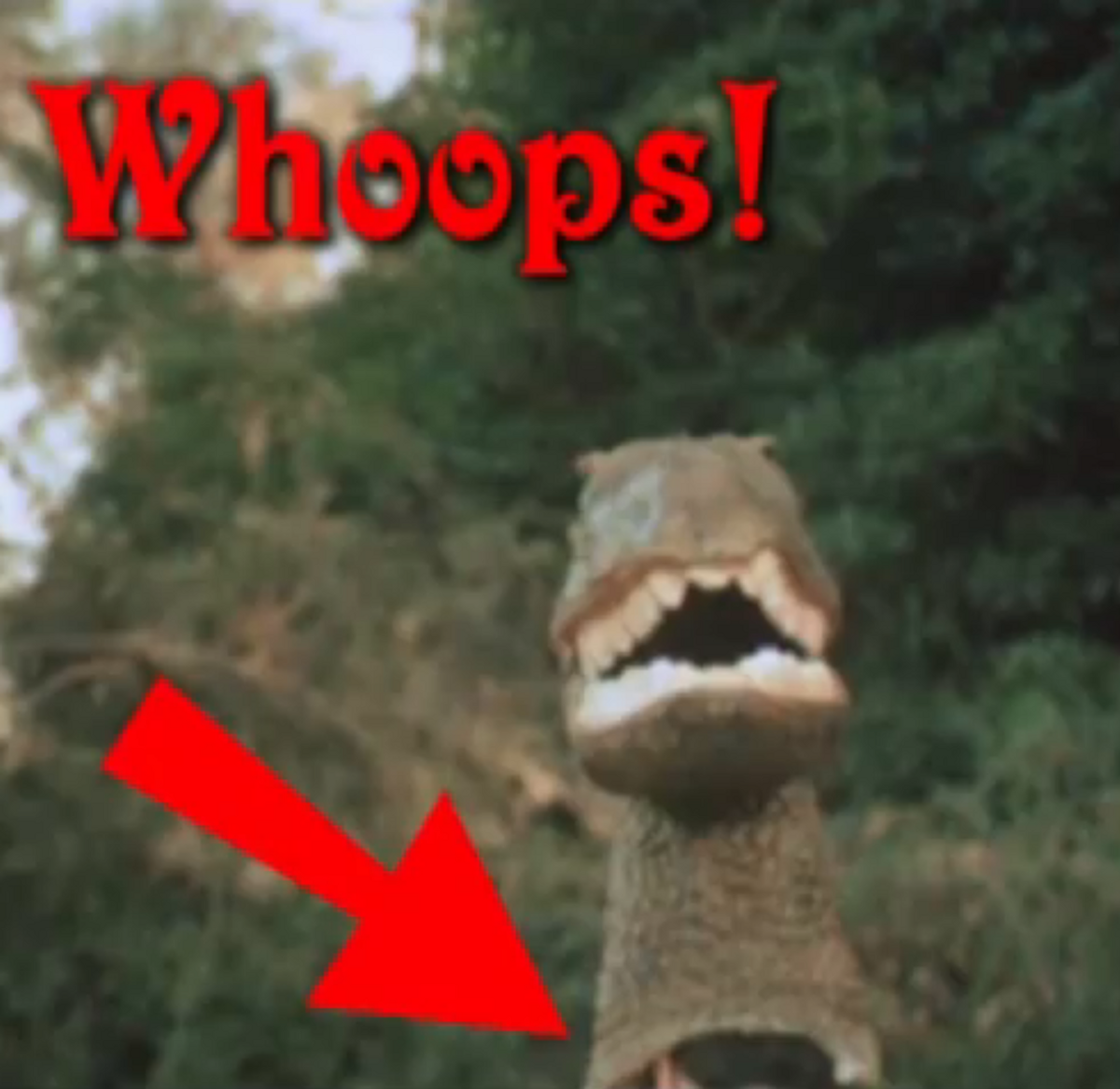
When special effects look really cheap and dodgy, to the point of pulling the audience out of the narrative, you have a Special Effect Failure. All-too-common prior to 1980, and still with us today despite relatively inexpensive digital effects that can be very convincing and realistic... but often aren't.
The audience's expectations for effects have grown up with the media. For example, it is obviously a dummy being thrown from a train in The Great Train Robbery — but since it was filmed when filmmaking itself was in its infancy, people forgave it. If a modern remake had done that, however, they would not have been nearly as kind unless it was for other reasons. Star Wars raised the bar for visual effects so high that only the most advanced pre-1977 effects can measure up. It should also be noted that the modern push to update everything to HD can also result in a retroactive form of this, as a matte painting in a 1980s VHS release looks fine, but on the cleaned up, "remastered" Blu-ray looks like, well, a cheap matte painting in the background. Same for video games when prerendered backgrounds look weird.
Sometimes a Special Effect Failure is caused by resorting to Off-the-Shelf FX. Many examples are just plain Bloopers (a literal failure of the effects). In a video game it can be because of Model Dissonance being revealed by a glitch or oversight. In animation, it can be lumped in with Off-Model.
Sometimes cheesy FX are regarded as part of the So Bad, It's Good charm of a work. Sometimes authors will intentionally aim for this as a form of Stylistic Suck. See also Prop. Compare Fight Scene Failure and Audio Mixing Failure.
Note that, despite the name, many newer examples may actually be visual effect failures, the difference being special effects are created practically on set while computer generated imagery, miniatures (both in-camera and motion controlled), matte paintings and Stop Motion are visual effects done in post.
Example subpages:
- Advertising
- Anime & Manga
- Films — Animation
- Films — Live-Action
- Live-Action TV
- Music
- Professional Wrestling
- Theatre
- Video Games
- Web Original
- Western Animation
Other examples:
- Motu Patlu (2012): In "Motu Banega Don", Motu and Patlu hide in one of the containers in a container yard to hide from John the Don's gang, who are chasing after them. Inspector Chingum notices John's gang entering the container and goes in as well. In the dark insides of the container, the characters can only be seen By the Lights of Their Eyes, then they start to beat each other up, creating visible hit stars that light up the inside of the container just enough to make it noticeable that their eyes are the only part of their bodies that they animated for that scene, with the rest of their bodies nowhere to be seen.
- In-Universe from Calvin & Hobbes: The Series, combined with Nightmare Retardant:
Hobbes: Bumper cars are fine when there aren't ghosts constantly flying down in your face!
Calvin: They were paper and on fishing line! - The "destruction" of the Munich terrorist facility in the James Bond fan film Diamond's Cut seems to intentionally go for the Camp factor with what seems like a really bad photoshop. Absolutely nothing collapses and the only signs of destruction are little tongues of flame with thin tendrils of smoke at the forefront.
- Essentially all of the special effects in the animated version of The End of Ends, but Count Logan's dragon form breathing fire stands out.
- In Parody Fic Plan 7 of 9 from Outer Space, the alien abductor D'Ork of the Thorkoth looks like a cheap prop from a Roger Corman film, has a Killer Robot that's just a diving helmet on a gorilla suit, and pilots a Flying Saucer that's held up by visible strings.
- Through Her Eyes: In-Universe, the Sinister Scythe Ruby can summon with her powers doesn't seem to reflect light at all, and is described as looking like rather sloppy special effects, possibly a jab to the background figures in canon before things picked up or to highlight how unnatural the thing is.
- In-Universe example in Diary of a Wimpy Kid: Double Down, where Greg and Rowley try to create a No Budget horror movie.
- Since Greg is the cameraman, Rowley has to play every character (including a woman, but he refuses to wear a dress and they can't find a wig anywhere, so he plays her wearing yoga pants and a hoodie while facing away from the camera). And Greg has no video editing skills, so they can only show one character on-screen at a time.
Woman: I hope you don't mind if I don't turn around but I am really concentrating on doing these dishes.
- They film scene in which an unnamed man tries to take a shower, but worms come out instead of water. Greg can't find a way to make it look natural, and settles for throwing gummy worms at Rowley's face and hoping it'll look realistic once they make the final cut. They also use ketchup as fake blood, which according to Greg didn't look that bad but was still too thick to be realistic.
- Discussed in regards to the climax of the movie, which would feature a battle against a giant worm. Greg admits he has no clue how they're gonna film it, but they don't make it that far into the movie before giving up.
- Since Greg is the cameraman, Rowley has to play every character (including a woman, but he refuses to wear a dress and they can't find a wig anywhere, so he plays her wearing yoga pants and a hoodie while facing away from the camera). And Greg has no video editing skills, so they can only show one character on-screen at a time.
- Mom Can't Cook!: Special Effects in Disney Channel Original Movies are often mocked as being very obvious, although they are occasionally more congratulatory to the creators.
- In Halloweentown (1998), they make quite a few mentions of the "monsters of varying levels of attention to detail", which range from people in decent costumes to "person in a Shrek mask" and "man in a hat".
- After Get a Clue has a newspaper article as a plot point, Luke starts looking closely at newspapers shown in other DCOMs to see what the articles say. The one from Get A Clue turns out to feature the same text repeated 3 times, while one from Ready to Run, with a headline about a horse coming to an inspiring finish in a race, has text about the disappearance of a couple in Hawai'i from an area notorious for its drug dealers!
- One of the podcast's more notable Running Gags is to refer to wonky special effects as "[effect]_notfinal.png" being wiggled around in the shot. The Merch even includes a black T-shirt reading "tshirt-design-NOT-FINAL.png".
- Digitally-overlaid graphics can often go awry;
- One time, ESPN's 1st down line during a football game rendered on an angle
 .
.
- During game 2 of the 2017 World Series, a Masterpass sign was digitally added to the outfield wall with a chroma key, but at one point, it accidentally overlaid on top of a player's head.
- The 2017 Army vs. Navy football game was played on a very snowy day in Philadelphia, leaving the field continuously covered in snow. The production crew must have changed the "greenscreen" effect of the play lines to white. This lead to the first down and line of scrimmage overlays to appear on the jerseys, gloves, and wrist tape of players.
- Sometimes Australian sports broadcasters superimpose advertisements onto the grass beside the field or over other advertisements on billboards. The flat, jittering graphics tend to be unconvincing to say the least.
- One time, ESPN's 1st down line during a football game rendered on an angle
- Theme park animatronics and special effects will inevitably break down over time and need to be fixed—it doesn't matter if it's a multi-billion mega-media empire like Disney or Universal Studios or if it's a small independent attraction someplace you'll only hear about from people comparing it to one of the world-famous theme parks, it will happen eventually, and you might get to see it yourself if you happen to be there on one of the days when they're malfunctioning, if it wasn't bad enough to force the entire ride to be closed down for repairs. These can completely take you out of the moment and ruin the experience, or just make for an amusing memory if only part of it is working and the rest isn't.
- Disney Theme Parks:
- The Hatbox Ghost from The Haunted Mansion ride at Disneyland remained a legend for decades due to this. He was a skeletal old man with a hatbox in his hand, placed in the attic with the Bride figure, whose heart beat and glowed. Promotional materials said that in the story, the Hatbox Ghost was the groom, whose head faded from his shoulders and reappeared in his box in sync with his bride's heartbeat. (There is evidence that this was part of a murder story in the attic scene, with other hatbox heads in the attic, and the Hatbox Ghost exposing the Bride as the killer with his trick.) The effect was meant to be done with careful lighting- the light would go off above his shoulders, making his head seem to vanish, and go on in his box, revealing the second head inside. However, proximity of the figure to riders made the first part of the illusion fail and the Hatbox Ghost was removed very early in the ride's operation, never made it to the Walt Disney World version, and most riders never saw it, to the point that it was considered a myth until photos of the figure in situ emerged. After, the Attic scene was retooled to make the Bride a lonely, mournful character due to the lack of a victim. After several decades, during which a new murderous Bride story was implemented with more detail, the Hatbox Ghost was finally brought back to Disneyland in 2015 with much more complex effects, with fluid animation, a projected, animated face, and a head-traveling effect that worked while the character was placed right next to the riders' vehicles. (Part of this is due to the new figure being hollow and the head being pulled into the body when the "switch" occurs.) While the new Bride is more obviously murderous, the Hatbox Ghost assumes a similar narrative role to before, likely showing what's in the attic hatboxes, as the hats are on a rack.
- One Man's Dream II: The Magic Lives On at Tokyo Disneyland ended with a musical number where the company sings the praises of Mickey Mouse, complete with Mickey himself rising from the stage via an elevator. One performance had the elevator get stuck midway, causing the show to end abruptly. Mickey's performer is visibly confused at the malfunction, and some of the dancers can be seen booking it off the stage and behind the curtain when they realize what happened.
- Gran Fiesta Tour Starring the Three Caballeros originally featured an animated sequence of the title characters singing their theme song as part of the finale. When the Mickey Mouse Revue ended its run at Tokyo Disneyland, however, the Imagineers decided to fix up the animatronics of Donald, Jose, and Panchito used in the old show to enhance the finale of Gran Fiesta Tour. While a good idea in theory, the transition was anything but smooth; the animatronics were in their forties by that point and had a very hard time standing up on their own. In one notorious instance, Jose completely fell over during normal operating hours, forcing the park to replace him with a mock "memorial" while he underwent repairs (the same fate later befell Donald despite efforts to keep him propped up with poorly disguised boxes). Eventually the Imagineers decided all three animatronics were long overdue for a refurbishment, so as a temporary measure, they replaced the finale... not with the original animated sequence, but with cheap-looking, static cardboard cutouts of the characters. Soon afterward, the animatronics would return with more fluid movements.
- Rise of the Resistance, now the centerpiece attraction at Galaxy's Edge in the parks which have it, is a marvel of modern dark ride design, combining animatronics and screen effects very well: you'll know when something is really there and when it's a screen, but they're still integrated very well and you are moving through a whole physical set rather than it being a simulator ride. But then towards the end there's scene where animatronic Kylo Ren grabs your ride vehicle with the Force as a screen effect in the background shows a huge battle going on outside the Star Destroyer the ride takes place on. He moves pretty realistically, until a stray shot from the battle hits the window behind him and breaks his concentration as focuses on not being sucked out into the void and allowing your escape—his arm motions suddenly become very Muppet-like.
- A rather infamous example at Disney's Animal Kingdom: Expedition Everest, something of a local version of the Matterhorn Bobsleds, was one of the most complex roller coasters ever built by Imagineers up to that point, and the climax of it occurs as you ride under a huge animatronic yeti roaring and taking a swipe at you from above. In order for the entire ride to function as intended, it needed three different structures which are all interconnected but which never actually touch each other: one for the roller coaster track, one for the mountain scenery around you, and one exclusively for the yeti. Unfortunately, not too long after the ride opened, something happened with the yeti's support structure and now it's stuck in a less-dynamic mode which Disney has tried to compensate for by adding a fan to add motion to its fur and a strobe light to trick riders into thinking it's moving more than it actually is. Why not just fix it? Because of how the ride is built, they would need to take the entire thing apart in order to repair the yet. (A similar problem occurred in the Indiana Jones Adventure where an ice machine in the ceiling would produce "rubble" which falls out of it and to the floor below, well away from the actual ride track, "in response" to another special effect to give the impression that the temple is crumbling around you; much more of the show building would need to be taken apart to fix such a small effect than the park is willing to actually commit time and money to.)
- Quite a few examples exist of two main failures: putting up the wrong headline or accompanying image (the small pics appearing next to a news anchor's head for each story) and someone who decided to wear the wrong shade of blue or green, causing the clothing to pick up images or video meant for the green/blue screen behind the anchor. Weather forecasters are particularly prone to the second one, given all the use of this type of imaging in their segments.
- People responsible for news graphics are only human, and sometimes they put up a picture of the wrong person. Or in one case, show a hamster instead of a murder suspect.
- Most of the Avatar: The Last Airbender fancomic How I Became Yours looks rather poor. Special mention goes to all the copied poses. Diaz copies from everything, mostly the show itself (though she often uses Ichigo as a model for Zuko), and often uses the same artwork over and over (Iroh is depicted in the "holding out the white lotus tile" pose from "The Waterbending Scroll" several different times). He's also depicted in a pose from "The Storm" wherein he is in a dark room and lit from below by a fire, and no attempt was made to change the lighting, despite the How I Became Yours scene taking place in bright sunlight.
- She also has a nasty habit of making characters change position by rotating their models, which tends to make them look more like mannequins than people. The most infamous example is when Sokka and Zuko carry Aang off after a sparring session, but it also makes the Toph/Aang sex scene unintentionally hilarious when you realize that the characters are in the same position the entire time.
- When Diaz doesn't copy, the characters tend to look like they belong in the Unintentional Uncanny Valley, like one scene where Aang has a twelve year old's face, a teenager's body, and elongated limbs.
- Ever-omnipresent, as long with Off-the-Shelf FX, in The B-Movie Comic.
- In Commander Kitty, Mittens and Fluffy's plan for creating a fake teleporter effect involves distracting Ace right before CK himself shows up with an accompanying spray of glitter. The actual execution leaves much to be desired as well.
- Parodied by Freefall, where cheesy special effects have been painstakingly re-created by CGI. Sam considers the programmers responsible to be geniuses.
- Referenced in Skin Horse where UNITY refers to Tip's new wolf form as a plywood shark.◊
- In El Goonish Shive, this trope is used intentionally to make Sarah throwing a couch look fake as intended in-universe.
- Parodied in Basic Instructions in How to Fight a Fake-Looking Monster. The monster in question, the Snake-Ape, is so deeply unconvincing that Scott apparently felt the need to defend his sanity while drawing it.
Scott: Look at those teeth! Those arms!
Missy: Those eye holes. That zipper.
Scott: IT'S TERRIBLE!
Missy: Yes. It is.

