

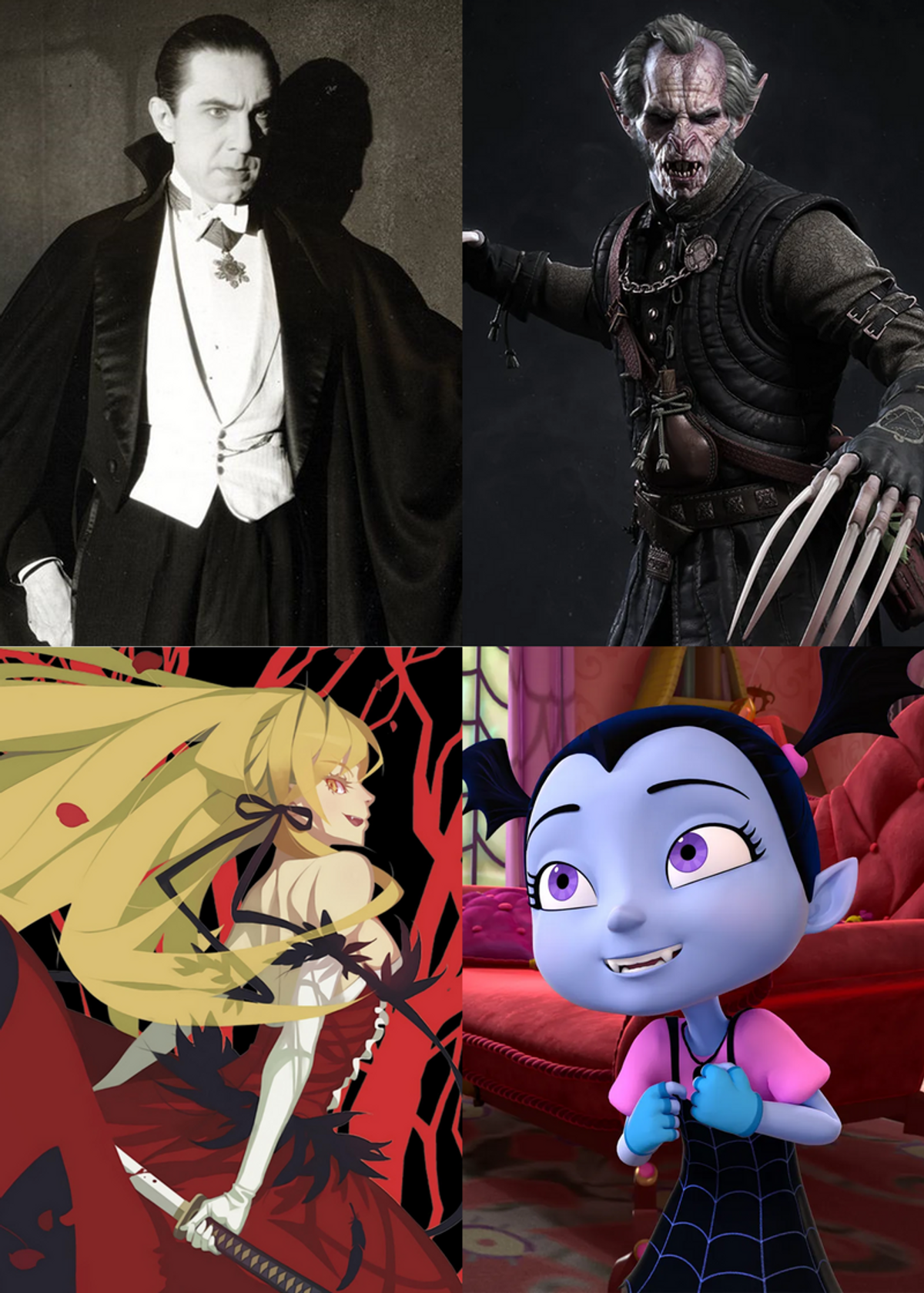
A Sub-Trope of Our Monsters Are Different. This one deals with everyone's favorite undead bloodsuckers.
The purpose of vampires in the story varies quite widely. They may serve as the Big Bad or as a metaphor for something, be it addiction or denial of aging, or even communicable diseases like the plague or an STD. There is some danger of the vampire character being too on-the-nose for the metaphor.
The "baseline rules" below are largely literary and cinematic inventions from the 20th century, with only limited ties to older works and the original folklore. For instance, a vampire's weakness to sunlight is not from folklore, but may have its origin in the 1819 novella The Vampyre. Sunlight holds no relevance to its vampire, but moonlight heals and revives him. Next up is the 1897 novel Dracula, which vampire suffers only the loss of his vampire powers in daylight. Following this build-up, the 1922 film Nosferatu was the first piece of media to portray sunlight as deadly to its vampire. It's been a thing ever since, which over a century later may seem like it's ''always'' been a thing.
Modern vampire treatment in popular culture is usually divided into cycles.
- The Malignant Cycle (1922-1948): The vampire is treated as a creature of pure horror, as popular in the early films like Nosferatu and Universal films.
- The Erotic Cycle (1950-1985): The vampire is considered evil but alluring, like in the Hammer Horror films.
- The Sympathetic Cycle (1987-2001): The vampire is seen as a tragic monster to be pitied, but still feared, though they can sometimes be redeemed, usually by becoming human once more.
- The Individualist Cycle (2003-present day): The vampire can be bad, good, or in between, much like humans, and their transformation to vampirism does not imply a change in morality.
The sheer number of different and contradictory myths that have built up around vampires over the years have made it difficult to explore all of them in great detail. To deal with this, writers have started putting multiple types of vampire into their setting, with the explanation that different myths describe different types of vampire. These are often referred to as "bloodlines", although any term suggesting shared descent or culture may also be used.
Another effect of the various vampire myths is that some traditional weaknesses might work while others might not. A vampire might laugh off crosses and garlic but instantly combust in sunlight. Many a vampire story involves the heroes figuring out what aspects of the myths are real and what was just invented for fiction, possibly perpetuated by the vampires themselves to give humans a false sense of security.
Differences may be reinforced by spelling it "Vampyre", or using a clever synonym like "nosferatu", "sanguinarian" or "strigoi". The term comes from Serbian vampir (вампир). If the differences are emphasized by overt mocking of other authors and unused vampire tropes it becomes Your Vampires Suck.
A work will usually address these baseline rules even if they're not enforced. Sometimes an unused rule will be explained away as a Fake Weakness propagated by the vampires themselves.
- They need blood. Mostly. Usually, vampires go insane/grow weak/die without it, or degenerate into mindless, rabid monsters.
- Variants on this point mainly involve drinking or consuming some other kind of thing from living bodies. Vampires and vampiric monsters that drain brain matter, spinal fluids, and more abstract things like youth, Life Energy, soul, willpower, chi, emotions, etc. all turn up. It's a whole big sucking thing. Some settings like The Dresden Files may even have different breeds of vampire based on their "diet."
- There are also different reasons as to why vampires need blood. Sometimes it's a metaphor for alcoholism or drug abuse. Sometimes it's that they've overstayed their welcome on life. They should be dead, so they have to steal life from others to remain "living".
- Some are Vegetarian Vampires who get by on animals and blood banks, and sometimes all they require is a quick, easily healed swallow from humans from time to time. These can become Friendly Neighborhood Vampires. The ones who must drink live human blood in fatal amounts aren't so lucky. The ones who enjoy it and get off on it? Well... Kiss of the Vampire is the option for Friendly Neighborhood Vampires. Otherwise? Vampire Bites Suck.
- Vampires are usually viral. In many tales or stories, their affliction is treated as a curse or supernatural corruption that can be spread to normal humans (or other creatures if there are other races besides humans). Of course this lead to a chicken-or-egg scenario where one questions where vampirism came from in the first place. This is usually explained in the form of Monster Progenitor or Patient Zero who somehow became the first of their kind and spread it to others. While the simplest and most common way to become a vampire is by infection, other methods which may have cause the first of the species to come about could be due to a Deal with the Devil by making a pact with dark supernatural forces, Ritual Magic that calls on dark powers to change someone into a vampire, or just being such an evil monstrous bastard that God Is Displeased and curses them or the final act that caused the transformation was symbolic and so depraved that it make the person a magnet for evil mystical energy that transforms them. Suffice it to say, Vampires created by these methods are usually much stronger than the average vampire and may have additional abilities or their weaknesses are reduced with some of them even being removed.
- They are capable of changing human beings into other vampires. Folkloric vampires were not so: one became a vampire after being cursed by one's parents, or dying by suicide, or after practising witchcraft, or being a werewolf or being born dead. Some say that Stoker's Dracula needed to go through a more elaborate process to make another vampire, but that bowdlerized versions removed the detail where he made the victims drink his blood to begin the transformation, but there is really no indication of this in the text—Mina is forced to drink his blood to establish a stronger psychic bond, and it is explicitly stated that a victim will, at natural death, become a vampire from just a bite.
- The more involved procedure has regained popularity and explains why not every victim of a vampire becomes one and, by extension, their rarity such as in Vampire: The Masquerade, True Blood, and The Vampire Diaries; at the very least, it explains why the 'vampire plague' scenario many heroes from Stoker onward try to prevent didn't happen thousands of years back. Some still use the "drained to near-death and left for dead" approach, but the modern blood-drinking-and-sharing offspring are usually beholden as servants to the parent vampire until released. Very few have the Heroic Willpower needed to resist becoming fully evil. Attempting to change a loved one into an eternal companion this way rarely works, either because the vampire in the equation cares about them so much that they don’t wanna risk killing them and/or said loved one would rather be dead than undead.
- Modern versions that don't have such a process often blur the line between vampire and zombie, sometimes leading to a full-on Vampire Apocalypse because of a runaway Viral Transformation. Worse, sometimes Vampires who don't keep fed turn into Zombies.
- Sometimes, vampirism is tied to the creator. Depending on how important the infectee is to the plot, killing the Vampire Monarch will either turn all of their "children" back into humans, kill all of their creations with them, or pass the position along to someone they turned. In some cases, killing the lower level vampires will do nothing to those they have sired; only the one at the top of the pyramid is tied in this way. There may be a psychic bond between creator and created.
- Recently, the idea has arisen that vampires judge each other by how far removed they are from a "source". The highest social status belongs to a Vampire Monarch who somehow became a vampire without being turned by one via bite; or else the next person below them if their spawn gets a Klingon Promotion.
- Of course, there can also be a fusion of "types". A vampire may create mindless undead slaves via simple feeding (often referred to as "spawn"), but to create a thinking vampire with the potential for the gambits of powers, the full process is needed.
- Or they create living servants like ghouls or blood-slaves who feed on their blood, get power from it somehow, and protect their masters any way they can. Vampire blood has often been depicted as having the power to extend the natural lifespan of ordinary humans, allowing them to bribe mortals to their service with drops of blood.
- Vampires are almost always inhumanly strong, fast, and durable, often to the point of being Immune to Bullets and most other mundane weapons. For some, especially more modern ones, this is where it ends, making them effectively little more than intelligent (and stylish) super-zombies. While it depends on the type of Vampire (usually the supernatural type) then tend to get Stronger with Age. This is for various reason which could be due to mastering their own powers, slowly gaining more dark power overtime, or that their long lifespans allow them to learn much more than mortals including magic and improving their mystical gifts.
- A variation of this is to give them their own unique "gifts" (telepathy, for example) that make them more distinct from their brethren, though all share the same aforementioned set of "normal" vampire powers.
- The original folklorish vamps were either disease ridden monstrosities or soul-sucking ghosts; in either case, their mere presence was likely to harm you, and though you could ward them off at night you couldn't actually kill them until the daylight hours, and sometimes you couldn't properly kill them at all since, being evil spirits, the best you could do is stop them from coming back.
- The traditional Victorian vampire has a range of supernatural abilities. Dracula had shape-shifting, limited flight, control over animals and the weather, the ability to scale walls, and other gifts, on top of the standard vampire strengths. It is unclear if this is due to Dracula studying Black Magic to enhance his skills (and this type of vampirism can come with an innate ability to learn that as well — it's also implied that this may have been how Dracula became a vampire) or if it was due to his advanced age. It's possible that both might be true.
- The strength of a vampire can sometimes be determined by its age, with older vampires usually (though not always) being stronger than younger ones. Sometimes this merely means that they are stronger and harder to kill, if it means anything at all. Some may evolve (or de-volve) into something closer resembling some progenitor vampire race, which can occur either gradually or in spurts, which makes them yet more superhuman.
- In other cases, the vamp can age into an outright Humanoid Abomination which will usually mean they are much more powerful, though some may understandably lament their transformation into outright monstrosities and more obvious loss of humanity; this, again, may happen gradually or in spurts. The ones who won the Superpower Lottery have, either naturally or through using their immortal lifespan to acquire ridiculous amounts of magical power, evolved into outright Gods of Evil, and are a menace to the entire world.
- Sometimes a vampire can be damaged by mundane weapons, and will feel pain and suffer consequences (for example, if you shoot them in the knee, they can't walk) — but it won't kill them, and they’ll eventually heal from all injuries. (Quite often, the vampire has to drink blood to heal.) In other cases, mundane weapons do nothing at all — weapons pass through the vampire like a ghost, or bounce off, or the vampire's flesh heals as soon as the weapon is removed.
- Another possibility if Overwhelming force or a medium-powered Cool Sword or general low-key Magic Spell (but not their specific vulnerability) is used is to turn into mist and return to their coffin, incapacitated until the next sunset.
- Achilles Heels
- Wooden Stake through the heart. In most modern depictions, this is fatal; in the original folklore, it merely stops the vampire from leaving his coffin. In most of the older stories, one had to use a hammer or a gravedigger's shovel to drive the stake in, which meant that vampire stakings mainly happened during the day when the vampire was asleep, but recently, it's become oddly easy to do by hand. Remember, the ribs are there to prevent just such an occurrence. In some cases, a special specimen of wood is needed for the stake to be effective, commonly Hawthorn, and occasionally it needs to be blessed or enchanted, but not all vampires are this picky about what goes through their chests.
- Decapitation - As with the aforementioned stake, this one works not only on vampires but on (almost) everything. Sometimes, these two weaknesses get combined, where the vamp can regenerate their head and a wooden stake through the heart merely renders them inert, meaning that one needs to put a stake through the heart and then cut off the head in order to truly kill it.
- Fire - another one that can be used to deal with most other supernaturals and also humans, although it varies between interpretations on just how much you need. Really, the only common Achilles's Heel definitely unique to vampires is...
- Direct sunlight. This is actually a modern invention; much newer than you'd think. In old legends, they actually had to sleep in their coffin during the day, but sunlight wasn't fatal. They were merely dormant during the day, making it "easy" to sneak up on them. Nowadays, they just hole up inside, and sunlight literally has the power to make them spontaneously combust. Sometimes this is specifically ultraviolet radiation; sunlight is dangerous, but a lightbulb is not. When UV radiation is what makes sunlight harmful to vampires, this also would explain why they've "become" vulnerable to it despite it being more or less harmless in earlier legends: ozone depletion means more UV radiation gets through the upper atmosphere. Meaning that bursting into flames is the vampire version of skin cancer.
- Weakness to sunlight often varies by age. Depending on the setting, elder vampires are either resistant (or fully impervious) to sunlight, or sometimes more vulnerable to it than younger vamps because they're so far removed from their humanity.
- An interesting inversion are Arabian vampires. They're active during the day and sleep at night, since people were naturally more afraid of the daytime in the desert.
- The idea that sunlight isn't fatal has undergone somewhat of a resurgence. The vampires in L.J. Smith's Night World series can survive exposure to sunlight, but it inhibits their powers. The vampires in Moonlight can survive exposure to sunlight for a limited amount of time. Vampires in the the Night Huntress series aren't really bothered by the sun, but they do tend to sunburn easily (then quickly heal, peel, and do it again), are somewhat weaker, and newly made vampires fall asleep involuntarily during the day. In some folklore, vampires were actually at their strongest at high noon, when their shadow was at its smallest. They were weakest at dusk, when their shadow was at its longest.
- Another way to explain why vampires are immune to sunlight would be through simple logic and real-life science. After all, Fridge Logic dictates that if vampires were truly vulnerable to sunlight, they obviously wouldn’t be able to go outside during daytime or nighttime. If they went out at night, they would be exposed to moonlight, which is simply sunlight reflected off the surface of the moon like a giant mirror. Therefore, sunlight and moonlight are technically identical, and vampires would have to be immune to both to survive on Earth at all. Otherwise, they would have gone extinct a long time ago.
- This rule doesn’t apply for vampire werewolf hybrids and as an added bonus they don’t have the werewolf witnesses i.e. vulnerability to silver either.
- If they exist in the story, magical weapons or other supernatural creatures might also have special abilities to kill vampires.
- Cannot bear the touch of special symbolic items, like silver, similar to werewolves or other supernatural beings; silver is toxic or burns them. This may relate back to the days when silver was thought to be solid-light, and as a symbol of the light, would harm anything non-human. Silver has become popular in recent years as authors try to avoid what some consider Unfortunate Implications of crosses' (or other religious symbols') having power. Silver isn't alone, however, as some folklore also mentions garlic for its pungent scent, which spirits both good and ill are normally repulsed by (although in some variants it's the flowers of the garlic plant, for their flowery sweetness) or maybe just because it smells bad to people with really sensitive noses, pure rough wood for its connection to nature, and salt for its ability to ward off spirits and other nasty beings as it represents purity of soul. Garlic and salt are also used widely as preservatives, especially in pickling; driving off and preventing decay is anathema to their kind. They also can harmed by magically augmented weapons and ammunition.
- The Vampire Hunter. Someone with a special destiny, equipment, powers, or training for taking on vampires. In some legends, vampires can mate with humans to produce dhampyrs, beings that are often born with an instinctual hatred for vampires and occasionally an innate ability or advantage to destroy them.
- Attempting to cross flowing water (e.g., rivers and oceans). Frequently interpreted to mean vampires can't cross flowing water. The effects of flowing water vary greatly depending on the story. Dracula, for example, could cross running water at the slack or flood of the tide. Sometimes, being immersed in water is enough to outright kill a vampire.
- Crosses, and possibly other religious symbols depending on the belief of the wielder. Originally, it had to be a full-blown crucifix (that is, a cross with a figure of Jesus on it). In modern renditions, this is usually subject to the faith of the wielder, the vampire, both, or neither. For instance, if a character is a devout Jew, then they could use the Star of David to ward off a vampire, and in one Doctor Who episode, a devoted Red Army member used a Soviet star to repel vampires. Then you can have a vampire who carries their own crucifix, being a believer too, like Henry Fitzroy in Blood Ties. He also prays and goes to confession (he figures that he is subject to the same sins as humans, and needs to do penance for them). Fortunately, he is a Friendly Neighborhood Vampire. But sometimes just being in an old church or some other holy ground can harm the vampire even if no living person is present. Sometimes, the religion the symbols represent have to have been around during the vampire's lifetime to have any effect. If a vampire predates all modern religions, don't go reaching for your crucifix.
- Religious music can have this effect too. In Vampire in Brooklyn, when Maximilian impersonates the heroine's pastor, the gospel choir's singing — even humming — causes him discomfort. And in Werewolf: The Apocalypse, it's suggested that Native American tribal songs and drums can drive away vampires.
- Holy Water often burns vampires like acid; drinking or total immersion in it will obviously exacerbate the effects, and are generally lethal.
- Communion Host (in Bram Stoker's novel, it was used to seal a crypt and prevent a vampire from entering their coffin at sunrise, and to draw a circle that vampires could not enter or leave).
- White roses / roses in general (might have connection with beliefs that roses will not grow over a grave). According to Dracula, a branch of wild rose laid on a coffin could stop the vampire in it from leaving (but wouldn't hurt them).
- Garlic or Onions, although this was more to ward off vampires, not harm them, Mustard seed for Arabian Vampires who are Djinn-augmented Humans to start with.
- Thorns (especially hawthorn) in Middle and Eastern European folklore
- Wolf's Bane (Aconite), a plant featured prominently in the 1930s Dracula film, but also Foxglove (Digitalis) and Holly Bushes.
- Also, folklore tells us vampires get disoriented (or even driven mad) At the Crossroads, and cannot tell one direction for another. Urban vampires seem to have developed a strong resistance to this weakness, especially those that frequent downtown districts (probably by building up an immunity from all the intersections).
- They cannot enter a home unless invited in by someone. This can range from killing them to simply that they physically can't enter. However, it is still a large disadvantage. The original Dracula was able to skirt around this problem if he had already drunk the blood of someone inside (Lucy sleepwalked, so he bit her when she left the house at night). Some versions allow the invitation to be revoked in an instant, others require elaborate ceremonies, while some do not allow the invitation to ever be revoked. In any case, locked doors are never an obstacle to an invited vampire. In other cases the invitation may need to be renewed every time the vampire returns. In some modern versions (Being Human) the Vampire will begin to spontaneously combust if he crosses a threshold without an invitation, though elder Vampires are completely immune to this. True Blood showed the logical downside to this flaw: all restrictions are lifted if the vampire buys the house. Fright Night (2011) uses a different loophole: you don't need to get into the house if you can just set it on fire. In the Angel episode When detective Lockley was drowning herself in the shower Angel was able to walk in in order to save her like he already had an invitation when he didn’t: It turns out the powers that be circumvented the rule.
- In some folklore, vampires are all stricken with a debilitating obsession with numbers, if you throw a quantity of small objects on the ground in front of them (seeds, grain, beads etc.) they will not be able to resist the urge to pick it up and count it; this affords the victim time to either run away or kill the vampire. ("Three! Three mustard seeds! Muha-ha-ha!"). Putting said objects into a vampire's coffin keeps them busy counting as well. Sometimes, the urge is powerful enough that you can force the vampire to expose itself to dawn. Sometimes it is not an "urge", but they are somehow forced to count those objects.
- Some folklore claim the only way to permanently kill a vampire is to hammer a stake through its heart, shove garlic in its mouth, cut off its head, tear off its ears, dismember it, burn the pieces in a fire, and then scatter the ashes across holy ground. A few old folklore suggest that even this only works until a full moon shines on the ash. This was all based on the theory that vampires were corpses animated by evil spirits. Doing all these things rendered the corpse unusable by the spirit. By contrast, the easiest supposed way to stop a vampire is finding their coffin and turning them face down to make them "bite the dust, not people".
- Mandatory tell-tale.
- No reflection (often because the vampire has no soul, but see below). This sometimes extends to shadows. But it depends on the vampire apparently. In one medium there are several types of vamps who have various weaknesses. In more recent examples this has been 'modernized' in terms of the vampire not being able to be picked up by audio or video recording or transmitting equipment. A popular explanation for this is because early mirrors contained silver, and older cameras had mirrors and made use of silver in the film chemicals. With modern mirrors using cheaper aluminum and most cameras being digital now, this aspect of vampirism isn't as common as it once was.note
- No heartbeat/breath. They still have functioning lungs, since they must take breaths to speak, but they have no fear of drowning and can't be detected by heartbeat.
- No mortal-brain activity (making them easily recognized by telepaths). However, other vampires can seemingly pick up on the minds of each other, thus some vampires have 'unique' mental signals that mortal telepaths cannot detect. This extends to some vampires having the power to dominate the will of other vampires.
- Physical features, such as being exceedingly pale, having unusual eyes (see Glowing Eyes of Doom), and, of course, fangs. In folklore, there were numerous physical telltales - eyebrows that met over the nose, fingers all the same length, hair in the center of the palms or backward-facing palms - that are rarely included in modern versions. The original novel-version Dracula has practically all of them. If they can hide some or all of them, dropping the disguise constitutes using Game Face. Sometimes vampires will become more and more human-like in appearance as they consume more blood/live longer. Sometimes... not.
- Body temperature: Vampires, being dead, are almost always at room temperature or colder.
- The smell of decay or of graveyard earth can also be a factor. For ones depicted as possessed corpses this might be obvious even to humans, in other depictions it only may be that other creatures with Super-Senses (like werewolves) can detect vampires by scent.
- Immortality
- The Ageless / Long-Lived: Vampires don't age as we mortals do. Sometimes, this is genuine eternal youth. Sometimes long periods of time undead can result in a pretty inhuman-looking character. Sometimes, they age like us, just at a much slower rate.
- Life Drinker: Rarely, the vampire is immortal but must restore his/her youth by drinking blood. In abstinence, they "age", and immediately begin to grow young after they've fed. This originated with Dracula and with persistent stories about one Elizabeth Báthory's bathing habits.
- Related, they usually suffer from Creative Sterility and/or the Immortal Procreation Clause. In regards to the latter, they usually cannot beget any children unless it's a male vampire and a live woman, in which case a Dhampyr is the result. They may however be capable of turning a child into a vampire, which results in an ageless Vampire Child. If it's a Technically Living Vampire species, this is usually waived and they can freely make vampire children through sexual reproduction.
- Cannot be photographed or caught on video, often an extension of the "no reflection" rule. This may also be related to the silver rule; mirrors and photographic film are both (usually) made from silver. It may also apply only to SLR and TLR cameras, where a mirror deflects the image from lens to film.
- In Moonlight, Mick explains in a voiceover that he could not be photographed when silver was used in film, but digital cameras have changed all that.
- In the TV series Ultraviolet (1998) (unrelated to the film), the vampire hunters use sights that pretty much amount to video cameras strapped to their guns in order to tell vampire from non-vampire.
- In the anime Magical Pokaan, Pachira does not show up on a normal digital camera but is perfectly visible when viewed with an infrared camera.
- One episode of True Blood has Jessica visit Bill because she doesn't know how to admit to Hoyt that she fed on a stranger in Fangtasia. Bill asks if she was videotaped or photographed doing so because he can't protect her as her maker if that's the case.
- Cannot be heard over phone lines, another logical conclusion of the "no reflections" law.
- If there are any actual Holy Relics lying around, these things will often kill a vampire even if they're just in close proximity. Again, some variations have the relics' effectiveness dependent on the faith of the wielder, the vampire, or both.
- Can turn into bats, wisps of smoke, or wolves for travel. (Bats are by far the most common.) A rare transformation featuring prominently in early literature (such as Dracula) was the ability to turn into elemental dust in moonlight. A connection to bats isn't part of older vampire folklore because all vampire bats are native only to the New World, and wolves aren't used today because of the rivalry between vampires and werewolves.
- Relatedly, can turn into other creatures that drink blood: vampire bats, mosquitoes, ticks. (Sometimes they become a single creature, more rarely a whole flock/swarm.)
- Unaided flight in human form.
- Can spider-climb up walls.
- Have a hierarchy of strength or other powers based on age or generation. Older Vampires or those from a previous generation tend to be more powerful than the younger. For example, a Vampire's sire (the one who changed them) may be more powerful. Older Vampires may also be more gothic and classic in depiction, due to an inherent conservatism. Younger ones are more modern. Sometimes vulnerability to normal weaknesses such as sunlight increases with age, while sometimes it reduces. As vampires age, their increase in strength may be accompanied by a less human appearance, becoming more visibly an animated corpse and/or more animalistic.
- Creating too many vampires generally "spreads the bloodline thin" and leads to too many weak or crazy vampires.
- Can pass through locked doors. Can sometimes alter their bodies to slip through impossibly small spaces by turning into mist or smoke.
- Can mesmerize mortals into doing their bidding, most often by looking straight into their eyes.
- If killed, can be restored to unlife with the proper procedure. One early version of this, appearing in both pre-Dracula stories The Vampyre and Varney the Vampyre, is that a vampire will be revived and healed automatically if its corpse is bathed in moonlight. Another common variant has vampires that turn to dust or ash when killed resurrect if the remains are mixed with fresh human blood. In some universes staked vampires will resurrect if anyone pulls the stake out of their remains before they've decayed to absolutely nothing.
- Animals react with fear or aggression towards them.
- Conversely vampires can sometimes command the loyalty of animals, particularly nocturnal ones such as wolves.
- Sometimes, vampires have two options of converting their prey à la The Virus. With some effort and rule-following, they can be changed into full, if younger, vampires. Sometimes, they have the option of just making either zombie-like or less powerful (often carnivorous) vampire slaves. Killing a vampire also kills any vampires that particular one created by the above means. Occasionally, it just restores them to non-vampiric life.
- Must sleep in the soil from their homeland/original grave.
- There are two social profiles for vampires. The first is a loner who may keep a cadre of vampire slaves and possibly a mate. Dracula fits this profile. The second is a "vampire society" where houses of vampiric lineages act and compete within a Masquerade.
- The Undead: Typically being turned into a vampire means getting killed by being bitten by one, then being brought Back from the Dead (though obviously you'd definitely Came Back Wrong if you have any of the other traits of a vampire). Pretty spry for a dead guy, though. Alternatively, they may be perfectly alive, just of a different (sub-)species of humans, like werewolves. Level of "deadness" varies. On one side of the spectrum, it's just lack of heartbeat and skin that's cool to the touch. On the other, they're literally a moving, rotten animated corpse.
- Modern updates of the vampire legend may completely avoid using the word "vampire" to describe them; see the "Curse of Fenric", Ultraviolet (2006), and Preacher examples below. The protagonists of Vampire: The Masquerade are called vampires, but do not like to call themselves such: they prefer "Kindred" or "Cainites", thank you very much.
- Level of retained humanity also varies immensely, from being ravenous, soulless monsters incapable of passing for anything but the above, to being soulless monsters who are very good at pretending to be their former selves, to being basically normal folks Blessed with Suck (or Cursed with Awesome, depending on viewpoint) and either a desire to be human again or are dedicated to using their powers for good.
- Occasionally suffer from severe OCD. One folkloric method of dealing with Vampires was to drop thousands of grains of rice in their coffin, the theory being they'd be compelled to count them all when they awake, wasting the whole night instead of getting up and terrorizing people.
- The folklore version also is told with sesame seeds, and may also extend to any small, numerous nut or grain, if not any particulate (handfuls of sawdust?). Fairies also have this problem.
- Dropping a bunch where you stand is a known way to escape the OCD variant of vampire.
- A similar folklore variant involves hanging a sieve, colander, or other household item that's full of holes outside your front door. That way, the vampire will stop and count all the holes, leaving them vulnerable at sunrise. ONE! TWO! THREE! FOUR! FOUR GRAINS OF SAND! AH-HA-HA-HA!
- Apparently poppy seeds were used to great effect in Greece, as they had the additional benefit of putting the vampire to "sleep".
- Also on the OCD theme, vampires will, like fairies, be obsessed with out of place and messily-tied knots, and must stop what they're doing to untie them.
- Act like Bela Lugosi's portrayal of Dracula.
- Sometimes use Vampire Vords.
- May or may not be at war with werewolves. If there are werewolves (or other supernatural beings such as The Fair Folk) around, attempting to mix the two (by 'converting' a werewolf into a vampire) may be impossible, dangerous, or simply against the rules of The Masquerade. In the case of Faeries, Demons or similar otherworldly beings, drinking their blood will generally cause the Mushroom Samba, possibly combined with strange random supernatural effects such as precognitive flashes or a delirious walk in daylight with no other ill effects. This differs in folklore, where vampires often have the ability to turn into wolfmen, and werewolves who are killed can return as vampires.
- Sometimes instantly turn to dust or dissipate completely when killed, an idea believed to have first turned up in Stoker's Draculanote . This may ignore mass-energy conservation, as in Buffy the Vampire Slayer, or release enough energy to cause serious damage to anything nearby, as in Ultraviolet (1998) and From Dusk Till Dawn.
- Their nocturnal existence naturally predisposes them to operate night clubs.
- Can willingly enter a state of torpor or otherwise safe suspended animation. Sometimes this is something they have to regularly perform, like in RimWorld, or it might be needed to heal from wounds. Proper torpor may require special facilities, such as a coffin or a pool of fresh blood for the vampire to submerge themselves in.
- Absurdly Sharp Claws: Fingernails of the lethal slicing kind, for both sexes.
- Blood Magic
- Brainwashing: With a side order of Mind-Control Eyes.
- Dream Weaver
- Elemental Powers
- Healing Factor and Super-Toughness: Anything that isn't immediately lethal is shrugged off and eventually heals. Usually treated as type 4 on the Sliding Scale of Undead Regeneration.
- Hypnotic Eyes
- Immortality
- Life Drain
- Mind Control
- Necromancy
- Nigh-Invulnerability: Varies from human to super tough (except against wooden stakes and wooden weapons), usually part of the Immortality package.
- Super-Reflexes
- Super-Senses: Particularly hearing, smell, taste, and night vision.
- Super Smoke
- Super-Speed
- Super-Strength
- Vein-o-Vision
- Voluntary Shapeshifting: Bats are most commonly associated with vampires, but wolves, snakes, rats, and insect swarms are popular too. More rarely you might see cats, nocturnal birds, or sea creatures like sharks or lampreys, basically any creature that is sufficiently predatory and/or creepy. Sometimes they can mimic other humans too.
- Wall Crawl
- Weather Manipulation
See also Looks Like Orlok.
Given that vampires are by definition fictional, No Real Life Examples, Please!
Example subpages:
- Anime & Manga
- Comic Books
- Fan Works
- Film
- Literature
- Live-Action TV
- Tabletop Games
- Video Games
- Webcomics
- Western Animation
Other examples:
- Rare commercial version: A famous Rayban commercial
 suggested that seeing direct sunlight was what harmed vampires. It showed a group of them gathered on a seawall, watching the sun rise over the ocean; it's only when one fails to put on his shades (and suffers the consequences) that we find out what they are. Maybe it wasn't the seeing of sunlight. Maybe the glasses were just that good.
- Reactolite did the same in England. Count Dracula no longer dies when people throw open the curtains, as he wears Reactolite Rapides.
- A 2012 commercial for Audi had the attendees of a vampire party wiped out by the car's incredibly bright headlights. One of the victims is the driver.
- An ad from 1993 shows how "a Count" likes to eat his Reese's Peanut Butter Cups: "I like to eat the peanut butter... first."
- A 1994 Energizer commercial featured Dracula going after the Energizer Bunny's battery...and locking himself out of his own castle. Just as he gets the key out from under the mat, the sun comes up. "Oh, great." *POOF*
- A 2013 Nutri-Grain Fruit Crunch bar commercial features a family of vampires who suddenly love mornings because of said product. They have pale, white skin and Transylvanian accents and wear completely black clothing. They also seem to lack reflections.
- One GEICO commercial shows a very, very excited Count Dracula working a blood drive—complete with pale skin, Romanian formal garb, and visible fangs. Otherwise he appears to be unfazed being out in the daytime or under fluorescent lights.
- Count Chocula is a Friendly Neighborhood Vampire who doesn't seem to have any of the traditional powers or weaknesses of regular vampires, except the ability to change into a bat. And he's afraid of ghosts.
- Virgin Games gambling website has a series of adverts involving a teenage Friendly Neighborhood Vampire struggling to cope with his unlife, particularly with all his innate weaknesses. Garlic burns him, he can't go into shops without being invited and can only sunbathe during a downpour.
- In a certain Canadian Cheese commercial, a vampire has his human maidservant prepare him a meal. She prepares a lovely casserole, with "A single clove of garlic" as one of the ingredients. Which she only mentions after he's swallowed his first bite, to his dismay. The vampire is a Classical Movie Vampire in all respects, except for the fact that he eats human food on the regular.
- A 1988 Duracell commercial features a toy vampire who awakens from his coffin after sleeping in it for three years to demonstrate the shelf life of the then-new-and-improved Duracell battery. He then transforms into a bat and flies out the open window of his castle.
- Dalja and her parents from Dalja, The Vampire Girl are Daywalking Vampires who has a rabbit's ears on their heads. Dalja can transform into a lot of bats with a rabbit's ears. In the show's intro theme song, the song says don't be afraid of Dalja because she is "different."
- Vincent from Hero Circle, the vampire of the Hero Circle, does not drink other's blood despite his being a vampire. He doesn't get any damage even if he's in the daytime on a sunny day.
- Ian from Shinbi's Haunted House is friendly towards his girlfriend, Gaeun. He has silver hair and does not wear a cape. Also, he cannot not turn into a bat.
- It's more of a metaphorical lesson on power-hungry humans, but Fred Clark does pose an interesting idea as to why vampires fear crosses in this blog post.
- In the world presented in How to Hero vampires are weakened by silver and garlic because Draculok, the first vampire was rude at a witch's party and tried to take her silver candelabra (and also he didn't like the garlic dish she made for the meal, she was petty like that).
- Limyaael's Fantasy Rants: Limyaael has a rant on vampires in fantasy fiction, which is apparently common breeding grounds for vampiric love interests.
- German Shit Happens comics feature various kinds of odd vampires, e.g. cow vampires draining the udders of the living, beaver vampires biting trees (vampire style, that is), or tree vampires drinking maple syrup.
- Scary Gary: Gary is a fairly classic vampire (burns in sunlight, can turn into a bat, sleeps in a coffin, etc.), but he isn’t exactly what someone would imagine the average vampire to look or act like after his Heel–Face Turn.
Kid: So you’re a real vampire?Gary: That’s right.Kid: You don’t look like the ones on tv.Gary: You’re probably wondering where my black cape is, huh?Kid: More like why you’re so fat and doughy.
- In the international Aarne-Thompson-Uther Index, in the tale type ATU 363, "The Vampire" or "The Corpse-Eater", the heroine is an unmarried maiden who gets hitched to a mysterious, handsome man. When they go to church at night, the man leaves the maiden outside and enters the church to devour a corpse, a scene his human wife spies in secret.
- "Hate the Day" by Behind the Scenes paints the vampire narrator as an Anti-Villain suffering from the dreadful sunlight, Horror Hunger, and killing their loved ones.
Like a lover, like a beast we catch you in your sleep
The lips approach your neck again
Her skin smells so sweet, it smells so sweet
Despair after the deed as I've been the beast again
Each night the raid repeats
Our nature drives me on
We kill what we love - Beth Crowley's "Monster" describes how the singer is "turning into a monster" who feels compelled to seek out deadly fights.
- Disturbed's "Devour" is vaguely about vampires. The song was inspired by David's experience with the Queen of the Damned soundtrack.
- "Collapsing New People" by Fad Gadget clearly refers to vampires as he talks about them sleeping all day, avoiding the sun, having no reflection but adds some other details such as talking about how they "exaggerate the scar tissue, make wounds that never heal." It may be less about actual vampires and more about how goth types fetishize vampires.
- "The Vampire Waltz" by Hannah Fury, sung from the perspective of a hypnotized vampire victim.
- Die Krupps' "The Vampire Strikes Back" portrays vampires as fast, dangerous hunters who enjoy the thrill of the chase.
- Lords of Acid's "Kiss Eternal" has a woman who wants to be turned by a vampire. The vampire is happy to oblige.
You gotta kiss me now
I wanna feed you now
You gotta kiss me now
I wanna feed you now - In Catrien Maxwell's "Like A Vampire", the singer compares herself to a vampire, believing her past trauma with an abusive man has "infected" her and made her incapable of ever having a healthy romantic relationship.
- "Slaying the Dreamer" by Nightwish.
Put a stake through my heart and drag me into sunlight
- "The Man Who Swallowed My Soul" by Persephone rdescribes someone who looks young except for the eyes, hypnotizes the narrator with his voice and kiss, and sucks her blood.
- "Follow Me Into Madness" by Tarot is narrated by a vampire turning his lover into other vampire and waxing lyrical about the beauty of the night.
- "Unsterblich" by Subway to Sally is about an immortal, ever-hungry creature. Once, someone gave him his blood; now, he is about to change another human being into a vampire.
- "Vampire" by Xandria.
Follow her until her thirst is sated
An immortal lie, heartblood
Can't help yourself, she's got you paralyzed
So would you kiss the sun goodbye?
And give your life to never die?
She's a vampire - Nautilus Pompilius: In the song "Gentle Vampire", the vampire called himself "an innocent child", but that doesn't seem to be true.
- Folklorists label many nocturnal carnivorous or parasitic supernatural being as a "vampire" (and the former is not even required, as the yara-ma-yha-who stalks during the day); entire books have been written on the subject.
- Armenian folklore tells of a vampire named Dakhanavar, who sucked blood through the soles of people's feet. He could easily be tricked by two people sharing a sleeping bag with their heads on either end, though.
- Vampire-like creatures appear in English folklore dating back to The Middle Ages, with Walter Map and William of Newburgh being two prominent vampire story tellers. Not too many English vampire tales after that date, though.
- Romanian mythology has what's called strigoi. Quick notes:
- Unlike Russia's upir, which is a walking, bloodsucking corpse from day one, strigoi start as harmless poltergeists.
- Some ill-omens can point to a human rising as a strigoi, but they're just indicators of what's possible: stuff like a black cat walking across the grave, moonlight falling on it, monkshood growing nearby, the list goes on and isn't conclusive.
- Driving a stake through the heart of a recently deceased strigoi vio (or human doomed to rise as a strigoi mort) will keep it from rising altogether. If that can't be done, wait until the spirit manifests through poltergeist activity and then call in the priest to exorcise it.
- The ghost grows increasingly more volatile until it's spent seven whole years in the town it inhabited in life. Then it's free to wander around the land.
- Full-fledged strigoi mort can be identified by red eyes, red hair, and a pale complexion.
- Feasts on human blood. Also has two hearts.
- Makes more of 'em by fathering children instead of with an infectious bite. The kids will become strigoi mort after death.
- Strigoi are also frequently described as being able to turn into owls, much like modern vampires turn into bats. "Strigoi" in fact is etymologically related to the word "Strix", "owl" or "screecher" in latin.
- It can be destroyed by cutting out its heart, burning it and mixing the ashes with water for the victims to drink. This practice was also common in Rhode Island.
- Romanian lore also includes an Eldritch Abomination variant called a Varcolac, that apparently has the ability to swallow the moon for a small amount of time.
- A majority of European vampires (or revenants, see first point) are corpses with a ruddy complexion, skin and nails that have fallen off to reveal new ones below, and have gained weight/bloated up. In short, they look like bodies in the natural process of decay. They may also appear similar to victims suffering from a number of severe illnesses that were more common at the time.
- As a potentially-interesting side note, hawthorn was considered vampire kryptonite in Central Europe (although garlic was seen as having some anti-vampire properties) and the same was thought of mustard in the Middle East and salt in the Philippenes.
- The Bajang of Malaysian Mythology is a cross between this and a Familiar. Bajangs are ghosts in the form of polecats who are kept by sorcerers in bamboo jars, fed on milk and eggs and released to drink the blood of the sorcerer`s enemies.
- Malaysian vampire lore also includes the Pontianak, a ghost of a woman who died in childbirth who lures victims to her by making noises like a crying baby. They have a hole in the back of the neck that if plugged will turn the pontianak back into a human.
- Another Vampire-meets-Familiar type creature is the South African Impundulu, a human-sized black hen that drinks blood, can emit lightning from its claws and works for witches. Like many mythical vampires, they are vulnerable to Kill It with Fire.
- Malaysian vampire lore includes a truly bizarre creature called a Penanngalan, which looks human by day, but by night detaches its head and flies (trailing its intestines) to people's windows where it uses its long, thin tongue to suck blood. It can be killed by filling its body with glass (so it shreds it's organs on re-entry) or trapped with thorns on a windowsill. Notably, this vampire, unlike most mythological variants, is vulnerable to sunlight, but only in its detached form, which is why trapping it until sun-up is a viable way to kill it.
- Filipino mythology has basically the same creature, but instead called a Manananggal, that detaches its entire upper body and grows bat wings.
- Tagalog uses the same word for vampires (of which there are two sorts, the other kind has a long, proboscis-like tongue), ghouls, and witches: "aswang," which is closer to "spook" than anything specific.
- Bali folklore has yet another similar creature known as the Leyak, except it only drinks blood from the fetuses of pregnant women.
- The Japanese have two very similar creatures, one that detaches its head and is basically the same as a Penanggalan, and one that simply stretches its neck out. They are respectively called the Nukekubi and the Rokurokubi, and likely originated from the importation and distortion of the Penanggalan myth from Southeast Asia to China to Japan.
- And finally, Burma has an all-male variant called a Kephn, that is arguably worse than all of the above because it feeds on people's souls. In mainland Southeast Asia, these kinds of vampires are called krasue.
- Filipino mythology has basically the same creature, but instead called a Manananggal, that detaches its entire upper body and grows bat wings.
- In the Andes, there is the Pishtaco. Instead of drinking your blood, he drains the fat out of your body and sells it to the white man on the coast, who uses it to grease his machines. After he's dried you out, he cuts you up. Makes an appearance in Death in the Andes by Mario Vargas Llosa and on the ninth season Supernatural episode "The Purge".
- India has the Vetala (or Baital), an evil spirit that inhabits a corpse, transforms it into a batlike monster and drinks blood. It's notable for functioning more like a trickster spirit then a vampire, and enjoys rhymes and riddles.
- Greece gives us the Vrykolakas, a bloated, ruddy, superhumanly strong walking corpse with a taste for livers and a habit of spreading plagues. If a vrykolakas is invited into a home, the home`s inhabitants will become vrykolakas. They are vulnerable to Kill It with Fire, a Wooden Stake, decapitation, exorcism or severing the tendons. Placing a wax cross and a pottery shard with the inscription "Jesus Christ Conquers" in its coffin will prevent it from leaving. Like many mythical vampires, they have an obsession with counting, specifically sand and poppy and sunflower seeds.
- Ghana has the Adze, a disgusting, hunched gnome that takes the shape of a firefly to feed on blood. Also from West Africa are the Asanbosam and Sasabonsam. The former is described as a humanoid with hook-like legs, while the latter is a monstrous bat-like ogre. Both are agreed to be tree-dwelling blood-drinkers with teeth made of iron, so they are often synonymous.
- In Finnish folklore, a child born out of wedlock, murdered by its mother after birth and buried in forest would stalk after her for the rest of her life, seeking to suck her breasts, not for milk but for blood, until she died. If they couldn't find their mother, they could go after any unfortunate woman. The stories usually depicted them as naked, paper-white toddlers, in spite of the murder taking place when they were newborns.
- In Albanian folklore, a 13th century tale speaks of the Dhampyr. A soldier goes to war but he promises his wife to come back to give her a son, legacy and stuff. Of course, he dies, yet still comes back, undead. He has the son and raises him, all this time not going in the sun. When his wife tells his mother that she is living with him she tells her that the dead are dead and the living should not mess with that. They get him high on weed (not making it up) and expose him to the sun. The end. How do we get from this to Blade, Blood+ and Vampire Hunter D? Who knows.
- The Russian Eretica (plural ereticy) is a vampire that always takes the form of an old woman dressed in rags. They were believed to have been witches who became vampires after death as punishment for sin. They sleep in coffins of blasphemers, gather with other ereticy in ravines and can curse someone to have a slow and painful death.
- Greek kathakano were thought of as vampires by the Medieval era, who transmitted their curse by vomiting scalding blood onto people. In addition to being a Daywalking Vampire, they were also strongest at noon. They can be killed by decapitating it and boiling its head in vinegar, trapping it in seawater or burning the toenails. Additionally, they are sometimes called "The Happy Vampire" for their constant Slasher Smile.
- In China, there are the Jiangshi, which are something of a mix between the traditional Slavic vampires and zombies. One notable difference is that the Jiangshi is not free of rigor mortis: Given enough time after its death, the creature will get so stiff that it will be able to move only by hopping. Oh, and they feed on the moisture in the breath of the living instead of blood.
- Asturias (northern Spain) has the Guaxa, a nocturnal creature with the aspect of an extremely old woman with big owl eyes and a single, needle-like tooth that uses to suck the blood of children. It can squeeze in through any crack, and sleeps by day in a cave or a hole in a tree - making it oddly similar to the "Teliko" seen in The X-Files.
- Brazilian Folklore:
- The urban legend of the "Papa Figo" ("Liver Eater"), who's always described as roaming the night in search of children to drink their blood and eat their liver (thus his name) because of some sort of rare disease, for which only the liver of children can serve as medicine. Further more, he's often described as very skinny, pale, tall, with long fingernails and long teeth. He also tends to be a very wealthy man with the means to hire thugs to find suitable children, making him basically a Brazilian Count Dracula of sorts.
- The myth of the "Corpo-Seco" ("Dry Body") tells about a man so wicked in life that neither God nor the devil accepted his sould after death, which cursed him to become an undead monster with a thin and shriveled body and long hair and nails, attacking the living at night. The myth shares similiarities with the way some folkloric vampires and others became undead as punishment for crimes committed in life in European folklore.
- Aboriginal Australian Myths contains a creature called the yara-ma-yha-who, which can be roughly described as their equivalent of a vampire. It's a monstrous humanoid that Was Once a Man and can transform another human being into a creature like it by drinking their blood, but the similarity ends there, which isn't nearly as reassuring as it might sound. The yara-ma-yha-who is a little, frog-like red man with a large head, an even larger toothless mouth, and incredibly long tentacle-like fingers, which lurks in fig trees waiting for unsuspecting travelers to pass by. When they do, it reaches down and entangles them in its tentacle-fingers, draining their blood with the Lamprey Mouth-like suckers that line them. Not for sustenance, but just to keep its prey nice and weak so it can swallow them whole. After that, it regurgitates them, and when it does, they come out ever-so-slightly redder an ever-so-slightly shorter, with an ever-so-slightly larger head and ever-so-slightly longer fingers. Then it lets them go, falls asleep, and waits to catch them again another day so it can repeat the process, again and again until its hapless victim is completely transformed into a yara-ma-yha-who themselves. Oh, and in some versions of the tale, it specifically preys on children. Australia has a few other, less famous vamps, such as:
- Garkain, a giant bird from Arnhem Land that drinks people's blood and forces their soul to wander the jungle forever
- Mrart, ghosts of improperly buried people who kidnap people and are capable of Demonic Possession.
- Namorado, a clawed flying skeleton used as a bogeyman.
- Judaism has the estries. Although they are all women, it is unclear if the estries are a One-Gender Race or women who have become cursed. They have Voluntary Shapeshifting and flight. The estries need to feed on blood to survive. They cannot fly if their hair is bound. If someone injured them, the estries must eat the bread and salt of the person responsible or die. Some sources say they can be killed by setting them on fire or chopping their head off. More recent depiction of them tend to give them more traditional vampire weaknesses including silver and wooden stakes.
- Scotland has the baobhan sith (pronounced Baa-VAN-Shee), which is usually depicted as a stunning fairy-like woman with feet resembling deer hooves, which she often conceals with a long dress. Rather than bats, they're also said to shapeshift into crows or ravens. Like other faeries, they can be warded off with Cold Iron.
- The Soucouyant (a.k.a Loogaroo/Lagaroo/Asema) is a kind of witch empowered by a Deal with the Devil from Caribbean folklore that by day appears as an old woman, and by night, removes her skin and transforms into a ball of fire to fly through the sky in search of homes to infiltrate and sleeping victims to drink the blood of. How a fireball drinks blood is unclear. Soucouyant victims possess blue-black marks on their arms, legs and soft parts, and if drained of enough blood, they will die and possibly become a soucouyant themselves, leaving their killer to assume their skin. Apparently they have OCD, because if rice or sand is scattered in its path it will drop whatever it's doing to count the grains, and will die if still in vampire form by dawn. The other way to kill them is to find the skin (helpfully left on a tree) and rub it with salt or pepper, which will make the soucouyant explode when it puts the skin back on.
- The Chupacabra is considered by some to be a modern take on the vampire myth, changing the monster from an undead human to either an extraterrestrial creature or a canine mutant. However, unlike most other versions of the myth, it prefers to pry on livestock rather than humans.
- Many myths amongst the Native American tribes of the Pacific Northwest claim that mosquitoes and other bloodsucking insects are in fact the spawn of a single gigantic mosquito monster (sometimes a child-eating boogeyman instead) that was defeated by brave humans after terrorizing the world for years. In most stories, the humans burned the monster to death, and then mosquitoes, blackflies, horseflies, etc. were born from its ashes so it could continue to feed on humanity as thousands of tiny creatures rather than one giant creature.
- Of all things, pumpkins, squash, and melons can become vampires in the folklore of some Balkan countries. If they're left ripe in a storm (or left out for ten days after Christmas), they fill with water, which coalesces into a Living Shadow, who endeavors to fill its gourd with blood so it can become a corporeal creature. It takes to moving its house around to collect said blood from unsuspecting travelers. Once full, it hatches into one of the vampires we know and... well, know. They can be slain by dunking in boiling water, beaten with a broom and the broom being burnt.
- The strangest vampire this side of the Yara-ma-yha-who is the German Neuntoter, whose name translates to "Killer of Nine". Neuntoter are covered in pus and sores and appear in times of plague. Lemons, not garlic, ward them off, and they can be killed by cutting of the head and stuffing the mouth with a lemon. For added weirdness, they are created from children born with an (apparently literal) spoon in their mouth.
- Due to his iconic stature and Public Domain (read: free) status, Dracula often appears in Pinball games with a horror theme:
- In Monster Bash, Dracula is the lead guitarist of a local band.
- In Elvira and the Party Monsters , he's the barbecue cook ("Chief Cook")
- Stern Electronics' Dracula has a more traditional presentation, with Dracula standing on a rooftop cradling a hapless victim while a crowd with flaming torches watches from below.
- Bram Stoker's Dracula is based on the movie of the same name.
- "Drac" is one of the passengers in Taxi.
Drac: "Yo, taxi!"
- In Zaccaria's Magic Castle, the Dracula Expy "Zaccula" appears in the castle gateway during the game.
- Nosferatu has a cartoonish vampire with bright green skin who gets noticeably drunk from drinking blood out of wine bottles.
- Ain't Slayed Nobody's "The Between": The vampires of the setting appear human but have fangs and pale skin, can create and control thralls, cannot enter buildings unless invited, can transform into bats, and as they grow more powerful can freely manipulate blood and even teleport into a target's body and emerge by tearing them open from the inside.
- The Limehouse Lurker is an ancient vampire who resembles a child but possibly dates back to Roman—if not Old Testament Biblical—times. He can freely control blood, transform into a swarm of bats, and has a hangup regarding threes—which fellow vampire Julias opines is due to him having gone insane in his old age. He also has a thing for draining sailors.
- Julias is a centuries-old Vampire Monarch who was once a Hunter at Hargrave House when he was alive, but in undeath runs a rat-baiting gambling den. He takes an interest in Sebastian Melmoth and Roland Kessler—intending to eat them, but after this is resolved by Melmoth using a Janus Mask to make Julias a member of his cult, he becomes Kessler's on-off lover.
- The Magnus Archives' vampires are an interesting case. They are humanoid in outside appearance only, sharing almost nothing else in common with us. They are carnivores who feed exclusively on human blood and are not able go eat any form of solid food. They spend most of their time in their "lairs", only coming out to hunt. They seem to prefer living close to potential prey, some of them being shown owning homes in human settlements. While not able to speak, they blend into society using their appearance and their gaze, which has a hypnotic effect and can give people sensations, simulating conversation. Once they isolate their prey, they will attempt to feed, biting into their victim's neck using their shark-like teeth and then drain the blood front their body using their massive tongue. They can drain a person's entire blood supply in a manner of minutes. Each meal is quite literally filling for them, their bellies engorging with blood, and they will take long rests between each meal. They are apparently very dry, being highly vulnerable to fire.
- The Magnus Archives: As Trevor Herbert describes them, vampires in the series are more like humanoid fleas or ticks than the Dracula or Anne Rice standards. They can dislocate their jaws, have extremely long tongues, and visibly distend while consuming blood. Additionally, they do not speak but can make themselves understood through some sort of telepathy or mind control, they are not hurt by sunlight, and their bite does not create more of their kind.
- This (apparently Twitter-original) Micro Flash Fiction:
"Hello! Do you have a minute to talk about Dracula?"
"No — wait, Dracula?"
"Yes!"
"You're vampires?"
"Yes. We have pamphlets."
"Vampires have missionaries?"
"Where else would new vampires come from?"
"I assumed you bit people."
"There are many hurtful stereotypes. May we come in?"
- David Heath made his career playing wrestling vampires. He worked in the independents for years as Vampire Warrior before arriving in WWE in 1998 as Gangrel, derived from White Wolf's Vampire: The Masquerade. He himself has acknowledged The Lost Boys as an influence. As Gangrel, he had a Big Entrance involving him rising from below the stage through a Ring of Fire while wearing Cool Shades and holding a goblet of "blood" that he would drink from before his matches. His Finishing Move is a jumping DDT called the Impaler.
- The Canadian wrestler El Vampiro made his name in Mexico. His Finishing Move is called The Nail in the Coffin.
- Vampires do not often feature in the radio medium, although the BBC has in the past dramatised Bram Stoker's Dracula for radio performance, in both straight and comedy parody versions.
- The surrealist BBC Radio Four comedy series The Burkiss Way once did an extended parody of Dracula. The naive young lawyer arrives in Transylvania to realise things are not what they seem. In fear and panic, Harker protects himself as best he can:
I laid a semi-circle of nuns around the bed and tied an archbishop and a rural dean to each bedpost. Finally I hung Cliff Richard up over the bedhead...
- Dawn of a New Age: Oldport Blues: Daigo gains a superpower that turns him into a vampire in all but name — his physical abilities are enhanced at night, and only become more powerful when he feeds on blood. When exposed to sunlight, rather than turning to dust, he is put in a lot of pain, and cannot use his vampiric powers.
- Fire Emblem on Forums: While vampires are rare (owing to them not existing in the Fire Emblem games), there are still a few setting-specific examples:
- Wonderful Blessing: Generian Vampires are immortal as long as fed blood. While once the terror of Generia, once their wizards figured out how to generate magical blood using a small cantrip, their entire society had a collective case of And Then What?, descending into pointless hedonism and fratboy-style stunts. One of the main characters, Keith, is one.
- Solrise Academy: Vampires are a subrace of the Belgor in this setting, having smaller horns, but much of the physical traits associated with vampires such as pale skin. However, they are not known to actually drink blood, this being instead a stereotype perpetuated out of general prejudice against the Belgor, but the name has since stuck.
- The Insane Quest of Unfathomable Randomness: Eddie has nearly all the weaknesses of a traditional vampire and none of their strengths (except when under the influence of his Superpowered Evil Side). He can survive on a diet that does not contain any blood (though the smell of it causes him to go into a shark-like feeding frenzy) and can withstand mild doses of sunlight but temporarily disintegrates when exposed to high concentrations of light. Since no other vampires have appeared in the series, it is unknown whether all vampires in his universe share these attributes, though it is implied that he is a weakling by their standards.
- Code:Realize: Vampires are a sub-race of humans with greater physical capabilities. Interbreeding with humanity means that pure-blooded vampires have become vanishingly rare even before most of the species were wiped out by the human-initiated Vampire War.
- Diabolik Lovers: Vampires are a distinct race that originate from a parallel world Home of Monsters. They have the core vampire upsides (superhuman strength and durability, quick recovery from injuries, immortality) and very few downsides (not harmed by sunlight, garlic or crosses, but vulnerable to silver.) They are not under any sort of Immortal Procreation Clause and they can turn humans into vampires too - but it is a protracted and unreliable process unless the vampire is extremely powerful. Former human vampires are weaker than born vampires in basically every respect but do have all the base characteristics. Being predators, vampires are all cruel by nature with an implication that the more powerful they are, the greater their Lack of Empathy. By extension, the heroine of the series has an implied ability to make them catch feelings because they take levels in kindness from being around her.
- Fortune Arterial: Many vampires strive to fit in among normal humans, their need for blood is similar to a substance addiction that has to be periodically quenched, and they also possess none of the traditional weaknesses, but cannot make more vampires via feeding. Rather, one who consumes a vampire's blood becomes a kenzoku (progeny,) gaining the abilities of a vampire (minus blood-sucking) but becoming bound to that vampire as a servant and an all-day breakfast on legs. While blood bags are commonly used, they cannot sustain a vampire forever—eventually, they will have to suck the blood of a human. Vampires typically make a contract with a human who becomes their servant and provides them with a source of blood, in exchange for immortality. The vampires also have the ability to erase memories. Also, while their eyes are not normally red, they do turn red when sucking blood or using their memory-erasure.
- Hakuouki features "furies" created by experimentation with a Western drug (revealed in Heisuke's route to have been made from vampire blood), identifiable by their white hair and glowing red eyes. They are inhumanly fast and strong and heal most injuries almost immediately, to the point that the only sure way to kill them is to pierce the heart or cut off the head, but being out in daylight is physically taxing and painful for them, they have difficulty healing wounds made with silver, and their craving for blood is so intense that it drives most of them quickly insane. The furies strong-willed enough to hang onto their sanity suffer episodes of crippling pain when the bloodlust hits them. It's eventually revealed that the furies' power comes at the cost of their lifespan, as they burn up in minutes the energy they would normally have used to live for years; when it's finally used up, they crumble into ash.
- Havenfall Is for Lovers: The vampires are immortal former humans who sustain themselves by drinking blood. Resident Friendly Neighborhood Vampire Diego is vague about how he became what he is, referring to it as a curse earned by his past misdeeds, but a threat made by his season 1 antagonist indicates that vampires can turn living humans into their kind. They also Must Be Invited in order to enter someone's home. Much of the rest of classical vampire lore is dismissed as myth, however; sunlight doesn't affect them, they reflect normally in mirrors, and even a stake through the heart is likely to only incapacitate a vampire unless it's the right kind of wood (Diego directs the main character to use cypress). Aside from enhanced strength and immortality, the exact range of their abilities seems to vary from vampire to vampire: Diego can warp through shadows, and another vampire in Diego's storyline demonstrates the power of telepathy.
- Marco & the Galaxy Dragon: An alien resembling a stereotypical vampire tries to invade Earth during a montage. He’s quickly driven off when the heroines brandish a cross, garlic, and silver at him.
- The Nasuverse (emphasis on Tsukihime) muddles the meaning of "vampire" quite a bit. There are two categories — "True Ancestors" and "Dead Apostles" — detailed below, but all vampires generally lack the classical weaknesses. The only ones that seem to be true are that they have trouble with large bodies of water and are weak to sunlight, though this applies more to Dead Apostles. True Ancestors merely don't like it. Holy powers do work on them, but they're not particularly effective.
- True Ancestors are the original vampires, spirit beings so powerful they can manifest in a physical form. They were willed into being by the planet itself as a self-protection program against the spread of humanity. They don't need to drink blood at all, but because the Crimson Moon tricked Gaia into using him as the template, they have a desire for it so powerful that they must use their own power to suppress it. If their will fails, they go insane and become Demon Lords, so the sane True Ancestors created Arcueid to deal with them. Apart from Arcueid and Altrouge (who is a hybrid of True Ancestor and Dead Apostle), they are considered to be extinct at least in the Tsukihime-verse. Fate/Grand Order reveals at least one True Ancestor still exists in the Fate-verse in the Crypter Hinako Akuta, who has existed since the Qin Dynasty of China and recorded in history as Consort Yu, the lover of Xiang Yu who supposedly committed suicide after his death and is summonable as an Assassin-class Servant. Specifically, she's an incarnated Elemental created by Gaia, rather than by Crimson Moon, for the purpose of maintaining the Planet's surface, though she shares the Crimson Moon True Ancestors' bloodlust. She can also feed herself from myths and stories instead of blood.
- Dead Apostles, the other category, are a bit more complicated. A Dead Apostle is created either when another vampire sucks their blood or when their research into immortality reaches the point where they enter this category. For the first category, they begin as zombies, become mindless ghouls and another step or two with long periods in between until finally they are a vampire. The odds of any one zombie becoming a vampire is very low, but magical potential boosts both the odds and the rate as seen with Satsuki Yumizuka, who became a Dead Apostle literally overnight. Unlike the more powerful True Ancestors, Dead Apostles (particularly their leaders, the Dead Apostle Ancestors) tend to have some extremely bizarre form or ability, with such wonderful specimens as a bird-man, a vampiric mobile forest, a man who has turned himself into a mass of chaos, and a magus who literally transformed himself into a phenomenon. Some beings are classified as Dead Apostle only because they act somewhat like them, however, such as ORT or Primate Murder.
- Shall We Date?: Blood In Roses: Vampires can turn people into their "belongings" by the way they suck that person's blood. They can also make their "belonging" do whatever they want when their eyes turn red. Two of the guys in the game attempted to do this to the heroine and make her their "belonging" and the player can choose which guy from that bunch, if they want either, "succeeded".
- Tavern Talk: Kyle's first instinct upon arriving at the tavern is to ask the Innkeeper if he can suck their blood. Naturally, they refuse, so Kyle settles on a red, bloodless drink for his first order instead. He can also turn himself into a bat, but he's out of practice, and he easily burns up in the sun. According to him, his aunt Mathilda used to apply chimera saliva on her skin as sunblock. Additionally, vampires like Kyle are immortal, with his age being unknown, although him saying "in all my millennia" suggests that he's around thousands of years old.
- Tomato Clinic: Tomato Clinic is a blood donation clinic for vampires. The characters explain that most of the depictions in fictional works are exaggerated, referencing vampires turning into dust when exposed to sunlight, that they're repelled by garlic or crosses, them sleeping in uncomfortable coffins, and being able to turn into bats or mist. They still say that they're affected by sunlight, receiving a sunburn much more quickly than normal, and are now able to go outside due to modern sunscreen.
- Wicked Lawless Love: Contrary to the in-universe mythology about them among Muggles, vampires are not undead, but living, ageless beings. Some are created by turning non-vampires; others, like Cecelia, are born vampires. All vampires feed on blood, are harmed by sunlight, and Must Be Invited in. They also have access to abilities including flight and compulsion.
- Murder Drones: The Disassembly Drones are essentially robotic vampires, given they possess limited Voluntary Shapeshifting, bat-like Razor Wings, Super-Strength, and an incredible Healing Factor. They are also so vulnerable to overheating that direct sunlight can break them and they need to drink the oil of Worker Drones in order to regulate their temperatures. That last one is implied to be an intentional design flaw meant to make the Disassembly Drones self-destruct once they've disassembled all Worker Drones given that not even the frozen planet that the series takes place on can keep their temperatures down.
- Strawberry Vampire: This indie cartoon centers around Franny and her family of vampires adjusting to their life in America. They prefer strawberries over blood.
- The Vampair: Getting possessed by dark magic can turn you into one. However, this doesn't turn Missi into a full vampire since casting the cane away turned her back to normal. There's also the fact that sunlight won't kill her, but it does hurt like Hell for her. In addition, she doesn't need to sleep in a coffin and seems to still have her reflection, unlike Duke.
- Bogleech: "Reviewing the Classic Halloween Monsters" discusses the "classic" movie vampires —meaning broadly a spectrum between the aristocratic, caped Bela Lugosi type, broodily philosophizing in a Gothic castle and sometimes ruling over other monsters, and the monstrous Count Orlok lookalikes— and speculates about the potential of introducing more batlike traits into vampires, such as drinking blood using their tongues rather than their teeth, having batlike faces and leaf noses, or echolocating.
Though the Lugosi vampire is the most common, we're still lucky enough to see some modern emulations of the Count Orlok style vampire, the famously terrifying star of the nearly lost horror masterpiece, Nosferatu. Between these extremes of seductive, high-society vampire and rat-faced, spider-clawed demon vampire, we enjoy a whole spectrum of fanged haematophages, including that mid-way point where a dapper vampire count has pointed ears and lovely blue or green skin.
- Everything2: Quite a few short stories, including (but not limited to):
- The Federal Vampire & Zombie Agency: Vampires are biological creatures, and vampirism is caused by a virus of the rabies family. As such, vampires are not immortal (though very long-lived), have reflections, can't be killed by stakes in the heart (in fact, they don't use the heart at all), crosses or holy water (but can be drowned), have no problem with silver or garlic, and can't turn into any animal. Only fire, beheading and sunlight kill them. They don't burst into flames by sunlight, it just causes them a serious of seizures that would eventually kill them, and they can only sustain themselves on human blood.
- Gaia Online:
- Vampires do not die in sunlight. They just get really sunburned, really easily. And sometimes catch fire. They do still need blood though, but can subsist on human-style fare (though they find it unpleasant) or soy-based blood substitutes. Also, (as Louie is quick to point out), they do not sparkle. Stop asking.
- zOMG! also has vampires as enemies in Deadman's Shadow, which are unconventional even by Gaia Online standards.
- The "vampires" of Orion's Arm were goths who programmed their genetic tweaks and life-extension bionano to include sensitivity to sunlight and a need to drink hu blood. Most polities can easily cure them when discovered.
- SCP Foundation: SCP-742 is a mutagenic retrovirus that transforms humans into vampire-like creatures. They bite their prey with a paralyzing venom, and instead of feeding on blood they drain stem cells from their victims' bone marrow, which allows them to become biologically immortal.
- skary.net, the website of Katy Towell, brings us the Mockingbird Song, an animated short about a girl named Shawnee Jenkins. Her parents are attacked and bitten at some point. They eventually turn into feral vampires. They degrade to the point where they're basically animals, unable to even speak. Yet Shawnee continues to care for them and clean up the messes they leave behind. They're still her parents after all.
- Taerel Setting: Vampires are known as kin'toni and are living, not undead. They are Transhumans made to be Super Soldiers, given superhuman abilities by the virus that alters their bodies. They lack traditional weaknesses besides sunlight.
- This Tumblr post talks about a vampire using slang.
- This video showcases information gained from the accidental creation of a "real" vampire through gene therapy. Most of their traditional weaknesses don't even exist (garlic and holy water don't work, sunlight just hurts their eyes). The ones that do act different (right angles like crosses cause them to have fatal seizures because of the way their brains are wired). They also feed primarily on human flesh and only drink blood as a last resort. Oh, and they're now extinct because of the right angle-laden structures our ancestors began to build.
- Afterlife SMP: The Vampire origin (held by Scott on his second life) grants the ability to drink blood from others, a couple Flash Step-based powers, and numerous buffs during the night; however, the player takes extra damage from wooden weapons and burns in sunlight (added after the developers found a way to make it so the game wouldn't be unplayable in this condition; previously, it merely weakened the player).note
- The vampires in Blood Light are pretty much your typical broke-ass urban twentysomethings. Or at least they look twentysomething. Some don't even have fangs.
- Carmilla the Series: Vampires such as Carmilla are not weakened by sunlight, though the standard staking does apply (the rest of the main cast pulls out garlic at one point, but it's not all that clear whether it actually does anything). They're also seen to be super strong, super fast, and have a variety of other powers such as lighting things on fire and shapeshifting (only into an animal form specific to each vampire). It's also explicitly stated that the powers afforded to a vampire grow as one ages. Some have been shown to have an even wider range of abilities including teleportation, sonic screams, some equivalent of magic, and Demonic Possession. On a physical level, they don't age, but according to a bonus, apparently canon side video, they're fully capable of reproduction (implied by the fact that the video in question confirms that this universe's vampires can get periods).
- CollegeHumor lampooned this trope in their video "Vampire Reunion". It shows in a very humorous manner the inherent problems this trope makes with creating any sort of Intercontinuity Crossover with more than one series that includes a vampire. Among the vampires featured are Count Dracula (as the leader, naturally), Edward Cullen, Bill, Count Von Count, Blacula, Angel, and Count Chocula. Even the assorted vampire hunters waiting to strike in the next room (Buffy, Blade, and Van Helsing) can't agree on what methods they should use to kill the vampires. It also carries shades of Your Vampires Suck, since Dracula calls Edward out on the fact that he doesn't have fangs, and Edward in turn states that at least he doesn't look like Angel, who has a monstrous true form.
- Cryptobiology has its main vampires inspired by both The Federal Vampire & Zombie Agency and Blindsight, being created by a virus that completely restructures their anatomy. Most of the normal abilities of biological vampires apply, including superhuman physical abilities, agelessness, and superhuman senses, but on top of that there is superhuman intelligence, with their abilities of perception bordering on precognition. Most of the traditional weaknesses dont work, but right angless give them seizures, they have an aversion to bright light, and a compulsion with counting small objects. Outside of this, there are two additional types of vampires:
- The Chupacabra, who in this setting is a canine(like a dog or a coyote), infected by a relative of the virus that creates human vampires.
- The Strigoi, which are created by a fully different parasite(a protozoan this time), that mutates the body, creating bald, pale, hunchbacked entities, with reduced intelligence, enlarged, sharpened incisors, a rotten off nose, and perfect night vision, at the cost of loosing their higher faculties.
- Suzy Eddie Izzard has a bit (about 0:50 onwards) about vampires, and the tendency of directors to "change the rules".
- In Forever Sucks, many of the standard Western vampire tropes apply to main character Izabel and other vampires — they drink blood (duh), burn up in the sunlight, are biologically immortal, and appear to have Super-Strength and lightning reflexes, among others. Instead of lying prone in a coffin, however, Izabel sleeps upside-down like a bat, and she and other vampires are capable of telepathic Mind Control. Also, it's reasonable to think they're not affected by crosses, given they live smack dab in the Philippines, one of the only two overwhelmingly Catholic countries in Asia — if crosses affected them, they'd have all either died long ago or else fled to literally any other Asian country (except Timor-Leste, the other overwhelmingly Catholic Asian country). Their irises can also turn red (or at least Izabel's does). Notably, they appear to exhibit more of the abilities and habits of generically Western vampires, instead of being like indigenous-Filipino vampire equivalents, like the aswang or manananggal.
- Sheigala: Vampire Business Women has many examples of this, including;
- a deadly aversion to lavender, which will literally blow them up.
- eating the flesh of their victims, instead of just sucking blood.
- giving explosive birth to their young, who emerge from eggs.
- In Vampire Reviews, the Maven of the Eventime (roommate to The Nostalgia Chick) reviews anything and everything to do with vampires. She will go into well-researched and explained detail as to how this trope applies to the specific franchise's vampires, what this has to do with the given work's era's more popular style of depicting vampires, and the actual origins. She's a known trooper, and will often explain the earliest known variants of vampire tropes present in the works she reviews. For instance, when she reviews Underworld (2003), she explains how it was what popularized the vampires versus werewolves trope, but states that Vampire: The Masquerade actually did this before them, but that the original instance of the trope was in Abbott and Costello Meet Frankenstein, but also how in the earliest known Eastern European (this is the same area of the world that houses Transylvania) lore, the rivalry was nonexistent, because vampires were originally undead werewolves.
- Vampires SMP: Vampires consist of three stages, with each stage being more powerful than the last, at the cost of losing the ability to blend in with humans as they consume more blood, from animals or people. They are able to level down to lower stages by taking damage, which drains their blood/experience bar but doesn't turn back their appearances. Their abilities also don't work when in range of consecrated beacons.
- At Stage 1, vampires have Innate Night Vision that they can toggle on or off and all the other basic perks, such as Resurrective Immortality, the inability to be afflicted by illness, a Photographic Memory (according to Pyro), and being The Sleepless (according to Scott), but Must Be Invited into a place of residence. They can also temporarily transform into a bat and summon a surrounding swarm of other bats with an extensive cooldown and immunity to fall damage once their transformation time runs out, but they cannot damage other entities during that time and their human form would die if they die in bat form.
- From Stage 2 onwards, they have increased resistance to damage, but are weakened and burnt by silver and their eyes start to turn reddish. They are also able to leap through the skies using a "Vampiric Lunge", gain "elongated claws" that make them more suited to killing with their bare hands as opposed to using tools, become able to turn invisible for 1 minute and can teleport between desecrated beacons. It's also at this stage when hostile mobs stop attacking them.
- At Stage 3, their hair turns white and their eyes become permanently red. They also gain the ability to use the "Call of the Storm" to summon 10 minutes of rainfall with a crack of thunder, and their invisibility is upped to 3 minutes.
- Vamp You has two examples of this:
- A sequence showed what appeared to be a sentient vine that attacked two girls and turned them into vampires.
- The lamia of Unsealed and Blood News are: living beings that start off by stealing the victim's voice and a piece of their soul which they only return when the bite comes and the blood is taken.
- Vlad from Vladimir And Mr Smith is a puppet (and decidedly non-threatening).
