

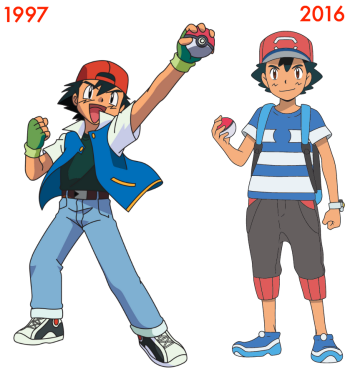
AKA "perpetual childhood". An old (and in live-action, discredited) trope which was implicit in many early sitcoms that focused on the standard American Nuclear Family of father, mother, and 2.6 children — the situation necessary for the comedy to exist was so rigidly defined that the children could not be allowed to grow up, lest the program dynamic change unrecognizably. After the tragedy of Anissa Jones of Family Affair, who was straitjacketed by this trope to very unhealthy effect, most live-action sitcoms now just accept that their kid characters will grow up and take advantage of the story opportunities with teenage and young adult characters should the series last long enough.
This later became a staple of animated shows. Since animation does not require on-screen acting, it is much easier to control the physical aspects of the characters, and therefore keep them the same age year after year without major psychological harm to the person doing their voice. Among the most famous examples of this situation are Bart, Lisa and Maggie Simpson, who have been intentionally kept the same age since their debut in The Simpsons Shorts in The Tracey Ullman Show in 1987note .
This trope affects the sexes differently when it comes to live-action media. Once a child actress becomes a teenager and has her "summer growth spurt," concealing the secondary sexual characteristics can be very difficult, sometimes even impossible. With boys, even if they maintain a youthful physical appearance, their voice might still break. Bobby being 12 years old can be hard to sell when he sounds like his senior thesis is due next week. It wasn't until The '70s that the showrunners finally figured out how to manage a smooth transition from adorable child star to Teen Idol.
The opposite of the trope is Soap Opera Rapid Aging Syndrome.
Comic-Book Time, also known as a floating timeline, applies this concept to an entire setting. This can be particularly problematic if the main characters, such as superheroes, have children over the course of the series. The kids will age a few years—maybe up to 10—then abruptly stop, as making them any older would mean aging the main hero to an undesirable degree. Don't be surprised if this trope is applied inconsistently in shared universes, such as Kitty Pryde going from 13 in 1980 to her mid/late-20's today, while Franklin Richards hasn't so much as reached puberty despite his first appearance being his birth back in 1968.
With real-life actors, this trope can lead to Contractual Purity, which is when celebrities grow up and move on to adult roles and behavior, but are still expected to behave like children and know nothing of things like sex and nightclubs.
Not to be confused with Never Grew Up, which is when child-like characters are literally not able to age for in-universe reasons. See Not Allowed to Grow Old for when adult characters do not age the way they should.
Of course, this trope overlaps with Perma-Shave for actors that are supposed to be young boys.
Example subpages:
Other examples:
- Happy Friends takes place on a planet where Ridiculously Human Robots capable of aging are very easy to come across, among them the main team of heroes, the Supermen; there are also plenty of humans such as the Supermen's non-biological father, Doctor H. The show has been on the air for almost a decade and none of the main or major characters, mechanical or organic, have displayed any signs of aging.
- Pleasant Goat and Big Big Wolf: After over a decade of adventures, the goats are still school-aged.
- Upin & Ipin: The characters celebrates Ramadhan and Eid al-Fitr Once a Season, and some of the Ramadhan episodes are explicitly set a year after the one from the previous season, yet after over ten seasons the kids are still in kindergarten.
- Calvin & Hobbes: The Series:
- The original strip's example is lampshaded hard. For context, after Calvin has gone through quite a bit of Character Development over the course of four seasons, he gets Laser-Guided Amnesia and gets reverted back to how he was in the strip itself.
Hobbes: You know, I don't know how I dealt with you four years ago.
Calvin: Four years! That would make me... ten years old now!!
MTM: Uh, no, Calvin. You're only six.
[Beat]
Calvin: How is [this] possible?
MTM: Television contracts. Besides, this is kind of a sci-fi-y show. We'll think of an excuse soon. - As revealed in a later entry in The Calvinverse (The Collective), however, a race of aliens actually invoked this; the Chill Collective kept Calvin and those associated with him from aging in a plot to control the universe. Once they're defeated, the Floating Timeline goes with them.
- The original strip's example is lampshaded hard. For context, after Calvin has gone through quite a bit of Character Development over the course of four seasons, he gets Laser-Guided Amnesia and gets reverted back to how he was in the strip itself.
- Lelouch in Soul Chess is a justified example. After he died, a Timey-Wimey Ball sent him to Soul Society over a hundred years before his death. Mayuri theorizes that Lelouch will start aging at a normal rate (well, normal for a shinigami) once he reaches the time he died. Though it does end up rather amusing when people he knew as children end up looking his age or older.
- Averted in the Code Lyoko fanfic Lyoko Championship
 series, where each new book is set one year later and at Book 3 has it to where Jenny from Team Sin is no longer on the team because she is in college.
- Subverted for Stewie in the Family Guy fanon wiki project Family Guy Fanon, as he has his second birthday in "Life of Brian 2: Revival Reversal", fifteen seasons after his first birthday.
- Briefly discussed in Fantasy of Utter Ridiculousness, which takes place after Touhou Project's eighth game. Marisa claims that she’s both a child at heart and a woman of at least 20 years. When asked why she still looked like an adolescent, her response is that both she and Reimu become younger whenever an incident is in progress. Reisen is quick to complain that this doesn't make sense.
- Because everyone is caught in a "Groundhog Day" Loop, no one ages in The Infinite Loops. Loopers, however, do consider themselves to age from when they first Awaken, so this is played with.
- let's go out with a bang! is set in a world where the events of the Danganronpa series all took place within VR simulations. The cryptosleep participants are placed into while in VR prevents their bodies from aging biologically, impacting the growth of anyone who spends a long time in the sims... such as the casts of the first two seasons. When asked for his age, Naegi Makoto states that he's twenty-four, and nobody from said seasons is any older than twenty-six, even when they should be.
- The Pokémon Squad zigzags this trope. The Author Avatars age in Real Time, but characters like Ash, Brock, Misty, May, Henry, June, Loopy, and Larry haven't aged a day since the beginning of the fic's run. This actually played a large factor in RM and May breaking up in "Missing Master"; since RM ages and May doesn't, it would be too creepy to keep them in a relationship.
- Alpha and Omega: Kate and Humphrey's pups are introduced in the second film and never age through the next several films. This is despite the Halloween special being released after the Christmas special.
- This is the case for the three girls in the Despicable Me films and even lampshaded in the 3rd movie.
- The Land Before Time: It's pretty clear that over the course of the 14 movies and the 1-season tv-series that make up the franchise, several years pass in-universe. Yet, none of the young dinosaurs ever seem to get any older, or grow any bigger.
- The Proud Family Movie takes place two years after the series. Penny is now sixteen, but Bebe and Cece are still babies. They are aged up in the revival The Proud Family: Louder and Prouder, yet Penny is back to being fourteen.
- A similar thing to The Land Before Time example occurs between The Rescuers and The Rescuers Down Under. Both movies seem to take place around the time they were released (1977 and 1990, respectively), yet not only are Bianca and Bernard still alive in the second movie (real mice only live about two years), they don't seem to have aged at all.
- The managers of the Puerto Rican Boy Band Menudo kept the group young by use of a simple method: every member would be obligatorily replaced when he reached his 16th birthday, his voice changed, grew facial hair, or got too tall.
- Similar restrictions apply to the Vienna Boys' Choir, though the boys graduate when they turn 15. This, however, is for more realistic reasons. The Vienna Boys' Choir is an all-treble choir, so once a boy's voice drops, he no longer has a part. If his voice drops while his choir is touring, he is allowed to finish the tour, and the boys continue attending the same school, they simply do not sing in the famous choir.
- In drum and bugle corps affiliated with Drum Corps International, the maximum age of a marching member is 21.
- While Eminem has aged and has allowed his alter-ego Slim Shady to grow up too, he's still expected to look and sound the way Em looked in his late 20s or early 30s, which has caused Eminem a certain amount of frustration due to the outdatedness of the persona's look and social values. The Death Of Slim Shady explores this by using AI de-ageing and archive footage/photos to feature a young Slim Shady in the videos, and have him rap portions of the songs in his young voice.
- Connie Kendall in Adventures in Odyssey was an example for many years. She first appeared as a 16-year-old and stayed that way for so long that several of the kid characters surpassed her age. This was later retconned so that she just ages very slowly: Connie is now in college, has been engaged, and runs a wedding business called Dreams by Constance, so she's allowed to age after all.
- Our Miss Brooks: Teenagers Walter Denton, Harriet Conklin and Stretch Snodgrass stayed sixteen from the time the show premiered on radio in 1948, through the television episodes starting in 1952, and finally to The Movie Grand Finale in 1956.
- Used in-story in Gypsy, where vaudeville child stars June and Louise have their real ages kept secret by their mother. Louise can't be sure how old she really is, having had parties celebrating her tenth birthday for several years in a row. (Given that Gypsy is a biography, and Mama Rose allegedly was that bad, this may also be a case of Truth in Television.)
- Used very often in Annie, where the shuffling of orphans was usually done due to the onset of puberty (though some younger girls would move up to older girl roles). Thus, literally hundreds of girls played roles in the musical through its original Broadway run and four national tours. The documentary Life After Tomorrow interviews quite a few of the women who appeared in the original run, many of whom cited their last show as the worst day of their lives.
- One of the Angry Kid shorts from Aardman Animations, "Boyhood", double-subverts the trope. The setup is that Angry Kid has supposedly photographed himself every day for ten years, and a rapid series of Polaroids show that he has remained unchanged, despite the "changing every day" lyrics in the background. In the middle of it, he remarks while strumming a ukulele, "I don't look any different, do I?" It seems to hang a lampshade on the fact that the series itself vanished for ten years then reappeared with an identical character — despite a significant change in animation techniques. But then the photos continue, and Angry Kid gradually starts growing facial hair. It may take a second or two to notice that it's actually drawn on his face in pen. In the end, we return to the ukulele shot, where the Kid now sports a full handlebar moustache, and he argues with an unseen spectator that no, it is not scribbled on. It totally is.
- When Hellsing Massive Multiplayer Crossover fancomic And Shine Heaven Now incorporated Little Orphan Annie into its canon (yes, really), this trope is semi-lampshaded by Annie (by now in her thirties in 1998) claiming that she ages at the quarter of a rate of a normal human, due to being born on February 29th.
- Lampshaded in an Achewood strip. When the one-sentence capsule of a character is "Phillipe is five", then that's all there is to it. He recently celebrated his fifth birthday again.
- Lampshaded even more cruelly in the "Philippe's Journey Home" arc, where Philippe makes a killing selling useless junk to rich people a la The Sharper Image and goes back to his mother's house, only to find out that his mother (apparently never completely stable at the best of times) has turned into an apathetic and somewhat spacey lady who lunches.
- The protagonists of Sluggy Freelance should be approaching their forties, and Bun-Bun and Kiki are both a lot sprier than an animal of their age has any business being. At the least, Kiki could be handwaved due to being experimented on when she was a lab animal and Bun-Bun is actually the Egyptian god Sluggy.
- Ozy and Millie had been running for a good 10+ years, yet they only aged once by two years, and it wasn't a big deal (or even known about until they made an offhand comment about their ages). The creator has hinted of a spin-off with the characters as teens. But nothing has been heard of that for a while. Especially now that much of her time has been dedicated to her other comic Phoebe and Her Unicorn.
- in Unreality, the author had originally planned for the characters to realistically age, but that was eventually dropped in favor of keeping the pace and tone of the comic consistent.
- El Goonish Shive could easily be mistaken for this. It debuted in 2002 and the main characters were still high school students fifteen years later. However, due to the production schedule and serialized nature, only roughly 18-20 months have passed since the beginning. It's quite normal for a single evening to be covered in months worth of comics. For example, Ashley was deciding on her outfit for her date with Elliot in March 2015. The evening finally ended in May 2016. Much of the early 2020s has been setting up their graduation and a new status quo at college.
- Least I Could Do started out this way. Then the characters were gathered together to receive a memo from the cartoonist announcing that thenceforward they would age normally (Urchin was declared immune). Rayne did not take it well. Later plots included Rayne acclimating to his young niece Ashley growing up, as well as his own progress from youthful Manchild to middle-aged Manchild.
- June Havoc got this treatment from her mother, as seen in Gypsy.
- Shirley Temple was treated like a very young child actor well into her adolescence, in that she was allowed to appear in adult roles only after her marriage at the age of seventeen. Shirley failed to gain any cinematic success as an adult and discontinued acting almost completely after her divorce, only making sporadic film and television roles since until that petered out as well. She then spent the remainder of her adulthood working political appointments in the U.S. Foreign Service, officially representing America in Ghana, Czechoslovakia, and the UN.
- When Annette Funicello from the original Mickey Mouse Club entered puberty, the directors and the producers behind the show pulled many stunts to cover her developing chest. One method was positioning shorter Mousketeers in front of her, while another involved body doubles and yet another used tight close-ups on her face. They probably would have removed Funicello from the show altogether if it wasn't for her popularity among viewers.
- The Spanish Ur-Example is Andalusian actress/singer Josefa "Marisol" Flores. Discovered at the age of 11 in 1959, she became the poster child of the heavily-censored family-oriented cinema of the Francoist years. Directors forced her to bind her breasts and act younger than she was when she hit puberty as she ended her decade-long child acting career by playing teenage ingenues. Franco's death in 1975 harkened the repealing of his regime's draconian censorship laws, which allowed for the distribution of more adult-oriented media including magazines. A nude Flores would grace the cover of the September 2, 1976 issue of liberal news magazine Interviú, which was "meant to signal the erotically-charged, liberating mood of Spain's transition to democracy," according to Lafayette College Spanish professor Katherine O. Stafford in a 2018 essay. The cover riled much polemic from moral guardians despite the fact that Flores was 28 and had given birth to at least one of her three daughters by that point. Flores's remarks about Franco-era directors sexually abusing her in her childhood in the magazine also resurfaced in 2018 thanks to the #MeToo Movement.
Katherine O. Stafford: ...Marisol's evolution in the public eye reveals unsettling continuities between the Franco era and what comes after.
- Mara Wilson has been subjected to this, both by studios (she wore a binder while filming Thomas and the Magic Railroad to hide her growing breastsnote ) and by fans, which Wilson herself has lampshaded.
Mara Wilson: Yes, you just got advice on sexy books from a former child actor. I feed off your ruined childhoods.
- In addition to bullying, this is one of the reasons why Christopher Robin Milne ended up hating Winnie-the-Pooh and his father, A. A. Milne. Christopher grew up, but the world still wanted him to be that cute little boy that they were reading about.
- Tara Strong has discussed this trope in interviews that ask why animated young boys are often voiced by grown women; if a show goes on for several years, a boy can maintain the voice for only a limited amount of time before his vocal chords change drastically, whereas a woman can ensure that a young male character consistently sounds prepubescent to early pubescent.
- Melissa Joan Hart got famous as a teenage star for Clarissa Explains It All. She was legally an adult when the show ended, but played a teenager in her next sitcom Sabrina the Teenage Witch (1996). Even when Sabrina became an adult, the subtitle 'Teenage Witch' was still retained. She's talked about how difficult it was to get seen for roles after it as, despite being in her mid-twenties, they saw her as a teenager. She finally rebounded with Melissa & Joey.
- One major criticism with the children's media franchise Ryan ToysReview is how its namesake Ryan Kaji is supposedly pushed by his parents to be in the same infantile role well into his teens.
