

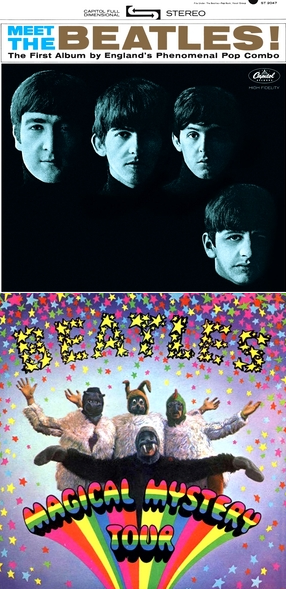
So, there's Band X. Band X has become popular and generally well-received by critics quite a while ago and are known for a certain style.
However, Band X decide to do something completely different for their next album, for whatever reason. Maybe they're tired and believe they've taken their style to the limit. Maybe they're afraid of being one-trick ponies. Maybe it's Executive Meddling. Regardless, the result will be a change of style. This can be either a total Genre Shift, general simplification for bands with highly complex styles (thrash metal, prog rock, etc.), more prog tendencies for simple pop-rock bands, or sometimes even becoming purely pop bands, whatever. The point is that they will continue with this style for a period, to either continued success or diminishing returns.
Cue shock and They Changed It, Now It Sucks! from parts of the fanbase, along with a whole spectrum of opinions from others.
The New Sound Album represents an album where a band generally known for a certain style backs away from its roots and makes a radical change, if not a total Genre Shift. Reactions to this tend to vary. There's always a segment of the fanbase that says They Changed It, Now It Sucks! and labels them as sellouts, even ignoring that sometimes the band honestly admits to wanting a change. In other parts there's a whole range of reactions, from mixed to positive. In the worst case the album will divide a fanbase into Old Guard Versus New Blood, and in the best case a majority of fans will enjoy both periods of the band's career. When this happens, fans will usually cite the album as a case of Growing the Beard. Often times, the New Sound Album serves as a springboard into a new phase (genre-wise) of the band's career, when looked at in retrospect. Other times, the band returns to its roots, either because the new album was just a temporary divertissement, an experimentation, or because the backlash from fans and critics alike was too heavy (particularly when it is necessary to sell albums and live tickets to pay bills). In the latter case, despite initial intentions, the new sound album might result in the equivalent of an Aborted Arc in the career of the band.
Contrast Formula-Breaking Episode, where the change is usually temporary, and the artist goes back to their old sound with the next album. Also see Creator's Oddball.
Examples
Unclassifiable
- The 1970 album Songs of the Humpback Whale was the first album released to the public featuring nothing but sounds of singing whales. Yes, whales have been around for centuries, so in that sense this album didn't offer anything new, except for the fact that humans had always believed these animals were mute. To hear them actually produce sounds was a big surprise to many listeners in 1970.
- Le siège de Corinthe isn't really an album, but with it Gioachino Rossini changed from his old Italian bel canto operatic style to the grand opéra style that dominated Paris for the next forty years. He wrote three more works in this style, then faded from the operatic spotlight after William Tell.
- Likewise, Giuseppe Verdi saw his style shift around the time he wrote the "new sound opera" Macbeth, where he shifted away from the Donizetti-and-Bellini-land and more toward the Verdian tone. By the time Rigoletto fully established his name in 1851, his previous sound was gone, and comparing many albums of his operas will show the difference.
- Stop Skeletons From Fighting: Thatz a Rap.
