

Lando Calrissian: You said they'd be left at the city under my supervision!
Vader: I am altering the deal. Pray I don't alter it any further.
Alice and Bob make a deal. However, Alice has much more power than Bob, because Bob is really desperate for whatever Alice is offering, and will do whatever it takes to get it. Alice ends up abusing this power badly, reneging on the initial agreement and making a seemingly endless series of demands on Bob without ever keeping her end of the bargain. Each time Bob fulfills her requirements, she simply adds another one. If he protests, she threatens to withdraw her offer entirely.
For example, Bob wants a promotion. Alice, his boss, says that he'll be promoted if he succeeds in closing a particularly important deal. Bob lands the deal... but Alice tells him that, though it was impressive, the deal didn't bring in as much money as she predicted, so Bob needs to bring in a couple of big clients. Bob does... and then Alice tells him that he hasn't attended an important course, and he needs to complete the course before he's eligible for promotion. And on and on it goes, with Alice continually changing the requirements needed for the promotion so that Bob will never be able to obtain it.
Alice is Moving the Goalposts.
The trope name comes from a British idiom in which a hypothetical football/soccer player is told he has to score a goal from a certain spot on the pitch. But after he scores, the goalposts are moved further away, the player is told that the first goal didn't count, and now he has to score again. Essentially, it's changing the previously-set standards for something after those standards have already been met.
This set up can end in a number of ways in fiction. Sometimes, just to add insult to injury, Alice will manipulate Bob until she gets bored or has everything she needs, then tells Bob "sorry, but it'll never happen" (e.g. someone else has already been given the promotion that Bob's been chasing all this time). Sometimes this will result in a Freak Out and some well-deserved retribution. Alternatively, Alice will develop a conscience (or a third party will hammer one in) and she'll finally live up to her promise. A third option is that Bob will realize what Alice is up to and call the whole thing a wash, choosing to walk away (usually with a few choice words for Alice in the process — ironically, that may lead to Alice finally letting Bob have the now-worthless bargaining chip). In Fairy Tales, the king setting Impossible Tasks may eventually decide it's not worth it. But usually, one of the tasks backfires on him badly.
There's also a Blackmail version of this trope, where the powerful party keeps his word — more or less — but makes it clear that he could change his mind at any time. Murder mysteries that involve the death of a blackmailer usually cite this as a motive: the blackmailer made an initial demand that was met, but soon realized that they had their victim trapped, and kept making additional demands until the victim decided the only way to get free was to kill their tormentor. Military/political agreements where one force is stronger than the other often have this connotation to them: a one-off favor might be used to bully the weaker country or politician into supporting the stronger, whether they like it or not. Indeed, it can be a problem with any Leonine Contract.
The effect on the viewer depends on whose side they're on. If they like the weaker partner of the deal, it can be hugely frustrating to see them strung along like this. If their sympathies lie with the more powerful half, though, it can be used as slapstick humor. If the roles are usually reversed (Bob is Alice's boss, for example), it can be used to give a bossy or overbearing character their comeuppance.
On the odd occasion, Alice might have genuinely good intentions. Maybe Bob wants Alice to introduce him to Alice's pretty coworker, who Alice knows is a Manipulative Bitch and a Gold Digger, so she tries to deter Bob from the girl without saying outright that she's bad news because she knows Bob wouldn't believe her.
There also exists a situation that looks like this, but isn't: the proposed item fulfills the stated requirements, but not the unstated ones. For example, offering a reward for the head of a Gunslinger, but forgetting to add "unattached to his body". Or asking for a polite courtier, and getting one who delights in stealth insults and backhanded compliments.
"Moving the goal posts" can also be used to describe a debate fallacy. In this scenario, essentially Alice will make a point and/or demand evidence to counter Bob's argument. Bob provides evidence or a counter argument to Alice's original argument. Alice then dismisses the evidence and/or demands further evidence on grounds which were not mentioned in the original point and which may only be tangentially linked to Alice's original point. For example, Alice claims that there's no product that easily kills fleas on cats. Bob directs her to a product which does so, only for Alice to then dismiss Bob's point by claiming that the product in question doesn't kill fleas on cats and on dogs. Although it should be added that non-fallacious "goalpost moving" exists, when the original standard is realized to be incomplete in some way; to expand on the above example, Alice would be a lot more justified in her objection if she dismissed Bob's claim because the product in question killed both the fleas and the cat.
Compare Taking Advantage of Generosity. Can overlap with Social Darwinism. Contrast Sharpshooter Fallacy, when the goalposts are moved to favour an argument instead of to reject it. Lies, Damned Lies, and Statistics may be used as a tool to move the goalposts. A possible reason the victim keeps coming back and trying again is the Sunk Cost Fallacy.
Compare and contrast There Will Be Cake. I Lied is the even more shameless version. Certain character types, like the Bad Boss who always has one last task for their employees to do before they get a "favor" that they had earned anyway, are particularly prone to this trope. See also Win Your Freedom, Obvious Rule Patch, No True Scotsman. In video games, this may take the form of a Disc-One Final Boss or Disc-One Final Dungeon: what is presented like the final challenge of the game isn't.
Sadly, not only Truth in Television, but a common tactic employed by those running a 419 Scam.
Example Subpages:
- Anime & Manga
- Fan Works
- Literature
- Films – Live-Action
- Live-Action TV
- Video Games
- Western Animation
- Real Life
Other Examples:
- One commercial for Carmax invokes a literal inversion, where it's the starting line, itself, that leads someone around.
- One Outback Steakhouse commercial played with this — the proprietor was offering a free steak to whoever could hit a bullseye on a dartboard. Cue a dozen darts all in that spot. "Wait, did I say bullseye? I meant a triple 20." The last line of the commercial: "Wait, did I say blindfolded?"
- A literal variation where Segata Sanshiro, as a soccer goalie
 , gets a "nice save" by flipping it onto its side. He gets a red card for this.
- A Toyota advert has a mother promising to buy her son an ice cream the next time they stop for gas. Fair enough, but the car turns out to have ludicrously good gas mileage, and the kid never gets his ice cream.
- In X-Men (2019), Xavier and Magneto constantly dangle the promise of reviving the mutant Destiny to Mystique to get her to do various jobs. However, since resurrecting precogs in Krakoa is secretly forbidden, the two keep suggesting that the various jobs she does aren't enough and keep requiring her to do more. She gets fed up and goes and resurrects her herself in Inferno (2021).
- Dilbert:
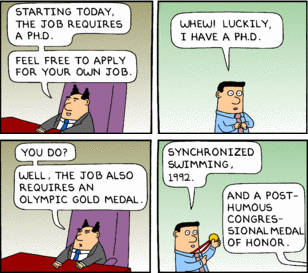
- This comic provides the trope image, with the Pointy-Haired Boss continually adding new requirements for one man to hold his job.
- In another strip, Wally complains to the Pointy-Haired Boss about constantly deferring project objectives every time he's about to meet one, saying, "What does this prove about my performance?" The boss tells Wally: "It proves I'm better at setting objectives than you are at achieving them."
- This
- Garfield: One strip has Garfield approach a "Keep off the grass" sign. So he climbs up onto the sign... only for another sign to pop up, saying "Keep off the 'Keep off the grass' sign". Garfield's "Oh, come on!" is golden.
- Peanuts: Lucy repeatedly fools Charlie Brown by snatching away the football he is about to kick. This captures the feeling of this trope in a single instant, distilled down to its essence.
- The Clever Little Tailor: The princess asks the tailor what color her hair is in order to marry her, and after he guesses right, she says he also has to spend the night with a bear before they marry, her hoping he could get eaten.
- In Dapplegrim, the king sets more tasks before he allows the hero to marry the princess.
- In Fair Goldilocks, the princess tries to put off a wooer with Impossible Tasks.
- As did Princess Kaguya from the Japanese folktale The Tale of the Bamboo Cutter.
- As did Princess Kaguya from the Japanese folktale The Tale of the Bamboo Cutter
- Ferdinand the Faithful: Whenever Ferdinand does whatever the king asks, the king decides it's time to lade another task on him as the price of not executing him. Until finally, the princess decides she'd rather marry Ferdinand than deal with the king and tricks him into letting her kill him.
- Similar events play out in Boots and the Troll, Esben and the Witch, The Gold-Bearded Man, and The Firebird and Princess Vasilia.
- Similar events play out in Boots and the Troll
- In The Fish and the Ring, Vasilii the Unlucky, The Devil With the Three Golden Hairs, The King Who Would Be Stronger Than Fate, and many other fairy tales, a man who discovers his child is doomed to marry a poor child tries to kill them with many tasks, before and after the wedding; in the end, he fails.
- In the tale of The Fisherman's Wife, the fisherman finds a fish that can grant any wish in his pond, and starts making wishes that will make his wife happy. However, the wife is never pleased for long, even after being slathered in wealth and being made queen of the world, all while promising the next wish will finally make her happy. Finally, the fish gets fed up with all of the wife's greed, and reverts everything back to how it was at first, thereby teaching a lesson about hubris. The fish also teaches the man a lesson in fulfilling his wife's every whim without seeing the futility of it and not taking a stand.
- In The Grateful Beasts, at the instigation of his brothers, Ferko has to, in turn, cut all the corn in a single night, gather it all into barns the next night, and summon all the wolves in the land. It stops with the wolves because, well, they're wolves.
- The Griffin: The king promises whoever brings an apple to cure his daughter shall marry her. Hans succeeds, but the king refuses to keep his promise and orders him to make a ship that travels over both dry land and sea, catch a hundred hares in one day, and fetch a feather from a griffin.
- In Hansi and the Nix, a young cowherd named Hansi falls in love with (variously) a water spirit or a freshwater mermaid he calls "Nixie." But then fall comes, and she doesn't want to come up to the surface of the lake anymore because it's getting too cold. So Hansi agrees to live with her. But then he starts to get homesick for the classic aspects of Yodel Land. He misses his dairy cow, and when Nixie brings her to him, he wants to sample the cheese he made from the cow's milk a few months back. When Nixie brings him some of the cheese, Hansi gets wistful for wildflowers. Nixie responds by bringing his entire village down into the lake.
- "The Three Feathers": The king says that if any of his three sons brings the most beautiful carpet, he shall be his heir. When Simpleton succeeds, his two brothers preassure their father to give them another test, so he tells them to bring the most beautiful ring. Simpleton succeeds again, then they are tasked to the most beautiful woman. After Simpleton succeeds yet again, each woman the brothers brought are tasked to leap through a ring, if one of the women succeeds then her partner shall be the heir. And in the end Simpleton's woman wins.
- The Two Kings' Children: The king promises to let the prince marry one of his daughters if he stays awake at night and answers him at each hour. But after some living statues help by answering instead of him, he says he cannot marry until he cuts down a forest with glass tools, then he is helped by a bunch of short people. He orders him again to clean a muddy pond and put all kinds of fish in it, and he is helped by the short people again. Then the short people help the prince for the final time when he is tasked to clear a mountain of briars and build a castle on it.
- The White Snake (Brothers Grimm): The second king tasks the servant to retrive a ring from the ocean in exchange of marrying the princess. After he succeeds, the princess refuses to marry him, so she tasks him to refill some sacks of grain that were spilled into the grass, then getting an apple from the Tree of Life; he succeeds in both tasks, so then the princess is willing to marry him.
- The Wicked Stepmother from the Disney version of Cinderella promises Cinderella to let her go to the ball... if she can find a dress, and if she finishes her chores on time. Naturally, she and the stepsisters pile on the chores so that she can never be done on time, let alone find a dress. When she does comes out with a dress (courtesy of her animal friends), the stepmother lets the sisters rip it to shreds.
- In The Little Mermaid (1989), Ursula gives Ariel three days to woo and kiss the prince to become a permanent human. When she sees that Ariel might have greater chances to succeed on her side of the deal, Ursula turns herself into a beautiful young maiden and uses Ariel's own voice to hypnotize the prince into falling in love with her so Ariel won't have a chance at success. Given the sheer number of merfolk turned into polyps in her lair, it is likely she does this with every deal she makes.
- Inverted in The Road to El Dorado. Miguel's plan to break out of jail is to convince a horse to bring them a prybar. Tulio thinks it's a stupid idea and mocks Miguel for it, but then the horse manages to bring back the keys to their cell. Even though the outcome was arguably better, Tulio still insists that the horse technically failed to bring them a prybar.
- Zootopia (2016): Chief Bogo attempts this on Judy. When Bogo allows Judy to take on a missing person case, Bogo adds the condition that Judy solve it in 48 hours; if she can't, she has to resign. Later, Bogo responds to an emergency call from Judy and Nick about a savage jaguar that is not present when Bogo arrives. Since she still hasn't found the missing animal, Bogo then orders Judy to turn in her badge immediately, even though her 48 hours aren't up yet and resigning after one mistake wasn't part of their deal. Thankfully, Nick calls Bogo out on his behavior, saying that Judy has done more in half a day to solve the missing person case than Bogo has in months, and she still has 10 hours left on her timer to solve it. Bogo concedes the point, and the case is allowed to move forward.
- The Song "Sixteen Tons", describing the life of a miner. Sixteen tons, and what do you get / another day older and deeper in debt / St. Peter, don't you call me, 'cause I can't go / I owe my soul to the company store.
- In the folk song "Soldier, Soldier, Will You Marry Me?", the soldier keeps coming up with things he lacks that would be necessary for a proper wedding (clean shoes, a good coat, and so on), which the young lady supplies for him. In the end, having obtained a complete new outfit at the young lady's expense, he admits to one more obstacle that she can't overcome — he has a wife already.
- The same thing happens in "Lazy John". This time, the titular character has the lady buy various articles of clothing to complete his outfit, and at the end, admits that he has a wife and ten children at home.
- In Taylor Swift's "Dear John", she accuses her ex-boyfriend of this, telling her he expected a certain sort of behavior from her, but then turning around and deciding he wanted something else when she complied, all as a means to "test" her love for him.
I lived in your chess game,
but you changed the rules every day. - Norwegian singer Wenche Myhre's song "Jåmpa Joik" (from the film "Operasjon: Sjøsprøyt") is about a woman who starts out demanding of her suitor that he own eight reindeer for her to agree to marry him, increasing the number every time he comes back with the number she asked. In the last verse she demands two hundred reindeer, but at that point he marries someone else.
- The Bible:
- This is how Jacob ended up with two wives. Laban had two daughters, and Jacob fell in love with the younger one, Rachel. The father agreed to let Jacob marry her if he worked on Laban's land for seven years. Jacob obliged. At the end of his agreement, Laban snuck the elder daughter, Leah, into bed with Jacob in the dark of night, and in the morning claimed that he couldn't possibly let the younger daughter marry before the elder. He gave Rachel to Jacob shortly after in exchange for another seven years' labor (bet the daughters were really grateful to dear old dad for this set-up), so Jacob continued working. He ended up walking off with almost half of Laban's possessions at the end of twenty years.note
- Subverted—or even inverted—in the tale of Doubting Thomas, who claimed he would need to touch the wounds of Christ before he believed in the resurrection. One common interpretation of the story says he believed as soon as he merely saw them.
- Classical Mythology:
- In some tellings, the reason Hercules had Twelve Labors is because King Eurystheus invalidated two labors (cleaning the Augean Stables and slaying the hydra) for technicalities. In the case of the hydra, he had Iolaus help him by burning the neck-stumps, so Hercules hadn't performed the labor alone (Keep in mind that the Hydra wasn't alone either: Hera sent a giant crab to distract Hercules). In the case of the stables, it was disqualified either because he was paid for the job, or because he did it by redirecting a river and therefore "the river did the work".
- There was a music contest between Apollo and someone else (the myths vary). Apollo with his lyre and the challenger with his flute duke it out musically and the judges (except Midas) all agree that Apollo is the better musician. Incensed that he didn't get all the judges' approval, he promptly challenged his opponent to play the instrument upside down or while singing (the myths vary), which lets him win handily (and in one version, flay the loser alive).
- In The Odyssey, Penelope is harassed by over a hundred suitors pursuing her hand in marriage while acting like they own the place, but she doesn’t want to remarry because she’s firmly holding onto her hopes on reuniting with her husband, Odysseus. So she stalls them by claiming she will choose a new husband after she’s done weaving a burial shroud for her father-in-law, only to undo it every night for three years straight. When one of her maids betrays her by revealing this to the suitors, Penelope gets even more pressured in choosing a new husband. So she sets up an archery contest for her hand, except the challenge itself is to bend her husband’s recurved bow and shoot into twelve axe heads. Nobody but Odysseus has the strength and knowledge to do it, and he just so happened to make it back home to win his wife’s challenge. Then he kills all of the suitors for long overstaying their welcome.
- Midst, Phineas learns that saving a hostage is, somehow, not Valorous enough to eliminate his debt. In fact, he actually arrives at his breaking even ceremony before anyone bothers to tell him. It's heavily implied that this is how the Trust usually operates. Breaking even by merit is something that takes a lifetime, when it's possible at all.
- The occasional match with special rules tied to a heel wrestler that change on the fly whenever they appear to lose. This way, it's virtually impossible for the face to win, given how far the heel takes the gimmick.
- The best known example is probably William Regal's win over Chris Jericho at WWF Backlash 2001 under "Duchess of Queensbury Rules", which suddenly had a round system, no submissions, and a no disqualification rule announced as soon as Regal "lost" by pinfall, submission, and disqualification respectively. Regal eventually won after hitting Y2J with a chair and pinning him.
- At WCW New Blood Rising in 2000, Lance Storm defended his Canadian (née United States) Heavyweight Championship belt against Mike Awesome under "Canadian Rules", with guest Canadian referee Jacques Rougeau conveniently relaying new rules to the announcer whenever Awesome seemed to win. These included a 5 count for pinfalls, no submissions, a boxing-style 10 count to get up after a pinfall, and a "last man standing" 10 count if both wrestlers are out. Rougeau himself knocked out Awesome in the latter instance to ensure that only Storm answered the count, much to the approval of the crowd in Vancouver, British Columbia, Canada.
- More recently, Baron Corbin (during his acting general manager period on WWE Raw) would use his executive privilege to restart matches he "lost" to add stipulations so that he could eventually win, in theory.
- On a meta level, bad GMs will often do things like this if the players do something unexpected and throw a monkey wrench in their plot. An example would be if a player attacks a character they aren't "supposed" to attack/kill yet and roll a hit and the GM reacts by secretly increasing the target's armor class so the attack actually misses.
- Mercenary players are warned of this as a possible screw-job tactic by unscrupulous employers in BattleTech. In an effort to save money, some employers may claim that mercenaries 'failed to do their utmost' even if the mercenary unit successfully completed their mission (for instance, claiming that mercenaries failed a defensive mission by not killing or destroying every enemy on the field even when they drove off the opponent and kept their objective safe). Frustration over this led to the formation of the Mercenary Review and Bonding Commission, which oversaw contracts and offered neutral arbitration in the event of disputes. Unfortunately for mercenaries, the Word of Blake Jihad resulted in the MRCB's destruction. The Successor States are also known to put mercenary units out of business with the "Company Store" gambit (as detailed in the Real Life section) by nickel and diming them for parts and transport and charging premiums, forcing them to become more and more dependent on their employer for supplies until they're so in debt to them they can't afford to leave. In lore, the end of the Refusal War between Clans Wolf and Jade Falcon involved this: as Clan Wolf had committed their military force to the war, the Falcons claimed that their loss constituted a Trial of Absorption and laid claim to Clan Wolf's resources. Luckily for the Wolves, a witness to the end of the war turned out to be Not Quite Dead.
- A mutual version happened in Warhammer 40,000 with a Tau world under attack from Hive Fleet Gorgon, noted for being small (relatively speaking, Tyranids can unleash billions of organisms in a single wave) but highly adaptive. The Tau guns kept it at bay for a while, before the Tyranids came up with refractive chitin that cancelled out the guns. Then the Tau holed up behind thick undergrowth which entangled the Tyranids, allowing the Kroot to engage them in melee. The next wave was smaller and more agile, the one after made specifically to kill Kroot, but in both cases made more vulnerable to mass plasma fire. When the Tyranids became nearly immune to plasma weapons, the Tau went back to solid munitions used by Kroot. And so on and so forth. In the end, the fleet was pushed back from the planet as the need to adapt made it deploy less synapse creatures (making it vulnerable to suicidal decapitation strikes), and destroyed by combined Tau and Imperial fleets, whose wildly different weapons it couldn't adapt to fast enough.
- Some Inquisitors in the lore have been known to do this. A particularly memorable example was one who accused a man for heresy, but discovered the man was innocent of the crime. The Inquisitor executed the man anyway, declaring that "wasting an Inquisitor's time" was heretical.
- Calavius, from the Mythic Legions line, was a gladiator promised his freedom if he won 100 matches. When the promise was not kept, he helped lead a Spartacus-style revolt.
- In their first conversation in Double Homework, Dennis offers the protagonist a deal that each shall pursue only two girls in their class (Johanna being off-limits). However, as time goes on, Dennis keeps adding new conditions to the deal, and when the protagonist pushes back, Dennis calls off the deal entirely, and tries to bed all five girls in the class, plus Tamara.
- In GENBA no Kizuna, Kurou Mikazuki is initially willing to wait until Ryuunosuke Hazama's film project hits theaters for him to pay back the loan he took from Kurou, but soon becomes more insistent that he pay back the loan soon, since his real goal is to repossess Ryuunosuke's house, which is worth far more than the money he took for the loan.
- Ride or Die: A Bad Boy Romance: Logan says even if his gang finishes the job the Brotherhood tasked them with, they'll still ask for more.
- What a Legend!: After Waldo has rudely and repeatedly told you that you can't enter the city without a passage permit, you can finally give him one — but he just declares that he'll never let you enter the city no matter what the law says. He backs down when Lana surreptitiously threatens him, and his much-abused subordinate Kevin is only too happy to accept your permit in his stead.
- BIGTOP BURGER: Cesare, the owner of rival food-truck "Zomburger", is revealed to be an agent of the Underworld who has been capturing cryptids for exactly one thousand years by the time he manages to catch Steve at the end of Season 2 in order to repay some sort of debt. Believing himself to have fulfilled his duty, Cesare prepares to go into retirement when the Underworld's secretary LDG points out that he still has to discuss this with their boss Caligari. When Cesare tries to do just that, Caligari simply decides to double his sentence and send him back to work, intimidating Cesare into compliance when he complains. Upon asking LDG how long the other watchers have been serving for, it's revealed that none of them were ever released from service.
- In an FMV promoting Crash of the Titans, Nina goes to a salon that has a sign in the window saying that it's giving manicures for $10. The owner clearly does not want to work on her Cyborg hands, so they throw her out and change the sign to say that it's $20 for cyborgs. When she gets the money from Dr. Cortex, the short ends with them throwing her out again and making another addendum to the sign saying that it's now $20 per hand.
- Homestar Runner: In the Strong Bad Email "theme park", Pom Pom plays a ring-toss game at Strong Bad's hypothetical theme park. He manages to win, but then Bubs (who's manning the booth) tells him "You gotta get those rings inside the bottle!"
- Let Me Explain Studios: Rebecca one time described her long experience in High School with her Theater Teacher "Medusa". Medusa was a Sadist Teacher who treated Rebecca like dirt and always gave her the short-end of the stick when it came to casting in plays. For years, Medusa told Rebecca that the reason she never cast Rebecca with decent roles was because she wasn't a senior-year student, as they have casting priority since they will be graduating. Rebecca accepted this reason, in spite of the abuse her teacher inflicted on her, so she worked hard and had proven herself to be a capable student and actress. However, when Rebecca finally became a senior-year student, and was in fact the only senior year student in Medusa's class, Medusa still refused to cast her in any roles, claiming via Blatant Lies that Rebecca was too tall for the role (she was actually fairly short).
- This is a major part of Joe vs. Elan School, and it's Played for Drama. As the narrator describes it, the titular "school" is a cover for institutionalized abuse, and only serves as a cash cow for its millionaire owner. The school offers "graduation" to its inmates, but only at the school's discretion, and they can (and will) cancel it if they decide an inmate needs to stay longer. The narrator explains that this is done so the school can milk tens of thousands of dollars of tuition from parents and from the state; an extended stay means much more additional profit.
- In Not a Villain, Danni has been struggling with this. Due to her paralysis, her City considers her a "costly liability", and they've been changing their rules to impose more and more difficult requirements on her to justify the resources she consumes. They want her to fail so that they can take her off life-support and import a replacement citizen capable of working on the Farms.
- In The Order of the Stick Belkar strongly suggests that they immediately kill the vampirized Durkon, which is a pretty good idea considering the whole "evil bloodsucking abomination" thing. Roy rejects the proposal because they can't transport the body easily. When that's taken care of, Belkar again raises the suggestion and gets shot down again because there's no cleric to revive him. Everyone else seems just a little too happy to have Durkon back, even if it's not the man they knew to accept that the situation has changed and something needs to be done about it. When the vampire reveals his true colors, Roy admits that Belkar was right all along.
- Our Little Adventure: It's mentioned that the Hell equivalent for Lawful Evil people is an endless cycle of being punished for every inadequacy, then having the goalposts moved if you ever stop being inadequate.
- YU+ME: dream : Sadiko offers to let the protagonist leave with the love interest if she can find the only sword in the castle in five minutes. Turns out that according to Sadiko's watch, five minutes is about four minutes, thirty seconds. And the stakes were also raised from "steal my girlfriend and leave forever" to "kill me and take over the planet".
- Botnik Studios: Their AI-generated Friends episode, "The One With The Chimney Shoes", contains a short exchange about Phoebe's standards for an ideal man.
Phoebe: I don't want a sexy guy, I just want a guy who likes knitting.
Rachel: Didn't No-Ears Mark like to do that?
Phoebe: I just want a guy who likes knitting and has at least one ear.
Monica: Didn't One-Ear Tyler like—
Phoebe: God damn you all, stop bragging! - Critical Role: During his quest for vengeance, Percy made a deal with the demon Orthax, giving him the knowledge he needed to kill the five people on his kill list, whose names are magically engraved into the barrel of his gun. However, after Percy's sister Cassandra betrays him, her name gets engraved onto a now-empty barrel. During the campaign wrapup, Matt revealed that if Orthax hadn't been banished, new names would have just kept appearing on the gun ad infinitum.
- Gaia Online's "Save Our Shops" gold-sink event revolved around giving the NPC shopkeepers enough gold to pay off back tax debts. Rumors circulated that characters who failed the event would be removed from the site. So when the mods started changing the amounts Liam and Ruby owed, fans furiously tried to meet the new goals, which changed again and again to mounting outrage, until the event ended... and Liam and Ruby opened new shops, like the admin had been planning the whole time.
- The 2009 Christmas event had the depowered demigods attempting to build an airship so they could run Christmas while Santa was missing-in-action. Again, users quickly donated all the gold and items they needed... so Cresento ran them down with his own airship and then sued them for damages, necessitating further donations.
- Man Carrying Thing: "basically every Jubilee video," one of the murderers asks his intended victim if anyone would care if he got murdered, and the victim says yes, since he has a family. The murderer asks if anyone else would be upset, and when the victim says his mother would be "disappointed," the murderer then asks if anyone besides her would be.
- The Map Men episode "The longitude problem: history's deadliest riddle" explains an incident that occurred during John Harrison's attempt to solve the titular Longitude Prize. The episode mentions that Nevil Maskelyne, who had become the new head of the Board of Longitude (which managed the contest) by the time John Harrison finished his H4 chronometer, was after the Prize as well, and thus he decided that Harrison's clock needed to be put through several more previously undisclosed tests. The narration is helpfully paired with a Visual Pun of hosts Jay and Mark literally lifting up a soccer goal and then carrying it a few meters away.
- In 2005, an email forward made the rounds, stating that the original sender of the email had hit some financial hard times, and would have to cook and eat his pet rabbit if he didn't receive enough donations. A variation on the same also appeared, with an alleged young couple threatening to have an abortion unless they received enough donations. In both cases, either the amount asked for, or the time in which to donate the money was increased.
- In the Quinton Reviews episode "That Time the World Ended", Quinton talks about what doomsday prophets do when they predictions turn out to be wrong. One method is to claim you got the year wrong and make a new prediction. Just keep moving the year (goalposts) forward for as long as the world refuses to end.
- Done in the What If? (xkcd) entry "Train Loop" in order to allow for an interesting answer (as in, other than "no"). "Could a high-speed train run through a vertical loop, like a rollercoaster, with the passengers staying comfortable?" becomes (changes bolded) "Could a modified and reinforced high-speed train with a jet engine on top run through a vertical loop, like a rollercoaster, with the passengers surviving?"
