

Affably Evil is when a villain is polite, friendly and genuinely kind, even while plotting evil. Good Is Not Nice is the inverse: characters who are rude, unfriendly, or mean, but still firmly on the side of good.
They won't kill (if they can help it), nor would they turn a blind eye to human suffering. They are always willing to go out of their way to save the town and complete strangers. When the call comes, they answer it, usually with little protest. They often help people in need who can't pay them back. In almost every way, they act like the Ideal Hero, except...
...they are asocial and sometimes downright rude. They may refuse to explain anything or listen to anyone. They actively refuse offers of gratitude, friendship, love, and/or support for their own emotional problems. Yes, they'll always be there for you. But they don't always seem to like you.
There are a few reasons these people may act like this:
- They may want to be selfish and arrogant or just unbiased to either side, but their morality keeps on getting in the way, even if it is to their detriment. They may put on "jerkass/bitch mask" to try to counter it.
- They do consider themselves as better than everyone else, and their attitudes range from Smug Super to Insufferable Genius to flat-out prick. After all, it is difficult for them to be nice to people when they do not even respect them. However, they still feel compelled to help these lower creatures on a regular basis.
- They are natural loners. Their senses of duty force them to perform heroic acts, but they do not consider chitchat or politeness to be parts of their obligations.
- They may want to be affable people, but they believe that being nice does not always get things done, and that doing good can require them to be harsh or cruel sometimes, particularly if they have to teach something (this may be an intermittent effect, applied only when necessary; contrast Beware the Nice Ones, where such outbursts result from break-down. On the other hand, emotional trauma can coincide with the realization that nicety won't cut it.).
- They cannot afford to let others get close to them because their enemies will use others against them.
- They might wish to be nice but live so far outside normal human experience that they have no idea how to go about it; similarly, the hero might be autistic, or a non-human alien.
- They weren't always like this. They had friends and/or even romantic relationships, but time kept taking their friends and family from them. So, at some point, they decided never to have any relationship deeper than acquaintance.
- The world the heroes live in is operated through cynical ends, so Strict Good Guyism does not work — either in the eyes of the author or in a literal in-universe sense.
- They operate on Blue-and-Orange Morality, their unpleasant actions can be seen as "nice" in their worldview.
- They intimidate enemies through harsh demeanors.
- They used to be a villain before warming up to the heroes. While they may have renounced their evil ways, they retain their bad attitude.
- They may be good, but SOOO fed-up dealing with people who don't know and won't learn, the constraints of working within a dysfunctional system, the hostility of people who resent their heroic reputation, etc, that they've become... abrasive.
Note that when handled well, this can create an interesting, complex character. When done poorly, you can end up with an Unintentionally Unsympathetic character or even a Designated Hero. Furthermore, a "good" character with an extremely abrasive personality and/or deplorable actions may find themselves targets of Ron the Death Eater and/or Never Live It Down.
Compare Noble Demon, who will likely fall into this if not too morally ambiguous. Often a Knight in Sour Armor, Mr. Vice Guy, Jerk with a Heart of Gold, Jerkass Woobie, or sometimes just a Jerkass who does good things. The term Anti-Hero is sometimes used to cover this trope. Sister trope to Creepy Good. Naive newcomers may be surprised to learn they are not the idealized hero everyone thinks they are. The hero's meanness will result with him becoming a Hero with Bad Publicity.
Why Light powers can be the Holy Hand Grenade even when Light Is Good.
Lawful Good versions of this trope may be strict, humorless and serious. In other cases, they will put more emphasis on "Lawful" than "Good". This is fairly often used as a personality flaw for The Paladin. Chaotic Good versions will often see politeness and good manners as useless rules and are only concerned about doing good.
See also Hidden Depths. Also see the Knight Templar, who goes beyond merely not being "nice" into darker territory.
Contrast Good Is Not Dumb. May overlap with Good Is Not Soft, but the key difference is that a character can be nice but ruthless, which makes them Good Is Not Soft, or they can be mean but not necessarily ruthless, making them this trope.
See also Affably Evil, a trope that could be called "Evil Is Not Mean." Contrast both with Faux Affably Evil, for when the villain is a far bigger asshole than any hero under this trope while acting superficially nice.
This is what the Knight Templar and the Obliviously Evil tend to think they are.
- Adaptational Jerkass: Heroic characters can be jerks in another adaptation.
- Aloof Leader, Affable Subordinate: When the leader isn't nice.
- Captain Smooth and Sergeant Rough: When the subordinate isn't nice.
- Anti-Hero: They're heroic, but are willing to do not very nice actions to save the day.
- Beat the Curse Out of Him: The only way to free someone from mind control or possession is through physical violence.
- Break His Heart to Save Him: A hero acts like a jerk to someone they love (usually their love interest) so they'll leave them and stay out of danger.
- Brutal Honesty: A good character telling the truth, no matter how painful it may be.
- Byronic Hero: Troubled and brooding, with a passion that inevitably causes trouble.
- Compassionate Critic: Being critical of others because you want them to excel.
- Cruel Mercy: Sparing someone's life to a worse fate isn't really nice at all.
- Cruel to Be Kind: A hero's hurtful act is kinder than it seems, better than the alternative, or at least is intended to benefit the victim.
- Cynical Mentor: A mentor who doesn't care much about the hero, but tries to teach them anyways.
- Dark Shepherd: Where a character gets moral behavior out of others through threat of punishment.
- Drill Sergeant Nasty: If they are heroically aligned or their superiors are not General Ripper.
- Dr. Jerk: A physician who isn't very nice to the patients they treat.
- Exalted Torturer: Torture is presented as heroic.
- Forgiven, but Not Forgotten: Forgiving others doesn't mean this hero has to be nice about it.
- For Your Own Good: A statement a character makes to explain their "not nice" actions towards another character.
- Gentle Touch vs. Firm Hand: While the former is about guiding others tenderly, the latter is about guiding others harshly.
- Get a Hold of Yourself, Man!: When a character gets another character out of a depressed state by shaking or slapping them.
- God Is Displeased: A benevolent deity withdraws their protection.
- Good Cop/Bad Cop: While the good cop is respectful, the bad cop deals with suspects harshly.
- Hair-Trigger Temper: A hotheaded hero has a bad temper, but is still good to the core.
- Hard Boiled Detective: A stereotypical tough, cynical, hard-drinking detective.
- Hidden Heart of Gold: The hero does have a soft side, but doesn't want to let it show.
- Holy Is Not Safe: Holy powers are just as dangerous to bystanders as infernal powers.
- Honest Advisor: Good advisors give unpleasant advice.
- Hypocrite Has a Point: Someone manages to provide valid points on a subject in spite of his/her hypocrisy.
- Jack Bauer Interrogation Technique: Good (or at least lawful) characters using torture on captives for information.
- Jerkass Has a Point: A Jerkass, if they're heroically aligned, manages to provide valid points.
- Jerk with a Heart of Gold: Outwardly mean, inwardly good.
- Kind Restraints: A character restricts another character's movement to prevent them from harming other persons or themselves.
- Knight in Sour Armor: A cynical and sarcastic (and sometimes openly misanthropic) character in a cruel and brutal world, who has no real hope of changing anything but continues to do good because it is right.
- Lovable Alpha Bitch: When they're heroically aligned.
- Mentor in Sour Armor: A stoic, snarky mentor who cares about their students but is too world-weary to express it much.
- Mook Horror Show: Mercilessly slaughtering countless Mooks without a second thought isn't the most noble way to go about defeating enemies.
- The Napoleon: When a hero is too hostile to be "nice", due to being short stature with an aggressive façade.
- Noble Bigot: A good person who holds prejudiced beliefs.
- Noble Bigot with a Badge: Same as above, but they are aligned with the law enforcement.
- Omniscient Morality License: Someone does whatever they want with the heroes, but is still considered good because they know it will turn out alright.
- Pay Evil unto Evil: Doing villainous things to villainous characters.
- Percussive Prevention: Physically attacking someone to keep them out of danger.
- Perpetual Frowner: A good person who looks angry all the time.
- Polite Villains, Rude Heroes: Heroes are mean while villains are nice.
- Politically Incorrect Hero: The good guy who holds racist, sexist, or controversial beliefs.
- Pragmatic Hero: Whereas a Pragmatic Villain will do good deeds because it will benefit them in the long run, a Pragmatic Hero will do terrible things for the same exact reason.
- Red Eyes, Take Warning: If they're the good guys.
- Red Is Violent: If the hero is colored red, it associates with anger, violence, and aggression.
- Reformed, but Not Tamed: A character goes from villain to hero, but their bad attitude or behavior remains.
- Refuse to Rescue the Disliked: These heroes won't be willing to save those who aren't deserving of it.
- Rejected Apology: Don't expect these heroes to be the forgiving types, no matter how apologetic you are.
- Rightly Self-Righteous: Being good doesn't stop the character from expressing how morally superior they are compared to others.
- Rude Hero, Nice Sidekick: The hero is horribly rude, but their sidekick isn't.
- Scare 'Em Straight: Deterring people from misbehavior by claiming that terrible things will happen to them if they don't keep their noses clean.
- Sergeant Rock: Military leaders can be rough as well as being tough.
- Shoot the Dog: A good character doing an evil deed because it's the only option, or at least the most morally expedient one.
- Sink-or-Swim Mentor: When mentors don't go easy on newcomers.
- Smiting Evil Feels Good: It isn't nice to feel satisfied when punishing evil, but...
- The Snark Knight: A world-weary hero who snarks at everyone, even themselves.
- Sour Outside, Sad Inside: The hero might treat others badly because of how depressed or hurt they feel on the inside.
- Spared, but Not Forgiven: The hero won't seek vengeance for what you did, but he won't forgive you either.
- Stern Teacher: When a teacher is strict and no-nonsense.
- Sugar-and-Ice Personality: The hero is emotionally cold or distant to others at times, but can also be warm and compassionate, too.
- Terror Hero: The hero who seeks to strike fear in evildoers.
- Threatening Mediator: Making peace between two characters through threats of punishments.
- To Be Lawful or Good: The hero chooses the former option if they are more concerned about upholding principles than being compassionate.
- Token Evil Teammate: If they're not evil, they'll be most likely jerks in a group of kind heroes.
- Tough Love: Treating other characters harshly as a means to make them better.
- Trickster Mentor: They troll others, sometimes to the point of coming off as antagonizing, to teach a lesson.
- The Troublemaker: Some heroes just like causing trouble for fun.
- The Unfettered: Some heroes are willing to do anything in order to achieve their goals.
- Unscrupulous Hero: A hero who's both exceptionally flawed and ruthless.
- Was Too Hard on Him: The character who deals with others harshly may feel bad about doing so.
- What the Hell, Hero?: People call The Hero out and hold them accountable for their actions.
- Well-Intentioned Extremist: When you put more emphasis on the "well-intentioned" part than the "extremist" one.
Examples:
- Reggie Mantle from Archie Comics sometimes falls into this category. Some stories portray him as hating the holiday season because the Christmas spirit interferes with his natural desire to be rotten, while others portray him as actively taking precautions to make sure the victims of his pranks are only humiliated, without actually being hurt.
- Aloysius Crumrin of Courtney Crumrin and the Night Things does not get along well with others most of the time and the feeling is mutual. He's had a long life of making tough ethical decisions which has worn him down considerably, and he's faced a number of personal tragedies and setbacks as well, but he's also generally arrogant, manipulative, and rude. His great-niece Courtney shares many of his personality traits, which is probably why they get on so well - and also why she seems to be following down the same path he did.
- Gemini Storm. The heroine helps keep down the plague of monsters by viciously killing them and enjoying every minute of it.
- Grimjack aka John Gaunt. His code of "Always Seek The Truth" can (and often does) hurt his friends, family, clients, random people on the street, etc.
- In Holy Terror, the Fixer shows no compassion at all to any of the terrorists, shooting them, breaking their spines and blowing them up.
- WildC.A.T.s (WildStorm): Mr. Majestic is what you get when an alien warlord tries his hand at superheroing. While his intentions are mostly benevolent, he is not above imprisoning criminals without a trial or, in one instance, unilaterally re-arranging the entire solar system in pursuit of his goals.
- Red Sonja is (usually, Depending on the Writer) known in-universe for kicking ass first and asking questions never. Anyone who offends her or violates her code gets a Badass Boast and one chance to apologize and leave. Those who fail to do so are almost universally killed. Corrupt leaders often don't even get that chance because Sonja knows their crimes by the time she's in their presence.
- The British-published Sonic the Comic by Fleetway paints the eponymous hedgehog as such. He's a hero and saves the day constantly, but if you're one of his allies? Expect to be belittled, verbally abused, and made to cater to his ego.
- The Internship:
- River Lakes is, as the storyline shows, a very compassionate, supportive, and helpful person…while also being, at the same time, hypocritical, short-tempered, and even manipulative. Volume 3 has them inadvertently reveal to Cooper that their cheery attitude is something of an act; River's heart is truly in the right place, but they're also a Stepford Smiler who uses being cheery to cope with their own loneliness. Volume 3 and onward showcase this; River provides a major catalyst in getting Coop's head out of his ass and pushing him to regain control of his life, while also being quite physical with him and betraying his trust by outing him as gay without his knowledge or consent. And then subsequently lying about it.
- Andy is a Downplayed example. He's pretty nice, but his insecurities can drive him to be a real A-hole when they get the better of him, something he admits in Volume 3. Emery then tells him (in response to his confession, in fact) that Andy's still a genuinely kind person, and that what matters is that he focuses on improving himself.
- The Transformers (IDW):
- Prowl gets this treatment a lot here. He's an arrogant prick, a Manipulative Bastard, comes off as cold and unfeeling, seems to treat even people he professes to like as tools more than as comrades or friends, and sometimes does some morally-questionable things in the name of getting things done... but in the end of it all he's without a doubt a loyal Autobot dedicated to defeating the Decepticons, protecting the innocent, and reaching for the greater good overall.
- Several Autobots come off this way in the course of the IDW run of comics. Repugnus is underhanded, ruthless, argumentative, and more than willing to resort to violence, but he's an Autobot all the same - just one who does jobs that those with more delicate morals could barely consider.
- The Wreckers by and large consist of violent diehards, mental jobs, or trouble cases with an appallingly high body count and casualty count, but they go after the most dangerous of foes that no normal Autobot team could hope to match. In particular, Wreckers leader Impactor coldly executes the entirety of Squadron X after their capture on a neutral world on the basis that the threat posed by a crack team of ten Decepticons outweighed the political technicalities that required the Wreckers to release their foes.
- The Transformers (Marvel):
- The Dinobots. They're a rag-tag bunch of jerks who don't really like anyone, and occasionally go off to do their own thing. None of them like Optimus. But they like Megatron and his lot even less.
- The Wreckers probably count. Their first appearance involves them planning to lure several prominent Decepticons into a trap and kill them in any way they can, including harpoons or hammers to the head.
- Spider Jerusalem from Transmetropolitan is usually very fitting of this trope. He can be perfectly nice to those he considers innocent, however.
- In Bambi, The Great Prince of the Forest is a harsh and emotionally neglectful parent by being too aloof towards his son. The 2006 sequel gives him Character Development, turning him into a much more loving father.
- The Day the Earth Blew Up: A Looney Tunes Movie: The Invader may really have been Good All Along, but he still sicced the gum-mutant upon Daffy, Porky, and Petunia with lethal intent, clearly feeling that the lives of everyone on Earth (and their boba tea) outweigh the lives of two pigs and a duck.
- Basil of Baker Street, from The Great Mouse Detective, is condescending and rude. Children coming to his office to say their fathers were kidnapped are told "I have no time for lost fathers!" Of course, this turns out to be because he's focused on trying to apprehend a local crime lord named Professor Ratigan, whom ironically happens to be very Faux Affably Evil, the polar opposite of this trope.
- Shifu in Kung Fu Panda 1 is unquestionably on the side of good, but is irritable, harsh to his students and insulting towards Po.
- God in The Prince of Egypt. See the Religion and Mythology section.
- The eponymous ogre of the Shrek films initially just wants to be left alone in his swamp. Then he agrees to rescue a princess in exchange for clearing out the exiles in his swamp, and things spiral from there.
- In The Super Mario Bros. Movie, after the Kongs form an alliance with the main heroes, Donkey Kong, who is willing to help defeat Bowser, is still openly rude and condescending towards Mario for most of their time together.
Donkey Kong: Cool raccoon suit!
Mario: Really?
Donkey Kong: Not at all! - Quite the literal example from Wreck-It Ralph: while the arcade game characters fulfill "good guy" and "bad guy" roles while the game is being played, offscreen their actual personalities greatly vary. Many "bad guys" are nice, gentle people while various "good guys" or "innocent bystanders" are mean, condescending and/or Innocently Insensitive (Felix...). Or in the case of Turbo, who was the main protagonist of his game, psychotic, attention-obsessed, spiteful, murderous and insane.
- Chief Bogo in Zootopia is blunt about his (often negative) opinions, has disdain for niceties, is easily annoyed, appears somewhat prejudiced against small animals at first, and is a stubborn stickler for procedure. Yet, he's one of the most consistently honest characters in the movie, willing to accept he was wrong after being shown proof, and the Token Good Teammate among the city's major authority figures during the events of first movie.
- Bernie LaPlante from Accidental Hero (1992) is an unscrupulous thief who nevertheless can't help but do good deeds like rescuing people from a crashed airliner.
- Ace Ventura is a send-up of this sort of character, whether intentionally or otherwise. He talks out of his backside, is inherently immature and even sociopathic, but losing someone he was trying to save drives him into seclusion in a monastery. That someone was a raccoon...
- Alien: Ellen Ripley is consistently snippy, short-tempered, rude, and authoritarian to the point of coming across like an insufferable martinet. She's also usually right about the threat the titular aliens possess, and willing to single-handedly Mama Bear her way through The Hive in order to save her Morality Pet.
- Bringing Out the Dead centers on paramedics in New York City. They are genuinely dedicated to saving lives (or at least most of them are), but they're also way too burnt out to bother with niceties or to pretend not to be angry about their valuable time being wasted.
- A major theme of the Dirty Harry series, where the title character is portrayed as frequently doing cruel but justified things. Summed up with a remark he made after punching someone in the face to make it easier to stop him from committing suicide.
"Now you know why they call me Dirty Harry. Every dirty job that comes along..."
- The Man with No Name from the Dollars Trilogy is a classic example of this trope.
- The Driver (1978): The Detective is a giant asshole, but he is trying to catch crooks.
- The various church members from End of Days know that the best way to foil Satan's plan of siring the Antichrist on Earth is to kill Christine, the one woman he needs to impregnate, and are more than willing to do it once their hit on the Prince of Darkness himself fails. Even Jericho, who is fighting tooth and nail to save Christine, makes it very clear he's willing to kill her to foil Satan as well when he puts a gun to her head orders Satan and his minions to back off.
- Although Black is one of the more heroic characters in Exam, he has no problem lashing out at those who go too far, specifically White, whom he has punched, tied down and knocked out.
- Gamera: Gamera is the Friend to All Children and a walking, turtle-shaped natural disaster to everyone else.
- Hancock starts off like this. He goes out of his way to help people in need and stop criminals, and he also doesn't commit murder, with one possible exception right near the end of the movie. He's also an alcoholic with a short temper who isn't afraid to use his powers to intimidate people he doesn't like.
- While Thorin in The Hobbit is unmistakably one of the protagonists, he can often be incredibly stubborn, proud, harsh, and quick to criticize, as well as discriminating against all things elvish. Well, he is the stereotypical Dwarf.
- Merlin from Kingsman: The Secret Service. He comes across like a Jerkass to his students, but he is doing so to keep them in reality and to test them to see if they truly are Kingsmen material.
- The Axe and Cross of The Last Witch Hunter has been mankind's bulwark against witches for centuries, but it didn't make them nice. They sentence witches without giving them a chance to speak, they are merciless in their prosecution of magic, they keep dark secrets from Kaulder to keep him working for them and they treat their top hunter as little more than a tool.
- Lean on Me portrays Joe Clark as on several occasions being willing to do the right thing when the right thing isn't exactly nice. He expels hundreds of "troublemakers" at a time to improve the school for the better students, orders the school's doors "chained and locked" on being told that someone from inside the school let an expelled student into the school building, and fires a teacher for picking up trash during the school song for which everyone was told not to move.
I cried "my God, why has thou forsaken me?" and the Lord said "Joe, you're no damn good. No, I mean this! More than you realize, you're no earthly good at all unless you take this opportunity and do whatever you have to." And he didn't say "Joe, be polite."
- Action Hero Snow in Lockout is snide, sarcastic, and deeply cynical throughout the movie. He's also constantly rude to the woman he's trying to save, including cutting her hair against her will and punching her to make her pass for a male prisoner.
- Non-Stop: Air Marshal Marks is definitely the good guy, but he has no qualms about roughing up suspects, which does little to endear him to anyone. The crew can barely tolerate him and the passengers think he's borderline psychotic.
- Larry Garfield from Other People's Money is almost the Trope Namer:
"Since when do you have to be nice to be right?"
- Chuck Hansen in Pacific Rim. The Australian may be doing everything in his power to protect and save humanity from the Kaiju, but don't expect him not to insult or sneer at the people around him, especially if he believes they're incompetent or just not worth his time. The only person he's truly nice to is his English bulldog, Max.
- Painkiller Jane: Watts holds Jane against her will for testing and makes her justifiably afraid she'll never be free, so she escapes. It seems like he may be the villain briefly due to Graham's assertions. However, in the end he turns out to be good nonetheless, just heavy-handed about finding out what's happened with her.
- The Sound of Music: Sister Berthe, Mistress of Novices, is a stern, no-nonsense nun who is by far the most critical of Maria at the convent. She is adamant in calling a Maria a clown. Maria also relates that Sister Berthe makes her kiss the floor in front of her whenever they have a disagreement, so much so that Maria has taken to kissing the floor whenever she sees Sister Berthe, just to save time. But at the end, when the Von Trapps are hiding from the Nazis? It is Sister Berthe who slowly and intentionally fumbles with the keys to the convent before letting them in. Sister Berthe is one of the two nuns who sabotage the Nazis' cars so as to let teh Von Trapps escape.
- Terrified: When Walter tries to enlist the services of Allbreck, an Occult Detective, he just gets the runaround from Allbreck's assistant, who is remarkably passive-aggressive and callous to Walter's plight. Allbreck won't even speak to him unless he provides proof of his haunting, but by the time she finally takes notice of him, he's already become a victim.
- Carrie in Vicious Fun has no time for niceties and doesn't so much as smirk unless she's in the middle of stabbing a serial killer at least a dozen times. But she's still determined to save the innocent guy who wanders into the serial killer support group she's infiltrated, even if that means complicating her mission to rid Ohio of mass murderers.
- From The Prophecy, regarding biblically correct angels:
"Did you ever notice how in the Bible, whenever God needed to punish someone, or make an example, or whenever God needed a killing, he sent an angel? Did you ever wonder what a creature like that must be like? A whole existence spent praising your God, but always with one wing dipped in blood. Would you ever really want to see an angel?"
"I'm an angel. I kill firstborns while their mamas watch. I turn cities into salt. I even, when I feel like it, rip the souls from little girls, and from now till kingdom come, the only thing you can count on in your existence is never understanding why." - Rambo: John Rambo may be on the good guys side, but the mountain of corpses and Ludicrous Gibs he leaves in his wake proves he's not exactly the nicest guy around.
- A theme of the Star Wars series. More general examples include the strict Jedi code and the lengths the well-intentioned pro-republic characters are willing to go to in order to keep the galaxy together. (For example, an army of clones whose genetics are modified to make them obedient, as a means of crushing the separatists, was created, and Mace and Yoda didn't object at Palpatine's announcement of this.) In addition, in the novelization for Episode III, Kenobi and Yoda make quite clear they have nothing against sacrificing anyone, including each other, if it would end the war a day earlier.
- In Terminator 2: Judgment Day, this is Sarah's response to Dr. Silberman when she's leveraging his life to escape Pescadero State Hospital and he tries to call her bluff.
Dr. Silberman: It won't work, Sarah. You're no killer. I don't believe you'd do it.
Sarah: You're already dead, Silberman. Everybody here dies. You know I believe that, so DON'T FUCK WITH ME!
Dr. Silberman: Open the goddamn door! - The Voyage of the Dawn Treader: Edmund Pevensie is this to Eustace after his Heel–Face Turn, between his constant snarkiness to his death glares towards and his temptation to beat the crap out of his cousin. And he's almost always frowning or scowling at him. To everyone else, however, he's friendly, polite, and good-natured.
- Willow: Fin Raziel is the closest thing to a Big Good in this film, and she does help the heroes significantly. However, she revels in the idea of smacking down her old rival Bavmorda a... little bit more than is quite healthy. Or sane.
- X-Men: Apocalypse: Mystique is brisker and stricter with the young X-Men than Professor X.
- Doctor Who Magazine: Angus Goodman is a tough, no-nonsense, but flexible US fighter pilot with a convoluted temporal background, who joined the Fifth Doctor as his only regular companion in the comic. As a military man, he has no hesitation or guilt about killing enemies.
- David Eugene Edwards' lyrics for 16 Horsepower and Woven Hand are heavily inspired by The Bible (see the Religion section, below). Thus, the overwhelming majority of fans find Edwards' portrayal of a supremely good God rather frightening, even though Edwards has insisted that he isn't trying to write "dark" lyrics.
- David Byrne's song "The Gates of Paradise" is either an example of this or of Knight Templar. It's unclear how sincere the song's narrator is when he sings:
And the laws of Man are not the laws of Heaven
and the Angels' breath is like the desert wind
and terrorists are acting out of love, sweet love
to bring us home again - In the same vein as the David Eugene Edwards example above, Sufjan Stevens often applies this trope to God Himself. "Casimir Pulaski Day" (about a friend's death from cancer) is probably his most direct example:
All the glory when He took our place,
but He took my shoulders and He shook my face
and He takes, and He takes, and He takes.
- Christianity:
- God is always good, according to Himself and His prophets (His victims never get a voice in The Bible), but even they have to admit He isn't always nice.
- There are plenty of examples in the Old Testament where God provides some pretty harsh punishments to the wicked and sometimes the innocent. A good, well known example being the Ten Plagues of Egypt, the last of which involves killing thousands of innocent Egyptian children.
- This trope can also apply to God allowing evil and suffering in the world, including His followers. One common reason for God allowing His people to suffer is to test their faith in Him, much like in the Book of Job where He gave Satan permission to ruin Job's life to see if he would remain faithful to Him in spite of his sufferings.) In the end, God will make things better because He has sovereign control over everything in the universe. Another common reason for allowing suffering is to punish people for their sins, but this is done only for the purpose of calling people to repentance.
- This could also be applied to His use of death as a tool. Assuming that He has the capacity to judge any soul the moment it dies (Christian canon attests to this), He can call up someone's number whenever He wants, as the Book of Job calls to attention. Under this interpretation, "Let God sort them out" isn't wrong then because God 'can't' sort them out, it's wrong because when a person does that without specific judgement, they're presuming the right to non-defensively kill another — something a human doesn't have.
- Perhaps the biggest display of this trope is the idea of God sending sinners to hell. Because hell is considered to be an horrific, agonizing place, one would consider God willingly sending sinners and unbelievers to a place of non-ending torture and torment excessively harsh and cruel. Christians have an array of ways to reconcile this with God's goodness; one of them is to argue that it's justified and all sin against God warrants hell, but a rather common (and surprisingly ancient) view is that God doesn't actually "send" people to hell at all, but rather that people send themselves to hell by willingly rejecting goodness itself — so God isn't so much torturing people as He is letting them suffer on their own. There's another minority view in Christianity known as Universalism that argues that nobody goes to hell, ever.
- This trope also applies to Jesus, despite how He is perceived in modern times. For example, when the temple had been turned into a literal den of thieves, He started overturning tables and drove out the money changers with a whip, and His public debates with the Pharisees frequently utilized scathing (if not also well-deserved) insults that left His opponents the laughingstock of bystanders.
- Traditional Christian churches (Catholicism, Orthodoxy, some Protestant sects) are all over this trope. Telling your coworker when he asks if you think he is going to hell for rejecting God? That's not nice, but being nice would be lying, which would be worse. The idea of preaching can be considered this. Most of it is fairly blunt and harsh, especially if it deals with how fallen humanity is. With that, preaching is used to scare others straight into the path of righteousness.
- God is always good, according to Himself and His prophets (His victims never get a voice in The Bible), but even they have to admit He isn't always nice.
- The gods and heroes in Classical Mythology. Heracles, who was the symbol of the typical Greek hero, is also a Boisterous Bruiser who uses his Super-Strength to do what ever he feels like doing, and has slain numerous monsters with his own bare hands, besides having a lot of affairs with plenty of people in his run. His father, the Top God Zeus, cheats on his wife Hera, and strikes lightning bolts, or cast curses on people he doesn't like, weather they deserve it or not.
- Odin in Norse Mythology is quite explicitly a lying, manipulative bastard who does very little for humanity as a whole in the short term. He's also doing all he can to avert the end of the world as long as possible and be as prepared for it as possible if he can't stop it, to the extent that he just doesn't have the time or manpowernote to deal with lesser matters, like being anywhere near nice.
- This is what Mara turns out to be in The Fallen Gods. They confirm they're on the party's side after some fairly ambiguous first interactions, but that doesn't stop them from shoving a hot poker into the stump of Jana's leg as punishment for enslaving dozens of merfolk.
- As a world full of Black-and-Gray Morality, Pretending to Be People has heroes doing some pretty dickish things.
- Ferguson Beans is described by others as "doing his best to help the world" and as 'a total dick'.
- Player character Clark Bishop's trauma leads him to have a Hair-Trigger Temper. Even before this, he was more than willing to kill a child in a Blood Sport to save his own life.
- Keith Vigna's goodness is debatable, but he definitely murdered his brother Ferguson.
- A fair amount of wrestlers who are fan favorites can definitely come across as this, most especially if they made a Heel–Face Turn. Even though they stopped insulting the fans, they still can be found intimidating referees, picking on interviewers and commentators, trash talking their opponents, and even get into fights with other faces. In short, they're faces who act like heels.
- A study of his matches reveals that even superface Hulk Hogan would often pull out heel moves or tactics to fight and win, even in his original 80's glory days: he was fond of eye gouges, back rakes and face stomps (all heel moves), and more than once defeated his foe by throwing 'bad powder' into their face or hitting them with steel chairs when the ref was distracted. This is because Hogan was trained to wrestle like a generic big guy heel. Even though he had a Japanese technical background, he rarely used it in his American matches.
- Sting has been a face for about 99% of his career, but he is still kind of a jerk and not afraid to resort to heel moves like eye gouges, low blows and baseball bat attacks if pushed far enough.
- "Stone Cold" Steve Austin. A foul mouthed, beer chugging, asshole who hates his boss and fights for the good guys.
- Cheerleader Melissa is capable of being nice, but usually is not. She'll usually tease and taunt her peers and all but physically dissect her opponents, going well beyond the means to get a three count, and that how she's been known to treat people she likes and or respects. What she reserves for people she really doesn't like often requires them to be lead out on stretchers and yet she's spent a good deal of her career getting audience approval.
- Randy Orton. His past times include performing his finisher on women, punting a lot of people in the head hard enough to hospitalize them, and trying to kill John Cena with pyrotechnics during a match. These days, his attitude hasn't changed much, but he's just decided to use his violent tactics on Heels. Hell, in 2011 he punted all of the New Nexus, Chris Jericho, RKO-ed R-Truth into a table twice, kicked Christian in the nuts because he spat in his face, and has a street fight with him on the next episode of WWE SmackDown. Let's remember that a street fight is a no holds barred match that can take place anywhere in the arena, and Randy Orton has actually tried to use fireworks to kill an opponent. And he REALLY doesn't like Christian.
- When the Bella Twins were faces initially, they'd still pull a Twin Switch to beat their opponents, though they abandoned that when they turned back face. Nikki meanwhile would still be very feisty and aggressive towards her opponents, but would still show loyalty to her teammates — making it clear that she also loves her sister dearly. Brie is the nicer twin of the two in the ring.
- On NXT, Asuka is a shining example of this trope. A ruthless and dangerous competitor in the ring, about the only nice thing about her is that she fights by the rules and only dishes out punishment during matches. She merely wants to win and, once she has, she calms down.
- Roman Reigns actually pointed out this trope when Kurt Angle called him out for trying to kill Braun Strowman. As he noted, heroic wrestlers did stuff like that all the time during Kurt's era, and since Braun was a bad guy he did what he had to do. Roman often nudges into this in general in fact. He's smug, overconfident and often disrespectful to other faces, not to mention the mutual antipathy he has with the fans. He would finally turn heel in 2020, amplifying many of these traits in the process.
- MJF after his Heel–Face Turn was only really a face by virtue of most of his opponents being heels and him being cheered more compared to them, as even as a face he still liked to use heel tactics and put down both the crowd and his opponents though not to the same extent as when he was an outright bad guy. Fans didn't seem to mind however, as if anything it just made him even more popular and made cheering for him less egregious.
- Survival of the Fittest:
- Adam Dodd circa v3. Whilst he's supposedly the good guy of the series that doesn't stop him acting like a a complete prick to more or less everyone.
- V4's Aileen Borden seems to fit this trope so far. Being a Deadpan Snarker and somewhat of a Jerk with a Heart of Gold from the beginning, she tends to snark her way through events in the game, and does from time to time get annoyed with her allies. However, despite this, she genuinely wants to get as many people off the island as possible, gets worried about her team mates when they go missing and is relieved when they show up again, and gets upset at Announcement time, especially if someone she knows is named. Shame about her being an Unwitting Pawn to Aaron Hughes...
- The Templars from Deadlands: Hell on Earth slot quite neatly into this trope. Templars will gladly lay down their lives for people who prove themselves willing to do good and spread hope, but not lift a finger for anyone else. The Templars justify it by saying that After the End, resources are scarce, and trained Templars are the scarcest resource of all. As such, Templars need to be used where they, and the unique skills they bring to the table, can do the most good in the long run, and not thrown away on short-term "feel-good" missions or spread so thin as to be rendered useless by trying to save everyone. Most Templars agree that this is harsh, but very few find it unnecessarily so. Those Templars that do come at this trope from the other side. Templars get their powers from capital-G God, who sends various Saints to the Templars in visions to make his will known. God in this setting is an Old Testament sort and approves of the Templars' "no respite for the wicked"-attitude. When a Templar turns his back on the Order, God turns His back on the renegade... but there are plenty of less wholesome entities who are quite capable of masquerading as the Saints and fuelling the Anti-Templar's magical abilities. The Anti-Templars, unaware that they are drawing spiritual power and guidance from demons, inevitably grow violent, ruthless and Ax-Crazy as The Corruption sets in. By the time the patron shows its true identity, the Anti-Templar is inevitably too far gone to even care.
- Dungeons & Dragons:
- Paladins, especially those who veer towards Knight Templar or the Lawful Stupid end of the scale.
- In 3.5 Edition, the Book of Exalted Deeds directly says that good does not mean nice.
- Complete Scoundrel introduces a Paladin Prestige Class called Gray Guard that is this trope. The illustration even shows a Gray Guard strangling a necromancer. A Gray Guard is a paladin who fights dirty, and can turn his lay on hands ability into a variant on the Jack Bauer Interrogation Technique. Imagine Bryan Mills from Taken with a sword and a not-so-shiny armor.
- The Always Lawful Good metallic dragons are just as egotistical and arrogant as their Always Chaotic Evil chromatic cousins. All dragons, good or evil, in D&D believe that they are the most awesome creatures in existence and boy does it show. Silver Dragons are a possible exception, as they are mentioned to enjoy spending time disguised among humans unusually much.
- Even good gods are quite apt to find a tough test for their followers — a textbook example is being sent to find a specific flower in Fire and Brimstone Hell and bring it back. Immortals of Mystara are divided only by Sphere of influence and not Character Alignment, so they have even less obligations on this side.
- Lathander is one of the most benevolent deities in the Forgotten Realms, but God help you if you're a necromancer.
- The cake goes to Rafiel — he's a caring guy in his own way, but plays with his Shadow Elf (prototype of drow!) followers The End Justifies the Means hard enough to convince everyone else he's the exemplary case of Light Is Not Good (which is a part of his plan too).
- There is also Ben-hadar, the ruler of Good-aligned water elementals. His gruff demeanor usually causes him to be perceived as an arrogant, selfish boor, so he has few allies, and most say he truly pushes the limit of what can be called "good". This is emphasized by the fact that he feuds with two other good-aligned elemental lords, Chan and Zaaman Rul (who view him as an isolationist with a repugnant personality) and maintains truces with both the yugoloth lord Cerlic and the Slaad Lord Rennbuu. Still, he opposes evils like Bwimb, who sought to pollute the Elemental Plane of Water, and maintains strong alliances with a few good entities, including Queen Morwel or the eldarin, Deep Sashelas, Eadro, Persana, and the enigmatic Water Lion.
- In Nomine: The angels are, ultimately, servants of God whose primary mission is to drive off the demons and leave humanity to find its own destiny without supernaturals pulling it about. This does not mean that they cannot be rather grating on a personal level.
- The Seraphim are blunt as a brick to the head (except when they decide to tie the truth in knots), have egos the size of California, and generally find humans annoying, while the Malakim are serious hardcore Proud Warrior Race Guys. The only groups of angels that could be considered unequivocally "nice" from a human perspective are the Mercurians.
- The Archangel Michael is rude, arrogant, insulting, short-tempered, violent, close-minded and domineering. However, despite this, he's still the guardian of Heaven, and his entire existence is dedicated to making the world as excellent as it can be. Few of his angels like him, but all know that he has their back should they need it.
- Magic: The Gathering:
- White is often stereotyped as the "good" color, representing law, order and the sacrifice of the individual for the good of the community, but even when white-aligned characters legitimately are good, they're rarely nice. Other times, White's tendency towards xenophobia and Black-and-White Insanity drags it straight into another trope.
- The Boros Legion of Ravnica are the police and army and use a combination of White and Red mana. They're generally the ones most concerned with justice and keeping the citizens safe from lawbreakers or other such groups (such as the Cult of Rakdos). Their defining quote comes from the card Boros Charm
 : "Practice compassion and mercy. But know when they must end."
- Urza. In the process of trying to save his world from an invasion, he causes multiple cataclysmic events and blatantly manipulates everyone he comes into contact with. He is canonically white/blue aligned.
- Pathfinder:
- The Eagle Knights, a Lawful Good faction of abolitionists from a nation that is a clear stand-in for the US or Canada. They will gladly resort to brutal or underhanded means to free slaves or kill slavers, and many belong to an organization of privateers with quasi-official sanction. To wit, they may secretly raid a slave ship, free the slaves clandestinely, then sink the ship with the slavers aboard, shooting any who try to save themselves from the waves. On a good day.
- Sarenrae, pretty much the goddess of goodness with a portfolio that includes healing and giving all repentant creatures a chance at redemption, is probably one of the nicest deities in the core pantheon. Nevertheless, when the people of Ninshabur treat her every warning NOT to settle in Gormuz as a test of their faith, ignore her omens of ill and declare Gormuz a holy city dedicated to her name, and eventually kill her herald, she responds by putting her scimitar through the centre of the city. Today the site is a 20-mile wide chasm that opens into the deepest layers of the planet and from which unholy monsters occasionally spew forth. It is worth noting, however, that by the time she smote the city of her own rabid worshippers, they had been thoroughly corrupted by the monstrous god of destruction.
- Ragathiel is an empyreal lord renowned for his relentless ferocity against the forces of evil. While he's accepting of those who have repented, being half-devil himself, he's not proactive about offering chances for redemption, and his daily ritual of devotion is to kill a confirmed evildoer.
- Vildeis is an empyreal lord who makes Ragathiel look laid back, and tore out her own eyes because the sight of evil offended her so much. She lacks a realm like divine beings have, because that would imply a time when she's not either fighting or looking for things to kill. Her worshippers are supposed to abandon all wealth and family to devote themselves solely to the cause of destroying evil, with martyrdom their expected fate.
- Warhammer 40,000:
- The Salamanders chapter. Absolutely relentless in battle, a chapter of Scary Black Men ( their skin becomes "onyx black" as they undergo the Space Marine transformation due to a genetic flaw) with Red Eyes, Take Warning and a Kill It with Fire fighting style. However, the good part here is from how they actually care about the people they protect and find the thought of harming civilians disgusting, even punching out another chapter master for even thinking of it. Amongst this Knight Templar Warrior Race, this respect for innocent lives is only shared by Chapters like The Space Wolves, The Raven Guard and The Ultramarines.
- It's not actually that uncommon. The Celestial Lions are another notably humanitarian chapter, as are the Iron Snakes and presumably many of the other Ultramarines-derived successor chapters (and the majority of successor chapters are of Ultramarines stock). The majority of the first founding chapters at least try to keep civilian casualties to a minimum.
- On the opposite end of the spectrum you have the Black Templars. Definitely the good guys from the Imperium's standpoint, the hardest working and most pious Space Marine chapter. They have fought a crusade against aliens for 10,000 years, but they are willing to do things like sacrifice millions of human lives to kill an alien psyker that stood in the Imperium's way.
- In one story we see a Black Templar attack from the perspective of a simple human farmer when the battles over his farm is destroyed and he prays that they will never come back because they scared him more than the Orks they had fought. He even pitied the Orks for being in such a Curb-Stomp Battle.
- Ferrus Manus: a boundlessly loyal and often quite philosophical Primarch who sought to move his Legion away from its cybernetic obsession out of a belief that it would corrupt them in some way, and loyally served the cause of human unification. He was also passionate in his hatred of perceived "weakness" and intentionally rejected the offer to make his homeworld less brutal because he thought the harsh environment and constant warfare served the important social purpose of ensuring only the strong would thrive.
- The Adepta Sororitas are described as "shining examples of all that is good about humanity" by numerous Games Workshop sources. Even what are unequivocally the nicest of the Sisters, the Sisters Hospitaller who are beloved across the Imperium as saints for their tireless (and almost always selfless) medical work, will gladly torture a heretic for information and then kill them in a very painful way.
- Actually, everyone who you could consider to be "good guys" in the setting are not nice.
- To simplify things about the setting, the Imperium is the Protagonist Faction, and, Depending on the Writer (or whether it's a novel or background material), its members can range from being genuinely holy crusaders to being truly monstrous. Or both at once.
- The Eldar as a whole generally fall into this trope if you get past the Values Dissonance. Their race is dying, and they're out to preserve their society and their people; they are the only faction in the setting to which a non-zero number of casualties is an unacceptable number. However, their goal is to preserve Eldar life, and they won't give a rat's ass if it turns out that they need to kill untold numbers of anyone else to save a few of their own.
- In the fan setting Brighthammer 40,000, this is the defining trait of the Lords of Order, the Mirror Universe counterpart to the Chaos Gods. They're as unarguably good and benevolent as their Canon counterparts are evil and malevolent... but they're still ultimately alien manifestations of raw human emotion that can be truly dangerous if offended or treated carelessly.
- Warhammer:
- High Elves. True, they are the most noble faction in the setting and have saved the world many times in history, but this doesn't change the fact that they're a bunch of arrogant, uppity and haughty bastards who patronise humans, shun their Wood Elf cousins and hate pretty much everyone else.
- Lizardmen combine this with Blue-and-Orange Morality. They're continuing the Old One's plan before they up and left, which is to reset the world to the way it was. They're the foremost enemies of Chaos, and many of the targets of their genocides are irredeemably evil creatures like the Skaven. Word of God has compared them to Lawful Neutral.
- John Adams in 1776 definitely fits. He's an early promoter of the cause of independence...and so obnoxious, abrasive, rude, arrogant, and snarky that he's detested by most of his friends.
Benjamin Franklin: [referring to the Declaration of Independence] Why don't you write it yourself, John?John Adams: I am obnoxious and disliked.Benjamin Franklin: That's true, John.
- A major theme of Into the Woods, a Deconstruction of classic fairy tales in which the nice characters are viewed universally as good.
- The main heroes are Cinderella, Jack, Little Red Riding Hood, and a Baker and his wife seeking a child, all fairy tale characters who do morally questionable things to achieve their dreams. Act One ends with their wishes coming true, while the mean and nasty Witch is punished with the loss of her powers.
- Later, when the only way to save the kingdom is to turn Jack over to the giant's vengeful wife, the Witch is the only one willing to go through with it, only to be stopped by the liars and thieves who call themselves heroes.
Witch: You're so nice.
You're not good, you're not bad, you're just nice.
I'm not good, I'm not nice, I'm just right. - Compare and contrast with Little Red Riding Hood's final impression of the wolf who sweet-talked her into his stomach, as she realizes she was taken in by his false kindness.
Little Red: Although scary is exciting, nice is different than good.
- Mrs. Hawking: The lead character, Mrs. Hawking. As her apprentice Mary puts it in Part V: Mrs. Frost, "She's a hero. Not a saint."
- Parade (1998): Leo Frank may be the hero, but a big reason why everyone is so quick to condemn him and no one speaks out in his favor is that he is openly scornful of his neighbors, including others in the Jewish community. He's also a fairly neglectful husband and not much of a boss. The only reason he's sympathetic is that he's being framed for a murder he didn't commit.
- Elphaba in Wicked. She's a vocal champion for Animal rights (as in, magic talking Animals who are victims of Fantastic Racism), intelligent, and one of the only people willing to stand up to the Wizard and fight his oppressive regime — but she's also abrasive, sarcastic, contemptuous of virtually everyone around her, stubborn, and generally unpleasant. At least some of this is a Freudian Excuse because of her green skin — she deliberately pushes everyone away so they won't have the opportunity to bully or pity her.
- Transformers:
- Slag from Transformers: Generation 1 is incredibly mean and nasty, will even attack his own comrades if they irritate him... and an Autobot. No one is even sure why he is even an Autobot at all, though it is implied here and there that it is loyalty to his Dinobot teammates that keeps him around.
- Hell, all the Dinobots with the exception of Swoop and Sludge. None of them really like Optimus Prime for starters. Grimlock himself would gladly pull a Starscream if he could get away with it.
- Cross-universal consensus on this is that the Dinobots consider Optimus "soft", which usually results in Prime demonstrating this trope on Grimlock's head. That doesn't mean they consider a tyrannical dictatorship under Megatron or wanton murder to be good ideas.
- Similarly, there's the snobby, blunt, somewhat unhealthily violent Sunstreaker — he means well, being an Autobot, but is unpleasant and kind of a jerk to everyone, even his twin brother Sideswipe.
- Superion is the Autobot's first Combining Mecha, but most of the time he's shown as a violent, thundering titan, more unleashed than commanded. Yet he still very much aims to protect innocent life, given one of his lines is "No more, Bruticus! No more harm will come to the humans!"
- As noted on the TF Wiki itself: while he's charming and charismatic, we can't forget that he's a "Liar. Cheater. Compulsive gambler. Meet heroic Autobot Smokescreen, kids!"
- Primus, God-ancestor of all Cybertronians who is in the background of every subseries and universe, exhibits this quite well. His goal is to ensure that the multiverse is still here tomorrow, and will often make life quite difficult or unpleasant for mortals in the process if it is necessary for the greater good. It should be noted that most continuities, including the first he was created in, Primus essentially created the entire Cybertronian race to serve as nothing more than cannon fodder against Unicron.
- Dreamscape: Jenna is a "good guy", but not a "GOOD guy". And Aseir is just as distant and aloof as she is.
Dylan: I know she isn't the first person you'd invite to a party, and doesn't exactly spread happiness wherever she goes.
- Mandana, the Queen of Goodness from Elemental Goddess, is the adopted mother of the main characters (all six of them) and was/is a Magical Girl. However, she's a royal bitch who acts rude and bitchy towards everyone she meets without any provocation, even a random person who simply said hello and asked about her day, she opted to skip out of the bill at a restaurant rather negotiate or pay, and she acts more like a thirteen-year-old Alpha Bitch rather than the forty-year-old "embodiment of virtue" that she's supposed to be.
- In Madness Combat we have Jesus (aka Jebus). His title in episode 5 is "The Savior", he wears a supernatural halo, controls life and death (primarily in the form of zombies), tries to bring justice to the wicked, opposes the satanic Auditor, and only fights against the protagonist Hank on the grounds that Hank is a dangerous criminal guilty of murdering law enforcement officers. However, his method of "Justice" is more or less Judge, Jury, and Executioner.
- Most of the main cast in Red vs. Blue. They insult each other constantly, bicker over everything, and are generally jerks. But when it comes down to the wire, they'll put their lives on the line for a good cause.
- RWBY:
- Weiss Schnee is described by her voice actress, Kara Eberie, as "nice but can be a little bit bitchy". She starts out as a metaphorical and literal Ice Queen and Academic Alpha Bitch who has bigoted opinions on Faunus (with a good Freudian Excuse thrown in though) and generally speaks to others with a snarky, derisive tone. However, she still has a strong moral code and ultimately wants to change the world and herself for the better. Throughout the seasons, Weiss opens up more to the other characters and gets nicer in demeanor, becoming a lot more friendly and supportive.
- Qrow Branwen's introduction is him getting into a drunken fight with Weiss' sister. He has a snarky, jaded attitude and frequently gets into conflict with other adults due to his abrasive personality. At the same time, he's a genuinely good, altruistic person, one of Oz's most faithful lieutenants and a beloved uncle to Ruby and Yang.
- Sock Series: After Sock free creatures from hell and brings the apocalypse on a city, three gods come and try to stop him, giving hope to the humans. However, it quickly turns out that they only care about killing Sock and are indifferent to the humans' suffering. One of them uses their wind powers to strip humans to their bones to make a giant bone spear, another cries some parasitic tears on the humans to spawn huge plants, and the third god absorbs water from everywhere, including from living humans' bodies.
- Tatsuma from Beyond Bloom may be heroic at heart, but is oftentimes childishly cruel and may come off like a schoolyard bully to even her friends.
- Keroff's unnamed lieutenant in Crystal Sun refuses to empathize with Keroff, the main protagonists, or anyone really, in the name of doing what appears to immediately benefit the majority.
- Sidney from Distillum ain't nice. Maybe when she's not overworked... because of the protagonists meddling...
- Raven, from El Goonish Shive, is a strict disciplinarian, quite caustic and doesn't suffer fools gladly. And will fight monsters or wizards to protect his students.
- At some point in Exterminatus Now, the team meets an actual angel, who then proceeds to angrily insult them for being the Ragtag Bunch of Misfits they are.
- Rikk in Fans! get a rather epic moment that screams this trope when he is laying the smackdown on Keith Feddyg. It's an interesting moment, as most of the time Rikk is easily the kindest and most level-headed character in the comic.
Rikk: Your kind always underestimates ours. You mistake good manners for timidity. You mistake self-control for passivity. So self-controlled are we that sometimes we won’t retaliate when you harm us. But if you — ANY of you — harm our loved ones — we will come at you like fanged, slavering beasts from the darkest of LSD nightmares. Believe it.
- Girl Genius:
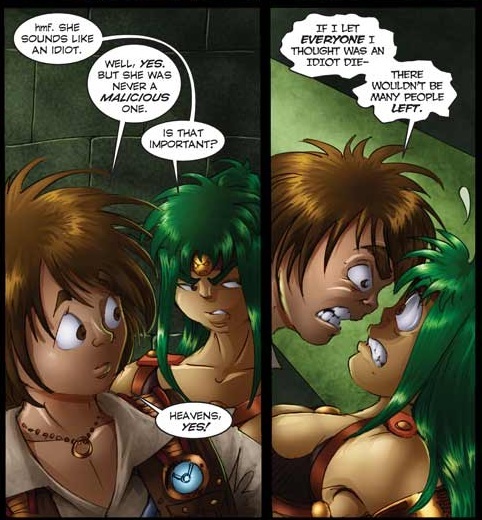
- After Gil delineates how Zola is fairly innocuous and in danger — an idiot, but not malicious — he is questioned about whether her lack of malice is important... which produces an intimidating burst of rage: if he let everyone he thought was an idiot die, there wouldn't be many people left alive.
- Girl Genius is pretty fond of this trope — practically all of the "good" characters are able to slip into Evil Demented Sparky Genius Mode at a moment's notice. Agatha, Gil, and Klaus would be the best examples—and are at each other's throat half of the time.
Agatha: I get it. I see where this is going. [...] I'm the big meanie, because I made Princess Psycho cry. I'm the bad guy because, for whatever reason, you didn't tell your nasty little friend who you are, and now she's sad. So you're mad at me — because now she's all sweet and teary and needs rescuing, and I'M the evil madgirl with the death ray and the freakish ancestors — and the town full of minions — and the horde of Jägers — and the homicidal castle full of sycophantic evil geniuses and fun-sized hunter-killer monster clanks and goodness know what else — [pause] And you know what? I CAN WORK WITH THAT!
- As an even earlier example — albeit with a good touch of Beware the Nice Ones — here is the very first time Gil realizes this and achieves a Crowning Speech of Awesome (if such a trope exists):
Gil: I am sick to death of this! What do I have to do?! I just took down an entire army of war clanks, and still I get treated like a halfwit child! [...] Always, I try to be reasonable. To be fair. I try to talk to people. And no one ever takes it as anything other than weakness. [...] You listen to me try to be civilized, and you think—"Oh, he's nothing." "Him we can ignore." "Him we can push around." "We can do whatever we want—he won't stop us." [...] Because nobody ever takes me seriously — unless I shout and threaten like a cut-rate stage villain. Well, you know what? I can do crazy. I really can. And it looks like I'm going to have to. [...] I'll have to give up all this "being reasonable" garbage — and show you idiots what kind of madboy you're really dealing with! ...Oh. Oh, no. This must be how my father feels — all the time!
- After Gil delineates
- Grrl Power: Maxima often comes across as brusque at best and scary at worst; she doesn't much care if people like her as long as she keeps them safe. That said, she cares for her team and genuinely likes and respects them (despite being frequently irritated by their shenanigans).
- Homestuck has a couple of examples:
- The Wayward Vagabond united the forces of Prospit and Derse and almost ended the war between the two kingdoms until Jack Noir interfered. At the same time, he's comically rude to John and frequently insults him for not following his instructions.
- Karkat Vantas is the Alternian equivalent of the descendant of the troll version of Jesus, and Karkat himself is very, very heavily on the good side, being very devoted to his friends to an almost Team Mom-ish level at times. It is almost impossible to have a conversation with him that does not involve him yelling colorful abuse at you.
- Terezi, who is obsessed with JUST1C3 and who has no pity for evil, considers herself this. However, by Earth standards, the Alternian justice system wouldn't exactly be considered "good". Terezi herself is much closer to human morality, though, and would still qualify.
- Vriska also at least sees herself this way:
VRISKA: I only ever wanted to do the right thing no matter how it made people judge me...
[...]
VRISKA: And you don't have to 8e a good person to 8e a hero.
VRISKA: You just have to know who you are and stay true to that.
VRISKA: So I'm going to keep fighting for people the only way I ever knew how.
VRISKA: 8y 8eing me.
- In Impure Blood, Elnor bluntly tells Roan that Fantastic Racism will continue if he doesn't act civilly.
- The angels in Maxwell The Demon run a Celestial Bureaucracy and, while working for good, are as dickish as the demons, if not worse.
Demon: Oh, sorry. Go on through. No hard feelings, ey?
Angel: [muttering] First against the wall when the Rapture comes. - "Nice Does Not Mean Good" by tooquirkytolose on Tumblr discusses the concept when a woman abandons her son in the forest. The boy spends three days waiting when he's taken in by a witch who was passing by. She becomes the boy's new mother, and tries explaining to him over the years that just because someone is nice, that doesn't mean they're good. The comic juxtaposes this with his birth mother, whom he claims is "too nice" to have abandoned him, and his new mother, who has a blunt way about her and doesn't mince words but raises him to be a good man. He remembers that as when he runs into his birth mother by random chance after he's become an adult. She doesn't recognize him, but he recognizes her yet doesn't say anything about it to her... or her new kids. All he can do is think about how polite and kind and nice she seems, and that "Nice does not mean good."
- The Order of the Stick:
- Roy to a certain extent, who, while being Lawful Good, enjoys verbally lambasting his friends and enemies a bit too much and is even berated for it by several other Lawful Good characters.
- The paladins of Azure City are pragmatic in general, cunning to the point of underhandedness when necessary. (Yes, even Miko.)
- Miko is socially inept, Lawful Stupid, and eventually jumps off the slippery slope, but she's unfailingly courageous and eager to save innocent bystanders.
- The deva who evaluates Roy's case rather easily intimidates Eugene from interfering.
- Haley has her moments, too. Those who read her origin comic may get Mood Whiplash when they see her friends again. She kills most of them without hesitation, and in many cases without them even having the chance to surrender or speak in their own defense. Mind, they're there to kill her, too.
- The same can be said, albeit in different ways, of Durkon. He's Lawful Good to the core, and weeps tears of joy when he realizes that he'll be going home to his people as a corpse. He also has Charisma as his dump stat, so even when people can understand his accent, he comes off gruff.
- Eugene Greenhilt qualified for the Lawful Good Heaven after death, but more or less got bored of being a husband and father, dumped a major quest on a son he denigrates at every opportunity, and thinks wizards are superior to everyone else. His son's condition for cooperating is that Eugene have nothing to do with the family afterwards, and Eugene cheerfully accepts.
- Angels in Slightly Damned canonically tend towards good. What little we've seen of their society could be generously called a hyper-conformist borderline-fascist state.
- Aeris from VG Cats. She tends to very bluntly berate Leo for his stupidity, but often times it's for his own good. (Here's an especially classic case of this.) She's also implied-but-not-shown to hit Leo from time to time, but it's presumably based on a similar principle. This varies from strip to strip though. Occasionally she will become so enraged by Leo's antics that she will go back in time to erase him from existence completely. He gets better though.
- Walkyverse:
- Mike from It's Walky! has this in him. He comes off as a total Jerkass until he sacrifices his life to save Joyce at the end. He also does several other heroic things before then, but that's the kicker.
- When Mike shows up in Shortpacked!, some of the horrible things he does end up forcing other characters to confront bad aspects of themselves, making them better people overall.
- Gilgam in The Water Phoenix King is the embodiment of this. Being Really Seven Hundred Years Old is only part of the reason; it mostly seems caused by post-war disillusionment and depression, though he was probably always sarcastic and irreverent (he was a lawyer, after all) and being the Only Sane Man (in his mind, at least) doesn't help.
- Though Gray is the protagonist of Weak Hero, and the story is ultimately about him taking down a hierarchy of bullies, that doesn't mean that he's a kind person. Due in large part to the trauma of his past, Gray is stoic at best and a cold-hearted demon at worst.
- This tumblr thread is full of people sharing their experiences in Boston. Bostonians are very rude but still go out of their way to help strangers.
#boston my dearly beloved #I miss the east coast man. I lived in Oregon for 4 years and it's not the same #ppl are all 'oh a flat tire? thats really shitty. I really hope you get this sorted out!' and then they drive off #where on the east coat [sic.] someone's dad is already changing it for you while telling you you're an unprepared idiot. thanks man
- The SCP Foundation is an organization dedicated to protecting humanity from the supernatural, in a setting where doing so requires a great amount of dog shooting, doing what's necessary, and protecting you from things you don't need to know about. They avoid collateral damage wherever possible, get rid of any of their agents who put their own desires above protecting innocents, and generally take great pains to make sure that any terrible acts they do are only done if there aren't any better, more moral options.
Ethics Committee agent: You've done horrible, awful things while working for the Foundation — don't try to deny it, Doctor. You've consoled yourself by thinking that all the torture and murder is for the greater good. This implies that there is a greater good... and a lesser good. It implies that there are multiple distinct goods, and that these can be quantified and compared.
- The Angry Video Game Nerd briefly shows some compassion in the Battletoads review by letting Kyle Justin sit on the couch, and in the R.O.B. episode, he single-handedly defeats R.O.B. so that all the games in the world aren't limited to Gyromite and Stack-Up.
- The Courier in Courier's Mind: Rise of New Vegas is a snarky, cynical, sadist with a Hair-Trigger Temper. But when the people of The Mojave need a hero, he'll always (begrudgingly) step up to save the day, no matter the cost.
- Demo Reel. Carl Copenhagan and Quinn both have terrorist backstories and little patience for stupidity, but become part of the Lonely Together family by the end of the second episode.
- Captain Hammer from Dr. Horrible's Sing-Along Blog is a Superhero who's apparently saved the city numerous times over. He's also the world's biggest Jerkass; he only even seems to do the hero gig to earn the adulation of others and thus feed his insufferable ego, and, upon discovering the secret identity of his arch-nemesis, decides to gloat and continue dating the girl of the villain's dreams just to make him squirm instead of simply arresting him for his crimes. The first time he's ever actually hurt in the commission of his heroic duties, he runs like a scared child and spends months in therapy.
- Hero House has several of the heroes acting like dicks. Particularly Red Hood.
- The Nostalgia Critic may be a Psychopathic Manchild with a Dark and Troubled Past, but God help you if you were to hurt a child.
- Nyx Crossing: The natives help the group in episode 4, but in doing so, they severely injure one, tie them all up, go through their things, and abandon them before helping them.
- RWBY Abridged:
- Ruby is an extremely rude smartass, who makes her annoyance at others very well known. But, she also genuinely wants to keep her hometown safe and routinely stops criminals all by herself.
- Weiss is pretty much just like her canon self, with the added bonus that she's not even training to become a hero by choice. Still, when people are in danger, she will do what she has to, to defend them.
- Avatar:
- From Avatar: The Last Airbender, post-Heel–Face Turn Zuko has shades of this. He's only slightly friendlier than he was in the first season. In fact, almost all of the Gaang is like this: when Aang gets pissed, he turns into a cold, ruthless Creepy Child with Glowing Eyes of Doom and the Voice of the Legion; Sokka is not big on sentimentality and always solves problems in a pragmatic way; Katara has shown a nasty, vengeful side when someone wrongs the people she loves; and Toph is a Deadpan Snarker who cons several Fire Nation citizens and sinks a zeppelin full of Fire Nation soldiers in the finale.
- From the Sequel Series, The Legend of Korra:
- Lin Beifong, daughter of Toph and chief of the metalbending police. She can come off as overly harsh at times and appears to be a total hardass. However, she is unquestionably a good person who is trying to keep the peace and protect the innocent. This is made only more clear by her Heroic Sacrifice in the first season which cost her her bending all in the name of protecting the last airbenders in the world which are very important to her ex-boyfriend Tenzin. Another case is her would-be another sacrifice in the third season in order to give her former estranged sister Suyin a shot to kill one of its enemies using herself as a bait. She might be an ass, but she takes her role as a protector seriously, into the point that she considers herself as expendable.
- The true identity of Avatar Spirit, Raava, can also be considered this. She's an extreme version of this during the Beginnings, which also proves to be her undoing in unleashing Vaatu to the world despite pinning the blame to Wan by being dismissive to the human as of why interfering their fight is a bad thing. She mellows out significantly thanks to her unlikely alliance with Wan, the eventual progenitor of the Avatar Cycle by permanently merging with him that enables her remember and understand why the world is worth protecting and fighting for. But she's not to be trifled with if she's crossed and anything who gets in her way in her goals to protect the balance of the world. Whenever Aang went on his rampages in the first series, Raava was probably holding the controls. This includes annihilating the Fire Navy when they managed to kill a spirit of importance of the Water Tribes. It's heavily implied that the reason behind Aang's rampages was because at his time, the world is clearly worse than a Crapsack World, it's basically out of balance with the Fire Nation trying to conquer the world and even managed to commit genocide against the Air Nomads and another transgression against the Water Tribes when they killed the Moon Spirit which would eradicate waterbending as a whole, and given that Wan was once hailed from the ancestors that would form the future Fire Nation, it's like seeing all his work being undone... something that the spirit of light and peace won't appreciate one bit that might as well as she experienced even worse than a culture shock. And not to mention, spending a century being dormant meant also another short time to prepare for the Harmonic Convergence, which she will face her Arch-Enemy Vaatu once again. Small wonder she's damn pissed during the events of the first series, most especially when she and her incarnation via the Avatar State faced Fire Lord Ozai at the finale.
- Blinky Bill and his friends are sometimes considered to be downright cruel in terms of behaviour. Considering that he was "toned down greatly" in the cartoon compared to his original literary incarnation, he must have been a real Jerkass in the books.
- Huey Freeman from The Boondocks. Although he has good intentions in building a greater American society, he is quite cynical, pessimistic, cantankerous, and has been labeled — not unjustifiably — as a "domestic terrorist".
- Codename: Kids Next Door: Chad Dickson, f.k.a. Numbuh 274 was so devoted to the cause of the KND that he willingly turned traitor and smeared his good name in order to serve as a spy. That does not detract from the fact that he became a jerk as his jealousy for Numbuh 1 consumed him. Eventually, he is so driven by his envy that he tries to kill Nigel in his final appearance on the penultimate episode of the show, despite still being loyal to the organization as a whole. As a result, this prevents Nigel from idolizing him again, as well as restoring their friendship.
- Scrooge McDuck of Disney comics (such as ones by Carl Barks and Don Rosa) and adaptations such as DuckTales (1987) will never resort to illegal or underhanded means to make money (the one time he did, he ended up haunted by a zombie for several years — and Donald got chased as well several decades afterward), but neither will he donate a single penny to charity. He'll give you a (really low-paying) job at the drop of a hat, though.
- Donald Duck too. Especially when he's put in a blatantly heroic role, such as the Kingdom Hearts series. He might be selfish and temperamental, but when you get right down to it, he's nothing if not loyal to his friends.
- There was a cutaway gag in Family Guy where Peter encounters Kenneth, the bad-ass mail clerk with a heart of gold. Peter is then told by another employee that the clerk donated half his paycheck to orphans with diseases.
- Glitch Techs: While Mitch Williams is the best Glitch Tech in their division, he's also a complete egotist who happily abuses the company's technology to serve his own personal needs and constantly talks down to his coworkers.
- This sums up the morality of Granamyr from He Man And The Masters Of The Universe. He brokers no disrespect from anyone, actual or perceived, and has been known to demand tribute for any help he gives. His enemies also rarely return for a second round once he decides to get involved.
- On Invader Zim, Dib is the Hero Antagonist who wants to save the human race from an evil alien monster. And he often makes it clear that he will enjoy taking part in that alien's autopsy.
- Rex Splode from Invincible (2021) may be a superhero but that doesn't stop him cheating on his girlfriend, try to antagonize everyone around him, and every word that comes out of his mouth is either to express anger or complain.
- The Legend of Zelda (1989):
- The show portrays Zelda as a hard-edge Action Girl with an occasionally short temper. One episode has Link distinguishing between the real Zelda and the fake one by setting up a kissing contest in which Zelda's evil twin eagerly kisses him whereas Zelda herself slaps him in the face. Link assumes the real Zelda to be the one who slapped him. She's not completely unaffectionate, though, since she agreed to kiss him a few times but they always got interrupted before it could happen. When Link's body is separated from his body, she's able to see him because she's in love with him — the "kissing contest" in hindsight appears to show her reason for hitting Link wasn't because of him asking to kiss her, but because he kissed someone else.
- Link himself could hardly be called "nice" most of the time. He's lazy, selfish, and basically harasses the princess for a kiss. But he's also unwaveringly heroic and courageous. It also turns out that he's not particularly good with a sword if it doesn't shoot beams, because he could actually hurt someone with it rather than simply sending them to Ganon's Evil Jar.
- The main trio of Mao Mao: Heroes of Pure Heart may be the town's sheriff's department but they're hardly paragons of virtue. Mao Mao can be quite the tight-ass when it comes to rule enforcement, Baderclops can be quite lazy and doesn't take criticism well. (It's later revealed he used to be a thief), and Adorabat is quite violent for a 5-year-old, to the point where even her father is scared by her.
- In Miraculous Ladybug, Master Su-Han is a member of the Order of the Guardians dedicated to safeguarding the Miraculous and protecting the world from evil. He's also a genuine asshole; he constantly insults Master Fu, who last he remembers was a scared 14-year-old who was forced into inheriting a legacy he didn't want, all of his interactions with Marinette/Ladybug involve him bitching her out for "failures" she couldn't have possibly known about and generally doing nothing to help her improve, and he has no problems using physical force against either of them.
- Skipper from The Penguins of Madagascar is supposed to be the main protagonist, but he's pretty coarse and violent even on his comrades.
Alligator: That looks as if it could be violent.
Skipper: If done correctly. - Major Monogram from Phineas and Ferb. He's dedicated to fighting the forces of evil, but he's not a very nice person, especially to Carl, his unpaid intern.
- Spinelli from Recess is hot-tempered, cynical, and has a violent streak, but is still a good friend to the rest of the main characters.
- Benson from Regular Show. He's constantly angry and constantly threatening to fire Mordecai and Rigby, but all he's really doing is his job which includes making them do theirs. Plus, as later seasons show, he can actually be a friendly and fun guy when things aren't out of hand.
- Rick and Morty: Rick admits he falls under this category during his best man speech at Birdperson's wedding. Of course, even calling this guy "good" is a real stretch, but even if only for entirely selfish reasons the guy has saved the world numerous times and does have a habit of saving his family, even Jerry, for no reason other than he might actually care for them.
"Listen, I'm not the nicest guy in the universe, because I'm the smartest, and being nice is something stupid people do to hedge their bets."
- In Samurai Jack, the Scotsman is Jack's closest ally and probably the closest thing he has to a friend in the future world. He's really not nice. In fact, he's downright rude.
- Hefty as the Smurf Of Christmas Future in The Smurfs: A Christmas Carol leaves Grouchy in the Bad Future where all the Smurfs are captured to be chased after by Gargamel and Azrael.
- South Park has this in spades. Usually Kyle or Stan fits this, particularly when Cartman is the antagonist.
- The Big Damn Movie, South Park: Bigger, Longer & Uncut, has "Ze Mole." A huge Jerkass to everyone, who spews obscenities about God frequently, and goes on about how childish and naive the other boys are, but he still joins the boys to help Terrence and Phillip in the name of freedom and dies in the process. He does get better thanks to the Reset Button, though he's never had a major appearance since.
- Reality, which takes the form of a top hat-wearing villain, in "Safe Space". He attacks an incredibly rattled Butters for filtering everybody's negative comments, and verbally attacks everyone for letting their obsessive fear of criticism push Butters into suicide by having him work to maintain their safe spaces. The townspeople, just make third-world children filter comments for them and publicly hang Reality.
- James Cameron is portrayed as an unbelievably arrogant, egotistical, and gullible "hero" in "Raising The Bar", who is so obnoxious he forces his crew to listen to his theme music while he ignores their insistence that the "bar" is a metaphor. In true South Park fashion the bar is real, he saves the whole world from degenerate media by raising it, and he denies accepting any credit or thanks for what he's done because "James Cameron does not do what James Cameron does for James Cameron."
- Star Wars Rebels: After his Heel–Face Turn, Kallus qualifies as this, willing to do morally grey actions, including framing another Imperial officer he'd been on good terms with, in order to maintain his cover.
- Teenage Mutant Ninja Turtles:
- Raphael in all incarnations. He's cool but rude. (As he himself puts it, "I don't do nice!")
- Casey Jones is like this in roughly half the incarnations (for the other half, he's more a Knight Templar).
- Sentinel Prime from Transformers: Animated. He's technically a good guy, but is also a Jerkass who hates organics and is willing to work with Lockdown in order to defeat the Decepticons.
