

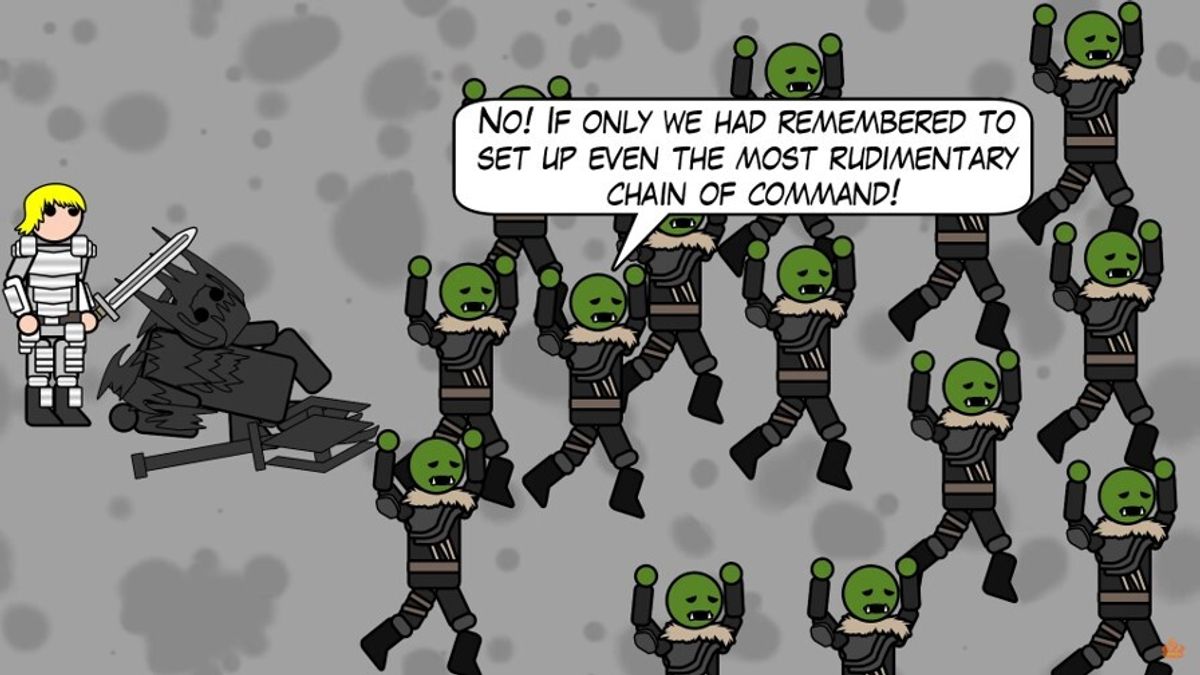
Fox: That's incredible! We can take 'em out in one blow!
A Keystone Army is an invasion force or army that's seemingly unstoppable...except for one particular weakness in the form of a well-protected but very fragile component. It can be an individual soldier, an object, or whatever, but if you destroy or tamper with it, the entire army is immediately disabled. This plot device is handy as it allows a handful of heroes to win the war without having to depict them fighting off the entire enemy force. Just a daring raid on the enemy's stronghold and BAM! Evil is defeated. It also allows otherwise unstoppable foes to be suddenly stopped dead in their tracks.
General forms include having the MacGuffin-weakness be the Hive Queen of The Hive's Hive Mind, the sole source of all the enemies' powers, or the lone connection to Another Dimension or sole anchor to our own. Just like a real keystone, once it's destroyed, the rest falls apart. Another possible cause could be that the one in charge is a total Control Freak who arranged it so that everything depended on him to operate, and as such, without him, the entire army is immobilized.
This trope is extremely commonly seen in The Hive. Bee People are likely to be a Keystone Army if they have a Hive Queen, and as such trashing it is a good way to win the Bug War. Another common Keystone Army simply replaces the insects with Killer Robots or Grey Goo and the Hive Mind with a Master Computer or evil AI, and yet another popular variation has an Evil Sorcerer whose (often Undead, Mind Controlled or Demonic) minions will cease to be a problem due to No Ontological Inertia upon his death/defeat/distraction. An army of monsters may be defeated by killing the Monster Progenitor. Easily Thwarted Alien Invasions often employs such armies. We Cannot Go On Without You is a case of the player character of a video game being the keystone in their party's army.
Of course, no one ever considered that someone would aim at their army's one weakness. After all, it would be rather anticlimactic to destroy the Killer Robot's central control but have a backup one come online in another location.
Despite the name, only occasionally is the vital component a Cosmic Keystone. A type of Instant-Win Condition. See also Decapitated Army, for when the keystone is the leader. Straight for the Commander exploits this trope. The armed forces equivalent of a Terminally Dependent Society. See also Fantastic Fragility. Compare Untouchable Until Tagged, when individual Nigh-Invulnerable fighters get mobbed after an unlucky hit.
See also Family Pillar Death when the death of one parental figure causes the rest of the family to break apart and either ignore each other as best as possible or fully go their separate ways.
Similar, but not to be confused with the Keystone Kops.
Examples:
- Baka and Test: Summon the Beasts: During the summoner test wars, taking out the class rep is an Instant-Win Condition. Naturally the students usually try to protect their leader, but sometimes the opposing class will bait them somehow and lure them away so as to weaken the rep's defenses and take them out.
- The Beginning After the End: Every single Alacrya has the blood of Agrona Vritra in their veins regardless of if they are considered truly Vritra-blooded or not. As such, when Arthur renders Agrona comatose by severing his connection to the Legacy, it results in an aetheric World-Wrecking Wave that affects every single Alacryan as their connection to him is severed. Interestingly enough, rather than being what instantly defeats the Alacryan invasion, it merely acts as a coup de grace as Arthur's allies had already beaten back most of Agrona's forces by the time he defeats him.
- Several Doraemon films have the heroes taking down a single element controlling the invading army leading to their immediate victory:
- Doraemon: Nobita and the Castle of the Undersea Devil has the Mad AI Poseidon, leader of the underwater robot army who wiped out the inhabitants of Atlantis and is targeting the surface world. Once Poseidon is destroyed via Buggy's Eat Me Heroic Sacrifice, his robots and drones quickly come to a standstill.
- The climax of Doraemon: Nobita's Great Adventure into the Underworld, where Doraemon and friends, including their new allies Miyoko and Professor Mangetsu, battle the Demon Lord Demaon and his legions. The battle ends when Demaon's heart is pierced, leading to his entire army's immediate downfall.
- Doraemon: Nobita and the Tin Labyrinth features yet another hostile robot race from Planet Chamocha, controlled by their leader Professor Napogisutora whose brain controls literally every robot in his army. Doraemon managed to fire a disc containing a Computer Virus into Napogisutora's mouth, and then the virus caused the robots in the entire legion to malfunction and destroy each other.
- Doraemon: Nobita's Drifts in the Universe has the Independence Army's Attack Drone fleet, meant for large-scale invasions on peaceful alien worlds, which got shut down once Nobita, Doraemon, and Lian sabotaged the antenna controlling them.
- Godzilla: City on the Edge of Battle: When the Bilusaludo merge with Mechagodzilla City their minds become linked to it. When the command center where Mechagodzilla's head resides is destroyed, the Bilusaludo soldiers cease functioning. That said most of the assimilated Bilusaludo were inside of the center when it was destroyed and it's only Belu-be, who was fighting outside, who drops dead.
- Invoked and discussed in Hoshin Engi: When Taikobo is tasked with the Hoshin Project and has to defeat Dakki and her followers, he points out that slaying all the followers listed in the Hoshin List is unnecessary, and by taking down Dakki her army would disband. For the first part of the manga, his plans revolve around finding a way to get rid of Dakki herself, but unfortunately, she's out of his league not only in power but also in strategy.
- Naruto:
- The army of ninja resurrected by Kabuto was controlled and created by his technique, and thus can be stopped by defeating him. However, just killing him won't get rid of it; he has to actually be forced to stop it.
- The first Naruto Shippuden movie features a nigh-invulnerable terracotta army that is animated by an Eldritch Abomination-type being called Mouryu. The only practical way to stop it is by sealing this creature, which is in itself a pretty tall order once its soul and body have reunited. Which, in a surprising moment of savvy, is why they sealed the soul & body in two different places. Mouryu, unfortunately, has shades of As Long as There Is Evil going on.
- Rebuild World: Justified Trope due to a Psychic Link which bordered on Hive Mind in some regards. The network led by Katsuya, and consisting of his Battle Harem all fall comatose for days instantly after the leader's death due to the shared emotions and knowledge from said link and shock to their nervous systems.
- Suicide Squad ISEKAI: The gem on Ratcatcher's staff is what enhances his powers and allows him to control his army of Beast Men. Deadshot sniping it while he's distracted is what breaks his control over his army as his newly-freed Battle Thralls turn on him.
- Super Dimension Fortress Macross: the invading Zentraedi armada is defeated by blowing up their command ship. This is entirely due to protocols and them being in the middle of a freak out: in case of loss of their flagship protocols dictate a retreat as soon as feasible, and since the Minmay Attack caused a fleet-wide freak-out out of culture shock the Zentraedi don't even think to finish the job, they just want to run away and try to figure out what the hell just happened.
- Space Battleship Yamato 2. Desslok's flagship has a brigade of robots that Kodai (Wildstar) defeats by blowing up their central computer.
- In Tengen Toppa Gurren Lagann, as soon as Simon beats Lordgenome, all of the Beastmen's Gunmen instantly power down. Beastman Gunmen are typically solar-powered (the heroes' run on fighting spirit), but the battle had dragged on into the night, and Lordgenome had been powering all of his side's mecha with his own fighting spirit in the absence of the sun.
- Judge Dredd: In the Judgment Day arc, the villain Sabbat's zombie army is entirely dependent on his continued control to function. The Judges of the world's Mega Cities eventually assemble a strike team to take out Sabbat in a last-ditch effort to prevent the Earth from being destroyed completely.
- In Paperinik New Adventures the Evronian Empire is entirely dependent on the Emperor: the vast majority of the species lack the ability to completely think for themselves or properly emote beyond hatred for outsiders and wish to please their genetic superiors and, in the case of the High Caste, establish their personal superiority over their peers, with only the Emperor and members of the Imperial Council having the full ability to think and emote, and if the Emperor dies without a replacement they will collapse in a civil war as the Councillors, generals and high-caste scientists try and prove they're the best before creating said replacement or, in case of the councillors, become the new Emperor:
- At the end of the Xadhoom Trilogy, Xadhoom kills the Emperor and blows up his Planet Spaceship, and the Evronians immediately collapse in multiple factions, of which we see three led by Imperial Councillor Zeron, the shape-shifting spy Grrodon (originally a member of Zeron's faction that struck on his own after being left without orders for too long), and the High Caste scientist Gorthan, plus Zoster (another scientist) operating alone once he finds out his Emperor was killed while he was trying to rejoin.
- In the reboot, the reason the Guardians of the Galaxy are winning the war is the death of two Emperors in rapid succession (one to the Guardian Drones when they raided Evron itself, and his successor to a Bodyguard Betrayal) left the Evronians without a replacement, and Evron's forces are fighting each other more than trying to conquer the universe. Imperial Councillor Gorthan has managed to unite under his command the fleets of at least two generals and the others recognize him as a sort of superiors, but since he hasn't yet proven himself fully he couldn't become Emperor and the Evronians remain relatively weak.
- The Evronian Planet Spaceship that appears in "Chronicle of a Return" ran the moment the Rettificators killed their Emperor and everyone of High and Middle Caste. Considering the enemy's superiority, they were right. And since their highest-ranked member is a low-caste sergeant, they are barely functioning and looking for anyone who could take over, or at least a High Caste scientist who could understand the procedure to create a new Emperor, leaving them vulnerable to Paperinik taking over by pretending to have the authority of the local Evronian Emperor.
- Supergirl: In the Red Daughter of Krypton storyline, Supergirl faced off against the Diasporans -an alien space force that had devastated several planets and wiped out their inhabitants-. However their leader was being mind-controlled, so the whole army surrendered once Supergirl defeated him.
- In Superman story arc "Brainiac: Rebirth", Brainiac is overwhelming New York City with a huge alien army. While fighting his soldiers, the Justice League and the Teen Titans realize that they have to reach Brainiac rather than waste time battling his troops. When Brainiac falls, his slave army surrenders.
- The Avengers:
- In a 1970s issue, Thanos's space fleet is attacking Earth. It turns out that all of the multivaried aliens in the fleet are depending on a single gizmo on one ship to translate for them so they can understand each other. The Avengers destroy it, and then win fairly easily. Somewhat justified when it turns out that Thanos arranged the whole thing as a distraction from his real evil plan, and didn't especially care whether the space fleet succeeded or not.
- Even Thanos' actual evil plan, using the Cosmic Cube to make himself a god, turns out to be this. Captain Mar-Vell (alongside a small group of allies made up of Drax the Destroyer, Drax's daughter Moondragon, Thanos' brother and father, as well as Iron Man) is hopelessly outmatched by the all-powerful Mad Titan, especially after he uses the Cube to become one with the cosmos. However, Mar-Vell realizes that despite becoming a Reality Warper, his power is still in-flux and reliant on the Cube. Thanos tries to age him into dust, but with his dying breath, Mar-Vell manages to strike the Cube and undo Thanos' changes. As a side-effect, Thanos is turned to stone, dead. The members of his forces that remain on his flagship and aren't members of the distraction fleet then scatter and flee without him to lead them.
- Wonder Woman
- This is inverted with Queen Mikra and her Living Statue spinx army. While Mikra is apparently a physical powerhouse in her own right, her soldiers seem flat-out invincible, being stronger than the Golden Age Wonder Woman, immune to the conventional weapons of the 1950s, and fast enough to outpace jet planes. Mikra will never truly die as long as these Nigh-Invulnerable spinxes exist, as she was once separated from them, mummified alive and left to rot for seven thousand years but the spinxes merely passing by her tomb was enough to instantly restore her body to full health. If the spinxes were somehow destroyed, Mikra's body would start turning to dust on account of her advanced age.
- In the final arc of Gail Simone's run on Wonder Woman Vol 3 run, Diana faces off against the Citizenry, a genocidal military force so fearsome that they eat Green Lanterns for breakfast. Fortunately, their self-justification is based on their own strength, so when Wonder Woman challenges their leader, said leader already starts to look suspect when she delegates the challenge to their emergency weapon, and when said weapon loses, the leader loses all status. Diana's then able to order them to stand down.
- The square miles of regenerating undead army in With Strings Attached are powered by the Heart of Evil, in a ruined city miles away from where the four and Jim Hunter are surrounded. Having been made a little stupid by rage, and never having grasped just how effective Ringo is at finding stuff, Jeft never imagined that the little band could escape their encirclement, get to the city, go straight to the Heart of Evil, semi-accidentally defeat its powerful guardians, and destroy it, which instantly destroyed all the undead. Which really pissed Jeft off, since not only did he not punish Jim Hunter for his Heel–Face Turn and the four for instigating it, but that heart was expensive.
- In the The Legend of Korra fanfic Book 5: Legends, when the bender animating the walking dead men is rendered unconscious, their animation fails and they fall like dominos. Naturally, this is incorporated into the defense of Republic City in the final chapters.
- A Shadow of the Titans has an example at the climax of the HIVE Arc: the Shadowkhan's keystone isn't Tarakudo, but the Queen/Kagehime, who has the fragments of the Red Mask in her. When they and Tarakudo's chi are expelled from her body, the Shadowkhan are re-sealed.
- Dungeon Keeper Ami: The Dungeon Hearts are the Keystones of a Dungeon Keeper's army, as killing the heart banishes the Keeper.
- The Equestrian Wind Mage:
- Whenever a Gohma leader is killed, all its subordinates die automatically. When their god Iemanis is killed in Season 3, the whole species goes extinct.
- When Shining Armor manages to kill Onox, the latter's dragon army — which only followed him out of fear — immediately disbands and flees.
- "The Long Haul
 " reveals that the Slayers are essentially a version of this; when Buffy and Willow accidentally join the Atlantis expedition while tracking a demon, their departure from Earth automatically weakens every active Slayer back on Earth with the exception of Faith, as the two of them were the focus of the initial spell to empower the Slayers.
- The MLP Loops: At one point Berry Punch defeats the changelings by getting Chrysalis drunk, and through her, getting the rest of her hive drunk.
Twilight: What I want to know is how you got the effects to propagate over the whole swarm. Changeling biology is loaded with dozens of failsafes to prevent exactly that from happening.
Berry Punch: Oh, it wasn't that hard. I just had to mix them with love. - For the Glory of Irk: As we learn during a major battle in Chapter 59, if a Control Brain is taken offline, all the brainwashed Irkens controlled by it go comatose.
- Guardians, Wizards, and Kung-Fu Fighters: When the stolen Heart of Meridian is returned to Elyon at the end of the Final Battle against Phobos, the Whisperer army that he conjured with it all disintegrate.
- Re: My Hostage, Not Yours: When Zim kills the Valkian Queen at the climax, all her drones immediately drop dead as well.
- The Weaver Option features several instances of this, as shown in the Warhammer 40,000 list:
- The Ork invasion of Fay is stopped when the Imperial forces manage to kill the Ork Warboss.
- Leet killing the Warboss in the Battle of the Death Star allows the Imperial forces to leave the artificial planet.
- When Taylor finally defeats Ka'Bandha, the demonic portal allowing it to come from the Warp is closed down.
- Arrgard's death during Operation Stalingrad puts an end to his WAAAGH! against the Necrons.
- Killing the last Synapse creature on Ardium reduces the Tyranid swarm from an unstoppable horde to merely being a large pack of feral beasts.
- The death of Lorgar causes a total morale failure in the Word Bearers Legion. The effects are temporary, but since it happened during a battle, the casualties before they can recover are catastrophic.
- One for All and Eight for the Ninth: The extra powers the Ennead gets through Bonding depend on Izuku. When Izuku gets hit by a Quirk-erasing bullet, the girls lose access to the special powers, and when the effects of the bullet ends they return.
- Invaders of Irk: Heavily averted, as Lard Nar notes in regards to the Irken Empire. Even with the disappearance of the Tallest and the First Fleet into the Florpus, the Irken Empire is still not stopping its conquest, with Warmaster Creed taking control as the de-facto leader of the Empire and continuing the Empire's war.
- Harry Potter and The Acts of Betrayal: The final confrontation between Harry and Voldemort results in Harry taking Voldemort's magic away. This causes Voldemort's artificial body to start destroying itself and pulling magic from his marked Death Eaters to try to sustain itself. When that fails, it then starts absorbing his followers' lifeforce, eventually killing them all before leaving Voldemort's corpse as nothing but a puddle of slime.
- Beauty and the Beast: The Enchanted Christmas: It's arguable as to how much sentience they have, but all the Cupid Babies fade away once Beast destroys Forte's organ, the source of their life.
- In the climax of Felix the Cat: The Movie, when Felix throws the Book of Ultimate Power at the Master Cylinder, the Duke of Zill's entire army of cylinders and cubes explodes. Poindexter surmises that the Master Cylinder was the Power Source for the army, and it reacted adversely to the book's gold binding. Felix believes there may have been more to it than that.
- In Kim Possible Movie: So the Drama, Dr. Drakken distributes toy robots around the world which turn out to be giant killer robots that he can activate with a command signal he broadcasts from his headquarters. When he launches the worldwide attack, Kim and Ron foil it by knocking out the main broadcasting tower, causing all the robots to revert back to their harmless toy forms.
- The LEGO Movie mimics The Avengers and The Phantom Menace by having the Micromanagers drop dead with the destruction of the Supervillain Lair.
- Most of Blackwolf's Legions of Hell from Wizards fade away or crawl back to Hell after he's defeated.
- Played with in Battle: Los Angeles. The alien invaders are ferocious opponents on the ground and are driving back the US military from Los Angeles and other coastal battlefields even before their drone support shows up overhead. The drones themselves are controlled from a large command center that, when taken out, causes the drones to crash and the United States military to regain air superiority over Los Angeles, but the war is far from over and the aliens remain a tenacious force on the ground.
- The zombies in Dead Again in Tombstone are corpses that are raised by an infernal artifact called the Horn of Lucifer. They are destroyed when the Horn is used to kill the man who raised them.
- On two levels in Edge of Tomorrow. Every Mimic force comes with an Alpha. If that dies, the Omega resets everything with foreknowledge of how things went down in the last loop, adapting until the Mimics win. Killing the Omega, however, stops all the Mimics.
- Used on a small scale in the movie The Fifth Element. Encountering a Hostage Situation, Bruce Willis takes a moment to figure out which bad guy is the leader, then offers himself as a "negotiator", turns the corner and immediately shoots the leader between the eyes. This works because Mangalores are honor-bound not to fight if their leader is killed. One even complains "no fair".
- Because the zombie guards in Frankenstein Island are powered by psychic energy channeled through the Brain in a Jar in the lab, when the brain is destroyed, the guards stop moving and slump to the floor.
- Godzilla: King of the Monsters (2019): Dr. Mark Russell compares King Ghidorah and his Titan army to the (defunct in real life) wolf pack alpha theory, declaring that defeating Ghidorah will cause the global Titan rampage to stop since Ghidorah is the one altering the baseline Titans' behavior to attack humanity in coordination. In the novelization, it's noted that Mark's proposed fix is a best-case scenario and there's a real possibility as far as anyone knows until the end that the Titans will continue rampaging even without Ghidorah's direction. Fortunately, after Godzilla kills Ghidorah, the Titans do stop rampaging under their new king's leadership, and they even begin cleaning up the ecological damage that's been done to the world.
- In The Great Wall, killing the Tao Tei queen causes all the other Tao Tei to become paralyzed.
- Done in Hellboy II: The Golden Army, where the demon crown is the keystone. Intentional on the part of its creators, as The Golden Army was deemed too dangerous to ever use again.
- In Heneral Luna, as it was in history, the Philippine Army was barely able to hold on when fighting the encroaching Americans, being poorly trained and suffering from a lack of resources. Thanks to the titular General Antonio Luna and his military genius, they were able to keep the fight up. After his death at the hands of his own countrymen, the situation becomes so bad that the Filipinos are routed in many battles unable to even kill any of their enemies in return.
- Independence Day:
- The alien ships are rendered shieldless through a virus uploaded to the mothership, which apparently maintains a constant data link with both the smaller motherships and the fighters. Although the heroes believed that this would only last a few minutes, they never get their shields back. Downplayed, as the aliens are still perfectly healthy and their technology (other than the shielding) is still functioning, but without the shields making them Nigh-Invulnerable, they're far less dangerous.
- Reused in Independence Day: Resurgence where after killing the alien queen, all of the aliens immediately drop dead and the mothership leaves Earth.
- In the Name of the King has the Krug, formerly mindless beasts who have been magically uplifted by Gallian to serve as his army. Still mostly beasts, they fight using We Have Reserves tactics. As soon as Farmer slits Gallian's throat, the Krug stop and, after standing around in confusion, drop their weapons and wander off.
- The rogue robots in I, Robot (2004). Since VIKI was remotely distorting their programming to make them hostile to humans, they immediately became docile upon their defeat.
- In Kingsman: The Secret Service, Valentine's entire private army and his powerful co-conspirators are taken out in a single keystroke due to the implants that kept them safe also doubling as a miniature explosive and Merlin's hacking enabling him to activate them all at once.
- The Last Sentinel: Subverted; the drone army deactivates after Tallis kills its AI, but a small number of Red Drones, and their leader, the Super Drone, continue marching after Tallis since they operate autonomously.
- The Last Starfighter: The Xodan Command Ship's communications turret. It is what allows the entire armada of space fighters to coordinate. Without it, they're not as effective and taken out quickly with a Macross Missile Massacre thanks to the Death Blossom.
- In The Lord of the Rings: The Return of the King, destroying the One Ring destroys Sauron (this at least is justified, as it's a Soul Jar), which causes his armies to flee while Mordor suffers what can only be called a catastrophic geographical failure. This was added in the movie, as the result from the books (several hours of orcs fleeing, surrendering, killing themselves, or performing hopeless stands) doesn't show well in cinema.
- Marvel Cinematic Universe:
- The Avengers (2012): Destroying the Chitauri's mothership causes all the Chitauri troops to drop dead. In the DVD Commentary, Joss Whedon admits that he hated having to resort to this trope, but it was necessary to give the heroes a clear victory instead of battling for seventeen more hours of cleanup.
- A Deleted Scene in Avengers: Endgame lampshades this when Rocket Raccoon asks the original six Avengers why they didn't just blow up the Chitauri's mothership immediately, and laughs when he learns they didn't know that this was the army's weakness at the time, as this is a well-known fact in his galaxy.
- The Mummy Returns: The unending army of Anubis turns to dust when the title's Scorpion King is killed and ordered to take his army with him; whoever kills the SK, becomes the legitimate master of the army. The Medjai army's job is to prevent the Anubites from getting out into the world; they knew they couldn't win on their own.
Rick: [as he stabs the Scorpion King] Go to hell! And take your friends with you!
- Mythica: Szorlok, an evil necromancer, controls a vast horde of zombies. Once he's killed, all of them instantly die once again too.
- Oblivion (2013): After the Tet gets blown up, the drones immediately deactivate.
- Pirates of the Caribbean:
- Pirates of the Caribbean: The Curse of the Black Pearl: The curse which rendered the crew of the Black Pearl immortal and unstoppable. Jack and Will break the curse while the crew is in the middle of a climactic battle with Norrington's men, and the second that the pirates realize that their key advantage is lost, they surrender.
- Pirates of the Caribbean: At World's End: Beckett brings an enormous Imperial Armada against the pirates, but they all turn tail and run when the Endeavour is sunk, despite it being heavily implied that they vastly outnumber the entire pirate fleet. May simply be a case of Lazy Backup. On the other hand, they are up against the Black Pearl, which is pretty infamous for her actions, as well as the Flying Dutchman, all at once. Especially the Dutchman, who would probably have made it a Curb-Stomp Battle given how everyone keeps saying "Control the Dutchman, control the seas."
- The Borg Queen and her Borg in Star Trek: First Contact (at least, those Borg who survived the engine coolant spill)
- Star Wars:
- The Phantom Menace:
- The Trade Federation's droid army has one as an intended feature: as part of their safety measures against a potential war droid revolt (something that had happened repeatedly in the backstory), their army is designed to remain active only if receiving an active control signal broadcast by a dedicated ship. This backfired on them when Anakin manages to blow up the only one they had left in Naboo's orbit, as the droids shut down on the spot upon losing the signal.
- A less literal version with the Gungan army; they turn and flee as soon as their shield generator is destroyed. Justified, because the Trade Federation army has brought tanks to the battle, and with the shield down they can move in. And do. The Gungans also have no reason to stay once the enemy is fully committed since their battle is only a diversion in any case.
- Subverted in cut content of Attack of the Clones; the Jedi blow up the droid control ship, shutting the droids down en-mass, only for them to all power up again seconds later when their new onboard backup systems boot up due to the Trade Federation and the Separatists changing the safeties.
- Revenge of the Sith: When Order 66 is executed, the Separatist Droid Army is defeated on a galactic scale by the activation of the new safety measure, the shut down signal - as intended by the plan, as Palpatine, being behind both sides of the war the entire time, wanted to be able to end the war instantly once he had accomplished his goals.
- The earliest Star Wars example is of course the original, with the Death Star's exhaust port. Reused in Return of the Jedi with the Death Star II's main reactor, not to mention Palpatine dying with it. These both are arguably subversions, however, given that the Empire, in the original Expanded Universe, kicked the rebels off the moon shortly after the Battle of Yavin and that the civil war still officially went on for another fifteen years after Endor and ended in a draw. In the new EU, on the other hand, the trope is present but downplayed. The rebels kicked the Empire off Endor's moon instead and the war still carried on, but only for about a year. The loss of centralized leadership and the massive financial losses the Empire suffered, not to mention a vast increase in support for the rebellion, all did the Empire in as it succumbed to infighting. So while the act of destroying the second Death Star and killing the Emperor did not magically make the Empire vanish, it did pretty much decide the course of the war in the Rebellion's favor. It helped that the Emperor had set the system up this way deliberately as an attempt at Vetinari Job Security, and left orders in the wake of his death to devastate loyalist worlds out of sheer spite.
- The Force Awakens: Starkiller Base is the Death Star writ large in more ways than one: like its predecessor, it has a fatal weakness: destroy its thermal oscillator, and the whole thing will blow up.
- The Rise of Skywalker: The Final Order is an unstoppable armada of Planet Destroying Star Destroyers, but their one flaw is that the planet they were built on is in such a violative part of space that they need a guiding signal in order to leave. Thus, during the Final Battle, the Resistance targets the source of that signal (initially a ground relay, but moved to the flagship by a pragmatic First Order officer), knowing that if they destroy it, the armada will be trapped and useless to their enemies.
- The Phantom Menace:
- Total Recall (2012):
- Cohaagen is making an army of robots to take over the only other habitable area in the world. Quaid finds out about a shutdown code for the army buried in his memories. When the La Résistance leader tries to access the memory, this triggers a hidden code that allows Cohaagen to find him.
- Played straight when Quaid destroys the Fall, a gravity elevator from Europe to Australia, destroying the robots aboard.
- Zig-zagged in Wonder Woman (2017). Diana entirely believes that mankind's love of violence and warfare is being caused by Ares and knows that once she kills him, humanity will end the war and return to peace. When she kills the man she thinks is Ares though, the trope is horribly, painfully averted. She sees that men will continue fighting and is forced to realize that the War Is Hell landscape she spent half the movie making her way across is really nothing to do with influence. After briefly flirting with the possibility that Humans Are Bastards who don't deserve her help, she goes on to confront the actual Ares.... who casually reveals that he influences humanity to fight each other, he doesn't force it. When Diana kills Ares, she sees several soldiers removing their helmets and looking confused and relieved, but it could just as easily be because two Gods were fighting in their base and they're happy to be alive.
- Anabasis: An early example of the trope that plays with it. After Cyrus's death at the Battle of Cunaxa (in 401 BCE), the rest of his army scatters, but the Greek mercenaries hold fast and win the day on their own — for all the good that ends up doing them. It sort of happens again when Tissaphernes betrays and executes the Ten Thousand's officers - the remainder panic at the news only for a spell before electing new officers and continuing their journey back to Greece. As the Anabasis was written by one of the Ten Thousand shortly after returning, this is Older Than Feudalism.
- The Afterward: The Old God's minions collapsed once he was banished since he'd controlled and animated them all.
- Justified in Animorphs:
- Inverted with the Helmacrons in Animorphs: The Suspicion. They're a hive species who kill their captain upon her ascent to leadership so she becomes "infallible", and keep her corpse seated on the bridge. In their case, their hive mind means that living members absorb the minds of dead ones, so killing the queen has the opposite effect of spreading her own consciousness rather than eliminating all of theirs.
- At the end of the series, in Animorphs: The Beginning, the Animorphs take control of the Yeerk Pool Ship and subsequently Visser One, the leader of the invasion of Earth, surrenders. Jake talks to a lone sub-Visser to offer a single use of the morphing technology to the Yeerks, which apparently pacifies all of the ones in the system. The Yeerks had focused heavily on Earth by that point but there was a whole Empire, multiple planets, and a Yeerk Emperor out there. However, the Andalite fleet then arrives in Earth orbit and are able to learn comprehensive intelligence from the captured Pool Ship, which allows them to turn tides in the war and defeat the Yeerk Empire.
- Area 51: Getting control of the Airlia Master Guardian computer that is inside Mount Ararat shuts down both Artad and Aspasia's Shadow's computers. Most of their forces are disabled instantly as a result, defeating them.
- Bazil Broketail: Once the Blunt Doom of Tummuz Orgmeen is destroyed, everyone under it loses the will to fight and flees the city, in despair at its loss.
- The Blood Guard: Bend acolytes have their life force donated to the Hands and are dependent on them to remain animated. If a Hand is killed, the acolytes under their control drop dead.
- Book of the Dead (2021): Tyron tries to learn more about his new Necromancer class, by reading up on historical necromancers, and he's fascinated by the discovery that when Arihnan the Black was killed, his whole tremendous undead army — skeletons, spellcasters, skeletal flying wyverns, you name it — immediately collapsed. Meaning that Arihnan had enough personal power to be directly controlling all of them.
The book detailed the moment that Arihnan had lost his head in excruciating, flowery language. One thing was clear though, the moment the mage had died, the entire army withered away and fell apart. Somehow, that one person had been holding the entire thing together.
Though he had no ambitions of destroying empires or burning cities of innocents to the ground, Tyron felt a sliver of excitement coiling in his gut. How many Classes could boast of this sort of power? - The Chronicles of Dorsa:
- The Prince of Shadows caused infection that possessed people to serve him, so when he's killed, they're all freed.
- This also happens when the deathless king is killed. All his minions who were also shadow-infected become free instantly of these, while confused and unable to fight.
- The Cauldron-Born (an army of undead) from The Chronicles of Prydain rampage without end until Taran recovers the Enchanted Sword, Dyrnwyn, and stabs one with it - instantly destroying all of them.
- Zig-zagged in The Chronicles of Thomas Covenant, specifically The Power that Preserves. Lord Mhoram thinks that by killing Satansfist, the commander of the army besieging Revelstone, he'll be able to rout the entire army. It doesn't work, because the ur-vile loremasters take command immediately upon Satansfists death and restore order. But when Covenant defeats Lord Foul, the ur-viles sense it and decide to call it quits, and the whole army crumbles.
- In Codex Alera without their Queen the Vord are just animals. Dangerous ones, but manageable. Although normally queens possess the ability to give birth to new subsidiary queens, so killing one may rout the Vord in the area, but won't destroy their threat. The Vord Queen in Alera explicitly says she blocked this ability in all other Vord since other Queens immediately tried to kill her, leaving one primary keystone target. Ultimately, though, this trope is averted: after The original Queen dies, the Vord revert to their simple, individualistic natures, but because they're arranged in a massively tight formation charging into the Aleran defenses, they still have no choice but to keep attacking. Although the battle is made easier since the Vord near the back will desert and some others might resort to attacking each other, the Aleran forces still have to fight on for several hours after their victory is assured.
- Common Clay: The undead in the Sarlboro dungeon are typically organized around leaders who raise and control several lesser undead, such as a [Wretched Corporal] leading half a dozen [Rotted Levy] soldiers. Killing the leader causes all the subordinates to immediately perish. Killing the subordinates without killing the leader is almost useless, since unless they're completely disintegrated, they will rise again within seconds.
- The Buggers and their Queen from Ender's Game. Somewhat subverted in that the Buggers actually know that this is their weakness and actively hide the Queen among the rest of the ships. It takes a genius tactician like Ender to figure out which one is the Queen ship, and even he can't do it in the middle of combat. On top of that, the Queen usually isn't even with her troops, being capable of instantaneous communication from halfway across the galaxy. As a result, Ender ends up having to wipe out whole fleets at a time.
- It's played straight in the narration of the past Bug Wars, with the justification that the Buggers only saw killing a Hive Queen as killing, which was part of the reason for Humanity's fear and hatred of the species; when they happened upon a human colony, they dismantled our technology to see how it worked - after they "dismantled" the colonists to see how they worked. They didn't understand how much that would piss us off any more than they could comprehend that we would kill a sentient queen, rather than the nonsentient workers. They've learned.
- In Fall of Damnos, both sides think that the other is this, but only one's right.
- The Necron warriors become stilted and repetitive when there's no Lord to command them. Sicarius spends the entire book trying to exploit this fact.
- Sicarius' target, the Undying, believes the same of the Ultramarines and thus goes straight for Sicarius. Unfortunately for him, humans aren't Necrons.
- The Fleshmarket Vampire features protagonists Danny and Mercy — Mercy being a vampire who has trained Danny to fight other vampires — targeting Gabriel, the head of the nest that is currently hunting Edinburgh. For this breed of vampire, killing a vampire causes all of that vampire's turned victims to become human again, so by killing Gabriel Danny and Mercy destroy most of the Edinburgh nest; the only two survivors are Danny's sister Aurelia and a woman who reverts to her chronological age of 90+, so she is left a senile figure in an old folk's home.
- In the Heralds of Valdemar series, the kingdom of Hardorn has waged two wars against Valdemar with forces composed of a few mages and loyal generals and a mass of mind-controlled conscripted troops. In both cases, killing the mage freed the soldiers, who then turned on their generals and ripped them to pieces.
- In Eragon, the Urgal army in Farthen Dur was routed when Eragon took out Durza, thus breaking his mind control over them.
- In J. R. R. Tolkien's The Lord of the Rings:
- The destruction of the Ring destroys Sauron's physical shape, which confuses and thus incapacitates the parts of his armies that were more directly controlled by his will (e.g. the orc leadership), which makes them easy game; the not-magically-controlled human armies had various natural reactions, some surrendering and some keeping on fighting. While it is shown that Orc kingdoms and tribes can still exist without Sauron's direct control, he was the only thing unifying them into a superpower, and without said leadership, they splinter and become easy pickings (even the relatively large Orc/Goblin realm in The Hobbit ultimately had the bulk of its strength exterminated by fewer than 2,000 Elves, Men, Dwarves, and Eagles).
- Sauron's human army from Harad are routed when their chieftain is slain by King Théoden.
- In the post-Apocalypse novel Malevil, depending on a Keystone Army becomes the plan of attack near the end of the novel. The villain is marching his army toward the hero's castle, he rules his men with fear and bad luck has cost him his two best lieutenants. If they can kill him and his last second-in-command then his army should disband. They have to succeed because while he can't take the castle in a single battle, they won't be able to win a prolonged guerrilla war against him.
- A Master of Djinn: Abigail controls her army of djinn with the ring she wears, so once her hand wearing this is bitten off, the spell which controls them is broken and they break free, no longer working to fulfill her plan.
- The Mortal Instruments: The lives of the Endarkened Shadowhunters are tied to the Infernal Cup. When the Cup is destroyed, every single one of them instantly drop dead.
- Downplayed in the New Jedi Order series with the Yuuzhan Vong. The Vong make use of telepathic creatures called yammosks or "war coordinators" which essentially function as organic supercomputers that can analyze an entire battlefield and then psychically feed information and orders to all Vong warriors within range, making them extremely organized and effective. However, the individual warriors are still individuals - killing (or, after the technology is developed, jamming) the yammosk is considered a viable tactic because it will shatter the telepathic link and have a severe impact on morale and tactical response, but the Vong will be able to continue fighting without it, albeit at reduced efficiency.
- The Queen of Ieflaria: The dragons turn out to be controlled by their emperor. When he's killed, the rest flee since they hadn't actually wanted to fight-he forced them.
- In the Starfire series, the alien Bugs (big spider monsters with insane numbers on their side) are all but invulnerable... until they are stopped by a tiny flaw in their evolution: kill enough of them at once and the others feel the pain of their deaths. Kind of like a whole race of Obi-Wan Kenobis, all feeling a billion voices crying out in pain only to be silenced. Only these guys all have a fatal stroke when they feel them.
- Averted in The Radiant Dawn. It isn't Aaron's death that stops the undead, but Stacie's surrender. Knowing that she can't summon Tyadrig without Aaron, she decides to let the heroes have an actual victory instead of a pyrrhic one and siphons the magic from all the undead.
- Shade's Children: The Overlords vanish, expelled to their home dimension, and the creatures they made all die when the Grand Change Projector is destroyed.
- A Sorrow Fierce and Falling: After the Ancients have been sent back to their dimension, Henrietta notes seeing people burning the bodies of their Familiars. Apparently, they died when the Ancients went home.
- In the Star Wars Legends series The Thrawn Trilogy, Grand Admiral Thrawn has a theory that the Emperor used his Force abilities to augment the performance and coordination of his troops until they were, unknowingly, completely dependent on him, and as a result became shockingly inept and amateurish after the Emperor's death. Thrawn's Number Two, Captain Pellaeon, refuses to accept this... until he sees a rise in troop performance similar to Thrawn's predictions after the Imperial Remnant allies with a Fallen Jedi and uses said Jedi's abilities to coordinate themselves in battle. This is in fact an explicit Force ability called "Battle Meditation".
Pellaeon: The Emperor was not directing the battle. Not in any way. I was there, Admiral—I know.
Thrawn: Yes, Captain, you were there. And it's time you gave up your blindfold and faced the truth, no matter how bitter you find it. You had no real fighting spirit of your own anymore—none of you in the Imperial Fleet did. It was the Emperor's will that drove you; the Emperor's mind that provided you with strength and resolve and efficiency. You were as dependent on that presence as if you were all borg-implanted into a combat computer.
Pellaeon: That's not true. It can't be. We fought on after his death.
Thrawn: Yes. You fought on. Like cadets. - The Warded Man: The Krasians are the strongest fighters in the world, but they're also a pack of blood knights obsessed with vendettas between and within their clans over perceived slights, to the point where only Jardir's status as Shar'Dama Ka (effectively the messiah) can get them pointing their spears in the same direction rather than destroying themselves in a pointless Cycle of Revenge because they can't stop putting their own egos above the needs of the war or even their own laws. After Arlen takes Jardir away from his people for a few months, the Krasians promptly turn upon themselves.
- In the Warrior Cats book Firestar's Quest, there's a large horde of Hive Mind rats. Once Firestar kills the leader, they're too confused to fight because they have absolutely no idea what to do now, and those who aren't killed scatter.
- The Wheel of Time: Trollocs are the vicious, monstrous foot soldiers of the Shadow. However, though they are bloodthirsty and physically powerful, they are also selfish, lazy, and undisciplined. The only way they can be utilized effectively as a military force is by psychically binding them to a Myrddraal; this makes them a great danger, but if the Myrddraal dies, so do all the Trollocs linked to it. (Downplayed in that each Myrddraal is only linked to a platoon or at most a company, never the full army.)
- Wind on Fire series: In The Wind Singer, the Zars are known for being unbeatable due to having infinite numbers. The titular Wind Singer's music, however, strips off their magic and makes them age.
- Doctor Who:
- In "The Age of Steel", the Cybermen are stopped when the program preventing them from feeling emotions is disabled — upon realizing the nature of the Body Horror they've become, the Cybermen kill themselves en masse.
- In "Doomsday", when the space-time rift that pulled through an army of Cybermen and a ship full of Daleks is closed, it starts to suck them back in.
- The Ood from "Planet of the Ood" have a form of hive mind. Destroying it would presumably kill all the Oods. The subversion being that the Big Bad tries to destroy it while the Doctor has to save it.
- Game of Thrones:
- By Season 7, Daenerys' court is clearly the most powerful faction on the show (with the possible exception of the White Walkers) once they are allied with the Starks to defeat the Northern threat. However, multiple characters note that if Daenerys herself (the only one capable of controlling her dragons and commanding the Dothraki) is killed, her alliance will crumble instantly. Tyrion advises against Daenerys fighting in the field for this very reason. In Episode 4 of Season 7, Jaime Lannister demonstrates Daenerys' importance when he initiates a suicidal charge against her for the chance to end the war between Daenerys's faction and the Lannisters. Jon later assassinates Daenerys, which demonstrates that their prediction was right, as her forces quickly evaporate, with her last dragon flying off with her corpse while the Dothraki and Unsullied go their separate ways, not even attempting to continue her campaign.
- Season 7's sixth episode reveals that the army of the dead is this as each White Walker is linked to the wights it raises from the dead, so if it dies, they die. It's suggested that (as he created all the other White Walkers) killing the Night King would kill all the White Walkers but it is left untested.
- Season 8's third episode brings the climactic Battle for the Dawn at Winterfell and the theory is both tested and ultimately proven right by Arya Stark when she kills the Night King. The entire Army of the Dead and all of the White Walkers literally fall to pieces moments thereafter.
- Kamen Rider Den-O: Since the Imagin come from a timeline that doesn't exist, they're entirely dependent on their boss, Kai, to use his powers as a temporal anchor to maintain their existence. Since Kai is a Non-Action Big Bad, when it comes time for the final showdown, he invests all of his remaining power in the creation of the extremely powerful Death Imagin to serve as the final boss. Killing the Death Imagin also kills Kai, causing his entire army to evaporate on the spot.
- The armies of Vortigern in Merlin (1998). Once Merlin disposes of their king, they cease fighting, and Vortigern's rival Uther is shortly thereafter crowned king.
- The Outpost: Yavalla controls the kinj which infected the people who became the United, who thus obey and worship her. The heroes therefore decide to kill her so they'll be free. It works temporarily when she's dead, with the United briefly disabled. However, then she regenerates, with her control restored.
- Power Rangers Dino Fury: The Hengemen first appear as inactive robots and don't start fighting until the Power Key that controls them is activated.
- Stranger Things: Since the Mind Flayer serves as the core of the Hive Mind connecting everything under its control, when the gate to its home in the Upside Down is forced shut, the Demodogs and Meat Moss it was invading Hawkins with all drop dead and dissolve.
- Star Trek: The Next Generation: In "Conspiracy", the "bluegill" aliens taking over Starfleet are defeated when the mother parasite is killed. Her death causes all other parasites to vanish, causing all taken-over personnel to be freed.
- In the rock opera by The Protomen called "The Father of Death" Dr. Wily, tricks Dr. Light into committing terrorist acts and sending Joe to destroy his tower. Turns out Wily had a second control tower located in a fortress and he was only waiting for Dr. Light's attack to give him an excuse to deploy his robot army and declare martial law.
- A BattleTech example would be the initial Clan invasion. When a lucky hit takes out their supreme war leader, the entire hitherto unstoppable Clan advance practically grinds to a halt for months as their Khans return to their distant homeworld cluster to elect a new one. (Choosing a new ilKhan requires a vote by all the Khans, not just the few actually running the invasion at the time.)
- Chaotic: Certain decks rely on a specific Creature to enable their combos or attack decks, and taking that Creature out usually hobbles or cripples the rest of the army. Warbeasts are a particularly notorious example since losing even a single Conjuror will often result in the beasts themselves imploding from Recklessness damage. Arrthoa, Captain of the Ezoa◊ is another notable instance, as decks built around him will often load up on difficult Stat Checks that they can freely abuse with his ability; this also means that losing Arrthoa completely neuters the majority of their attack deck.
- In Chess, the king is all that matters. If the king cannot move without being captured, it doesn't matter what the other pieces are doing. The same goes for the equivalent Japanese game of Shogi.
- This is a classic trope for fantasy RPGs like Dungeons & Dragons. Often times the Always Chaotic Evil races of orcs, goblins, and trolls are just as apt to fight each other as they are to attack the humans and other goodly races until a Big Bad manages to terrify them enough into cooperating under his leadership. The evil races' fear of and/or devotion to the Big Bad is all that keeps them cooperating. If the Big Bad is slain, the evil races will just as willingly turn on each other and the army will disintegrate. Needless to say, PCs are typically the ones who are tasked with destroying the Big Bad before his armies can attack the outmatched forces of good.
- One of the most notable examples in Dungeons & Dragons takes place in the War of the Lance in the Dragonlance setting. Takhisis, the Queen of Darkness and ruler of the evil gods, keeps her five Dragonarmies united through ruthless discipline and their fear of her. When she is banished back to the Abyss by the PCs, the Dragonarmies turn on each other and begin fighting for power. The canon post-War setting includes five territories that are each held by a mutually hostile Dragonarmy and are just as apt to fight each other as to attack the forces of good.
- This trope actually comes up mechanically in Dungeons & Dragons rather than just from a story point of view. There are several types of monsters who are able to create "spawn" (usually these are undead like vampires and wraiths) and for some of those monsters, those spawn are created completely subservient to their creator. It is possible to build an army of monsters like this, however killing the one who created the spawn in the first place will break the bond of servitude and cause them to act freely. This could be catastrophic for anyone who was using such a monster to create a personal army or just a way to dissipate an army with a single blow. Though with the potential to turn into a Nice Job Breaking It, Hero! moment as for some of these monsters their creator's control also serves as an effective Power Limiter and/or Restraining Bolt — kill the "master", and suddenly all its former created "slaves" may be finally free to achieve their true horrific potential...
- On the other hand, it's consciously averted in the adventure Red Hand of Doom, where killing Hravek Kharn, who's commanding the Red Hand, doesn't cause a total breakdown. It does cause the army to retreat, but only for a few hours, at which point the result depends on how well the party performed in their overall attempts to hamper and harry the army. If the PCs have been doing a good job (disrupting their alliances, making good tactical choices, killing the dragons and giants who showed up for the battle), then Kharn's death turns out to be just the latest and greatest in a long line of horrible setbacks for the army, and it disintegrates. But if the PCs haven't been doing too well, then the army simply regroups, falls under the next-highest person in the chain of command (typically a surviving member of the Quirky Miniboss Squad, or an Elite Mook if the former are all dead), and resumes the attack. It's justified, too, as the army is mostly hobgoblins, who have "organized militaristic fighting" as their hat.
- Iron Kingdoms: For both Warmachine and Hordes, the Warcaster/Warlock is the motive force keeping the walking tanks/giant monsters going, so killing one shuts down/frees their personal troops, and killing all of them (if there's more than one) is the most common automatic win condition.
- Warhammer 40,000 loves this trope.
- The Tyranids have certain breeds called "Synapse Creatures" that connect lower-tier organisms into the Hive Mind. Killing a local Synapse Creature causes the portion of the Hive under its sway to become disoriented until another one can move in to take its place, and the death of stronger synapse creatures can even cause units under it's control to die outright. That being said, unlike most Hive Mind portrayals in media, every synapse creature is ultimately as disposable as the units it commands, so there isn't any "true" keystone whose death can successfully thwart an entire invasion.
- Even more so with Norn Queens. Apparently, poisoning one can make an entire tendril with multiple Hive Ships defenseless, at least for a while. That being said, the death of a Norn Queen also sends out a signal to all the other nearby Hive Ships to produce their own and break off from the fleet, so that at least some of them will survive the (presumably) lost battle. If the attacker isn't able to fully capitalize on the opening their death causes, then they now have to contend with multiple smaller threats that are all seeking to flee and instead attack more vulnerable planets to rebuild their lost strength, potentially causing an exponentially more dangerous threat to deal with.
- The Tau ideology of the Greater Good places a tremendous amount of respect and symbolic value on the members of the Ethereal caste, their ruling caste, and spiritual leaders. The death of a hunter cadre's overseeing Ethereal will cause the entire cadre to fall back into retreat regardless of how well they were doing before. In game terms, if the Ethereal is killed, all Tau units have to pass a morale check or flee. Subverted in that while Tau initially fight with limited effectiveness, they eventually recover, and their fear and doubt will be replaced with a cold anger over what you just did. Cue Unstoppable Rage... with plasma guns. However, as of 6th, this has been removed, now it just gives the other guy an additional kill point. This was likely due to the surprisingly common strategy of shooting your own Ethereal.
- Though not as such in the rules, this is a common way of defeating Ork Waaaghs in related material — a Waaagh is the result of a powerful Ork Warboss gathering together a number of warbands and going to war; killing the Warboss means that, without his charisma and domineering personality lashing them together, the assembled Orks will return to their normal habits of shooting at each other as well as the non-Orks. This is demonstrated in the Ciaphas Cain novel Death or Glory; when Cain kills the Warboss, one of the Orks watching the fight tries to order the rest to attack, only for another to say something along the lines of "'oo says you're da new boss?!?" and attack one another.
- While this is also a common tactic against Chaos forces (whose commanders have to deal with ambitious subordinates, Overzealous Underlings, personal rivalries, and religious schisms on a regular basis), it doesn't always work (especially if the commander was just a figurehead for The Man Behind the Man). Another Ciaphas Cain story has a Warp-tainted warlord with a permanently Compelling Voice be killed by Cain, causing his army to attack (and his pilot to starve to death waiting for his return). The Alpha Legion Chaos Space Marines specifically mitigate this trope by having no centralized leadership. In the tabletop, this translates to the opponent being forced to kill every character in the army before they can earn a victory point for assassinating the leaders. In the lore, thanks to a Backup Twin and an I Am Spartacus culture, nobody's entirely sure if their original leader is dead or not or whether the many warbands follow any overall structure anymore.
- When the Necrons got their first codex, they were an odd twist on this trope with the "Phase Out" rule. Instead of the usual Keystone Army trait of having big blocks of mooks that fell apart when the leader was killed, the Necrons inverted it by having some incredibly powerful leaders and vehicles that all immediately disappeared if enough of the foot soldiers were taken out (if 75% of the army was neutralized, the army "Phased Out", teleporting off the field and granting your opponent an automatic win). This represented the Necrons deciding that they didn't have the strength or strategy to beat the enemy, and pulling out the entire force to regroup and repair.
- The Imperium of Man's sole lynchpin is Holy Terra, where The Emperor and The Astronomican reside. Without the Astronomican, FTL travel and communication would be all but impossible, immediately crippling the Imperium and dooming it. Multiple "who would win?" discussions pitting the Imperium against other sci-fi factions conclude that The Imperium in general will win through attrition, and their enemy's only chance to win is to rush and take out the Astronomican the first chance they have. This is also easier said than done, given Sol is the single most defended system in the entire galaxy.
- The Tyranids have certain breeds called "Synapse Creatures" that connect lower-tier organisms into the Hive Mind. Killing a local Synapse Creature causes the portion of the Hive under its sway to become disoriented until another one can move in to take its place, and the death of stronger synapse creatures can even cause units under it's control to die outright. That being said, unlike most Hive Mind portrayals in media, every synapse creature is ultimately as disposable as the units it commands, so there isn't any "true" keystone whose death can successfully thwart an entire invasion.
- Warhammer Fantasy Battle:
- In early versions, if the general of an Undead army (normally a Necromancer, Vampire, or Tomb King) was killed, the army would quite literally disintegrate. This was toned down in later editions as leader units were nerfed and killing them became a less daunting prospect (and the process of disintegration was changed from "everything collapses instantly" to "every unit takes Wounds every turn" — meaning a big unit or large monster might actually stay on the table until the end of the game, just weaker than before), but it's still bad news.
- The Dogs of War (essentially a lot of mercenary companies scraped together into an army) don't much care about their general... but if the Paymaster is killed and his treasure chest captured, they're likely to run for it.
- Inverted by Thorgrim Grudgebearer, who can grant his entire army Hatred (that is, the ability to re-roll misses in the first turn of melee) when he dies.
- While only mentioned in the fluff, killing an Orc Warboss will cause his WAAAGH to collapse in on itself, as weaker Warbosses and Orcs start to turn on each other to claim the title. However, this has no representation in the rules — no petty infighting is going to make them stop in the middle of a fight they're already engaged in.
- The spin-off game Warmaster has "kill the enemy's general" as one of the generic win conditions for all armies.

- A popular mechanic in Turn-Based Strategy games such as Fire Emblem, the Final Fantasy Tactics series, and the Luminous Arc series: kill the boss of the stage causes all other enemies to flee, stand still, or outright melt away, an Instant-Win Condition.
- Killing the opponent's king unit in Regicide mode in Age of Empires II gives you instant victory, regardless of how many other units and resources the other player still has. Of course, losing your king will do the same to you. In several campaign scenarios, the objective is killing one particular enemy commander or destroying one enemy building too.
- No matter how powerful or plentiful the enemy may be, in The Battle Cats, if you destroy the enemy base, all enemies in the field will die. Be careful though, as the enemies can also do this to you whether it’s through Zombiesnote or Long-Distance enemies.note
- In the single-player mode of the early Battlefield series games, your AI teammates are so incompetent that they will constantly lose ground if you're not being Rambo on the front lines next to them.
- Subverted at the end of Bad Company 2. Destroying the scalar weapon and killing Kirilenko makes Bad Company think that the Russians will no longer invade the US. Cue a bunch of American tanks rolling up beside them to tell them that the Russians have just started to invade through Alaska.
- Bloody Zombies ends with the revelation that the zombies are the result of a Synthethic Plague created by the K.R.O.N.O.S corporation to create balance among mankind, with the players finding the K.R.O.N.O.S supercomputer controlling all zombies after defeating K.R.O.N.O.S Alpha. They then reprogram the computer and make all the zombies devour themselves, stopping the apocalypse.
- All the units of the Scrin harvest escort fleet in Command & Conquer 3: Tiberium Wars are powered by Tiberium radiation emanating from a "Relay Node" established at the original Tiberium meteor's crash site, in Italy. While the Node has an operational range that goes as far out as the Moon, its destruction stops every Scrin unit on Earth dead in its tracks, and some even break apart. The Scrin are aware of its importance: it's ludicrously well-defended with everything from stasis shields, Storm Columns and a space fleet to phase fields that render it invulnerable temporarily. Additionally, their original invasion plan called for multiple redundant nodes, but they got sidetracked.
- Downplayed Trope in Command & Conquer: Red Alert 2 when it comes to Psychic Beacons. While their destruction immediately frees any and all troops under their Mind Control... Enemies that were operating out of their own free will before are obviousl unaffected by their destruction.
- This trope was the reason for the decline of the Bakkers, a defunct Nomad clan from Cyberpunk 2077. Their original leader and founder, Selita Bakker, had flowed the "Centralist" form of leadership; i.e her word was law, and was to be followed without delay or dissent. When she died, it left a massive power vacuum that nobody was able to fill, and the Clan began to decline. They went through a succession of leaders through the years, none of whom could adequately replicate the same "Iron-Fisted" leadership style that the Clan had come to depend on. After 6 years The Bakkers' influence and reputation had diminished to the point they could no longer maintain their independence and was disbanded. While most members would join up with Snake Nation, a few chose to set off on their own; a Nomad lifepath V being one such example.
- Dawn of War:
- The Assassination victory condition on a skirmish game gives every player their basic hero at the start of the game, but losing the hero immediately vanquishes the player. Similarly, Sudden Death mode defeats the player if they lose even a single Strategic Point.
- Dark Crusade:
- Campaign missions can be won by sending your entire force to the enemy's HQ building, as they're defeated when it dies.
- Noth the Tau and Ork strongholds end when you kill the Tau Etheral / Ork warboss (although Gorgutz escapes instead). But since they're at the other end of the map compared to your starting position, by the time you get to them you've pretty much eliminated the entirety of their forces already.
- In Mission 18 of Devil May Cry 3: Dante's Awakening, you have to fight a demonic chessboard set. If the Damned King is destroyed, the rest of the board pieces self-destruct. This is harder than it sounds; not only do the other pieces continually attack you, but both of the Damned Rooks must be killed first or the King will simply switch places with one (as a nod to castling) every time you try to hit him.
- In single player Diablo, all surviving monsters die when Diablo is killed.
- Dispatch: Shroud's self-centred and micromanager personality means he's all-but forced this on the Red Ring by having all of their cybernetic augments link back to his own, allowing him to control them remotely and making all of them dependent on him. In the finale, they'll all be strengthened if he manages to get the real Astral Pulse back...but if Robert pulls a fast one on him and tricks him into hastily inserting the inferior Proto Pulse instead, he and all of his goons will start vomiting their brains out as their augments malfunction, crippling the Red Ring on the spot.
- Doom Eternal: The demonic invasion of Earth is dependent upon the Hell Priests, who command its activities outside of Hell. Thus, a primary objective for the Slayer is to hunt down the Hell Priests to halt and reverse their advance—by the time two out of three are dead, their force has already diminished by 68%.
- On top of that, the Dark Lord of Hell's essence is what lets the demons operate outside of Hell. When the Doom Slayer kills him for good, every demon outside the realm suddenly vanishes.
- In Divinity: Dragon Commander, capturing the enemy's capital building and holding it for a turn results in you taking over all of their territory and surviving units.
- In Dominions killing the last commander (armies can have multiple commanders) will cause the army to rout while killing the last commander who can command the mindless undead (or magic) units will cause them to freeze in place and stop fighting.
- In Dragon Age: Origins, killing the Archdemon immediately ends the Blight. Justified since the Archdemon's will is what unites the Always Chaotic Evil Darkspawn hordes into an organized military force. The expansion Awakening subverts this — one of your tasks as the newly appointed Warden Commander in Amaranthine is to investigate why and how Darkspawn are still making fairly organized attacks on the surface (though not on the same scale as a full-blown Blight).
- This particular Keystone is also much harder to destroy than most examples. Not only is the Archdemon itself incredibly powerful, it can even transfer its soul to the nearest darkspawn and thus be reborn. So unless a Grey Warden sacrifices himself/herself by taking in the Archdemon's soul (an act that destroys both of their souls) or partakes in Morrigan's Ritual which transfers the Archdemon's soul into Morrigan's developing child, the only way to end a Blight would be to kill every darkspawn in existence. Which is impossible considering they outnumber just about everybody and the Broodmothers can generate more at a ridiculous pace.
- This is why the first Blight lasted something like two hundred years before the order of Grey Wardens was finally established.
- A smaller example occurs in Awakening, where a darkspawn uses a control rod to make a bunch of golems attack you. Killing the darkspawn deactivates all the golems and allows you to loot his control rod, allowing you to use another golem against some darkspawn in the next room.
- This particular Keystone is also much harder to destroy than most examples. Not only is the Archdemon itself incredibly powerful, it can even transfer its soul to the nearest darkspawn and thus be reborn. So unless a Grey Warden sacrifices himself/herself by taking in the Archdemon's soul (an act that destroys both of their souls) or partakes in Morrigan's Ritual which transfers the Archdemon's soul into Morrigan's developing child, the only way to end a Blight would be to kill every darkspawn in existence. Which is impossible considering they outnumber just about everybody and the Broodmothers can generate more at a ridiculous pace.
- Dungeon Keeper: Facing an enemy Keeper is like this: the moment its dungeon heart is destroyed, its forces go neutral and file out of the nearest portal en masse, leaving its dungeon to be claimed. Possibly it's because they're not getting paid anymore.
- In every Dynasty Warriors game except for Empires (which has different battlefield mechanics), defeating a general instantly causes his troops' morale to drop permanently to zero and any officers under his command to flee. So if you can get to the generals and put them down (without getting killed, of course), you can quickly swing the battle with a minimum of fighting. There are a number of tasks (particularly in 3) that are nearly impossible to accomplish any other way.
- Relatedly, in some Adventure Mode levels of spinoff crossover Hyrule Warriors, the enemy will send out an elite force of morale-boosted mooks led by an officer with a stat buff. These forces can endanger your keeps more quickly and are tougher to deal with than the ordinary Raid Forces, but will naurally rout instantly with the defeat of their officer.
- The Elder Scrolls
- In Oblivion's Shivering Isles expansion, the Forces of Order are the lesser Daedra servants of the expansion's Big Bad, Jyggalag, the Daedric Prince of Order, and are connected to Jyggalag's Obelisks of Order. The Priests of Order can activate the Obelisks and will resurrect if they are killed as long as the Obelisk remains active. The Knights of Order spawn from the Obelisks while active. The only way to deactivate an Obelisk is to overload it (by placing the hearts of the Knights into it).
- Skyrim:
- Summoned Daedra and undead will die/vanish if the person who summoned them is killed. This can comically extend to entire packs of vampires or a dungeon full of necromancers, as they will raise their fallen comrades, who then proceed to raise more of their comrades. However, if you allow them to do this while keeping track of the last "living" one, killing him results in the entire room dissipating into dust.
- Not to the scale of an army, but the Dawnguard DLC gives you a quest where you must fight your way through a cave of charmed Vigilant of Stendarr. It is entirely possible to ignore their attacks and take a sprint down to the vampire controlling them. Killing said vampire prompts all of its thralls to drop dead.
- A standard clause for battles in Exit Fate. Even though you and your opponent have multiple units to fight with, as long as you knock out their primary leader, the rest will flee/surrender and you win. (You get a better rating if you take them all out, though.) However, the same goes for you; if the enemy defeats the unit that represents the main character, it's an immediate game over.
- EXTRAPOWER: Attack of Darkforce: Dark Force isn't just the commander of his personal Alien Invasion force, he's also the source of dark energy that enhances and fuels his entire military. With his defeat, it all crumbles.
- F.E.A.R.'s Replica Soldiers depend on a psychic commander for their orders and become completely inert when the commander dies.
- The Federation in FTL: Faster Than Light is guaranteed victory once you destroy the Rebel Flagship, even if the sector, which includes the Federation's Home Base, is completely covered in Rebel-occupied nodes. Also the only time a Mutual Kill counts as a victory.
- Played with in the Homeworld series:
- In the first game, the mighty Taiidan Empire is defeated, and you can claim your ancestral homeworld of Hiigara, the moment you take down the Imperial flagship and the empire on it. Only this wasn't supposed to be a Keystone Army, and it took a lot of maneuvering to make it one. Taiidan had pissed off enough people that the Galactic Council, and the Bentusi in particular, took the chance to enforce your claim to Hiigara, while the Taiidan rebellion took the chance to destroy the databank with the emperor's genetic code, thus preventing a clean succession (the emperor was mad and had killed off all the possible heirs, and cloning him would have been the only way to find a successor acceptable to the whole military. It's implied he himself is a clone of the previous emperor) and creating their Taiidan Republic while the Imperialist forces (at least those who haven't defected) fight each other to try and impose their respective leaders as the new emperor. Though this is far from the end of the conflict; the former Empire is now a fractious mix of bickering successor states, and a lot of serious military hardware is in the hands of various "Imperial Loyalist" groups and Former Regime Personnel who've turned warlord or pirate.
- In Cataclysm, taking down the Beast's central organism in the final battle breaks the back of the Hive Mind, but all of its scattered parts will still have to be destroyed.
- In Homeworld 2 you take down Makaan in the second-to-last mission. As his charisma was the only thing keeping the various Vaygr Crusades together, this breaks their military might in multiple lesser fleets... Including the one equipped with almost indestructible planet killers, that now has nothing stopping them from attacking Hiigara. Destroying those planet killers (using the mighty warship you killed Makaan over) is your last mission.
- In Inscryption the Mage deck uses MOX cards both to play creature cards and power them. Destroying the MOX cards will prevent the summoning of additional creatures and can weaken or even neutralize those already on the field.
- It's mentioned in the backstory of Knights of the Old Republic II that after the massive amount of death and destruction at Malachor V, Revan decided that turning his enemies into allies was a better idea - and, particularly in the construction of HK-47, this trope was his primary idea on how to accomplish that: kill or convert one influential person, watch everything they held together crumble on its own.
- In the Langrisser series, when a commander is killed, all of its surviving soldiers are also removed from the map. It's often to the player's benefit to take out as many of the enemy's soldiers as possible before killing the commanders to get the most experience points.
- In The Last of Us Part II, the Washington Liberation Front (WLF) is a heavily armed paramilitary organization that controls a large chunk of Seattle. They plan and launch a massive invasion on the Seraphites' island, with the intention of annihilating the entire population and burning the island to the ground. Their army, however, is heavily reliant on Isaac's leadership and tactics. After Yara kills Isaac, confusion, disarray, and loss of morale breakout within WLF's ranks. After Abby and Lev escape from the island and reach the theater, they can listen to a radio tuned to WLF comms where it is revealed that the Seraphites have completely routed and obliterated their entire invasion force.
- Not a story example, but it's possible to create team compositions in League of Legends that work on this principle. Common ones include "Protect the Kog'Maw" comps, where four champions on the team are picked to buff and protect the fifth one, a long-ranged hypercarry who is almost unstoppable in the late game. Alternatively, teams that pick Soraka and rely on her incredible healing power to keep their damage dealers alive can end up as this- because her base healing spell costs her 10% of her maximum HP with each cast and cannot be cast on herself, Soraka is regularly left dangerously close to death as the price of keeping her teammates healthy, so if the enemy team manage to Shoot the Medic First her entire team can suddenly collapse like a Jenga tower with the base removed.
- In the near future mecha chapter of Live A Live, Akira will fight the Crusader, a skull-themed biker gang, several times during the adventure. In battle, a Crusader will be flanked by several underlings, ranging from RC cars to over-sized toy robots. Defeating the crusader will destroy all the enemies as well.
- Mass Effect - The Rachni have Hive Queens, who reside on toxic planets. The employment of Krogan (a sentient species that evolved on a Death World, so can survive on Rachni Homeworlds and attack the Hive Queens) was the turning point of the war.
- Metal Gear Solid 2: Sons of Liberty subverts this: Arsenal Gear is designed so that it wouldn't be a keystone if it was ever actually used, because while it's almost invincible as long as it has backup, when it doesn't it's so weak the Big Bad is willing to leave it to the Quirky Miniboss Squad as a way of killing them off.
- The SOP can be seen as the keystone in Metal Gear Solid 4: Guns of the Patriots. Sure, they give you more awareness and perfect response, and suppress PTSD, but if you lose it, expect withdrawal. Half of the game consists of Liquid Ocelot trying to find a way to control it and Solid Snake's attempts to hinder him.
- Killing a summoner in Nexus Clash instantly banishes their minions back to the dust (or heaven or hell for angelic or demonic summoners).
- The Stapler from Paper Mario: The Origami King was the one to staple all the folded soldiers from Olly's army. Once it is defeated, every single folded soldier can go back to their normal, flat selves.
- The Skedar from Perfect Dark. They had been at war with the Maians for a couple of centuries preceding the game's story, and are only stopped for good when the destruction of their home planet and murder of their king crushes their morale.
- One of the bonus missions shows they're savvy about this to the point that they have three back-up kings ready to take control of their forces in case the one from the main game bites it.
- Resonance of Fate will often have enemies with the Leader designation. Killing all Leaders in a battle will make the rest of the enemies flee. Considering health can be precious in a dungeon and fleeing enemies give the same drops as defeating them personally, going straight for the Leader is a sound battle plan.
- Quite a few Real-Time Strategy games will have this as a condition on various campaign levels. The player's goal is to destroy a single unit or structure, and doing so nets a victory, no matter how many enemy units are left on the field.
- The highly unique role-playing/real-time strategy hybrid Sacrifice uses this as a foundational rule — for both the player and their opponents. Each level is essentially a glorified arena for two (or more) wizards to compete in, and each wizard is a combination of a mobile base, resource gatherer and spell provider. Death Is a Slap on the Wrist applies because each wizard has a connection to a mystical altar, which rapidly revitalizes them; death merely prevents them from summoning new troops or casting spells, but their army keeps on fighting. Only by defiling the wizard's altar and then slaying them can they be removed from the battlefield — and when that happens, all of their troops drop dead, because they no longer have their master to sustain them. Each battle, then, is a constant struggle by all of the players to take out the rival wizards.
- The Siren series has a downplayed example. In certain levels there's a Shibito Brain who has the ability to coordinate all nearby Shibitos; if the Brain is defeated, every Shibito instantly faints from the backlash. The problem is that Shibitos will eventually get back up, so this is just a temporary solution (unless the level's mission was to defeat the Brain).
- In Sonic Heroes, there are gold enemies that take all nearby 'bots with them when destroyed.
- Justified in a realistic way in the slaughterhouse level of Tom Clancy's Splinter Cell. The bad guys are mercenaries working for cash, and Sam's boss informs him that once he kills their leader/employer, the remaining bad guys will say "screw this" and all go home (since the guy who writes their checks is now dead).
- Although it should be noted that if you're in the line of sight of an enemy soldier when you kill this boss, they do continue to shoot at you, which can quickly turn your mission success screen into a mission failed screen, especially since your controls lock up at this point.
- The show Burn Notice makes the same remark. Michael points out that if you take out the person handing out paychecks, mooks and mercenaries won't stick around to avenge him.
- StarCraft:
- The Zerg are defeated when their Overmind is killed. The Expansion Pack Brood War subverts this; without the Overmind to direct their actions, the Swarm launches into a mindless frenzy and slaughters half the Protoss population. Then lots of backstabbing intrigue about control of the Swarm happens. A similar effect occurs when a Cerebrate is killed, except the Cerebrates only control specific broods, or sections of the swarm. Both examples however apply only to the story and lore, and not the actual gameplay, except for specific campaign scenarios.
- The campaigns themselves are rife with examples where the key to victory against overwhelming odds lies in destroying weak points; for example, "Shatter the Sky", one of the two alternate penultimate missions in StarCraft II, tasks you to destroy a space station with overwhelming forces of zerg crawling on it by taking down its coolant towers.
- Downplayed with the Aparoids in Star Fox: Assault. As you would expect from a race of giant alien insects, they keep multiplying as long as their Queen is still alive. Luckily, Beltino Toad creates a virus that causes them to suffer from apoptosis; killing the Apaproid Queen with it kills them all instantly as it forces them to self-destruct on a cellular level. Simply put, the Aparoids were forcibly turned into a keystone army through a stroke of genius on Beltino's part.
- Stellaris:
- The Gray Tempest starts with multiple powerful fleets which are reinforced every 10 years. At the heart of their space is the factory which produces said fleets. Destroying the factory instantly destroys all Tempest fleets and allows any worlds they subsumed to be terraformed.
- The Contingency has 4 Sterilization Hubs. Destroying them will reveal Nexus-01, which is the primary core of the Contingency. Destroy Nexus, and all their ships, stations, and armies are destroyed.
- The Great Khan is a brutal warlord who managed to unite one of the marauder clans and start conquering the galaxy while bullying other empires into becoming its Satrapies. However, the Khan is the only thing holding the previously fractured marauders together. After he dies (either through the destruction of his war fleet, assassination, disease, or old age), the conquest will stop, and his army will either go back to being marauders or turn into multiple fractured empires fighting eachother for territory.
- In Supreme Commander: Forged Alliance, destroying the Quantum Rift of the Seraphim stops their invasion dead in its tracks. Justified in that the Seraphim technology simply doesn't work very well in our dimension, and the Seraphim have been taking a ruthless pounding for the last few weeks, just lost two major allies, and were in the process of turning on their last one when the Quantum Arch was destroyed.
- In both the Supreme Commander game and its expansion, armies will deactivate if their Armored Command Unit is destroyed. In multiplayer mode, losing one's ACU is a condition to lose the game. Justified in that the ACU contains the only person on the field, and that all the other units are robots under his or her control. sACU's are shown to sometimes be piloted by humans, but only in story missions.
- Dos game Thor's Hammer has dungeons that are filled with monsters - taking out the keystone wipes out all enemies in the dungeon. The combination is a bit odd, as killing the orc leader in the first dungeon also wipes out bats that are escorting him (even though they're perhaps just as dangerous), and also a bit egregious since the dungeon for the first axe upgrade has the keystone of opening the chest.
- Terminator Rampage requires you to infiltrate the Skynet facility where its latest computer system, the Meta-Node, is being developed. In the final stage, you face the Meta-Node, who assumes a One-Winged Angel form, and if you win the entire base deactivates before blowing up (with a cutscene where you Outrun the Fireball thrown in).
- The Commander in Total Annihilation is a good example of this trope. If it dies, you lose and your whole army blows up. The same goes for the opponent.
- Occurs twice in the Total War games. First, eliminating the general leading an army causes that army's morale and fighting capacity to decrease, making them much easier to defeat (though it's not an instant win). On the strategic map, removing all the adult male members of a faction's royal family (via Assassination, or by bribing/marrying them into your own faction) causes that faction to lose, no matter how many territories or armies it controls.
- Total War also includes an inversion. If a general has a lot of losses, their leadership bonus goes negative. Assassinating a general replaces him with a newly-promoted subordinate who starts at zero. So, killing an enemy's lousy general improves his army's chances for victory.
- Taken to an extreme by the Vampire Counts in Total War: Warhammer. Most armies will take the loss of their general poorly, but the undead units of the Vampire army will literally start to crumble should the Vampire Lord or Necromancer commanding the army perish in battle, as there's no more dark magic to sustain them. Going straight for the commander is the best anti-Vampire tactic given that Vampire units never rout or flee and always fight to the bitter end, but also given that Necromancers often hide in the back lines and that Vampire Lords are often skilled fighters in their own right, accomplishing this is easier said than done.
- In the Alexander expansion of Rome: Total War, the Macedonian campaign note immediately ends in failure if Alexander is killed in battle or dies from any other cause (for example, plague).
- Tyranny: One of the great advantages the Disfavored have in combination with their superior training, equipment, and tactics is a strange ability to get up from the most grievous of injuries and keep on fighting, living like the injury never happened. Graven Ashe, Archon of War and their beloved leader, is the one healing them from this near-automatically by taking on their injuries and pain; he can survive them, even if they've worn him down over time... but if he dies, all those injuries catch up with the Disfavored and most of them just flat-out drop dead, while others are permanently crippled by the injuries' return. Even those that remain unharmed undergo a massive mental breakdown (to which not even your party member Barik is immune) and end up in no condition to fight; it's unknown how much of that is just trauma from losing their beloved general and only leader they've ever known, and how much of that is the Aegis' fall taking their sanity with it.
- Valkyria Chronicles III: Invoked by The Nameless with the operation to assassinate Maximillian. It doesn't work, because said attempt is thwarted by Selvaria.
- This appears to be the case in the wider narrative of the Invasion of Gallia: the first Valkyria Chronicles credits Squad 7 with officially ending the war when they killed Maximillian. This seemed unlikely for a fairly grounded war story, and it was later revealed nobody involved knew what actually happened. Valkyria Chronicles 4 provided a concrete subversion: the actual turning point was a Federation ranger squad (consisting of Gallian expats) destroyed the rail base that was the logistic bottleneck supplying Maximillian's war machine. After that, the invasion was on borrowed time, though neither the Federation nor Gallia could compare notes after it happened.
- Subverted in the Warcraft Universe with the Scourge. The only thing keeping the Scourge from becoming an unstoppable army that would consume everything is the Lich King, who controls the entire Scourge and stops them from doing so.
- Warhammer 40,000: Gladius: A player loses once all their cities are destroyed. Space Marines can only have one city, which in theory makes them easier to beat. If they have an ally, however, control of their remaining units is given to the ally, so it's not necessarily an Instant-Win Condition.
- Warhammer 40,000: Mechanicus: When the last of Silva Tenebris's Necron Lords is killed, the Necron army's strategic coordination vanishes, and each warrior mindlessly falls into a passive patrol loop wherever it happens to be.
- In Wrath Unleashed, killing the Overlord Unit (the Demigod or God) of an army is an instant loss condition for whoever's controlling it.
- The XCOM series loves this trope. In UFO Defense, the entire alien army is run by a giant brain on Mars. In Terror From The Deep, the leader is hidden underwater. Averted hard in Apocalypse, where humanity's had quite enough of this nonsense, grabs the aliens invading from another dimension by the throat, invades them right back, and destroys everyone and and everything their city, with the building generating the dimension gates being the last to go.
- It's given a nod in XCOM: Enemy Unknown. After you take an alien base, your Number Two believes that you've broken the invasion. The Head Researcher, however, raises an eyebrow at that, mutters under her breath something about "Too easy", then walks off to begin researching the spoils. She's right. Turns out the base was only an outpost of the main force. Works the second time, when taking out the Uber Ethereal kicks off a reaction that causes the alien Temple Ship to implode.
- XCOM 2 averts the trope - defeating the Elders still leaves the general population having to rise up against the remaining ADVENT forces.
- XCOM: Chimera Squad either subverts the trope or plays it straight depending on your choices. After subduing or killing Yarvo, one of the two leaders of the Grey Phoenix faction, Xel will recognize that she can't lead on her own and surrenders unconditionally, causing the remaining forces to surrender. But if the Grey Phoenix was investigated last, the remaining gang will be too riled up and prepared to 'surrender' and need to be fought off, with Xel assisting Chimera Squad so that her former comrades don't nuke a city.
- In the Sticks and Stones part of Echoes, defeating the Troll King Feroxus and taking the Jewel of Harmonia off him causes his armies to scatter, since they were only kept loyal by the power of the Jewel.
- Erfworld: Since the world is based on a turn-based strategy wargame, this is to be expected. If a Ruler is croaked, their Side falls unless they have an heir. Heirs can either be popped naturally or designated at great expense. When a Side ends, any units in the field disband (cease to exist), while any cities go "neutral," meaning they freeze in time until someone attacks them. If all the cities are captured or razed when the Ruler is croaked, then if they have an heir, that heir will become a barbarian, a nomadic unit without a true Side. Barbarians have a limited purse and no easy way of making more money, but if they capture another capital they can start a new Side.
- Downplayed in Jupiter-Men. Bea mentions that the Titans, a gang that runs in Jupiter City, have gotten a lot less dangerous now that the police have arrested the gang's leader, Cronus. But the gang refuses to surrender even though they're running around like headless chickens compared to the more organized crime they did before.
- At the end of the first act of The Order of the Stick, Roy throws Xykon into Dorukan's Gate, resulting in him being destroyed. The Goblins in the throne room surrender, saying that no one is paying them anymore (though it's more likely that no insanely powerful lich is threatening them anymore). Unfortunately, the goblins tried to surrender to Belkar.
- Goodbye Strangers: All stranger strains except for the condroni are dependent on at least one other specific strain being present in the same city in order for them to manifest. A stranger infestation always begins with the manifestation of the condroni, followed by the ladroni, followed by the strains that require the ladroni, followed by those that require any of the previous ones, and so on. Killing all strangers of one strain in a city will keep any more strangers that require them from appearing, and wiping out all the condroni in a city and preventing them from coming back will eventually result in all the others eventually dying out, at least theoretically.
- In the "Starbox and Cindy" segments of Animaniacs (2020), Starbox's army, the Grimlox, can only start their Alien Invasion when he pushes his Big Red Button, so the fact that Cindy is keeping him from it means they're forced to remain in orbit just above Earth.
- In Arcane, taking out Victor kills his followers, although the "army" in this case was a peaceful commune composed of people he'd healed, which connected them to him magically.
- The Joining from The Batman (2004) are an army of robots. They are defeated twice by this: the first time by a self-destruct code that had been built into the various parts they were made off, and the second time by a signal to their mothership ordering them to go offline.
- Justice League:
- In "Hearts and Minds", an alien army is defeated when J'onn frees their power source from the corrupted leader controlling it.
- In "Dark Heart", an army of self-replicating robots is defeated when the Atom destroys the titular dark heart commanding them.
- Super Robot Monkey Team Hyperforce Go! featured in one episode the Vreen, a Horde of Alien Locusts from the future. Their weakness was the present-day bug they evolved from; when it was found and destroyed, the Vreen disappeared.
- Star Wars Rebels reveals that while the shutdown command on the droid army released after Order 66 did take into effect, super tactical droid Kalani received the command but, thanks to his calculations, determined that it was a trick by the Republic and choose not to shut down himself or the troops under his command. Apparently, he was the only, or at least one of the only, droids who determined something was fishy about the command.
- Trollhunters: During the Grand Finale, when Gunmar is finally killed, his body unleashes an energy wave that wipes out all his Gumm-Gumm soldiers.
- Conventional and asymmetric warfare work along this principle, with concepts such as decapitating leadership, disrupting communications, or destroying the enemy supply line the most popular. The ideal army has redundancy to prevent such tactics from collapsing it, but doing so is often easier said than done. Many a battle has been lost because the general was killed, a regiment failed to receive an important message, or the army ran out of equipment because a single bridge was destroyed.
- The advent of long-ranged ballistic missiles that could be tipped with nuclear warheads meant that it became theoretically possible to win a war (or at least paralyze the enemy sufficiently to guarantee the success of any following conventional attack) with a decapitation strike on the enemy's political leadership and/or nuclear arsenal, if they had one. This led nation-states to develop second-strike capabilities as part of nuclear deterrence, with the aim of deterring any such move by their opponents by ensuring that even with no or heavily paralyzed political/military leadership, their forces could still strike back and obliterate or at least heavily damage the enemy.
- A common problem on Ancient Greek battlefields: when the general died, the whole army tended to rout. This was exploited by the Thebans during the Battle of Tegyra. Outnumbered four to one by their Spartan opponents, they went straight for the officers, whose death threw the Spartan army into terminal paralysis.
- It was also a problem for the Persians, whose overwhelming numbers would mean little if their emperor was killed or routed. Knowing this, Alexander the Great reversed certain defeat, first at Issus and then at Gaugamela, by personally charging through the Immortals and getting Darius III to run, causing the Persians to panic and lose cohesion just when their numerical superiority was overwhelming Alexander's troops. It was actually a major strategic weakness for the entire history of the empire since their generals tended to lead from the front and stood right in the center of the line.
- Alexander's campaign in Persia was itself constantly at risk due to the devastating effect his death - whether in battle or through any other cause - would have had. He was young and thus had no son that was of age to succeed him note , no other capable heir note , and had many ambitious men serving under him. That meant that his death would likely have caused a deadly succession struggle that would have ended the campaign before it could be completed. This risk was amplified by Alexander's desire - and need - to consistently lead from the front. He was wounded multiple times in his years fighting the Persians, and the cumulative impact of these injuries likely contributed to his relatively early death. The strong drinking culture amongst the Macedonian political elite and the years he spent in arduous travel across far-flung areas with exotic disease pools certainly didn't help matters. In the event, he died of illness after the conquest of Persia was completed; in fact, after his army reached India and refused to go any further to fulfill their king's personal ambitions. The speed at which his empire unravelled thereafter is testament to what likely would have occurred had he died before victory had been achieved.
- The Battle of Cunaxa, 75 years before Alexander's invasion of the Persian Empire, and mentioned in the entry about Anabasis in Literature above, features both Persians and Greeks collapsing after losing their commanders. In this battle, the rebel Achaemenid prince Cyrus the Younger led an army to seize the throne from his brother, King Artaxerxes II. A major component of this army was a contingent of 10,000 Greek mercenaries, mostly hoplites (heavy infantry). That said, they did so for different reasons and with different results:
- Cyrus the Younger's army was winning the battle until Cyrus was felled by a javelin during a cavalry charge on his brother's bodyguard. When his army saw this, most units broke and fled, which actually made perfect sense: As this was a straight-up power grab by one prince, when that prince was dead (and with no heir), everyone's reason to be fighting was gone, and it was best to just leg it and disappear before the Shah's forces could catch up to you and have you killed on the spot for high treason.
- The exception to this was the Greeks who were unaware of Cyrus's death until after they successfully fended off an attack as a unit. In the aftermath of the battle, the Greeks knew that they could not possibly make it back to Greece—or even Persian-ruled Greek lands like Ionia—in time to avoid the king's wrath, so they stuck together for mutual protection. To undermine this, the Persians tricked the Greek officers into a fake parley and had them killed; the leaderless Greeks panicked for a while, but then elected new officers from among themselves and resolved to fight their way back home.
- During the Spanish Conquest of the Aztec Empire, following the events of La Noche Triste, the surviving Spaniards and their Tlaxcaltec allies fled north while being pursued by a far larger Aztec army that cornered them in the plains of Otumba with no possibility of escape. Seeing his enemy weak and outnumbered, the Aztec general Matlatzincatzin followed the Mesoamerican custom, spread his forces, and ordered them to take as many men alive as possible to sacrifice them back in Tenochtitlan. However, Hernán Cortés knew from previous battles that, as a general rule of Mesoamerican warfare, if he killed the general himself, the Aztecs, now deprived of their leader, would stop fighting and rout. There was only one chance. Cortés surprised the Aztecs by using his last 23 horses in a cavalry charge that he led himself, something that the natives had never seen before (they had already seen the horses being used in friendly jousting, but just that), killed the general and captured his standard. As predicted, the Aztecs broke lines and returned to Tenochtitlan. Cortés then took refuge in Tlaxcala, rebuilt his forces, and conquered Tenochtitlan the following year, when the city had just been ravaged by a convenient plague of smallpox caught from a Spanish slave.
- Some historians think that William the Conqueror's Norman victory at the Battle of Hastings was decided when enemy commander Harold Godwinson was killed by being shot in the eye with an arrow and/or by being hacked to pieces by four enemy knights. Much like the Greek and Aztec armies above, Harold's death caused his Anglo-Saxon forces to rout and sealed the Norman conquest of England.
