

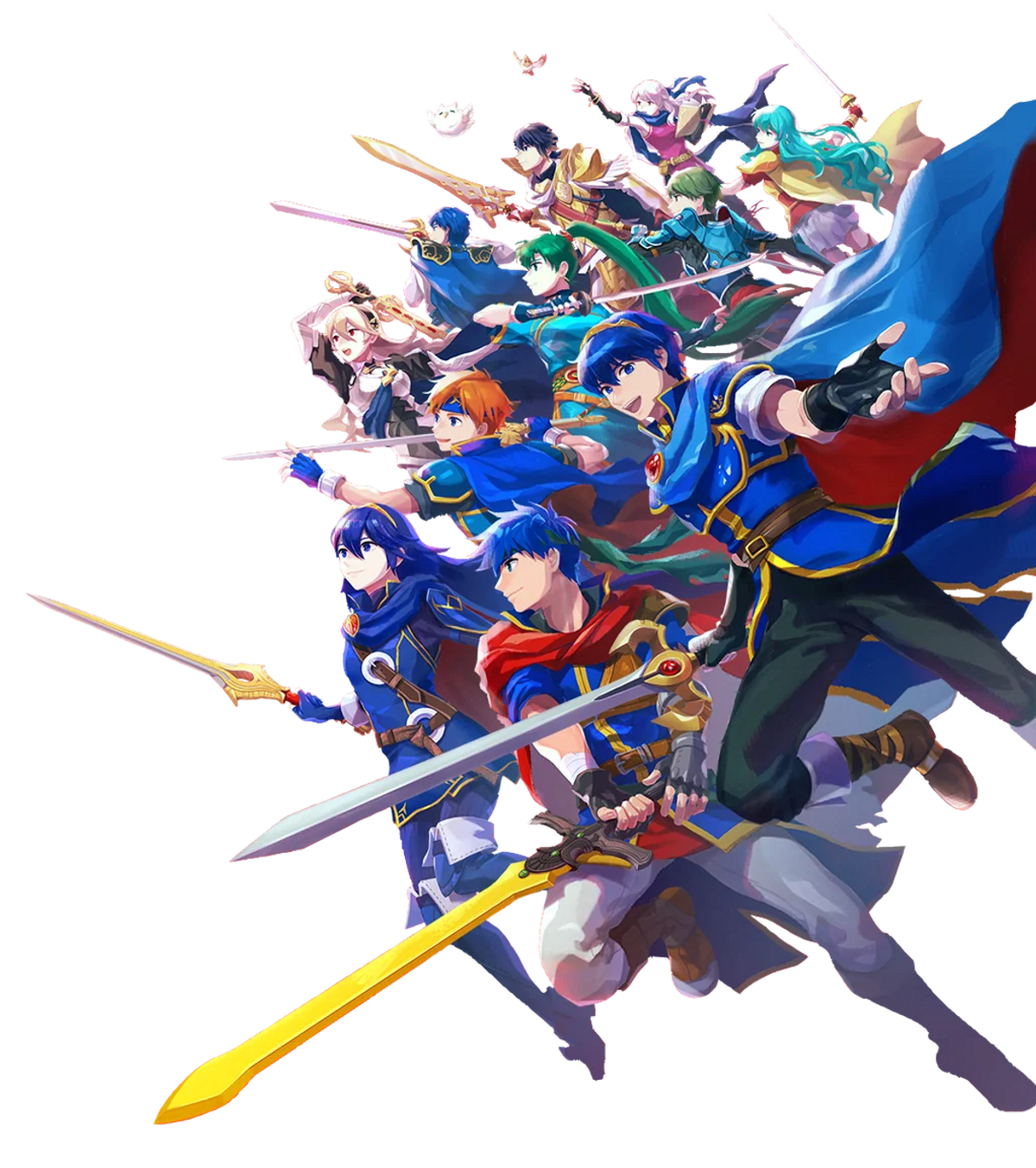
Your spirit shall shine
Across the generations — now, and for all time!
Fire Emblem,
Heroes bringing us hope's light
Journey from distant worlds to still the coming night!
For the game in the series released under the title Fire Emblem in Western countries, see Fire Emblem: The Blazing Blade.
Fire Emblem is a medieval fantasy Tactical RPG series created by Shouzou Kaga and developed in-house by Nintendo affiliate Intelligent Systems, also responsible for Turn-Based Strategy series Nintendo Wars. The series pioneered strategic role-playing games, later popularized in the West by titles such as Final Fantasy Tactics, and has spanned fifteen games so far on seven systems. Moreover, Fire Emblem, being roughly as old as genre mainstays Dragon Quest and Final Fantasy, helped make and codify many elements of the Strategy RPG genre.
The series has an interesting history for one of Nintendo's longest-running franchises. Started in 1990, Fire Emblem was originally Japan-exclusive with no Western releases, with its first games on the Famicom and later games landing on the Super Famicom. Its existence was relatively obscure overseas until 2001, when characters Marth (from Fire Emblem: Shadow Dragon & the Blade of Light and Fire Emblem: Mystery of the Emblem) and Roy (from the then-unreleased Game Boy Advance title Fire Emblem: The Binding Blade) made their debut internationally as unlockable fighters in Super Smash Bros. Melee. The two characters proved to be very popular among the English fanbase, garnering enough interest in the franchise to warrant the international release of the next game, Fire Emblem: The Blazing Blade; all subsequent games in the series have been released worldwide bar the twelfth title, New Mystery of the Emblem. Incidentally, Marth and Roy were originally only supposed to be in the Japanese version, included to promote the upcoming release of The Binding Blade; the intent was for the localization team to dummy them out in the translation process as they would theoretically hold no interest to international gamers.
The series' appeal comes from its unique flavoring of the typical grid-based strategy game with RPG Elements. The games also emphasize Character Development and story in addition to strategy and unit building — even relatively minor characters (of which there are a great many) included mostly just to flesh out the player's army receive lots of Backstory and interaction with the other characters.
Another thing to note about the series is how it handles the deaths of playable characters: if somebody in the player's army dies, they usually stay dead. If a game does have a method to undo death, it is usually hard to come by and has limited uses. Later games downplay this aspect with an optional Casual Mode, which revives any downed characters at the end of each chapter at no cost.
While Fire Emblem games can range in difficultly depending on the title, they are generally on the harder side relative to Nintendo's standard fare. New Mystery of the Emblem introduced a number of now standard beginner-friendly features (like the aforementioned Casual Mode) to be more inclusive, though they are still capable of giving you a run for your money with the higher difficulties.
In terms of narrative, the series is semi-linear. While each game takes place in a Medieval European Fantasy setting with similar motifs shared between them, there are multiple verses with their own canons. Games sharing a verse might not even be directly connected by the story; for instance, Awakening takes place thousands of years after Shadow Dragon and the Blade of Light but doesn't build off of the latter's plot beyond a single shared character.
- Fire Emblem: Shadow Dragon & the Blade of Light (Famicom, 1990): The very first game, starring Prince Marth and taking place on the continent of Archanea. Due to being the first game, Early-Installment Weirdness abounds. It would finally see localization 30 years later in 2020 on the Nintendo Switch.
- Fire Emblem Gaiden (Famicom, 1992): The second game of the series, following protagonists Alm and Celica. While it takes place in the same universe as its predecessor, the plot is unrelated and focuses on the continent of Valentia. Notable for having more traditional RPG elements like towns and explorable dungeons, and being one of the only entries to not have Breakable Weapons.
- Fire Emblem: Mystery of the Emblem (Super Famicom, 1994): The third game of the series, once again starring Marth. Unlike Gaiden it is a direct sequel to Shadow Dragon and the Blade of Light, and includes an abridged remake of that game's story.
- Fire Emblem: Genealogy of the Holy War (Super Famicom, 1996): The fourth game, set on the continent of Jugdral, which is in the same world as the previous titles but also takes place hundreds or thousands of years prior, according to
 Word of God. The Hero is Sigurd, but after a Time Skip his son Seliph becomes the protagonist. Notable for having the darkest storyline of the entire franchise, introducing the Weapon Triangle, and being the first Fire Emblem to utilize Relationship Values.
 - BS Fire Emblem: Archanea War Chronicles (Super Famicom / Satellaview, 1997): A collection of four Satellaview broadcast maps based on the Mystery of the Emblem engine, telling a number of side-stories set before the beginning of Shadow Dragon and the Blade of Light. The nature of these games' distribution system makes them difficult to emulate at all, never mind with accuracy, so they generally go overlooked. These four maps are generally considered to comprise a single game and are for the most part not counted in the numbering scheme of the Fire Emblem series, though Guinness World Records does count them.
- Fire Emblem: Thracia 776 (Super Famicom, 1999): The fifth game in the franchise, and the last one handled by series creator Shouzou Kaga. An interquel to Genealogy of the Holy War that takes place during its Time Skip. Stars Leif, Sigurd's nephew and Seliph's cousin, as he tries to liberate his country. Introduces Fog of War to the series and has the unique fatigue mechanic, which potentially makes units unusable for a chapter if they become too tired.
- Fire Emblem: The Binding Blade (Game Boy Advance, 2002): The sixth game, starring Roy on the continent of Elibe in the first brand new continuity. Introduces the Supports system, a revamp of the Relationship Values used in Genealogy of the Holy War that would go on to be used by most later games. Also the first game to have multiplayer in the form of Player Versus Player battles, which became a semi-recurring feature strictly for the handheld titles.
- Fire Emblem: The Blazing Blade (Game Boy Advance, 2003): The seventh game, a prequel to The Binding Blade, and the first game to release outside Japan. It stars Eliwood, Roy's father, as he teams up with his friends Lyn and Hector to fight the group known as the Black Fang. It's the first game in the series to utilize alternate story paths with the unlockable Hector's Tale. Also the first Fire Emblem game with a defined and customizable Player Character (known as the Tactician), though they are a noncombatant. In the West, it was initially released with the simplified title Fire Emblem; the "Blazing Blade" subtitle was retroactively applied in 2017 to reduce ambiguity coinciding with its content appearing in Fire Emblem Heroes.
- Fire Emblem: The Sacred Stones (Game Boy Advance, 2004): The eighth game in the series, taking place in the new world of Magvel. It stars the twins Eirika and Ephraim of Renais as they deal with the sudden antagonism of their southern neighbor Grado and try to stop the resurrection of the Demon King. It serves as something of a successor to Gaiden, bringing back some of said game's exclusive mechanics such as a traversable world map and random monster encounters on said map, as well as implementing its own ideas like branching class promotion. It was re-released on the Nintendo 3DS as one of the ten GBA games distributed for free as part of the Ambassador Program.
- Fire Emblem: Path of Radiance (Nintendo GameCube, 2005): The ninth game in the series, taking place on the continent of Tellius, which is home to two races, the Beorc and the Laguz. It stars Ike, the first protagonist to not be royalty or nobility, as he finds himself inheriting his father's mercenary company after the latter's death, and serving the head of a liberation army for Princess Elincia, whose homeland of Crimea had been conquered by Daein's Mad King Ashnard. It is also the first console Fire Emblem installment to be released internationally and the first to make the Video Game 3D Leap.
- Fire Emblem: Radiant Dawn (Wii, 2007): The tenth game and a sequel to Path of Radiance, centered around a new protagonist, Micaiah, alongside returning protagonists Ike and Elincia as they are caught up in the conflict between the two races of Tellius. Introduces a mechanic where discrepancies in terrain height would affect combat (though this was never used again) and reimplements 3rd-tier Character Class promotions from Gaiden.
- Fire Emblem: Shadow Dragon (Nintendo DS, 2008): The eleventh game in the franchise, a remake of the first game Shadow Dragon and the Blade of Light. Changes the gameplay of the original to be more in line with the modern titles and introduces the ability to reclass characters.
- Fire Emblem: New Mystery of the Emblem: Heroes of Light and Shadow (Nintendo DS, 2010): The twelfth game, a remake of the third game Mystery of the Emblem that was only released in Japan, and includes remade versions of the four maps from BS Fire Emblem as extra content. The Avatar/My Unit, first seen in The Blazing Blade as a Non-Action Guy, returns in this game as a fully-playable character with more customization options (default name Kris). Also introduces Casual Mode, a difficulty option that turns off the Permadeath mechanic and would become a mainstay in all future titles.
- Fire Emblem: Awakening (Nintendo 3DS, 2012): The thirteenth game in the series. Stars yet another royal blue haired swordsman named Chrom alongside another playable Avatar/My Unit (default name Robin), set in the same universe as the first five games but thousands of years in the future. The game brings back the world map system of Gaiden and The Sacred Stones, reintroduces the skill system along with a graphical style reminiscent of the Tellius games with CGI models for cutscenes and a Seinen art style for character portraits, with a 2.5D map and 3D fights. A new feature introduced allows units to join in on allies' attacks or block enemy attacks for one another. It would be the first game released by Nintendo to support paid Downloadable Content, allowing players to purchase new maps to challenge themselves and recruit alternate versions of characters from previous Fire Emblem installments.
- Fire Emblem Fates (Nintendo 3DS, 2015): The fourteenth game, also known in Japan as Fire Emblem if, developed by the same team behind Awakening with the story written by noted manga writer Shin Kibayashi. The game takes place in a whole new universe(!), centering on conflict between the glory-seeking Nohr and the peace-loving Hoshido, notably the first nation in the series to be based on feudal Japan. This time around, the Avatar/My Unit (default name Corrin) is the main character, born to the Hoshidan royal family but raised by the Nohrian royal family. In conjunction with this background, the game has for the first time three distinct storylines (which also have different gameplay styles) depending on whether the player chooses to ally with Hoshido, Nohr, or neither nation. Also featured in this installment is the first new major weapon type since the original game, shurikens and daggers designed for debuffing targets, and a return to Gaiden's unbreakable weapon system.
- Fire Emblem Echoes: Shadows of Valentia (Nintendo 3DS, 2017): The fifteenth game in the series, and a remake of the second game, Gaiden. Sticks to the original's mechanics while also implementing modern offerings like Supports and Casual Mode. Also introduces Mila's Turnwheel, an item that can undo actions or even restart battles a set number of times, and adds a fatigue mechanic that inflicts stat penalties on units that are used too much. The setting is also expanded upon with a more in-depth story and new post-game content that ties into Awakening's backstory.
- Fire Emblem: Three Houses (Nintendo Switch, 2019): The sixteenth game in the series, and the series' return to consoles since 2007's Radiant Dawn. The game's setting is the continent of Fódlan, which is divided into three powerful nations. The player controlled protagonist (default name Byleth) is a newly-recruited professor of the Officer's Academy, a Military Academy located in the center of the continent and overseen by the Church of Seiros. The students attending the academy are from all three nations, and as such the students are grouped into houses for each nation, with each house being currently led by an heir to their respective nation. Amongst the new mechanics introduced in Three Houses is that individual units can now be accompanied by a squadron of troops. Three Houses is also the first game to have another developer working on the game alongside Intelligent Systems, namely Koei Tecmo Games, who previously collaborated on the franchise with Fire Emblem Warriors.
- Fire Emblem Engage (Nintendo Switch, 2023): The seventeenth game in the series. Set on the continent of Elyos, home to four kingdoms who sealed away a Fell Dragon a thousand years prior to the game's story. Much like Awakening, the game includes the ability to summon previous characters from previous Fire Emblem titles, but this time, the ability to call heroes from other worlds is a key part of the plot.
- Fire Emblem: Fortune's Weave (Nintendo Switch 2, 2026): The eighteenth game in the series. A follow up to Three Houses, gladiators compete in the "Heroic Games" for a chance to have their any one wish granted.
- Fire Emblem Gaiden (1993): A novelization of the Famicom title of the same name by Katsuyuki Ozaki.
- Fire Emblem (1996): An unfinished Original Video Animation series based on Mystery of the Emblem. Notably the first piece of Fire Emblem media to leave Japan, receiving an English dub in 1998.
- Fire Emblem: Champion's Sword (2002-2005): A manga adaptation of The Binding Blade. Focuses on a group of Canon Foreigners instead of Roy, but still follows the game's plot.
- Fire Emblem 0 (Cipher) (2015-2020): A Collectible Card Game that uses characters from across the franchise, including Tokyo Mirage Sessions #FE. Only released in Japan.
- Tokyo Mirage Sessions ♯FE (Wii U, 2015 (JP), 2016 (NA, EU, AU)): A Crossover with Atlus's Shin Megami Tensei series that takes gameplay elements from both franchises.
- Tokyo Mirage Sessions ♯FE Encore (Nintendo Switch, 2020): An Updated Re-release with additional content and one new song.
- Mobile Games:
- Fire Emblem Heroes (iOS, Android, 2017): Spin-off of the series for mobile devices, released worldwide on February 2nd, 2017. The game is set in an Alternate Universe known as World of Zenith. The player character is called to this universe by Anna, leader of the Order of Heroes, and asked to use their summoning powers to gather heroes from all Fire Emblem continuities and lead them to stop the Emblian Empire from conquering the Kingdom of Askr and their own worlds. The gameplay still uses classic mechanics, but streamlined for the sake of faster pace and more mobile-friendly experience. Like most games of its type, it's free to play with premium upgrades buyable for real money.
- Fire Emblem Heroes: A Day in the Life (2017-present): A 4-panel gag-based web manga based on Fire Emblem Heroes.
- Fire Emblem Shadows (iOS, Android, 2025): A mobile game that merges real-time tactics with a Social Deduction Game. Players form groups of three to battle dark monsters, with the twist being that two of the players are Light aligned and one is Shadow aligned. After each turn's combat, players attempt to root out the traitor based on their actions, while the traitor attempts to throw off the scent until they can betray their allies.
- Fire Emblem Heroes (iOS, Android, 2017): Spin-off of the series for mobile devices, released worldwide on February 2nd, 2017. The game is set in an Alternate Universe known as World of Zenith. The player character is called to this universe by Anna, leader of the Order of Heroes, and asked to use their summoning powers to gather heroes from all Fire Emblem continuities and lead them to stop the Emblian Empire from conquering the Kingdom of Askr and their own worlds. The gameplay still uses classic mechanics, but streamlined for the sake of faster pace and more mobile-friendly experience. Like most games of its type, it's free to play with premium upgrades buyable for real money.
- Dynasty Warriors:
- Fire Emblem Warriors (Nintendo Switch, New Nintendo 3DS, 2017): A Crossover of various games with gameplay based on Koei Tecmo's Warriors franchise (in many ways a Creator-Driven Successor to Nintendo's previous franchise crossover with Warriors, Hyrule Warriors).
- Fire Emblem Warriors: Three Hopes (Nintendo Switch, 2022): A followup to Fire Emblem Warriors, based on the universe of Fire Emblem: Three Houses
As previously mentioned, Fire Emblem is one of the franchises featured in Super Smash Bros., Nintendo's Massive Multiplayer Crossover series, debuting in Super Smash Bros. Melee due to popular demand from the Japanese fanbase. Melee features Marth and Roy as unlockable playable characters; Brawl keeps Marth but drops Roy in favor of Ike, adds Lyndis as an Assist Trophy, and features the Castle Siege stage, a nonspecific amalgamation of typical location themes and tropes present throughout the series as a whole with a stylistic focus on the Tellius games. The fourth entry has Marth, Ike, and Lyndis reprising their respective roles, and introduces content from Awakening, namely Lucina and Robin (taking on their default name and appearance, while retaining the choice of both male and female variations) as playable fighters, Chrom making a cameo appearance to assist in Robin's Final Smash, and Regna Ferox's arena as a stage for the 3DS version. The Wii U version features a nonspecific Coliseum stage instead. Later DLC brought back Roy as a playable fighter and also introduced Corrin from Fates (available in both male and female variants). Ultimate brings back all Fire Emblem representatives along with adding Chrom as an Echo Fighter of Roy (though Robin's Final Smash remains unchanged) and adding Tiki and the Black Knight as Assist Trophies. Byleth was added later as part of the first Fighters Pass for Ultimate, and comes with a new stage, Garreg Mach Monastery, which features various characters from Three Houses in the background.
See also: TearRing Saga and its sequel Berwick Saga for the PlayStation, and Vestaria Saga for the PC. These are all Creator-Driven Successor titles made by Fire Emblem creator Shouzou Kaga after he left Intelligent Systems and the franchise.
