









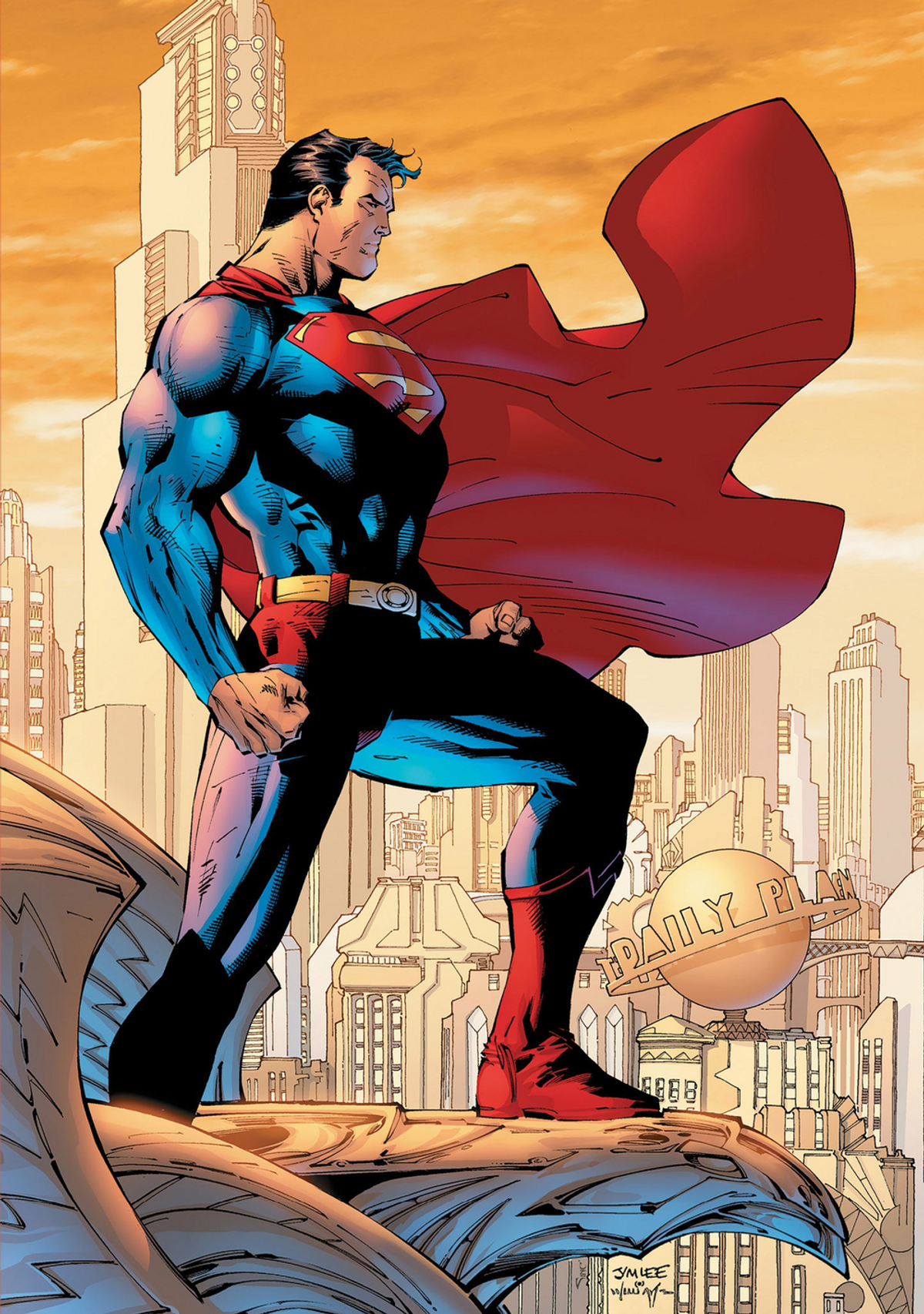
Look, up in the sky! It's a bird! It's a plane! No, it's the description for... SUPERMAN!
Superman is a DC Comics superhero created by Jerry Siegel and Joe Shuster. He is one of the most famous and popular superheroes not only in The DCU but in the history of comics; when you ask someone about "superhero", it's likely they'll first think of Superman. He first appeared in Action Comics #1 (June, 1938) and his works have been published continuously for eight decades and counting.
On the technologically advanced planet of Krypton, scientist Jor-El discovers that his planet will soon be destroyed by a natural disaster. No one will believe him, however, and further the Council of Scientists that run Krypton's government demand that neither he nor his wife Lara make an attempt to leave the planet, lest they cause "needless panic." A man of honor, Jor-El promises exactly what they ask for, but in a desperate attempt to save what can be saved, Jor-El builds a small rocket vessel to carry his infant son, Kal-El, to a different planet — Earth. Because Kryptonians are Human Aliens, the boy can blend in without being seen as alien. Just before Krypton explodes, baby Kal-El's rocket is sent to Earth. He lands outside of the rural town of Smallville, a small town in Kansas (although it wasn't too clear originally — see Wikipedia for a full list of canonical locations ). The baby is adopted by Jonathan and Martha Kent, who name the boy Clark, give him a loving home and teach him right from wrong.note However, Clark turns out to be different from humans after all. Kryptonians had evolved to absorb and store solar energy and to tolerate high-gravity environments that would immobilize or even kill weaker species. While on Krypton, which was fifteen times as massive as Earth and orbited a relatively low-heat Red Giant (or in some versions Red Dwarf), their physical abilities were about identical to humans. When exposed to Earth's lower gravity and the rays of its much younger, brighter yellow Sun, Clark learns that the surplus of energy gives him incredible powers, which increase as he grows up. Deciding to use his power for good, Clark puts on some spandex (or indestructible Kryptonian uber-cloth, Depending on the Writer) and fights crime as Superman!
His powers include vast Super-Strength and Super-Speed, Flight, X-Ray Vision, Heat Vision, Super-Breath, Freeze Breath, Nigh-Invulnerability (surviving supernova explosions and black holes), Super-Senses, and possibly others, depending on the interpretation. When not fighting evil, he masquerades as a mild-mannered reporter for a great metropolitan newspaper, The Daily Planet; this career helps him find disasters and emergencies that much sooner and does not require him to closely account for his whereabouts to his employers. Naturally, the Clark Kent/Superman dichotomy—most particularly, the question of which is the "real" person and which is the "mask"—has been explored a great deal, and has changed over time (with Kent going from nervous, geeky klutz to sharp-witted Intrepid Reporter, among other changes). In the Golden and the Silver Age, Clark Kent was little more than a façade for Superman. After Crisis on Infinite Earths, this idea was reversed. In some versions, both are essential parts of who he is; others, particularly Alan Moore, see both as masks worn by Kal-El to interact with humanity. Both sides also tend to be a lot more psychologically/emotionally vulnerable than you'd expect. Given his powers, and the usual stereotypes about strength of his level, it would be easy to mistake him for a simplistic oaf, but Supes is actually quite a complex guy.
Aside from fighting crime, much of Clark's personal life is explored in relation to his supporting cast from the Daily Planet, his hometown of Smallville, and his beloved home city of Metropolis. Possibly the most famous supporting cast of any superhero, it consists of a large number of changing characters, the fixtures of which are: his doting parents Jonathan and Martha (aka "Ma and Pa") Kent (pre-Crisis, throughout his childhood and teen years, before dying shortly after Clark's high school graduation; post-Crisis, advising him well into adulthood; and in the New 52 both dying before he becomes Superman); his gruff, hot-tempered, long-suffering boss, Perry White, who gladly accepts Clark's constant disappearances and eccentricities as long as he comes back with a headline story; his best friend (in both identities) Jimmy Olsen, a young cub reporter/photographer with a wildly fluctuating age, the highest Weirdness Magnet rating in the DC universe and the unique gift of a signal watch he can use to call Superman anytime he gets into trouble; his short-tempered, stubborn teenager of a cousin Kara Zor-El alias Supergirl, who also survived the death of their planet but arrived on Earth several decades later and has a hard time adapting to her new home and finding out what kind of woman and hero she wants to be; and most importantly, his sharp-tongued, recklessly determined go-getter of a reporting partner (and longstanding object of his affections) Lois Lane, who was desperately in love with Superman but who always dismissed the mild Clark Kent. However, in some interpretations, she would eventually fall for Clark, not Superman, before learning they were the same person and marrying him/them. In other takes, Superman has been a bachelor or dated/married different characters (in the New 52, he was dating Wonder Woman).
Originally created by Jerry Siegel (writer) and Joe Shuster (artist), two sons of Lithuanian Jewish immigrants who, after several tries, finally got him published in the first issue of Action Comics, where he immediately took off; imitations of him pretty much created The Golden Age of Comic Books.note Superman was an immediate success not only in the comics but in the wider culture. In The '30s and The '40s, he was adapted into radio, serials and most crucially into cartoons by Max and Dave Fleischer. It was in the latter adaptation that Superman received his most iconic superpower, that of flight. The phenomenal success and appeal of the character filtered into the wider lexicon to such an extent, that Superman has arguably become a major folk character, idiomatic of someone who can literally do anything and embody any Wish Fulfillment one yearns for. Many aspects of the Superman mythos have fallen into the common lexicon. Kryptonite has arguably displaced Achilles' Heel, and the name of one of his supervillains has become a synonym for genius: brainiac.
On the Sliding Scale of Idealism Versus Cynicism, he and the series he stars in almost universally tend toward the idealistic side, being the iconic Cape.
Along with Batman and Wonder Woman, he's one of the Big Three of The DCU. He has also been a member of the Justice League of America on and off (mostly on) since its founding.
See also Supergirl, his Distaff Counterpart, and Krypto the Superdog, his Kryptonian dog.
For a list of comic storylines and other works in the franchise, go to the franchise page here.
