Secure Communication, Buried In A News App

Cryptography is a funny thing. Supposedly, if you do the right kind of maths to a message, you can send it off to somebody else, and as long as they’re the only one that knows a secret little thing, nobody else will be able to read it. We have all sorts of apps for this, too, that are specifically built for privately messaging other people.

Only… sometimes just having such an app is enough to get you in trouble. Even just the garbled message itself could be proof against you, even if your adversary can’t read it. Enter The Guardian. The UK-based media outlet has deployed a rather creative and secure way of accepting private tips and information, one which seeks to provide heavy cover for those writing in with the hottest scoops.

Continue reading “Secure Communication, Buried In A News App”

New Artemis Plan Returns To Apollo Playbook

In their recent announcement, NASA has made official what pretty much anyone following the Artemis lunar program could have told you years ago — humans won’t be landing on the Moon in 2028.

It was always an ambitious timeline, especially given the scope of the mission. It wouldn’t be enough to revisit the Moon in a spidery lander that could only hold two crew members and a few hundred kilograms of gear like in the 60s. This time, NASA wants to return to the lunar surface with hardware capable of setting up a sustained human presence. That means a new breed of lander that dwarfs anything the agency, or humanity for that matter, has ever tried to place on another celestial body.

Unsurprisingly, developing such vehicles and making sure they’re safe for crewed missions takes time and requires extensive testing. The simple fact is that the landers, being built by SpaceX and Blue Origin, won’t be ready in time to support the original Artemis III landing in 2028. Additionally, development of the new lunar extravehicular activity (EVA) suits by Axiom Space has fallen behind schedule. So even if one of the landers would have been ready to fly in 2028, the crew wouldn’t have the suits they need to actually leave the vehicle and work on the surface.

But while the Artemis spacecraft and EVA suits might be state of the art, NASA’s revised timeline for the program is taking a clear step back in time, hewing closer to the phased approach used during Apollo. This not only provides their various commercial partners with more time to work on their respective contributions, but critically, provides an opportunity to test them in space before committing to a crewed landing.

Continue reading “New Artemis Plan Returns To Apollo Playbook”

Back To Basics: Hacking On Key Matrixes

A lot of making goes on in this community these days, but sometimes you’ve just gotta do some old fashioned hacking. You might have grabbed an old Speak and Spell that you want to repurpose as an interface for a horrifyingly rude chatbot, or you’ve got a calculator that is going to become the passcode keypad for launching your DIY missiles. You want to work with the original hardware, but you need to figure out how to interface all the buttons yourself.

Thankfully, this is usually an easy job. The vast majority of buttons and keypads and keyboards are all implemented pretty much the same way. Once you know the basics of how to work with them, hooking them up is easy. It’s time to learn about key matrixes!

Continue reading “Back To Basics: Hacking On Key Matrixes”

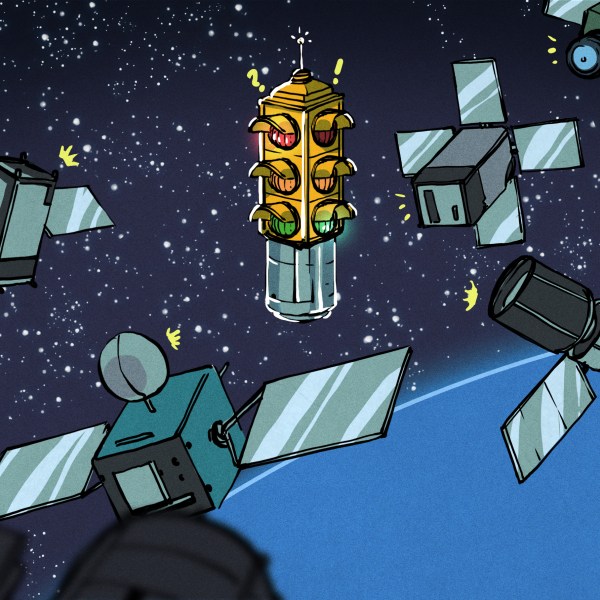
Accidental Climate Engineering With Disintegrating Satellites

For many decades humankind has entertained the notion that we can maybe tweak the Earth’s atmosphere or biosphere in such a way that we can for example undo the harms of climate change, or otherwise affect the climate for our own benefit. This often involves spreading certain substances in parts of the atmosphere in order to reflect or retain thermal solar radiation or induce rain.

Yet despite how limited in scope these attempts at such intentional experiments have been so far – with most proposals dying somewhere before being implemented – we have already embarked on a potentially planet-wide atmospheric reconfiguration that could affect life on Earth for centuries to come. This accidental experiment comes in the form of rocket stages, discarded satellites, and other human-made space litter that burn up in the atmosphere at ever increasing rates.

Rather than burning up cleanly into harmless components, this actually introduces metals and other compounds into the upper parts of the atmosphere. What the long-term effects of this will be is still uncertain, but with the most dire scenarios involving significant climate change and ozone layer degradation, we ought to figure this one out sooner rather than later.

Continue reading “Accidental Climate Engineering With Disintegrating Satellites”

Reflections On Ten Years With The Wrencher

An auspicious anniversary passed for me this week, as it’s a decade since I started writing for Hackaday. In that time this job has taken me all over  Europe, it’s shown me the very best and most awesome things our community has to offer, and I hope that you have enjoyed my attempts to share all of that with you. It’s worth a moment to reflect on the last ten years in terms of what has made our world during that time. Continue reading “Reflections On Ten Years With The Wrencher”

The Curse Of The Everything Device

In theory having a single device that combines the features of multiple dedicated devices is a great idea, saving a lot of space, time and money. However, in reality it mostly means that these features now conflict with each other, force us to deal with more complex devices that don’t last nearly as long, and become veritable vampires for your precious attention.

Whereas in the olden days a phone was just used for phone calls, now it’s also a video and photo camera, multimedia computer, pager, and more, but at any point an incoming phone call can interrupt what you are doing. There’s also always the temptation of doom scrolling on one of the infinite ‘social media’ apps. Even appliances like televisions and refrigerators are like that now, adding ‘smarts’ that also vie for your attention, whether it’s with advertisements, notifications, or worse.

Meanwhile trying to simply do some writing work on your PC is a battle against easy distractions, leading people to flee to the digital equivalent of typewriters out of sheer desperation. Similarly, we increasingly see ‘dumb’ phones, and other single-task devices making a comeback, both as commercial options and as DIY projects by the community.

Are we seeing the end of the ‘everything device’ and the return to a more simple time?

Continue reading “The Curse Of The Everything Device”

What One-Winged Squids Can Teach The Airship Renaissance

It’s a blustery January day outside Lakehurst, New Jersey. The East Coast of North America is experiencing its worst weather in decades, and all civilian aircraft have been grounded the past four days, from Florida to Maine. For the past two days, that order has included military aircraft, including those certified “all weather” – with one notable exception. A few miles offshore, rocking and bucking in the gales, a U.S. Navy airship braves the storm. Sleet pelts the plexiglass windscreen and ice sloughs off the gasbag in great sheets as the storm rages on, and churning airscrews keep the airship on station.

If you know history you might be a bit confused: the rigid airship USS Akron was lost off the coast of New Jersey, but in April, not January. Before jumping into the comments with your corrections, note the story I’ve begun is set not in 1933, but in 1957, a full generation later.

The airship caught in the storm is no experimental Zeppelin, but an N-class blimp, the workhorse of the cold-war fleet. Yes, there was a cold war fleet of airships; we’ll get to why further on. The most important distinction is that unlike the last flight of the Akron, this story doesn’t end in tragedy, but in triumph. Tasked to demonstrate their readiness, five blimps from Lakehurst’s Airship Airborne Early-Warning Squadron 1 remained on station with no gaps in coverage for the ten days from January 15th to 24th. The blimps were able to swap places, watch-on-watch, and provide continuous coverage, in spite of weather conditions that included 60 knot winds and grounded literally every other aircraft in existence at that time. Continue reading “What One-Winged Squids Can Teach The Airship Renaissance”