


Portal:Computer programming

The Computer Programming Portal

Computer programming or coding is the composition of sequences of instructions, called programs, that computers can follow to perform tasks. It involves designing and implementing algorithms, step-by-step specifications of procedures, by writing code in one or more programming languages. Programmers typically use high-level programming languages that are more easily intelligible to humans than machine code, which is directly executed by the central processing unit. Proficient programming usually requires expertise in several different subjects, including knowledge of the application domain, details of programming languages and generic code libraries, specialized algorithms, and formal logic.
Auxiliary tasks accompanying and related to programming include analyzing requirements, testing, debugging (investigating and fixing problems), implementation of build systems, and management of derived artifacts, such as programs' machine code. While these are sometimes considered programming, often the term software development is used for this larger overall process – with the terms programming, implementation, and coding reserved for the writing and editing of code per se. Sometimes software development is known as software engineering, especially when it employs formal methods or follows an engineering design process. (Full article...)
Selected articles -
-

Andrew Stuart Tanenbaum (born March 16, 1944), sometimes referred to by the handle AST, is an American-born Dutch computer scientist and retired professor emeritus of computer science at the Vrije Universiteit Amsterdam in the Netherlands.
He is the author of MINIX, a free Unix-like operating system for teaching purposes, and has written multiple computer science textbooks regarded as standard texts in the field. He regards his teaching job as his most important work. Since 2004 he has operated Electoral-vote.com, a website dedicated to analysis of polling data in federal elections in the United States. (Full article...) -
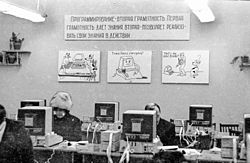
Computer class at Chkalovski Village School No. 2 in 1985–1986
The history of computing in the Soviet Union began in the late 1940s, when the country began to develop its Small Electronic Calculating Machine (MESM) at the Kiev Institute of Electrotechnology in Feofaniya. Initial ideological opposition to cybernetics in the Soviet Union was overcome by a Khrushchev era policy that encouraged computer production.
By the early 1970s, the uncoordinated work of competing government ministries had left the Soviet computer industry in disarray. Due to lack of common standards for peripherals and lack of digital storage capacity the Soviet Union's technology significantly lagged behind the West's semiconductor industry. The Soviet government decided to abandon development of original computer designs and encouraged cloning of existing Western systems (e.g. the 1801 CPU series was scrapped in favor of the PDP-11 ISA by the early 1980s).
Soviet industry was unable to mass-produce computers to acceptable quality standards and locally manufactured copies of Western hardware were unreliable. As personal computers spread to industries and offices in the West, the Soviet Union's technological lag increased. (Full article...) -
Lisp (historically LISP, an abbreviation of "list processing") is a family of programming languages with a long history and a distinctive, fully parenthesized prefix notation.
Originally specified in the late 1950s, it is the second-oldest high-level programming language still in common use, after Fortran. Lisp has changed since its early days, and many dialects have existed over its history. Today, the best-known general-purpose Lisp dialects are Common Lisp, Scheme, Racket, and Clojure.
Lisp was originally created as a practical mathematical notation for computer programs, influenced by (though not originally derived from) the notation of Alonzo Church's lambda calculus. It quickly became a favored programming language for artificial intelligence (AI) research. As one of the earliest programming languages, Lisp pioneered many ideas in computer science, including tree data structures, automatic storage management, dynamic typing, conditionals, higher-order functions, recursion, the self-hosting compiler, and the read–eval–print loop.
The name LISP derives from "List Processor". Linked lists are one of Lisp's major data structures, and Lisp source code is made of lists. Thus, Lisp programs can manipulate source code as a data structure, giving rise to the macro systems that allow programmers to create new syntax or new domain-specific languages embedded in Lisp. (Full article...) -

Ruby is a general-purpose programming language. Its design puts an emphasis on programming productivity and simplicity. In Ruby, everything is an object, including primitive data types. Yukihiro "Matz" Matsumoto started to develop the language in the mid-1990s in Japan.
Ruby is interpreted, high-level, and dynamically typed; its interpreter uses garbage collection and just-in-time compilation. It supports multiple programming paradigms, including procedural, object-oriented, and functional programming. According to the creator, Ruby was influenced by Perl, Smalltalk, Eiffel, Ada, BASIC, and Lisp. (Full article...) -

The source code for a computer program in C. The gray lines are comments that explain the program to humans. When compiled and run, it will give the output "Hello, world!".
A programming language is an engineered language for expressing computer programs.
Programming languages typically allow software to be written in a human readable manner.
Execution of a program requires an implementation. There are two main approaches for implementing a programming language – compilation, where programs are compiled ahead-of-time to machine code, and interpretation, where programs are directly executed. In addition to these two extremes, some implementations use hybrid approaches such as just-in-time compilation and bytecode interpreters. (Full article...) -

Carphone Warehouse is a mobile phone retailer based in London, United Kingdom. In August 2014 the company became a subsidiary of Currys plc (previously named "Dixons Carphone"), which was formed by the merger of its former parent Carphone Warehouse Group with Dixons Retail. Prior to this merger, Carphone Warehouse Group was listed on the London Stock Exchange, and was a constituent of the FTSE 250 Index. Following the closure of all stand-alone UK stores in April 2020, all remaining Carphone Warehouse UK outlets were within branches of Currys PC World. In April 2021, the Carphone Warehouse business in Ireland (including all stand-alone and co-located branches and the website) was closed with immediate effect. Currys continued to use the Carphone Warehouse brand in the United Kingdom, online and, until 2021, inside Currys stores. (Full article...) -
In computing, a loader is the part of an operating system that is responsible for loading programs and libraries. It is one of the essential stages in the process of starting a program, as it places programs into memory and prepares them for execution. Loading a program involves either memory-mapping or copying the contents of the executable file containing the program instructions into memory, and then carrying out other required preparatory tasks to prepare the executable for running. Once loading is complete, the operating system starts the program by passing control to the loaded program code.
All operating systems that support program loading have loaders, apart from highly specialized computer systems that only have a fixed set of specialized programs. Embedded systems typically do not have loaders, and instead, the code executes directly from ROM or similar. In order to load the operating system itself, as part of booting, a specialized boot loader is used. In many operating systems, the loader resides permanently in memory, though some operating systems that support virtual memory may allow the loader to be located in a region of memory that is pageable.
In the case of operating systems that support virtual memory, the loader may not actually copy the contents of executable files into memory, but rather may simply declare to the virtual memory subsystem that there is a mapping between a region of memory allocated to contain the running program's code and the contents of the associated executable file. (See memory-mapped file.) The virtual memory subsystem is then made aware that pages with that region of memory need to be filled on demand if and when program execution actually hits those areas of unfilled memory. This may mean parts of a program's code are not actually copied into memory until they are actually used, and unused code may never be loaded into memory at all. (Full article...) -

Erlang (/ˈɜːrlæŋ/ UR-lang) is a general-purpose, concurrent, functional high-level programming language, and a garbage-collected runtime system. The term Erlang is used interchangeably with Erlang/OTP, or Open Telecom Platform (OTP), which consists of the Erlang runtime system, several ready-to-use components (OTP) mainly written in Erlang, and a set of design principles for Erlang programs.
The Erlang runtime system is designed for systems with these traits:- Distributed
- Fault-tolerant
- Soft real-time
- Highly available, non-stop applications
- Hot swapping, where code can be changed without stopping a system.
-
Structured Query Language (SQL) (pronounced /ˌɛsˌkjuˈɛl/ S-Q-L; or alternatively as /ˈsiːkwəl/ ⓘ "sequel") is a domain-specific language used to manage data, especially in a relational database management system (RDBMS). It is particularly useful in handling structured data, i.e., data incorporating relations among entities and variables.
Introduced in the 1970s, SQL offered two main advantages over older read–write APIs such as ISAM or VSAM. Firstly, it introduced the concept of accessing many records with one single command. Secondly, it eliminates the need to specify how to reach a record, i.e., with or without an index.
Originally based upon relational algebra and tuple relational calculus, SQL consists of many types of statements, which may be informally classed as sublanguages, commonly: data query language (DQL), data definition language (DDL), data control language (DCL), and data manipulation language (DML). (Full article...) -
Programming languages are used for controlling the behavior of a machine (often a computer). Like natural languages, programming languages follow rules for syntax and semantics.
There are thousands of programming languages and new ones are created every year. Few languages ever become sufficiently popular that they are used by more than a few people, but professional programmers may use dozens of languages in a career.
Most programming languages are not standardized by an international (or national) standard, even widely used ones, such as Perl or Standard ML (despite the name). Notable standardized programming languages include ALGOL, C, C++, JavaScript (under the name ECMAScript), Smalltalk, Prolog, Common Lisp, Scheme (IEEE standard), ISLISP, Ada, Fortran, COBOL, SQL, and XQuery. (Full article...) -
Kotlin (/ˈkɒtlɪn/) is a cross-platform, statically typed, general-purpose high-level programming language with type inference. Kotlin is designed to interoperate fully with Java, and the JVM version of Kotlin's standard library depends on the Java Class Library.
However, type inference allows for more concise syntax. Kotlin mainly targets the JVM, but also compiles to JavaScript (e.g., for frontend web applications using React) or native code via LLVM (e.g., for native iOS apps sharing business logic with Android apps). JetBrains bears language development costs, while the Kotlin Foundation protects the Kotlin trademark.
On 7 May 2019, Google announced Kotlin had become its preferred language for Android app developers. Since the release of Android Studio 3.0 in October 2017, Kotlin has been included as an alternative to the standard Java compiler. The Android Kotlin compiler emits Java 8 bytecode by default (which runs in any later JVM), but allows targeting Java 9 up to 24, for optimizing, or allows for more features; it has bidirectional record class interoperability support for JVM, introduced in Java 16, considered stable as of Kotlin 1.5.
Kotlin has support for the web with Kotlin/JS, through an intermediate representation-based backend that has been declared stable since version 1.8, released in December 2022. Kotlin/Native (e.g., Apple silicon support) has been declared stable since version 1.9.20, released in November 2023. (Full article...) -
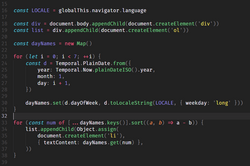
Source code for a computer program written in the JavaScript language. It demonstrates the appendChild method. The method adds a new child node to an existing parent node. It is commonly used to dynamically modify the structure of an HTML document.
A computer program is a sequence or set of instructions in a programming language for a computer to execute. It is one component of software, which also includes documentation and other intangible components.
A computer program in its human-readable form is called source code. Source code needs another computer program to execute because computers can only execute their native machine instructions. Therefore, source code may be translated to machine instructions using a compiler written for the language. (Assembly language programs are translated using an assembler.) The resulting file is called an executable. Alternatively, source code may execute within an interpreter written for the language.
If the executable is requested for execution, then the operating system loads it into memory and starts a process. The central processing unit will soon switch to this process so it can fetch, decode, and then execute each machine instruction. (Full article...) -
Laboratory Virtual Instrument Engineering Workbench (LabVIEW) is a graphical system design and development platform produced and distributed by National Instruments, based on a programming environment that uses a visual programming language. It is widely used for data acquisition, instrument control, and industrial automation. It provides tools for designing and deploying complex test and measurement systems.
The visual (aka graphical) programming language is called "G" (not to be confused with G-code). It is a dataflow language originally developed by National Instruments. LabVIEW is supported on a variety of operating systems (OSs), including macOS and other versions of Unix and Linux, as well as Microsoft Windows.
The latest versions of LabVIEW are LabVIEW 2024 Q3 (released in July 2024) and LabVIEW NXG 5.1 (released in January 2021). National Instruments released the free for non-commercial use LabVIEW and LabVIEW NXG Community editions on April 28, 2020. (Full article...) -
Margaret Elaine Hamilton (née Heafield; born August 17, 1936) is an American computer scientist. She directed the Software Engineering Division at the MIT Instrumentation Laboratory, where she led the development of the on-board flight software for NASA's Apollo Guidance Computer for the Apollo program. She later founded two software companies, Higher Order Software in 1976 and Hamilton Technologies in 1986, both in Cambridge, Massachusetts.
Hamilton has published more than 130 papers, proceedings, and reports, about sixty projects, and six major programs. She coined the term "software engineering", stating, "I began to use the term 'software engineering' to distinguish it from hardware and other kinds of engineering, yet treat each type of engineering as part of the overall systems engineering process."
On November 22, 2016, Hamilton received the Presidential Medal of Freedom from president Barack Obama for her work leading to the development of on-board flight software for NASA's Apollo Moon missions. (Full article...) -
William Henry Gates III (born October 28, 1955) is an American businessman and philanthropist. A pioneer of the microcomputer revolution of the 1970s and 1980s, he co-founded the software company Microsoft in 1975 with his childhood friend Paul Allen. Following Microsoft's initial public offering in 1986 and the subsequent increase in its stock price, Gates became the world's then-youngest billionaire in 1987, at age 31. Forbes magazine ranked him as the world's wealthiest person for 18 out of 24 years between 1995 and 2017, including 13 years consecutively from 1995 to 2007. Gates became the first centibillionaire in 1999, when his net worth briefly surpassed US$100 billion. According to Forbes, as of February 2026, his net worth stood at US$107.7 billion, making him the 18th-wealthiest individual in the world.
Born and raised in Seattle, Washington, Gates was privately educated at Lakeside School, where he befriended Allen and developed his computing interests. In 1973, he enrolled at Harvard University, where he took classes including Math 55 and graduate-level computer science courses, but he dropped out in 1975 to co-found and lead Microsoft. He served as its CEO for the next 25 years and also became president and chairman of the board when the company was incorporated in 1981. Succeeded as CEO by Steve Ballmer in 2000, he transitioned to chief software architect, a position he held until 2008. He stepped down as chairman of the board in 2014 and became technology adviser to CEO Satya Nadella and other Microsoft leaders, a position he still holds. He resigned from the board in 2020.
Over time, Gates reduced his role at Microsoft to focus on his philanthropic work with the Bill & Melinda Gates Foundation, the world's largest private charitable organization, which he and his then-wife, Melinda French Gates, co-chaired from 2000 until 2024. Focusing on areas including health, education, and poverty alleviation, Gates became known for his efforts to combat transmissible diseases such as tuberculosis, malaria, and polio. After French Gates resigned as co-chair following the couple's divorce, the foundation was renamed the Gates Foundation, with Gates as its sole chair. (Full article...)


.jpg)
Selected images
-
 A head crash on a modern hard disk drive
 -
 Stephen Wolfram is a British-American computer scientist, physicist, and businessman. He is known for his work in computer science, mathematics, and in theoretical physics.
 -
 Partial view of the Mandelbrot set. Step 1 of a zoom sequence: Gap between the "head" and the "body" also called the "seahorse valley".
 -
 This image (when viewed in full size, 1000 pixels wide) contains 1 million pixels, each of a different color.
 -
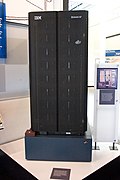 Deep Blue was a chess-playing expert system run on a unique purpose-built IBM supercomputer. It was the first computer to win a game, and the first to win a match, against a reigning world champion under regular time controls. Photo taken at the Computer History Museum.
 -
 Margaret Hamilton standing next to the navigation software that she and her MIT team produced for the Apollo Project.
 -

-
 A lone house. An image made using Blender 3D.
 -
 Partial map of the Internet based on the January 15, 2005 data found on opte.org. Each line is drawn between two nodes, representing two IP addresses. The length of the lines are indicative of the delay between those two nodes. This graph represents less than 30% of the Class C networks reachable by the data collection program in early 2005.
 -
 Bill Gosper's Glider Gun in action
 -
 An IBM Port-A-Punch punched card
 -
 Grace Hopper at the UNIVAC keyboard, c. 1960. Grace Brewster Murray: American mathematician and rear admiral in the U.S. Navy who was a pioneer in developing computer technology, helping to devise UNIVAC I. the first commercial electronic computer, and naval applications for COBOL (common-business-oriented language).
 -
 A view of the GNU nano Text editor version 6.0
 -
 GNOME Shell, GNOME Clocks, Evince, gThumb and GNOME Files at version 3.30, in a dark theme
 -
-
 Ada Lovelace was an English mathematician and writer, chiefly known for her work on Charles Babbage's proposed mechanical general-purpose computer, the Analytical Engine. She was the first to recognize that the machine had applications beyond pure calculation, and to have published the first algorithm intended to be carried out by such a machine. As a result, she is often regarded as the first computer programmer.
 -
 Animation of a Non-uniform rational B-spline surface. Modeled and rendered in Cobalt.
 -
 Output from a (linearised) shallow water equation model of water in a bathtub. The water experiences 5 splashes which generate surface gravity waves that propagate away from the splash locations and reflect off of the bathtub walls.


_in_Dark_theme.png)


Did you know? -

- ... that it took a particle accelerator and machine-learning algorithms to extract the charred text of PHerc. Paris. 4 without unrolling it?
- ... that the 2024 psychological horror game Mouthwashing utilises non-diegetic scene transitions that mimic glitches and crashes?
- ... that the Gale–Shapley algorithm was used to assign medical students to residencies long before its publication by Gale and Shapley?
- ... that both Thackeray and Longfellow bought paintings by Fanny Steers?
- ... that Perfectly Imperfect's social media platform has a main feed that is presented in reverse chronological order and is not algorithmically curated?
- ... that the study of selection algorithms has been traced to an 1883 work of Lewis Carroll on how to award second place in single-elimination tournaments?
Subcategories

WikiProjects

- There are many users interested in computer programming, join them.
Computer programming news
No recent news
Topics


| Fields |
| ||||||
|---|---|---|---|---|---|---|---|
| Concepts |
| ||||||
| Orientations | |||||||
| Models |
| ||||||
| Related fields | |||||||


Related portals


Associated Wikimedia
The following Wikimedia Foundation sister projects provide more on this subject:
-
 Commons
Free media repository -
 Wikibooks
Free textbooks and manuals -
 Wikidata
Free knowledge base -
 Wikinews
Free-content news -
 Wikiquote
Collection of quotations -
 Wikisource
Free-content library -
 Wikiversity
Free learning tools -
 Wiktionary
Dictionary and thesaurus


